
Showing posts with label childrens. Show all posts
Showing posts with label childrens. Show all posts
Friday, 5 June 2015
The Amè-ya

Blossoms from a Japanese Garden

Sunday, 24 May 2015
More Holme Lee children's illustrations

Saturday, 25 April 2015
Blackgang: Five Rocks

Spacious, warm and bright.
Where the island’s lords and ladies
Danced all thro’ the night.
But then the boggarts and the brownies
And elves, in they came.
Took over the mansion
Now things aren’t the same.
It’s dark and it’s gloomy.
The humans have fled.
It’s a fine house no longer.
It’s Rumpus instead!"
- cited from transcript at jbonline.org.uk/blackgangchine
Monday, 19 January 2015
John Lee's Nursery Ballads ... and two Royal Umbrellas

Saturday, 22 June 2013
Aargh! Two Sunflowers

Friday, 24 August 2012
Lawson Wood's "Mr and Mrs" series
I just scanned these images for The Topsham Bookshop, but I doubt Lily will mind my reproducing them here.
They come from a little compilation volume of Lawson Wood's "Mr" and "Mrs" series, 4"x4" children's books originally published in the 1920s and featuring the adventures and misadventures of a number of characterful anthropomorphised animals. There is a slight Devon connection: the brief obituary in The Times for Tuesday, Oct 29, 1957 mentions that the artist, born in 1878, died in Sidmouth, whose museum has a collection of his works.
Wednesday, 11 April 2012
Girls and Boys in Storyland

An Exeter event for local readers: while in town yesterday, I had a quick glance at the current Exeter Central Library exhibition, Girls and Boys in Storyland, which runs until April 31st.
Sunday, 22 January 2012
The Borrowers - not of this world
Somehow I'd managed to miss seeing, until yesterday, The Borrowers, Peter Hewitt's 1997 film adaptation of Mary Norton's classic children's book series about a family - later revealed to be a race - of miniature people who live by cannibalising items left around by humans. There have been other adaptations: the BBC's 1992 one springs to mind particularly, but there has also been a nice-looking 2010 anime adaptation from the studio that produced Spirited Away, and a very recent BBC adaptation over Christmas and New Year.
Monday, 2 January 2012
The "Bradshaw Baby", 1953

Reproduced from Helen Hemming's photo collection with kind permission of the subjects: characterful but rather excruciatingly retro images of 1950s childhood via the out-take press photos for a Daily Sketch feature from April 16th 1953, Ask Memory Boy. It concerns a relative portrayed as the "Bradshaw baby" because of his interest in Bradshaw's railway guide (then in the final few years before it ceased publication in 1961). I'm reliably assured that the powers depicted were exaggerated for the purposes of the story.
Tuesday, 29 November 2011
Isle of Wight for 10,000 years
 |
| right-click and view in new tab to enlarge |
On the subject of ephemeral landscapes, the above image comes from a children's encyclopedia, The World of Wonder: 10,000 Things Every Child Should Know (Amalgamated Press, Ed. Charles Ray, 1932), which looks a rich lode of interesting and sometimes off-the-wall illustrations.
This one, The Story of the Isle of Wight for 10,000 Years, doesn't seem well-informed geomorphologically, even for the time it was written. The south coast of the island is an entirely erosional coastline, so the new land at bottom right isn't going to form. Nor is the trend on the northern side of the western Wight depositional. The western promontory tipped by the Needles is essentially being eroded from both sides, like a pencil being sharpened. It'll certainly retreat with continued erosion, but while it exists, it'll continue to be a promontory because its Chalk erodes less easily than the softer Tertiary rocks that form the northern half of the island.
Note the persistence of the road patterns 5000 years into the future. Probably the artist put them there just there for geographical orientation, but I guess it's not unfeasible; in the UK, we're still using many Roman roads, many of whose routes pre-dated the Roman occupation.
- Ray
Sunday, 27 November 2011
The gumnut babies
As I mentioned in the previous post, the Dictionary of New Zealand Biography tells how Avis Acres' mid-1950s Hutu and Kawa mythos was inspired by the earlier "gumnut babies" of the Australian author and illustrator May Gibbs. There's a good BibliOdyssey post from 2008 - Snugglepot and Cuddlepie - with examples of Gibbs' work.
Saturday, 26 November 2011
Hutu and Kawa

Wednesday, 12 October 2011
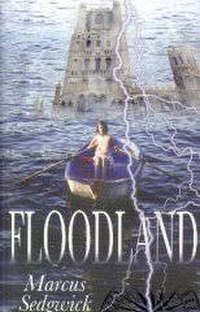
Floodland
Saturday, 6 November 2010
Stranger in a strange land

Monday, 2 August 2010
The Pinocchio paradox
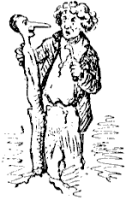 What happens if Pinocchio says, "My nose is about to grow"?
This is a regular Internet meme/joke posted by timewasters on Yahoo! Answers, but it's actually a nice paradox of the "I always lie" flavour. One resolution, which ought to be on a FAQ somewhere, is well-known; but I'd never actually bothered to verify it. The get-out is that Pinocchio's nose grows not merely when he lies, but also when he's stressed.
See the English translation of Carlo Collodi's 1883 Adventures of Pinocchio (Gutenberg EText-No. 500), where there are scenes showing that the nose grows during his presumably stressful creation ...
After the eyes, Geppetto made the nose, which began to stretch as soon as finished. It stretched and stretched and stretched till it became so long, it seemed endless.
Poor Geppetto kept cutting it and cutting it, but the more he cut, the longer grew that impertinent nose. In despair he let it alone.
... and when Pinocchio, first experiencing hunger, is disappointed to find that a cooking pot is just a trompe-l'œil:
A boy's appetite grows very fast, and in a few moments the queer, empty feeling had become hunger, and the hunger grew bigger and bigger, until soon he was as ravenous as a bear.
Poor Pinocchio ran to the fireplace where the pot was boiling and stretched out his hand to take the cover off, but to his amazement the pot was only painted! Think how he felt! His long nose became at least two inches longer.
We might expect, then, that creating a logical paradox will be stressful to Pinocchio, and his nose will grow. This is the standard resolution, though I guess that doesn't solve the problem entirely; what if he practised relaxation exercises to the point where he could confront the paradox calmly? I don't know.
The Wikipedia article on The Adventures of Pinocchio is very worth reading, by the way. Like many children's classics, it wasn't originally written for children and started out as very dark Frankenstein-like allegory about the tension between conventional behaviour and free instinct. Pinocchio accidentally kills the Talking Cricket ("Il Grillo Parlante"), which continues to advise him as a ghost; and in the serialised first version, the story ended at chapter 15 with Pinocchio being hanged. At the request of his editor, Collodi added another twenty chapters to lighten it up, in which Pinocchio meets the The Fairy with Turquoise Hair, with whose help he cleans up his act and as reward gets turned into a real boy. The Adventures of Pinocchio spawned any number of adapted and derivative works, notably a Russian analogue, Buratino.
- Ray
Saturday, 17 April 2010
Constance Savery
I've been in correspondence with Eric Schonblom via shared topic interests on Yahoo! Answers. He's just returned home to the USA after a two-month visit to Great Torrington, Devon, with the enviable opportunity to examine a large collection of materials, including unpublished works, relating to the prolific children's author Constance Winifred Savery (1897-1999 - see the Independent obituary).
The first fruit of Eric's work is the website www.constancesavery.com.
- Ray
The first fruit of Eric's work is the website www.constancesavery.com.
- Ray
Subscribe to:
Posts (Atom)