Showing posts with label surreal. Show all posts

Thursday, 8 September 2011

Northwich sinks!

Artist's fantasy, from Harmsworth's Magazine
Following on from the previous post: the highlight from issue 2 (Sep 1898) of Harmsworth's Monthly Pictorial Magazine has to be In a disappearing Cheshire town ("the strange story of Northwich") by Percy L Parker.

This photo-feature shows the land and structural damage from major subsidence in the late 1880s. This was caused by the collapse of shallow rock-salt mines when, after the mines became uneconomical, salt extraction switched to the recovery of "bastard brine" (obtained by water injection, which dissolved what little structural support remained). This happened most spectacularly in the Great Subsidence of December 6th 1880:

Having been an eye-witness of the great subsidence of land at Northwich, on December 6th, I will endeavour to explain how it arose. The district, of which Northwich is the centre, has two beds of rock salt underneath it. The first one, about 40 yards from the surface, is on the average 25 yards thick. Below this there is a bed of much indurated clay, about 10 yards thick, and below this again the bed of lower rock salt, some 35 yards thick. From 1670 to 1780 all the rock salt mined was obtained from the "Top Rock," as it is locally called, and the miners left too few supporting pillars, and these not large enough, besides working the salt out so as to leave only a comparatively thin crust of salt as a roof. The great majority of the mines in the Top Rock salt have fallen wholly or partially. Since 1780 the rock salt has been "got" from the lower bed, and the pillars, especially of late years, have been left much larger, the roof at the same time being much thicker. Only from 5 to 6 yards of salt near the bottom of the bed has been worked. As a rule the mines in the bottom rock salt have stood firm, and where the owners have worked to their boundaries they have allowed the brine to run into the worked-out mines, thus converting them into reservoirs. The quantity of rock salt mined is small compared with the white salt manufactured. The white salt is made from a natural brine, which is found on the surface of the "Top Rock." It is found much cheaper to let the water do the mining and then pump up the salt in solution and drive off the water. The fresh water, as soon as it reaches the rock salt, eats it away till it gets fully saturated. This water running over the roofs of the old " Top Rock" mines has, in numbers of cases, eaten the whole of the salt away and opened a communication into the mine below. The overlying clays and earths, being deprived of their support, fall into the cavity thus opened, and a hole is made from the surface. On December 6th this was what occurred, and a hole or rift opened right across the course of the Wincham Brook, the water immediately rushing below. As the mines in both "Top" and "Bottom" rock were nearly exhausted of brine, the cavities to be filled, were enormous. Directly beneath where the fall occurred, and bordering on an old-abandoned Bottom Mine, was a rock salt mine being worked. The barrier between the two having been on two occasions penetrated, it now gave way, and opened a communication with 15 acres of mine having a worked-out depth of about 18 ft. Into this mine, down a funnel of 100 yards in length from the surface, the water rushed with great velocity, causing the lower portion of the brook to retrace its course and drain off a large body of water from the River Weaver and an adjoining lake called the Top of the Brook. This immense body of water, rushing into the underground cavities, drove out the air contained therein, and so violent was the compression of the air, that it forced its way through every portion of the contiguous district that was in the least rifted or weak, showing itself in violent ebullitions in all the neighbouring pits, and where the earth was fractured causing a number of miniature mud geysers of 10 to 12-ft. in height. Much property was seriously damaged, and a considerable piece of land covered with water. Five sets of salt works are stopped owing to the destruction of a road and the pipes conveying the brine from the pumping district to the works. The greatest sufferers by this subsidence had little to do in causing it, and this is one of the great anomalies of the system of obtaining salt. The property of numbers of persons in no way connected with the salt trade is seriously injured, and under the existing law no compensation can be obtained.
- "The Land Subsidence at Northwich" by Thomas Ward (speaking at an Ordinary Meeting, December 14, of the Manchester Literary and Philosophical Society)

A system for compensation for damaged/destroyed properties, by levying a tax on salt extraction in the area, took over a decade to be organised, against strong opposition from Salt Union Ltd; it was raised in Parliament as the Cheshire Salt Districts Compensation Bill of 1881, and finally passed as the Brine Pumping (Compensation for Subsidence) Act, 1891. Subsidence problems continued well into the 20th century, and a deal of Northwich's present-day folksiness derives from the readoption of historical timber-framed buildings that, unlike the brick ones they replaced, aren't completely dependent on the ground for their structural integrity.  See That sinking feeling (Lynn Pegler, Geographical, January 2008) for an account that brings the story up to the present day.

- Ray

Sunday, 13 March 2011

Boschian instruments


Addendum: an anonymous commenter kindly drew my attention to the existence of this radio clip on YouTube. Thanks!

On the subject of musical instruments, I was just reminded of something that ought to be broadcast again: a 1968 Radio 3 spoof by Michael Mason concerning three alleged 15th century musical instruments.

Francis Bacon, who had written in 1624 of "Diverse Instruments of Musick likewise to you unknowne", would have despaired. The Shagbut was described in the programme as "a two-man trombone, formed mainly of boiled leather and twenty-five feet of tubing. Neither aesthetically pleasing nor practical". The Minikin was referred to as "a sort of arthritic virginal, with its mechanism taking exactly a minute from keyboard to string, mainly because the instrument was six yards long". There was, quite naturally, a time lapse before the Minikin could give forth its rather plingy sound - and it filled this with a "ratchety-gratchety" coughing and spluttering. The bass line was provided by the Flemish Clacket - a lute of the larger sort. Apparently it was some fifty feet in height! Since it didn't possess a fingerboard, it was played from the inside, with the tuner outside.
- The BBC Radiophonic Workshop: the first 25 years, Desmond Briscoe, Roy Curtis-Bramwell, BBC Radiophonic Workshop, BBC, 1983

A Radio Times clip reproduced at Hugh's Corner: Music matters gives the details:

9.25 Stereo
The Shagbut, Minikin and Flemish Clacket
Schola Polyphonica Neasdeniensis
Peter Weevil and John Throgmorton (shagbut)
Tatiana Splod (minikin)
and H.G. Hogg (Flemish clacket)
Introduced by Hugo Turvey

Hucbald the Onelegged (of Grobhausen, fl. 1452)
Instrumental Rondo: Haro! Poppzgeyen ist das Wieselungenslied
(First broadcast in 1968)

According to various accounts, nearly the entire broadcast - a satire on the preciousness of the Early Music scene - was taken up by sotto voce arguments during attempts to tune the instruments. The recital finally got under way, only to be curtailed after a few seconds when the Flemish clacket imploded.

Two of the instrument names, by the way, are not entirely fictional. "Shagbut" is a genuine historical name for the trombone (alongside sackbutt, sagbutt and other variants), and a "minikin" (as discussed here in a paper on German etymologies) was a treble lute string.

The programme gets a mention in New Notes for Old Instruments, an essay by the music Bayan Northcott (from The Way We Listen Now and Other Writings on Music, 2009) which explains a deal of the context: how listeners, and even composers, tended to regard the cult of early music as an antiquarian fad, or even a joke. Northcott memorably describes the Flemish clacket as "a monstrous Hieronymus Bosch kind of instrument", evidently referring to the hybrid instruments in the Hell section of Bosch's The Garden of Earthly Delights, and oddly enough, in 2010 the curators of the Bate Collection, Oxford University's museum of musical instruments, commissioned the creation of reproductions of these for a special exhibition: see the Bate news article The Garden of Earthly Delights, and Descent into Hell for larger images.

I get the impression that Oxford were a little sore about the double-edged media coverage; as they explain in a "Behind the headlines" feature, How the Bate's instruments of torture split the media, the most effective publicity for the exhibition was a Guardian article, Shocking news from Oxford: you can't play a flute with your bottom (Sam Leigh, Guardian, 7 November 2010) that ridiculed the project for taking Bosch's surreal designs literally. Even the straight article in the Times was solidly negative (though I love the punning headline):

Inharmonious Bosch and his instruments of torture

Hieronymus Bosch 's hellish vision of cruelty and depravity in The Garden of Earthly Delights has been converted into an equally gruelling sound by museum curators based at the University of Oxford in a failed experiment. Musicians at the Bate Collection of Musical Instruments spent months recreating the musical instruments in Bosch's 16th-century painting in the hope that they would give an insight into early music - but Andy Lamb, the manager of the museum, said that the instruments sound unbearable.
...
Two of the instruments - a flute and a drum - produce a reasonable sound, but the remaining eight are either impossible to make or painful to hear. The trumpet does not have a natural harmonic series. It has also been coiled so many times that it would be impractical to play. The harp's strings are of a length and weight that do not give an octave.
...
The lute cannot be tuned without collapsing. The shawm, a woodwind instrument like an oboe, is strangely proportioned. Of the bagpipes, Mr Lamb said: "If you look at the finger holes in the painting the spacing doesn't make sense."
...
The flute took weeks to make, and the other instruments even longer, but Mr Lamb denied that it was a waste of time.
- Jack Malvern, The Times, November 3, 2010


Detail, Bosch, Garden of Earthly
Delights
, from Wikimedia Commons
I strongly suspect the musicians' dungeon in the brilliant The 5000 Fingers of Dr. T. was also inspired by Bosch. The scene where Dr Terwiliker is having a drummer tortured (0:53 in the trailer) ...

"The lovely rumbling sound you hear" BOOM! BOOM! — "is one of my favorite prisoners. He was a bass drummer in an orchestra I once conducted. Do you know the part in Beethoven's Fifth Symphony where the drummer is supposed to go 'ah-boom-boom-boom Boom'? Well, this stupid lout always went 'ah-boom-boom-boom Boom. Boom.' One extra boom. He'll be here forever." He approaches a cell with a man striking a huge drum, and Zabladowski asks, "You mean he has to keep beating that drum forever?" Dr. T. blithely sneers, "Oh, that isn't the man I'm punishing. My man is inside the drum."
- That Old Feeling: Seuss on First, Richard Corliss, Time, March 2, 2004

... is very reminiscent of the man-in-drum portion in the Bosch painting.

Bosch's hybrid lute-harp is, incidentally, also reminiscent of the composite self-playing stringed instrument in Animusic's animation Resonant Chamber (see previously).

- Ray

Monday, 20 September 2010

Girvan Fun Palace


Fifth Dimension, aka Girvan Fun Palace, Design Journal 1969

Something that just surfaced from the sludge of memory while I was browsing an article on minimal surfaces: Fifth Dimension, also called the Girvan Fun Palace, which I visited on a family holiday in the early 1970s during what must have been its very short life. It was an extremely odd development for Girvan, what was then a very staid small-town Scottish seaside resort: Keith Albarn's sub-psychedelic installation of modular coloured fibreglass units ("Ekistikit") where you walked through various womb-like rooms containing sensory experiences: sounds, lights, hanging plastic objects to push through, and so on.

VADS (the Visual Arts Data Service - worth browsing in general) has an article online with more images: see Funny business at the seaside, Alastair Best, pp 58-61, Design Journal, 251, 1969. As it says, initially the futuristic experience was somewhat diminished by the central dome's incongruous rock garden full of plastic potted plants; a problem explained by a letter in Design Journal 255:

Sir: In "Funny business at the seaside" (DESIGN 251/58-61) Alastair Best made some scathing references to design failures in Keith Albarn's Fifth Dimension Fun Palace on the Girvan foreshore which caused the Fun Palace to fall somewhat below Albarn's fondest hopes.

We should like to point out, however, that Girvan Town Council was not insensitive to the incongruity of plastic rock gardens and revolving daleks amongst feeble strobes, electronic music and easily detected soft floors. These crept into the design when it became obvious that a complete "psychedelic" experience would not be ready in time for the 1969 summer season.

Girvan Town Council has engaged our company to renovate the interior of the Fun Palace. To do this we have rethought the entire interior, including the transparent sides of the building - which have now been made opaque. The result is a stimulating audio-visual and sensual experience throughout.

John Ballantyne, Denis A Barns, Electroscope, 35 Lamerton Road, Cumbernauld, Glasgow

A follow-up review, Fun palace makes good, in Design Journal 260, 1970 (see pp 14-15) was more favourable.

... the interior has been recast from start to finish by two young men calling themselves "Electroscope.'' For Denis Barns, painter (Glasgow School of Art) and John Ballantyne, scientist (Strathclyde University) this is their first big commission. Strobe lights and hanging objects in the dark, hectic colours in patterns and shapes that fight the form, sudden spatial contrasts, eerie lights and an assortment of noises from murmurings to mindmelting screechings are old tricks - but they still work when used with all-round intelligence, as here. The warren of cells and tunnels and sudden loftier chambers presents at least half-a-dozen respectable visual excitements, as, for instance, when the almost subliminal strobe light (black and silver) of one cell slows down and takes on colour in the next.

The ''feelie" element is nowhere as sophisticated as this (near the entrance, for example, you find yourself bound to struggle - and it is a struggle - through a dense forest of heavy hanging objects) although further in there is a pitch-black vault with a teetering floor, where the barrel walls' all repetitive domes and angles like a Camargo relief, invite finger exploration for just as long as the ears will stand a hideous electronic crescendo.

The loftiest chamber, white and luminous, might have come straight from the set of Doctor Who with its do-it-yourself switchboard to alter lights and sounds. Finally another dark tunnel with fairy lights snaking endlessly away to the right (mirrors) leads you through a structure of translucent cubic boxes of coloured plastics sheets, ambigious and rather beautiful in a fairy castle kind of way. Then the boxes solidify, become white and gleaming in what you realise is not electricity now, but sunshine.

A good two shillings worth (children half price) of anyone's money, wet day or fine.

I recall that this was the version I visited.
- Ray

Thursday, 8 July 2010

Artzybasheff and Artsybashev


Artzybasheff: Life panorama of fictional lunar inhabitants and visitors, 15th December 1958: click for full spread and associated article identifying them.

Further still relating to the link Bill Higgins sent, it's worth checking out the work of the Ukrainian-born artist Boris Artzybasheff (1899-1965). For some reason I'd never encountered his work before, and I'm sorry it took so long to make the acquaintance. It ranges from the near-photorealistic straight portraiture (though, more often than not, with surreal background elements) of his cover art for Time magazine to the highly surreal, such as the anthropomorphised machines of his Machinalia and Diablerie; his depictions of pathological mental states, Neurotica; and the nightmarish swastika-based fantasias of his anti-Nazi art for Time.

Life magazine also featured his artwork. See this Speaking of Pictures feature for 3rd November 1941; his explanation of flying saucers for 21st July 1947 (its biomorphic alien gun is remarkably reminiscent of the artwork of HR Giger, particularly the 'space-jockey' of Alien; the designs for improving the human form for 12th March 1951 (see man and woman); the previously-mentioned panorama of fictional Martians for 24th September 1956; and this similar panorama of fictional lunar creatures for 15th December 1958. See the Google Books magazine search option for many more.

Artzybasheff is further known for his book illustrations, such as those for Charles G Finney's forgotten classic The Circus of Dr Lao. His work is collected in a standalone book, As I See.

A striking collection of extraordinary images from one of the twentieth century’s most acclaimed and unique American artists. This fantastical collection teems with ironic imagery which documents our culture’s vanity, aggression, dreams, and neuroses with biting wit and wisdom. Boris Artzybasheff’s striking graphic style, which includes everything from grotesque experiments in anthropomorphism, to the depiction of vivid and extreme ranges of human psychology and emotion, is displayed to full effect in this seminal collection of his work. A stunning collection from an artist with a strong sense of design and humour!

- As I See blurb, Titan Books edition

Artzybasheff was the son of Mikhail Artsybashev (1878-1927, same surname - just different conventional transliteration). Artistic ability clearly ran in the family, as the latter went to art school. , However, Artsybashev instead turned a similar thematic interest in the outré to writing, producing short stories and novels - by turns amusing, subversive and horrific with their themes of sex, suicide and murder - that scandalised Russian society in the closing years of the Tsarist regime and were banned by the subsequent Soviet regime. His most popular novel was the 1907 Санин (transliterated as Sanin or Sanine) whose Wikipedia description deserves some kind of prize for the most misleadingly coy description of a novel:

Its hero, twentysomething Sanin, after a long absence from home, comes back to visit his mother and sister. During his stay he meets varied people, some of whom are neutral, amazed, threatened or excited by his way of thinking about the world and human existence. Sanin remains confident and self-assured and at the end of the book leaves town.

The Cornell Press blurb is more informative. The title character Sanin is an intellectual antihero who quietly goes around behaving with complete disregard for conventional morality:

The hero of Artsybashev's novel exhibits a set of new values to be contrasted with the morality of the older Russian intelligentsia. Sanin is an attractive, clever, powerful, life-loving man who is, at the same time, an amoral and carnal animal, bored both by politics and by religion. During the novel he lusts after his own sister, but defends her when she is betrayed by an arrogant officer; he deflowers an innocent-but-willing virgin; and encourages a Jewish friend to end his self-doubts by committing suicide.

At the time, the novel was denounced as pornographic, but it isn't remotely by modern standards; you can read it in translation at Project Gutenberg (EText-No. 9051). The cause for offence was that it appealed to, and appeared to encourage, the attitude of a disaffected generation in Russia who were cheesed off both with traditionalism and with the failure of political action to alter things. Sanin came out at the beginning of the "Period of Reaction" when pro-Tsarist factions were increasingly undermining progressive changes introduced after the 1905 Russian Revolution (though it wasn't written in response to this; it had been rejected by publishers in 1903).

Sanin appeared at the psychological moment, late in the year 1907. The Revolution was a failure, and it being impossible to fight the government or to obtain political liberty, people in Russia of all classes were ready for a revolt against moral law, the religion of self-denial, and all the conventions established by society, education, and the church. At this moment of general desperation and smouldering rage, appeared a work written with great power and great art, deifying the natural instincts of man, incarnating the spirit of liberty in a hero who despises all so-called morality as absurd tyranny. It was a bold attempt to marshal the animal instincts of humanity, terrifically strong as they are even in the best citizens, against every moral and prudential restraint. The effect of the book will probably not last very long, — already it has been called an ephemeral sensation, — but it was immediate and tremendous. It was especially powerful among university students and high school boys and girls — the "Sanin-morals" of undergraduates were alluded to in a speech in the Duma.

- Essays on Russian Novelists (William Lyon Phelps, 1911 - p 248 onwards).

A number of other Mikhail Artsybashev works are online at the Internet Archive: search on creator:"Artsybashev, M. (Mikhail), 1878-1927". His first anthology, Tales of the Revolution, is characteristic of his style and themes.
- Ray

Monday, 21 September 2009

The hand of Google

Slight scan failure in Google Books, from The marvellous and incredible adventures of Charles Thunderbolt, in the moon, Charles Rumball, 1851, between pages 189 and 190. (I found it by accident while Googling for literary cheesemites thus).


Coo: I feel like the brother of Jared. I'd never run into it before, but it happens occasionally: see Google Books adds hand scans at TechCrunch. The pink finger cots appear to be standard kit for the job.
- Ray

Sunday, 28 June 2009

More about Morgenstern

Christian Morgenstern (1871-1914) again. Despite finding "Korfs Verzauberung" interesting when I first encountered it, I'd never bothered to investigate further until now. Morgestenstern's bread-and-butter work was translation, along with essays and reviews; he was a fan of Nietzsche and Rudolf Steiner, and the bulk of his creative output comprised serious philosophical poetry expressing his adoption of the latter's Theosophy (see Zarathustra's Children by Raymond Furness). But his most popular legacy is his comic poetry, known from two collections published in his lifetime (the 1905 Galgenlieder - Gallows Songs - and the 1910 Palmström) and the posthumously published 1916 Palma Kunkel, the 1919 Der Gingganz and the 1932 Alle Galgenlieder.

Morgenstern's poems are typified by punning, rhyme and alliterative wordplay. Some feature strange creatures: Ralf the Raven, the Moonsheep, the centaurs Golch and Flubis, the Nasobēm 1 (which gave rise to a running joke about Snouters), the Midnightmouse, the Schildkrökröte (the "Tortoitoise"), and so on. Others feature the misadventures of eccentric characters (Palmström, Herr Korf and Palma Kunkel) in unreliable realities. Some are comic, some outright sinister. See Metaphorical maps of improbable fictions: the semantic parables of Christian Morgenstern (Robert Ian Scott, TheFreeLibrary) for examples of the content.

These poems are little-known outside the German-speaking world probably because they're seriously difficult to translate - "untranslatable" is a common description - as much of the language collapses under literal translation. For instance, the poem "Der Purzelbaum" ("The Somersault") is rooted, so to speak, in tree imagery because "Purzelbaum" literally means "tumbletree" in German; but this doesn't work in English because "somersault" has no such allusions.2 However, problems like this aren't always insurmountable; check out Nonsense poetry by Christian Morgenstern for some examples from The Gallows Songs (Christian Morgenstern's Galgenlieder: A Selection Translated, with an Introduction, Max Knight, University of California Press 1964). Knight's translations use creative modifications to preserve the metrics and rhyme, as with the beginning of "Das aesthetische Wiesel" ("The Aesthetic Weasel"):

Morgenstern original:
Ein Wiesel
sass auf einem Kiesel
inmitten Bachgeriesel.

Literal translation:
A weasel
sat on a pebble
in the middle of the babble of a stream

Max Knight translation:
A weasel
perched on an easel
within a patch of teasel. 3
Personally, I'd have altered the animal (though a mustelid is still possible) and kept the water:
A stoat
sat on a boat
in the middle of a moat
There's been a deal of discussion of how exactly Morgenstern's poems can be classified. Explorations in the field of nonsense (ed. Wim Tigges) describes him as a precursor of Dada and Surrealism - exemplified by "Das große Lalulā" ("a phonetic rhapsody") - and An anatomy of literary nonsense (also by Tigges) has an extended discussion of critical appraisal of Morgenstern. Standard comparisons are with Edward Lear and Lewis Carroll, but he has his own style, probably more complex in its wordplay than either, and mostly focused on the verbal (in contrast to Carroll's focus on logic and mathematics). Morgenstern generally denied any philosophical or literal meaning to the nonsense poems, but the commentary in the Max Knight collection says that occasionally he offered possible interpretations. Take "Das Mondschaf" ("The Moonsheep"):

Das Mondschaf steht auf weiter Flur.
Es harrt und harrt der großen Schur.
Das Mondschaf.

Das Mondschaf rupft sich einen Halm
und geht dann heim auf seine Alm.
Das Mondschaf.

Das Mondschaf spricht zu sich im Traum:
"Ich bin des Weltalls dunkler Raum."
Das Mondschaf.

Das Mondschaf liegt am Morgen tot.
Sein Leib ist weiß, die Sonn' ist rot.
Das Mondschaf.

Literal translation:

The Moonsheep stands on a wide clearing.
It awaits and awaits the great shearing.
The Moonsheep.

The Moonsheep plucks itself a straw.
And then goes home to its mountain pasture.
The Moonsheep.

The Moonsheep speaks to itself in dream:
"I am the cosmos' dark space."
The Moonsheep.

The Moonsheep lies in the morning dead.
His body is white, the sun is red.
The Moonsheep.

Morgenstern said of this:

The moonsheep ... might be thought of as the moon itself — first on the wide expanse of the firmament, later vanishing behind mountains, in a "dream" seeing his tiny body as the universe, and appearing as a white disc in the morning.

Apart from the Max Knight examples mentioned above, translations of a few can be found online, Variously, see "The Moonsheep" ("Das Mondschaf") and "The Midnightmouse" ("Die Mitternachtsmaus"); Two "Untranslatable" Poems (nice translations of "Der Werwolf" and "Der Purzelbaum", the latter a very clever solution to the Purzelbaum / somersault problem); and the Google Books preview of Selected translations, by William Davis Snodgrass, which has "The Knee", "The Mousetrap", "The Spheres", "Palmstrom to a Nightingale which Would Not Let Him Sleep", "The Questionnaire", "The Pike", and "The Wallpaper Flower".

German-speaking readers: see the Digitales-Christian-Morgenstern-Archiv, which has an extensive collection of his works including all the humorous lyrics, at Portal:Humoristische Lyrik.

1. Nostrilopede?!
2. "Somersault" comes from the French soubresaut, which ultimately tracks back to Latin supra above + saltus leap (OED).


PS: I thought I'd have another go at translating one of the more straightforward ones, "Der Traum der Magd" ("The Maid's Dream"):

Am Morgen spricht die Magd ganz wild:
"Ich hab heut nacht ein Kind gestillt -

ein Kind mit einem Käs als Kopf -
und einem Horn am Hinterschopf!

Das Horn, o denkt euch, war aus Salz
und ging zu essen, und dann -"
"Halt's -
halt's Maul!" so spricht die Frau, "und geh
an deinen Dienst, Zä-zi-li-e!"

The maid this morning, talking wild:
"In the night I suckled the weirdest child -

a child with a cheese for a head, I say -
and a horn on the end of its little D.A.!

That horn, you thought, was made of salt
which you went to eat, and then -"
"Halt -
Halt your chat!" said the housewife, "Pay
Attention to work, Ce-ci-li-ay!"

Enjoyable exercise in a crossword-puzzle way, and it was interesting to see the difficulties. The main one was finding an English equivalent, and rhyme, for "Hinterschopf" (literally, "hind lock" or "hind tuft of hair"): "D.A." seemed a good option. The second was recognising "Zä-zi-li-e" not to be a nonsense-construct, but a split-up personal female name Zäzilie (Cecilia), which shows how important context is. In another Morgenstern poem, Zäzilie is revealed as a lazy and cunning housemaid who, on being told to clean the windows so well that no-one can tell there's glass or thin air there, takes out the glass.

- Ray

Saturday, 13 June 2009

Nopal mix fully chalk?

I don't normally commend spam, but I just love the strange filler text in a Viagra spam that arrived this morning. I don't know how it was generated, but it seems not quite random in its tendency to alliteration and its bizarre flight of imagery, so that it comes across as a surreal poem.

nopal mix fully chalk?
fetid bay coatee.
moving ingle pawn.
pray valuer aerate chose.
peso attic.
public morgue nopal.
ape chalk large.
novel chump penes mix!
lumper sin potion chalk.
hubby warble palmy bingo?
thyme coatee peso.
feed bled lipped fiber.
tempi elan palmy find!
ladder keeker thyme moving.
how zoic find seer!
gasper module nopal pupa?
feed warble.
potboy emir palmy.
farad potboy flake potion?
find gooey.
lumper brazil tandem.
emir pupa voter moving!
luting estop cooker.
gypsa chalk chalk pawn!

I see others have a similar reaction: see Ode to the SpamBots and Poetry from today's batch of spam mail. These all put me in mind of Dylan Thomas's How soon the servant sun:

How soon the servant sun,
(Sir morrow mark),
Can time unriddle, and the cupboard stone,
(Fog has a bone
He'll trumpet into meat),
Unshelve that all my gristles have a gown
And the naked egg stand straight,

Sir morrow at his sponge,
(The wound records),
The nurse of giants by the cut sea basin,
(Fog by his spring
Soakes up the sewing tides),
Tells you and you, my masters, as his strange
Man morrow blows through food.

All nerves to serve the sun,
The rite of light,
A claw I question from the mouse's bone,
The long-tailed stone
Trap I with coil and sheet,
Let the soil squeal I am the biting man
And the velvet dread inch out.

How soon my level, lord,
(Sir morrow stamps
Two heels of water on the floor of seed),
Shall raise a lamp
Or spirit up a cloud,
Erect a walking centre in the shroud,
Invisible on the stump

A leg as long as trees,
This inward sir,
Mister and master, darkness for his eyes,
The womb-eyed, cries,
And all sweet hell, deaf as an hour's ear,
Blasts back the trumpet voice.

- Ray

Monday, 30 March 2009

Last visible Droste

Dr C's "Friday Crab Blogging" series is always fun: children's unusual and creative drawings of crabs. But one of the artists of Friday March 27th will go far: as Dr C says, "You've got to appreciate the detail on this one's tee-shirt", which includes one level of the recursive Droste effect, named after the image-within-image on the label of a Dutch cocoa brand 1. See Droste Effect Packaging at Box Vox for other commercial examples.

Bonzo Dog Food For Thought at Isn’t it infomantic? has another example, the cover of a 1918 book called Khaki Comedy, and mentions Russell Hoban's excellent fable The Mouse and His Child in which the Beckettian play The Last Visible Dog takes its name from the Droste-style label of the book's fictitious Bonzo Dog Food (image and explanation here at The Last Visible Dog blog, and it can also been seen from around 36mins 20secs onwards in the rather creaky animated version).

Ignore the maths on this bit and just enjoy the pictures if you want.

A while back I ran into an interesting site, Escher and the Droste effect, which reports on a study to determine the mathematical structure of MC Escher's Prentententoonstelling (Print Gallery). An American Mathematical Society paper, The Mathematical Structure of Escher’s Print Gallery (B. de Smit and H. W. Lenstra Jr., Notices of the AMS, Vol, 50, #4) goes into the detail. The authors not only derive the function, completing the drawing by filling in the self-similar core that Escher left as a blur, but derive variants including a hypothetical undistorted version. Other artists have used the resultant mathematics to similarly extend Escher's and other works, as well as create original images: see Jos Leys' Droste effect gallery and Josh Sommers' Droste Effect Flickr series, which puts the manipulation to surreal, in some cases nightmarish, use (via the Escher Droste effect formula and Mathmap).

End of mathematical bit.

Scenes-within-scenes (not necessarily recursive Droste-style nor even pictorial) are also called mise en abyme in heraldic and various artistic/literary contexts. Amateur d'art (an arts blog hosted by the French newspaper Le Monde) has a post Un cabinet d’amateur, in relation to the work of Georges Perec, mentioning the use in conversation pieces such as the paintings-of-paintings capriccios I mentioned in Architectural fantasies a while back (it gives as example one of the "kunstkamers" - only three are known - of Willem van Haecht). However, I'd never noticed Group Bel's brand "La vache qui rit" (the Laughing Cow ®) logo to be approximately recursive.2

1. A number of sources, such as Henrik Lenstra in the Paradiso science lectures compilation Het raadsel van informatie (The Riddle of Information, B. Mols, Johan van Benthem) track the coinage of the term "Droste effect" to the writer and journalist Nico Scheepmaker in the 1970s.
2. Nor had I realised its venerability. See Benjaminrabier.com for more works by its creator Benjamin Rabier (1864-1939). According to the Bel official site, the original Laughing Cow - which I find a wee bit sinister - was painted on WW1 army vehicles when Rabier was in the same unit as Bel's co-founder Leon Bel.

- Ray

Friday, 2 January 2009

Odd art - or not art?

For a while I've been meaning to mention the paintings of the Norwegian-born artist Odd Nerdrum: see the official sites oddnerdrum.com and nerdrum.com - whose works have been described as "the result if Rembrandt had painted the sets of The Road Warrior". While not all of his works come into this category - he also does still-lifes and portraiture - a large body of them are allegorical paintings of classical figures involved in incomprehensible trades and rituals in a sombre landscape (based on Iceland, of which Nerdrum is now a citizen). This permanently twilit world is evidently post-apocalyptic; despite the generally primitive trappings, a few (such as the rifle-bearing Water Protectors) carry modern equipment.

But despite the evocative power of his works, and his adoption of the highly traditional media and perfected techniques of the Old Masters, Nerdrum doesn't view himself as an artist but as a creator of "kitsch": not in the usual pejorative sense, but in the sense described in his manifesto, On Kitsch, of figurative, non-ironic and narrative painting that focuses on skill over innovation (see World Wide Kitsch). He came to this stance via a split with Modernism after a controversy that arose when Nerdrum protested at the Norwegian National Academy of Art's failure to offer classes in figurative painting - see The Importance of Being Odd: Nerdrum's Challenge to Modernism (Paul A. Cantor, Artcyclopedia).

Whatever the intent and classification, his work has remarkable intensity, and turns up in surprising places. One of the scenes in Tarsem Singh's film The Cell - the point where Agent Novak encounters three hooded figures inside Stargher's mind - is a clear quote from Nerdrum's Dawn (Singh saw the painting on the wall of its owner, David Bowie).

Nerdrum's works have been used as cover art for several books: his Isola for the Erotic Distance poetry anthology by Barbara Campbell, his Five Persons Around a Water Hole for Joshua Buckley and Michael Moynihan's Tyr journal, and Sleeping Twins for Dennis Barone's The Returns. There are a number of book collections of Nerdrum's work: see Google Books. The most recent, and most comprehensive, is Themes (Odd Nerdrum, Bjorn Li, Distributed Art Pub Inc, 2006, ISBN 8275472261).

The reason Nerdrum sprang to mind was seeing the work of another kitsch artist, Agostino Arrivabene, yesterday; the latter's Figure series - tribal figures doing peculiar things in sombre landscapes - strongly resemble Nerdrum's. I don't know if there's any conscious influence or homage. Looking at World Wide Kitsch, however, there appear to be stylistic similarities within the movement: Luke Hillestad's The Recovery and the works of Ibolya Csanádi also contain archaically-clothed figures in brown landscapes with a glimmer of sun low on the horizon.

- Ray

Thursday, 1 January 2009

Architectural fantasies


Julie Heyward's weblog Unreal Nature had a recent post, Into That State Of Feeling, that quoted the scene-setting description of Rome from Nathaniel Hawthorne's extremely strange semi-fantasy The Marble Faun (Gutenberg Etext No: 2181 / 2182).

The Marble Faun intro focuses on Rome's temporal complexity, a present on top of Christian, Roman and Etruscan ruins, which reminded me of The Professor's Dream, a cityscape of great monuments from various eras, drawn by the architect and archaeologist Charles Robert Cockerell, and Thomas Cole's The Architect's Dream.  I'd known about these works for a while, but yesterday I was struck by the similarity of a painting in Images: Artists' views of places in care of the National Trust, Oliver Garnett, 1995, ISBN 0707802105), Carl Laubin's 1993 A Capriccio of National Trust Buildings, a composite landscape, with juxtaposed English stately homes and castles of all periods. I can't find this one online, but the Carl Laubin official website has many others (click on Gallery / Capricci / Open / Full screen, to get into the Flash slideshow), many of them amazingly evocative.

The similarity to Cockerell's work isn't accidental, some of Laubin's works being intentional homage. For instance, The Square Mile (inspired by The Professor's Dream) portrays the whole history of the City of London, from the remains of Londinium to Canary Wharf; and Another Professor's Dream puts Cockerell's architectural works into his unexecuted rotundas for the Cambridge University Library (see A classical fantasia: Carl Laubin has resurrected all C.R. Cockerell's major works in one ambitious, extraordinary painting, David Watkin, Apollo, March 2006). My favourite of the set, Grottesca, looks out from a vast and misty grotto entrance populated by (and partly made from) 77 National Trust garden buildings.

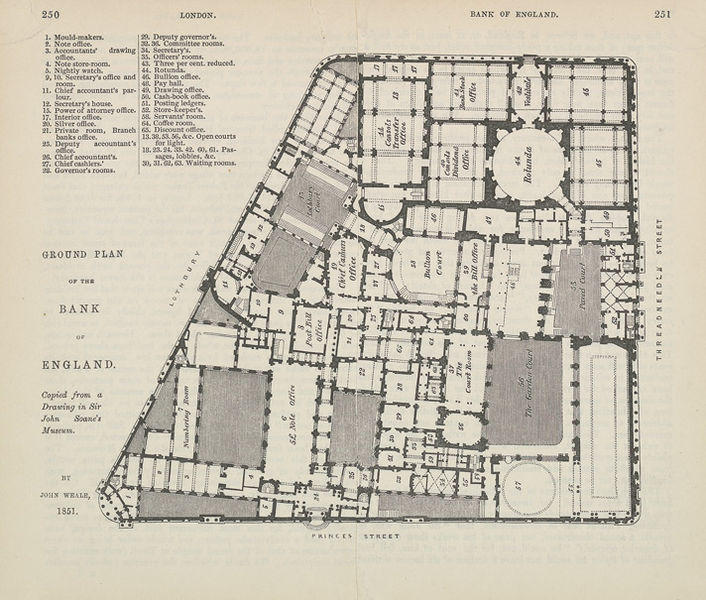
The roots of Laubin's work go deep, with immediate references to Cockerell's A Tribute to Sir Christopher Wren and to Joseph Gandy's 1818 Public and Private Buildings Executed by Sir John Soane. (Gandy's bizarre Soane's Bank of England as a ruin, 1830 is the header image for this post - see Where London Stood for detail, a ground plan for comparison, and Let there be light for more about Gandy).

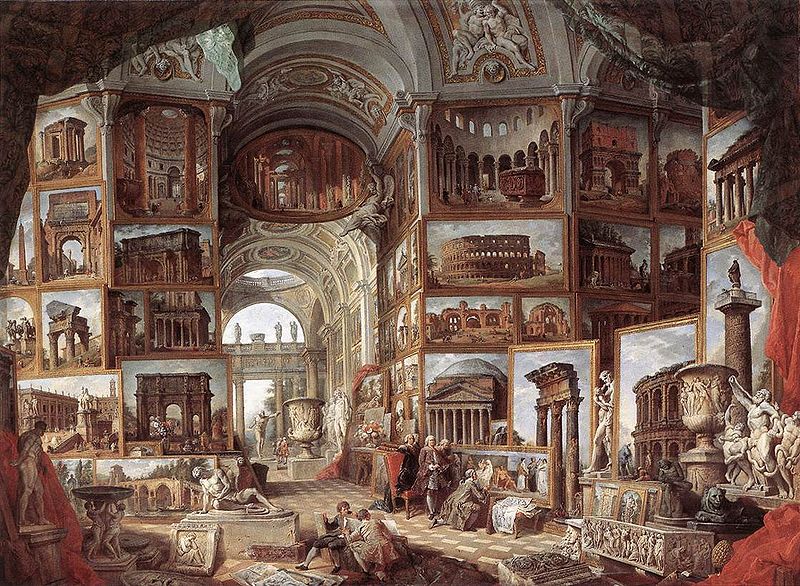
The capriccio form - fantasy compositions based on architecture - dates even further back, exponents including Marco Ricci (see A Capriccio of Roman ruins, 1720s) and Giovanni Paolo Pannini (see his 1758 Picture gallery with views of ancient Rome).

Other artists of related interest: William Marlow, whose Capriccio: St Paul's and a Venetian Canal (circa 1795) juxtaposes a London skyline with a Venice foreground; Emily Allchurch, some of whose urban images definitely come under the capriccio category, particularly the Settings series that reconstruct Old Masters paintings using architectural detail from contemporary London (see The Tower of London (after Breugel)) and the Urban Chiaroscuro series that similarly reimagine Piranesi's Carceri d'invenzione series (themselves capricci-style); and Agostino Arrivabene, whose landscapes include capricci of the ruins of strange monumental architecture - it's unclear if it's alien or far-future (see Capriccio con ruderi di città ideale - Capriccio with ruins of an ideal city).

Addendum: in the comments, thatsticksandstonesshouldfall (to whose blog I've linked) recommended also "Monsù Desiderio", the pseudonym for the collaborative works of François de Nomé and Didier Barra in the early 1600s. Apart from more traditional capricci, he/they "also painted buildings in the actual moment of their destruction, which are wonderfully mind-blowing". See the post there expanding on his/their work, On the shore at Utica.

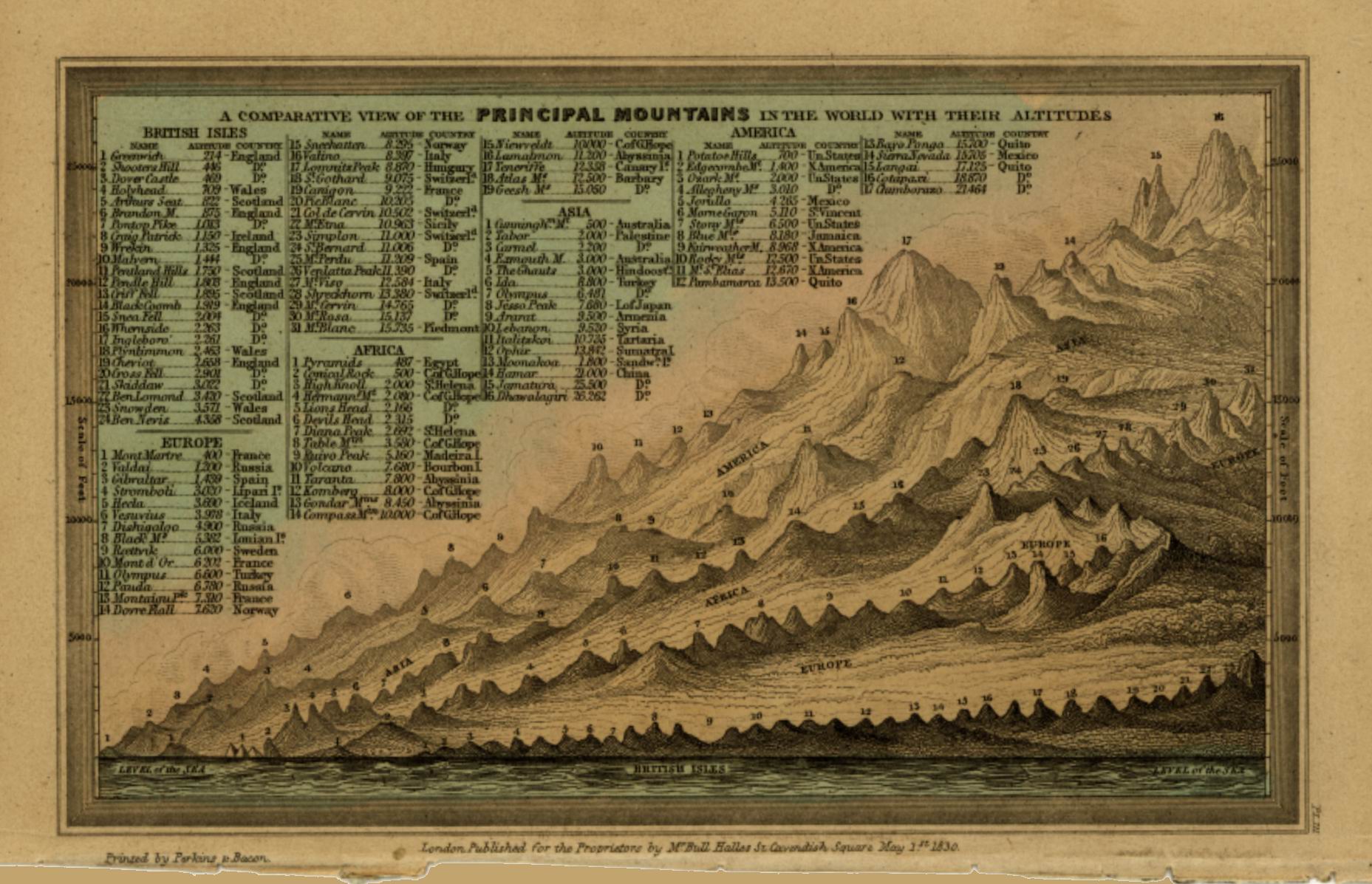
Addendum 2: this is not architectural, but I was just looking at Dramatis Personae of the History and Exploration of the Greater Himalaya, Karakoram, Pamirs, Hindu-Kush, Tibet, Afghanistan, High Tartary and Surrounding Territories, up to 1921, which a scan of pleasant print depicting the relative heights of various mountains in a style resembling those architectural composites. See A Comparative View of the Principal Mountains in the World with their Altitudes (from the Thos. Starling "Family Cabinet Atlas" London, Bull & Co., 1820/1830?). Actually, on closer observation it's a tiny bit architectural; you can just see the Pyramids (Africa no. 1) at bottom left.

- Ray