Showing posts with label kipling. Show all posts

Sunday, 4 April 2010

Kipling: fantasy, SF and horror

A recent Anecdotal Evidence post, `The Illegitimate Branch of the Profession', reminded me of an interesting Rudyard Kipling short story, A Matter of Fact, involving an encounter with a sea monster, that could almost be considered a precursor to HP Lovecraft's Cthulhu mythos.

Kipling's short story canon has a reputation for more or less realistic character-driven stories, many with Indian settings, but he actually produced a large body of works classifiable as fantasy, SF and horror. In this context, Rudyard Kipling's Tales of Horror and Fantasy (2008, Pegasus Books, ed. Stephen Jones, ISBN10 1933648783) looks very much worth checking out. The Kinokuniya BookWeb entry has a table of contents:

The Vampire
The Dream of Duncan Parrenness
The City of Dreadful Night
An Indian Ghost Story in England
The Phantom 'Rickshaw
The Strange Ride of Morrowbie Jukes
The Unlimited Draw of Tick Boileau
In the House of Suddhoo
The Bisara of Pooree
Haunted Subalterns
By Word of Mouth
The Recurring Smash
The Dreitarbund
Bubbling Well Road
The Sending of Dana Da
My Own True Ghost Story
Sleipner, Late Thurinda
The Man Who Would Be King
The Solid Muldoon
Baboo Mookerji's Undertaking
The Joker
The Wandering Jew
The Courting of Dinah Shadd
The Mark of the Beast
At the End of the Passage
The Recrudescence of Imray
The Finances of the Gods
The Finest Story in the World
Children of the Zodiac
The Lost Legion
A Matter of Fact
The Bridge-Builders
The Brushwood Boy
The Tomb of His Ancestors
Wireless
'They'
With the Night Mail: A Story of 2000 AD
The House Surgeon
The Knife and the Naked Chalk
In the Same Boat
As Easy as A.B.C.: A Tale of 2150 AD
Swept and Garnished
Mary Postgate
The Village That Voted the Earth Was Flat
A Madonna of the Trenches
The Wish House
The Gardener
The Eye of Allah
On the Gate: A Tale of '16
The Appeal

I thought I knew Kipling's short fiction well, but I recognise very few on the list. The Man Who Would Be King is of course thoroughly well-known: see The Great Game and other adventures and Larry J Kreitzer's analysis of its theological motifs in Borders, Boundaries and the Bible. With the Night Mail: A Story of 2000 AD and As Easy as A.B.C.: A Tale of 2150 AD are also quite well-known SF stories of a world dominated by the "Aerial Board of Control", an airship trading monopoly ("The A.B.C., that semi-elected, semi-nominated body of a few score persons") enforcing its control with non-lethal beam weapons.

Many of the other stories are findable online if you search the Internet Archive for Kipling stories. For instance, The Phantom Rickshaw and 'They', both ghost stories, are in the 1921 Selected Stories from Kipling. The Strange Ride of Morrowbie Jukes, concerning a man caught in a horrific trap, and The Finest Story in the World, in which a writer attempts to capitalise on a naive man who remembers his past lives, are in The Phantom Rickshaw And Other Stories. At the End of the Passage, concerning a man haunted in his dreams (on reflection I do remember that one as a horror classic), and The Mark of the Beast, concerning a man cursed to become a wereleopard, are in Mine Own People And Other Stories. And so on. There are plenty of strange tales to explore.

The New Readers' Guide to the Works of Rudyard Kipling has a good overview by Fred Lerner, Rudyard Kipling and Modern Science Fiction, listing the stories classifiable as SF.

- Ray

Sunday, 28 February 2010

Just not that into her ... and Kipling attribution

It's usually interesting to track aphorisms down to their original context; quite often the original has a very different spin from the conventional interpretation. I just ran into a couple.

"A woman is only a woman, but a good cigar is a smoke". This is frequently portrayed as an aphoristic opinion of Kipling, but it's actually a line from The Betrothed, one of Kipling's poems from his 1886 Departmental Ditties. These generally satirical poems were written when Kipling was moving in colonial society during his years in India, many referring to real people. The dedication to this poem refers to a "breach of promise case, circa 1885" where the lady said, "You must choose between me and your cigar".

Open the old cigar-box, get me a Cuba stout,
For things are running crossways, and Maggie and I are out.

We quarrelled about Havanas — we fought o'er a good cheroot,
And I know she is exacting, and she says I am a brute.

Open the old cigar-box — let me consider a space;
In the soft blue veil of the vapour musing on Maggie's face.

Maggie is pretty to look at — Maggie's a loving lass,
But the prettiest cheeks must wrinkle, the truest of loves must pass.

There's peace in a Larranaga, there's calm in a Henry Clay;
But the best cigar in an hour is finished and thrown away —

Thrown away for another as perfect and ripe and brown —
But I could not throw away Maggie for fear o' the talk o' the town!

Maggie, my wife at fifty — grey and dour and old —
With never another Maggie to purchase for love or gold!

And the light of Days that have Been the dark of the Days that Are,
And Love's torch stinking and stale, like the butt of a dead cigar —

The butt of a dead cigar you are bound to keep in your pocket —
With never a new one to light tho' it's charred and black to the socket!

Open the old cigar-box — let me consider a while.
Here is a mild Manila — there is a wifely smile.

Which is the better portion — bondage bought with a ring,
Or a harem of dusky beauties, fifty tied in a string?

Counsellors cunning and silent — comforters true and tried,
And never a one of the fifty to sneer at a rival bride?

Thought in the early morning, solace in time of woes,
Peace in the hush of the twilight, balm ere my eyelids close,

This will the fifty give me, asking nought in return,
With only a Suttee's passion — to do their duty and burn.

This will the fifty give me. When they are spent and dead,
Five times other fifties shall be my servants instead.

The furrows of far-off Java, the isles of the Spanish Main,
When they hear my harem is empty will send me my brides again.

I will take no heed to their raiment, nor food for their mouths withal,
So long as the gulls are nesting, so long as the showers fall.

I will scent 'em with best vanilla, with tea will I temper their hides,
And the Moor and the Mormon shall envy who read of the tale of my brides.

For Maggie has written a letter to give me my choice between
The wee little whimpering Love and the great god Nick o' Teen.

And I have been servant of Love for barely a twelvemonth clear,
But I have been Priest of Cabanas a matter of seven year;

And the gloom of my bachelor days is flecked with the cheery light
Of stums that I burned to Friendship and Pleasure and Work and Fight.

And I turn my eyes to the future that Maggie and I must prove,
But the only light on the marshes is the Will-o'-the-Wisp of Love.

Will it see me safe through my journey or leave me bogged in the mire?
Since a puff of tobacco can cloud it, shall I follow the fitful fire?

Open the old cigar-box — let me consider anew —
Old friends, and who is Maggie that I should abandon you?

A million surplus Maggies are willing to bear the yoke;
And a woman is only a woman, but a good Cigar is a Smoke.

Light me another Cuba — I hold to my first-sworn vows.
If Maggie will have no rival, I'll have no Maggie for Spouse!

See Wikisource for the full text of Departmental Ditties; and The New Readers' Guide to the works of Rudyard Kipling, a superb collection of texts and concordance on the works of Kipling.

Another interesting Kipling quotation from the same collection is:

The toad beneath the harrow knows
Exactly where each tooth-point goes.
The butterfly upon the road
Preaches contentment to that toad.

It's a very dark commentary on those who comment on suffering without engaging directly. The toad and harrow is an ancient metaphor, dating at least as far back as the fables of Odo of Cheriton (see The Harrow and the Road). Kipling's poem, however, is a more specific dig at the Pagett, M.P. of the title, who thinks the climate of India is an "Asian Solar Myth" until he experiences it. The kipling.org.uk commentary on the Kipling story The Enlightenments of Pagett, M.P. gives some suggestions as to the identity of Pagett.

It's interesting to see, pre-Internet, how rapidly attribution could be lost and become extremely difficult to trace. With this poem from an 1886 collection, as soon as July 1907 Notes & Queries featured a question from a John Pickford of Newbourne Rectory, Woodridge, asking about the origin of the toad-and-harrow quatrain, which had appeared in uncredited in an article by "A Looker-On", The White Man and the British Empire, in Macmillan's Magazine for February 1907. Similarly, The American Missionary, v. 68 - 1914, reproduced it credited as "Old Song". At times I wonder which is more hassle: pre-Internet when attribution could take years to trace; or post-Internet when attribution is easy to find, but buried in a mass of misattribution?

"Literature, from the very beginning, has had a single enemy, and that is the restriction of the expressed idea. It turns out, however, that freedom of expression sometimes presents a greater threat to an idea, because forbidden thoughts may circulate in secret, but what can be done when an important fact is lost in a flood of impostors, and the voice of truth becomes drowned out in an ungodly din? When that voice, though freely resounding, cannot be heard, because the technologies of information have led to a situation in which one can receive best the message of him who shouts the loudest, even when the most falsely?"

That one's not Kipling, but Stanislaw Lem, His Master's Voice.
- Ray

Wednesday, 19 August 2009

Fortifications ... and Gosport

Thoughts around a couple of chance details crystallised into memories worth exploring. Firstly there was Quest for Kim's description of Lahore Railway Station whose on-the-surface-fanciful castellated design is functional; it was built after the 1857 Indian Mutiny to be defensible as a fort. Then there's Ptak's Science Books' Snowflakes and Fort Construction--Scamozzi & Palmanova, which mentions the remarkable "star fort" of Palmanova, Italy.

Though I didn't remotely understand it at the time, I grew up among similar structures, the relics of a Victorian Cold War. Portsmouth harbour - see map -


View Larger Map
is a strategic naval port, and was historically even more so. The Portsmouth side housed the dockyard; Gosport (where I was born) was a garrison town that also handled the infrastructure of victualling and materiel. The 1850s saw a particularly tense period in its history. According to The Story of Gosport (Leonard White, various eds. including Barrell, 1966)

During the 1850-60 period there was constant rivalry between England and France and the danger of open warfare with a French invasion was constantly in the minds of English service chiefs. The aggressive diplomacy of Lord Palmerston, the rise to power of Napoleon III and the frequent clashes of policy between the two countries led people to quote the famous words of the Duke of Wellington: "I am bordering on seventy-seven years passed in honour. I hope that the Almighty may protect me from being a witness of the tragedy I cannot persuade my contemporaries to take measures to avert". The tragedy he contemplated was a full scaled French invasion of the south coast.

As a result of such concerns, Palmerston (as First Lord of the Treasury - i.e. Prime Minister) instigated the 1859 Royal Commission on the Defence of the United Kingdom, which concluded that fortifications should be upgraded for key locations. One of these was Portsmouth Harbour, with an especial focus on securing the weakly defended Gosport side against attack from landward; the town had relatively simple ramparts around its core harbour section. The upgrade took the form of a line of forts across the full width of the peninsula. These, and their contemporary fortifications - see the Palmerston Forts Society - became later known as "Palmerston's Follies". They were built on a new design that replaced the former "bastion system" (essentially, star-shaped fort designs optimised for defence against close-range attack) in favour of the "polygonal system": heavily-armed low-profile forts also designed to prevent attackers getting close, furthermore arranged according to the "Prussian system" where adjoining forts provided each other supporting cross-fire. (See Fort Brockhurst and the Gomer-Elson Forts, David Moore, Solent Papers No. 6, 1990, ISBN 0 9513234 3 1).

How effective they would have been is moot, as is whether they were actually follies or provided a deterrent. The similarly-designed Belgian fortresses (such as Fort Liezele) didn't significantly impede German advance in World War 1 (they were vulnerable to the latest heavy mortars) which was why the French didn't bother to much defend the also similar Verdun forts.


View Larger Map

Most of the Gosport forts are still extant: No. 2 Battery, Fort Grange (now occupied by a football pitch and tennis courts - swords into ploughshares!), Fort Rowner, Fort Brockhurst (which is open to the public and used as a store for English Heritage reserve collections) and the overgrown Fort Elson (which is being allowed to decay, being inside an M.O.D. facility). There are a number of others to the north, such as Fort Fareham, which houses an industrial estate. A final one, Fort Gomer, the first of these new forts, was here; I just remember it, shortly before its demolition in the early 1960s for the housing estate where we lived. The only physical reminder of its existence is a cul de sac on the estate called Moat Drive, and the adjoining Gomer Lane (whose name pre-dates the fort).

Another of my early memories is of seeing steam trains at Gosport Station (which closed to traffic in 1969). This too has a history I didn't know: like that at Lahore, it was designed to be defensible, the only one of its kind in Britain. This design feature was the result of a lengthy dispute in 1840-41 over its building location: the Board of Ordnance considered it too close to the ramparts of the Gosport Lines, and so required it to become part of the defenses. See The Battle of Gosport Railway Station. The sea forts in the Solent must be unique too (see My Gosport); at low tide, the Isle of Wight FastCat ferry travels quite close to one, Spitbank Fort.

I must visit these places some time. They were enigmatic and inaccessible when I was a child, being M.O.D. occupied. Now that that role for the district has declined, many are open to the public. Looks interesting. In rather the same vein, I'll definitely check out June Hampson's "Daisy Lane" series. These are crime novels set in Gosport, starting in 1962 (when I was six and the town looked like this) and I'm rather taken by the in-joke of the heroine's name: Daisy Lane is a lane in Gosport. Judging by previews I've seen, the location is thoroughly authentic: Daisy runs a cafe that "encompassed the corners of North Street and North Cross Street". It's all redeveloped now, but as late as the 1960s, this was one of the scruffier areas of Gosport, still showing wartime bomb damage with large gaps and the adjoining houses braced with wooden supports. As the Orion Publishing interview reveals, it's based on a location where the author lived ("Daisy’s view was my view, even down to the ironmongers’ shop where she goes to get all her bits and pieces from"). I remember that, as well as the cafe, and the folksy radio spares shop in North Street, Speedy's, where I used to get wire to wind induction coils ("Speedy" wore a ghastly wig). The Fox Tavern still exists. (This section of the town is described vividly in Norman L Edward's autobiographical The Times In My Life, although a few decades before I or June Hampson knew it).

Compared to many places, Gosport seems not to have a great number of literary connections, whether as birthplace of authors or as a setting. That's a bit surprising, considering the scope for storytelling about its robust history as a port town, which gave rise to at least one shanty, "Gosport Nancy". However, it features as a location in Benjamin Leopold Farjeon's 1894 indictment of antisemitism, Aaron the Jew, of which the main character is a Gosport shopkeeper. Arthur Upfield (creator of the aboriginal detective "Boney") was born in Gosport, as was the novelist Lilian Harry a.k.a. Donna Baker. Rudyard Kipling would have known Gosport well in his later boyhood. As he wrote:

[Captain Holloway] ... with whom as a small boy I perambulated all Portsmouth, Gosport and Fratton
- Kipling and the Royal Navy, quoting letter of 22 October 1919, The Letters of Rudyard Kipling, Volume 4, Ed. Pinney

(This was "Captain Hollaway" of the Captain and Mrs Holloway in whose Southsea house Kipling lodged for six years and where, as recounted in a number of his books, he was psychologically abused after the kindly Captain's death). A number of literati were among the guests at Bay House (now a school) when it was a minor stately home in the mid-1800s; they included Jane Carlyle (wife of Thomas Carlyle, and a considerable writer in her own right), Tennyson, Thackeray and Macaulay. See Bay House: a nobleman's seaside residence, by Jane Lewendon. A further indirect novelist connection is that one of Jane Austen's brothers, Charles, lived in Gosport for a time.

Addendum: For something of the flavour of the town historically, check out the landscape artist Martin Snape, 1852-1930, who painted many locations around Gosport, Hampshire, about a century ago. Recording the changing scenes of the semi-rural creeks and shores around Gosport in the early 20th century, they have a gloomy atmospheric quality that, for me, evokes a spine-tingling nostalgia. The above site by Gosport Discovery Centre, which recently assimilated Gosport Museum, has 188 images in a searchable database, Snape Online. The Richard Martin Gallery, Gosport, specialises in local artists and keeps a biographical page. There are a few more on the Martin Snape page - largeish images - at My Gosport.

- Ray

Friday, 14 August 2009

If...

Still on the subject of Kipling: Must the nation's favourite poet really be Kipling? The Guardian Books blog looks at the current BBC Nation's Best Poet poll, for which Kipling is a likely favourite (his If—, from the anthology Rewards and Fairies, was voted Nation's Favourite Poem in 1995 in a similar pseudo-poll 1).

If—, written in 1895, rapidly became the standard litany in praise of British stiff upper lip. Obviously it's an "author is dead" situation, but the background is interesting; in Kipling's autobiographical Something of Myself, he describes it as alluding to the Jameson Raid. This was a nasty piece of military-political manoevering, a British-supported attempt to destabilise the Transvaal Republic that was, ultimately, one of the factors precipitating the Boer War. The poem's advice is evidently to the expedition's leader, Dr Leander Starr Jameson, who was covertly supported by the British government, but disavowed when the attack failed (although newspapers spun it as a victory).

If— has attracted many ripostes and pastiches. For instance, Shackleton's last voyage. The story of the Quest (Internet Archive shackletonslastv00wilduoft) tells how Sir Ernest Shackleton had two verses of If— put on brass plate by the bridge of his ship, The Quest. His crewman Leonard Hussey, after a gruelling stint coaling the ship in bad weather, wrote:

If you can stand the Quest and all her antics,
If you can go without a drink for weeks,
If you can smile a smile and say, "How topping!"
When someone splashes paint across your "breeks";

If you can work like Wild and then, like "Wuzzles," 2
Spend a convivial night with some "old bean,"
And then come down and meet the Boss at breakfast
And never breathe a word of where you've been;

If you can keep your feet when all about you
Are turning somersaults upon the deck,
And then go up aloft when no one told you.
And not fall down and break your blooming neck;

If you can fill the port and starboard bunkers
With fourteen tons of coal and call it fun.
Yours is the ship and everything that's on it,
Coz you're a marvel, not a man, old son....

Witha less macho flavour, the Jamaican feminist Una Marson wrote her version of If— about the role of a wife in the sexist culture of 1930s Jamaica


(from see 20th-century Caribbean literature, Alison Donnell). Or there's Rudyard Kipling as a Job Consultant from Frank Jacobs' 1994 Pitiless parodies and other outrageous verse. Or HAC Evans' version about business ethos, If Not, in New Statesman in 1975. The list is probably endless.

There's an excellent story, "The Man Who Would Be Queen", with some vicious Kipling parodies, in the National Lampoon's The Book of Sequels. This untold Kipling tale, an account of a soldier's impersonation of a Maharani to gain possession of a prized ruby, includes several pseudo-Kipling poems from the character Old Ruddy's best-selling anthology Jingo Doggerel Ditties.

Old Ruddy began to recite from memory:

O, the 'eathens of the 'indu Kush
They stank like a 'erd o' goats,
And when they weren't grovellin' at our boots,
They was slashin' at our throats.
We'd come to teach 'em the Rule of Law
But for all the thanks we got,
We might 'ave been dealin' with Micks or Spics
Or the bone-rained 'ottentot.
An' 'alf the time they was 'umble an' meek,
An' 'alf the time they was snoooty,
So we shot 'em down like a pack o' curs,
As is a soldier's dooty,
And we shouted in battle frenzy
Through lips that were flecked with foam,
'If you don't like it in Injah,
Why don't you go bloody 'ome?'

There's also a version of If— that I hope is ridiculing sexism.

If you can fix your hair when all about you
Are tearing theirs out, blaming it on you;
If you can tell him he can go without you,
The pout, because you wanted to go, too;
If you can wink, and sigh, and be vivacious,
And paint your lips and eyes and scent your bust,
And after acting utterly flirtatious,
Take great offense at man's unseemly lust;

If you can dress in feathers, fur, and leather
While swooning over kittens, fawns, and chicks;
If you can never quite remember whether
A half a dozen is the same as six;
If you confuse 'withdrawal' with 'deposit'
When dealing with the bank account you share,
If you can shop for clothes and fill your closet,
and never have a decent thing to wear,

If you can picket, bluster, march, and bellow
For equal rights—protest and suffragette it—
Demanding the same treatment as a fellow,
Then wail and weep and blubber when you get it;
If you can fill with guilt the hearts and spouses
For everything they've done—or haven't done
You'll wind up with both town and country houses,
And—which is more—you'll be a WOMAN, son!

1. I use the term because you don't actually get to vote for your favourite, only for your favourite out of a set of options pre-selected by the poll creators (in this case, the list was "compiled in consultation with The Poetry Society and The Arts Council". So no luck that I like the work of RS Thomas and David Dabydeen. It's pretty elitist too that the popular poet Pam Ayres isn't on the list.
2. The Captain, Frank Worsley.


- Ray

Sunday, 9 August 2009

The Great Game and other adventures #2

Further to The Great Game and other adventures, a book recommendation: Quest for Kim: in search of Kipling's Great Game (Peter Hopkirk, 1996 - various editions inc. John Murray, ISBN-0-7195-5560-4). There's an extensive preview at Google Books. Its genre is travelogue / literary detection in which Hopkirk explores the roots of Kim, which is itself available in various editions at the Internet Archive and as Gutenberg EText-No. 2226. To recap briefly, Kim concerns an orphaned boy of Anglo-Irish parentage who grows up as a resourceful and multilingual street urchin in Lahore, until he is recruited and educated as a member of the British Secret Service, simultaneously acting sidekick to a wandering lama who is searching for the sacred "River of the Arrow".

Quest for Kim starts with historical context from Hopkirk's earlier The Great Game (espionage arising from British concern at the Russian empire's closer and closer encroachment toward the frontiers of India) as well as the origin of Hopkirk's own lifelong interest in the subject, formed while browsing in the Oriental book and antiquarian shops around the British Museum, such as Arthur Probsthain and those of Cecil Court. Hopkirk finds Kim to be strongly based on real persons and locations, While some are ambiguous and/or untraceable, others are clear, such as Kim's teacher Lurgan Sahib, who is based on the charismatic Simla jewel merchant Alexander M Jacobs (who also appeared as the subject of F Marion Crawford's 1907 Mr Isaacs, and as "Mr Jacob" in Newnham-Davis's 1898 Jadoo). Such bibliographic tips abound. For instance, Timeri N Murari's two sequels, The Imperial Agent and The Last Victory - which tell their stories extremely well, Hopkirk says - continue Kim's story, in which he becomes disaffected with British rule and ultimately dies in the Amritsar Massacre in 1919.

Quest for Kim is also rich in general historical background on India. Kim's journey from Lahore to Benares (now Varanasi) crosses what is now the Pakistan-India frontier and the locations of horrific massacres of refugees (fleeing in either direction) during Partition. The identification of Kim's school, "St Xavier's" with La Martinière, Lucknow, naturally leads to the latter's role during the 1857 uprising; and Hopkirk's search (unsuccessful) for Lurgan Sahib's shop in Simla (now Shimla) has many digressions to Simla's crucial role during the Raj as the summer seat of government, with its bizarre system of annual migration to and from Simla. I read Kim decades ago, too young to appreciate the cultural context, but it's not vital for reading Quest for Kim, which talks you through the story in enough detail to whet the appetite to read it in full. Definitely worth finding.

On Kiplingesque matters, the Telegraph just carried a story - "Alexander's army and the blondes of the Himalayas", also in the Irish Indepedent as Experts in bid to uncover a Great mystery - on the Himachal Pradesh village of Malana. This is one of various places said to have a population - "fair-haired and blue-eyed" - descended from soldiers of Alexander the Great's army, like those of the Kafiristanis in Kipling's The Man Who Would Be King. The news item tells of a Swedish-Indian initative to find out their origins, genetically and linguistically. Their language at least seems to have nothing to do wth Ancient Greek: although entirely different to that spoken in the region, it's a hybrid of Sanskrit and Sino-Tibetan languages (see Experts to study Alexander's 'last descendants' in Himachal, Jagdish Bhatt, Times of India, 29 July 2009).

Malana has a unique and highly insular culture whose basics haven't changed since it was documented in the 1911 A glossary of the tribes and castes of the Punjab and North-West frontier province. There's a modern documentary at Culture Unplugged, Malana A Lost Identity by Aparna Katara Sharma. Malana is certainly no Shangri-La, with fierce winters, and difficult interactions with the outside world arising from its various cultural taboos (centrally, the belief that all outsiders are unclean) - complicated by its reputation for producing high-quality cannabis. As described in this Guardian report, Valley of shadows (Adrian Levy and Cathy Scott-Clark, Guardian, 20 April 2002), this has created extreme tensions in the area.

I notice from the documentary, incidentally, that the Telegraph appears to be exaggerating. The blonde Malani woman in the photo illustrating its story - unfortunately not online - appears to be non-representative; although considerably paler-skinned than Indians in general, few Malanis are actually blonde, and they're generally less European in appearance than the people of Nuristan and the Pamirs, regions that saw far more extensive contact with eastward migrations.

- Ray

Sunday, 31 May 2009

Cross purposes


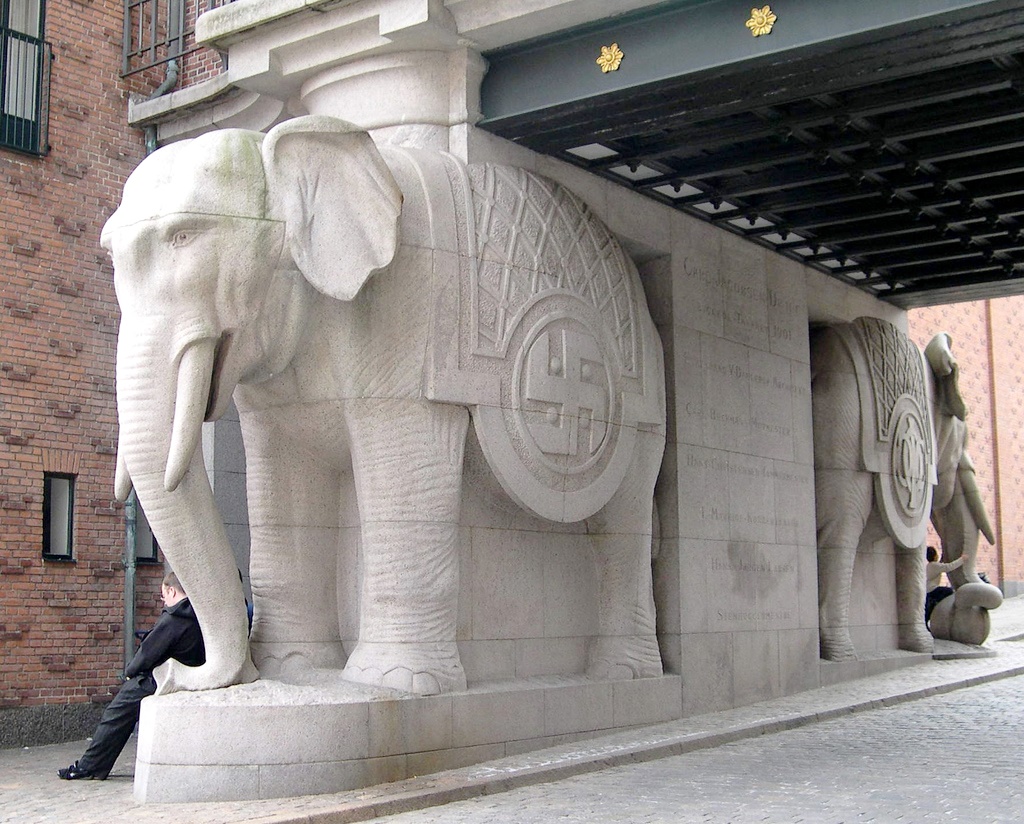
Further to The Urge to Preserve, Weathercasting, the Anthropology of Mud, and Mapping Nipple Church at Unreal Nature and discussion at The hunger games at The Growlery (both of which impinged on swastikas) I just dusted off my copy of the 1920 Macmillan edition of Kipling's 1910 Rewards and Fairies (see Gutenberg EText-No. 556). This sequel to Puck of Pook's Hill 1 has nice examples of the swastika logo that appears on editions of Kipling works prior to the mid-1930s.

As the Kipling Society's Kipling and the swastika page tells, the Society frequently has to field the question of whether Kipling was a Nazi, and the answer is clear: this swastika, shown alongside an elephant representing Ganesha with a lotus flower, is used in its context as a Hindu good luck symbol. Arising from Kipling's familiarity with Indian culture and history, it was his trademark for some 40 years until he discontinued it when the swastika became associated with Nazism.

It's well-known that the swastika (aka fylfot, tetraskelion, gammadion, et al) is an astonishingly ancient symbol: see Wikipedia's swastika article and Symbols.com. What's less known is its ubiquity in Western culture immediately prior to its Nazi use, as listed at Western use of the Swastika in the early 20th century. Kipling's use wasn't even particularly unusual; the Fylfot File has articles on swastikas in surprising places such as Cambridge churches and Scottish World War I memorials (.PDF). There does seem to have been a widespread craze in the late 19th and early 20th centuries - perhaps from a general fascination with shared Western cultural roots. The Nazi movement's grasp of propaganda was adroit, and from that point of view, hijacking the swastika as an emblem was appallingly brilliant.

Over 50 years later, we're left with difficult cultural fallout, with the issues exemplified by the German Strafgesetzbuch § 86a criminal code; this bans it except for scholarly and religious use (the latter, particularly, refers to Hindus and Buddhists, for whom it continues to be a traditional and benign emblem). But it's not far less inflammatory elsewhere, as shown by a stream of news items such as Swastikas on bank floor (The Bolton News, 23rd April 2006), about the local controversy over tiled swastika logos in the 1927-built premises of a Bolton bank.

There are, however, groups working to reclaim the swastika: see, for instance, Hindus reclaim their symbol of life (Ruth Gledhill, The Times, January 19, 2005) and the Reclaim the Swastika website. One of the boldest attempts is by the Canadian artist, mystic and lecturer ManWoman (birth name Patrick Charles Kemball) whose goal is "to begin a change of thought that will return the swastika back to its rightful place". His book Gentle Swastika: Reclaiming the Innocence collects many examples worldwide of harmless use of the swastika, historical and present-day. (He mentions Kipling, as well as Carlsberg Beer, whose Elephant Gate used swastikas similarly). He himself is heavily tattooed with swastikas in the styles of its sacred use in many cultures. He says of it:

How can a symbol be guilty for the acts of a madman?
This website has no connections to any racist propaganda. We do not deny the pain and anguish of the Second World War and the Holocaust. We feel that the time is ripe to put the Nazi decade into the proper context in full view of the ten thousand years of suppressed swastika history and to let the Swastika get on with its benign life. We invite Jews, and all others affected by the war, to look at the evidence for the existence of a sacred Swastika in the world.

The authors of some other books on the swastika - notably The swastika: symbol beyond redemption? (Steven Heller, Jeff Roth, Allworth Communications, Inc., 2000, ISBN 1581150415) and The swastika: constructing the symbol, Malcolm Quinn, Routledge, 1994, ISBN 041510095X) are generally more pessimistic about the chances of redemption for the swastika. (But personally, I think it's a very worthy aim).

Meanwhile, the swastika (and Nazi regalia in general) remains a very powerful meme, an instant shorthand for totalitarian evil. As I mentioned at The Growlery, even the subliminal hint of a swastika shape and strong allusion in colouring in the UK cover of Suzanne Collins' The Hunger Game is enough to tell us what kind of world it's set in (a totalitarian future America); and likewise the many even more overt allusions, many closely modelled on Leni Riefenstahl's Triumph des Willens, in Paul Verhoeven's controversial Starship Troopers film - see Bug-hunts and militarism previously, and The Reich Stuff (Bejamin Svetkey, Movie News, #406 Nov 21, 1997).

While watching Starship Troopers on BBC1 a few days ago, I just remembered a different satire on the appeal of Nazism: Norman Spinrad's The Iron Dream (Avon, 1972). Check out the reviews by Thomas M. Wagner (SF Reviews.Net, 1999) and Ursula Le Guin (Science Fiction Studies, Vol 1, Part 1, Spring 1973). It's set in a alternative timeline in which Adolf Hitler emigrated and became a pulp writer who wrote a Hugo-winning sword-and-sorcery novel, Lord of the Swastika. At one level it's Swiftian satire: in a scholarly analysis the fictitious Homer Whipple analyses the text of Lord of the Swastika, its mass rallies and phallic symbolism, and concludes "Obviously, such a mass national psychosis could never occur in the real world". And yet Lord of the Swastika tells the real-world Hitler's rise to power seen through a Mary Sue fantasy filter. Spinrad's further point is to make explicit connection between the tropes of fantasy fiction and of Nazism: such as macho triumph over subhumans. It's worth finding. Bizarrely, as Spinrad tells in his SF cultural/litcrit book Science fiction in the real world (Southern Illinois University Press, 1990, ISBN 0809315386), there were those who didn't get the ironic intent: he found the book on the American Nazi Party's reading list, and also commented:

To make damn sure that even the historically naive and entirely unselfaware reader got the point, I appended a phony critical analysis of Lord of the Swastika, in which the psychopathology of Hitler’s saga was spelled out by a tendentious pedant in words of one syllable.

Almost everyone got the point…

And yet one review appeared in a fanzine that really gave me pause. "This is a rousing adventure story and I really enjoyed it," the gist of it went. "Why did Spinrad have to spoil the fun with all this muck about Hitler?"

- Ray

1. In both books, Puck, the last surviving fairy, introduces two Pevensey children, Dan and Una, to various historical figures who tell stories of their times. Rewards and Fairies contains two of Kipling's best-known poems, "If--" and "The Way through the Woods".

Monday, 9 February 2009

The Great Game and other adventures

I always find it an interesting experience to revisit literature with a greater knowledge of context. Kipling's Kim (Gutenberg EText-No. 2226) was set reading when I first was at secondary school, but even though it explicitly mentions "The Great Game", that part made little sense, and I don't recall any analysis or discussion.

For those who don't know it, Kim is the story of an Anglo-Irish orphan, Kimball O'Hara, who has grown up as a street urchin in Lahore and who (with various spiritual asides involving a kindly lama) is recruited and trained as a Secret Service agent - via exercises such as what's now called "Kim's Game" - to go undercover on missions to thwart Russians in the Himalayas. Only now that I know a bit more history, does Kim fit into the complex game of espionage and diplomacy played out in 19th century central Asia between the Russian and British empires. Nor was I aware of the sensitivity of Kipling's politics. Kim appears to be one of many books that has fallen into the "children's literature" slot by virtue of having a juvenile protagonist, but is really rather heavy in its demands on the modern reader in understanding cultural context.

A further level of complexity is that Kipling's stance - he has been called "prophet of Empire" - is not quite a simple as once thought: see, for instance, Artist of empire: Kipling and Kim (Clara Clairborne Park, The Hudson Review, Winter 2003). Although Kim doesn't fit this description, many of Kipling's works can be read as ironic commentary on imperialism. A prime example is the 1888 The Man Who Would Be King (Gutenberg EText-No. 8147), which is a story of the inevitable downfall from hubris when its protagonists go to Kafiristan - now Nuristan - to set up their own kingdom, but ultimately fail through lack of understanding of the local culture.

Nowadays The Man Who Would Be King is widely known from John Houston's film version, which manages to be largely faithful to the story while expanding it creatively: for instance, making Kipling himself part of the framing device, and building an aside about Alexander the Great into a central plot element. It's extremely well cast (I can't imagine without mentally - no, actually physically - wincing at the thought of Houston's various previous ideas for the pairing of Daniel Dravot and Peachey Carnehan: Humphrey Bogart and Clark Gable, then Burt Lancaster and Kirk Douglas, then Robert Redford and Paul Newman). However, the personas of Connery and Caine, good as they are, sanitize the activities of Daniel Dravot and Peachey Carnehan, making them into largely likable rogues. In the story, they achieve their aims with considerably more cynicism, brutality and cultural insensitivity, such as shooting their own followers to encourage the others; creating demeaning rituals such as demanding food but only accepting it when a chief brings it; and not bothering to learn locals' names, instead calling them English names after people they look like.

... he brings forward that same Chief that I left at Bashkai—Billy Fish we called him afterwards, because he was so like Billy Fish that drove the big tank-engine at Mach on the Bolan in the old days
...
We gave them names according as they was like men we had known in India—Billy Fish, Holly Dilworth, Pikky Kergan that was Bazar-master when I was at Mhow, and so on, and so on.

Nor does Dravot fall for a specific local woman as in the film (even there, it can scarcely be called love - just unreciprocated attraction combined with her role in slotting into Dravot's delusion of destiny). In the crowning and ultimately fatal cultural blunder, he just demands a wife, with menaces, until an unnamed woman is brought to him:

All that night there was a blowing of horns in a little dark temple half-way down the hill, and I heard a girl crying fit to die. One of the priests told us that she was being prepared to marry the King.

"'I'll have no nonsense of that kind,' says Dan. 'I don’t want to interfere with your customs, but I’ll take my own wife. 'The girl’s a little bit afraid,' says the priest. 'She thinks she’s going to die, and they are a-heartening of her up down in the temple.'

"'Hearten her very tender, then,' says Dravot, 'or I’ll hearten you with the butt of a gun so that you’ll never want to be heartened again.'
...
Up comes the girl, and a strapping wench she was, covered with silver and turquoises but white as death, and looking back every minute at the priests.

"'She’ll do,' said Dan, looking her over.

Charming fellow! The story includes a number of interesting regional details omitted in the film. Kipling is more or less correct about Kafiristan being pagan. Before its Islamization and renaming in 1896, it was an enclave of ethnic religions incorporating elements of animism, polytheism and shamanism. The Kafiristani in the story are also pale-skinned:

Then the Chiefs come round to shake hands, and they was so hairy and white and fair it was just shaking hands with old friends.

This has a large grain of truth: like some other ethnic groups in the region, such as the Pashtuns - recall the iconic image of Sharbat Gula - the Nuristani frequently have European-like colouring of light hair, eyes and skin (the consequence of multiple migrations into the region from the West). Kipling weaves this into a story of their descent from Alexander the Great's people. The primary influences for the overall scenario are generally cited as the careers of James Brooke, the "White Rajah of Sarawak", and Josiah Harlan, "Prince of Ghor". See also Rudyard Kipling and his Masonic Career for background on the Freemasonry aspects that are crucial to both Kim and The Man Who Would Be King.

Elements of Kim and The Man Who Would Be King impinge on a different piece of literature, Sir Henry Newbolt's melodramatic ballad He Fell Among Thieves (which appeared in Newbolt's 1898 anthology of jingoistic poetry The Island Race). Again, I remembered this from school minus context. The poem dramatises the murder in 1870 of the explorer George W Hayward in Darkot, Dardistan, on an expedition to reach the Pamirs region. At the time, accounts predictably took an un-nuanced view of events:

Thus, this intrepid and accomplished traveller, in the prime of his youth, was treacherously slain, and his body lies under a heap of stones in that inhospitable region
- The Times, Thursday, Nov 17, 1870

However, without diminishing an unpleasant death, Hayward must have known he was in very dangerous territory. An ex-soldier, he was first hired by the Royal Geographical Society to explore central Asia after approaching Sir Henry Rawlinson (and it's significant context that Rawlinson was a known Russophobe, and that geographical information was highly significant intelligence in the Great Game - as The Great Game, linked below says, "the dividing line at that time between exploration and intelligence-gathering was often extremely narrow"). The Great Game was not the gung-ho boy's game portrayed in Kim, but a deadly serious one. After one close shave - capture by Yaqub Beg, an Uzbek ruler who was negotiating with the Russians - he returned to India; then, after a harrowing winter trek to and from Gilgit via a warzone, had a letter published in a Calcutta newspaper about alleged atrocities committed by the Kashmiri in that region.

At this point, sense would suggest not returning, at least not immediately. However, even after having been told he'd get no help or protection from the Crown or Geographical Society (from which he resigned) Hayward went back to the region via Gilgit, and was killed en route to the Pamirs. Theories for the perpetrators and motive vary: the two main versions say a) he had argued publicly with the friend, Mir Wali, who had told him about the atrocities; or b) that Mir Wali was framed by the Maharajah of Kashmir, who had Hayward killed in revenge for the unfavourable newspaper exposure. Whatever, Hayward had put himself in astonishingly dangerous circumstances: maybe he was simply reckless, maybe a danger-lover, and maybe his geographical activities were serving the Great Game in some capacity (some sources actively say he was working for the British government 1, 2 - which would make his murder by agents or allies of the Russians a third and highly plausible option).

There's a very clear account of his career at Death in the Morning. The sources aren't cited, but it concurs largely with Chapter 26, The Feel of Cold Steel Across His Throat, The Great Game: On Secret Service in High Asia (Peter Hopkirk, Oxford University Press, 1991, ISBN 0192802321). This book has some fascinating details about espionage in the era that inspired Kim, such as details of the work of "Pundits", native explorer-spies who carried out clandestine surveying through artifices such as disguise as Buddhist pilgrims, carrying rosaries modified for tallying distances and various other equipment hidden in everyday gear. For more detail, see The Pundits: British Exploration of Tibet and Central Asia (Derek John Waller, University Press of Kentucky, 2004, ISBN 0813191009 - Google Books preview).

Apart from Kim, a number of other novels use a Great Game setting, such as John Buchan's The Half-Hearted and John Masters The Lotus and the Wind.

Addendum, Feb 10th 2009: We just had a very nice e-mail from Robert Middleton who comments: "Congratulations on posting interesting historical information on your website. The mystery surrounding Hayward's death will probably never be cleared to everyone's satisfaction". Robert is co-author of the recently-published Odyssey guidebook Tajikistan & The High Pamirs: the heart of the Great Game, this is the region that Hayward was trying to reach. Robert mentions that his research for the book included the little-known reports of the original Pundits: "one of these, 'The Havildar' 3, gives an account of an interview with Mir Wali a few weeks after the murder in which the latter provides some interesting additional information - see pp. 349 and 357 of my book!" Robert sent me a sampler, and I can highly recommend the book on its basis. For instance, one snippet I can give away as I've seen it elsewhere, online, is that the final scene of The Man Who Would Be King appears to have been based on a real event, when the head of the explorer Adolph Schlagintweit was brought back to colonial administrators (see Central Eurasia Experts Directory).

Robert runs a highly informative website Pamirs.org about the Pamirs region, with a comprehensive bibliography. Aside from the more academic aspects of the region's uniqueness, my immediate impression is that its inhabitants are incredibly striking in appearance - a remarkable and varied mix from the distinctly Asiatic, via people that one wouldn't be surprised to see in Eastern Europe, the Mediterranean and the Middle East, to many indistinguishable from Western Europeans - the result of the area's role as "a crossroads for the passage of the many different tribes and ethnic groups that controlled Central Asia over the past 3000 years".

Addendum 2, February 11th 2009. I've just been reading The Imitation of Alexander the Great in Afghanistan (Robert J Rabel, Helios, Volume 34, Number 1, Spring 2007, PDF format). In an extended analysis, the paper quotes the scene in the screenplay by John Huston and Gladys Hill, not in the Kipling story, where Dravot comes to a deluded realisation of his destiny:

Danny: I ain’t going, Peachy.

Peachy: What? ...Have you gone barmy?

Danny: No, I ain’t been drinking neither. I see things clear. It’s like bandages have been removed from my eyes. Have you ever walked into a strange room, and it’s like you’ve been there before? . . . This isn’t the first time I’ve worn a crown. There’s more to this than meets the eye. It all adds up . . . More than chance has been at work here . . . One more thing is needful for my destiny to be fulfilled. That I take her [Roxanne] to wife...A queen to breed a king’s son for the king . . . The contract only lasted until such time as we was kings, and king I’ve been these months past! The first king here since Alexander, the first to wear his crown in 2,200 and . . . 14 years. Him, and now me. They call me his son and I am, in spirit anyway. It’s a huge responsibility . . . It’s big, I tell you. It’s big.

Peachy: And, I tell you, you need a physic!


Compare and contrast:

LADY MARY (shivering). You hurt me. You say these things, but you say them like a king. To me it is the past that was not real.

CRICHTON (too grandly). A king! I sometimes feel--(For a moment the yellow light gleams in his green eyes. We remember suddenly what TREHERNE and ERNEST said about his regal look. He checks himself.) I say it harshly, it is so hard to say, and all the time there is another voice within me crying--(He stops.)

LADY MARY (trembling but not afraid). If it is the voice of nature--

CRICHTON (strongly). I know it to be the voice of nature.

LADY MARY (in a whisper). Then, if you want to say it very much, Gov., please say it to Polly Lasenby.

CRICHTON (again in the grip of an idea). A king! Polly, some people hold that the soul but leaves one human tenement for another, and so lives on through all the ages. I have occasionally thought of late that, in some past existence, I may have been a king. It has all come to me so naturally, not as if I had had to work it out, but-as-if-I-remembered. 'Or ever the knightly years were gone, With the old world to the grave, I was a king in Babylon, And you were a Christian slave.'4 It may have been; you hear me, it may have been.

The latter section comes from JM Barrie's The Admirable Crichton, the scene where the butler Crichton, having become effectively king of an island, declares similar feelings of destiny to Lady Mary. I wonder if Huston and Hill had this in mind.


1. "the British Government deputed Lt. George Hayward on reconnaissance purposes to the Pamirs" - British Policy Towards Kashmir, 1846-1921: Kashmir in Anglo-Russian Politics, FM Hassnain, Sterling Publishers, 1974
2. "George Hayward had become an ambitious and successful explorer-cum-agent", Chapter 6, Playing the Great Game, For a Pagan Song: Travels in India, Pakistan, and Afghanistan, Jonny Bealby, by William Heinemann, 1998
3. Pundits went by code names such as "The Pundit", "the Havildar" and "the Mirza".
4. Quote from William Ernest Henley's Echoes of Life and Death XXXVII. How exactly a King of Babylon, which was destroyed in the Hellenistic period at least a century BC, could have a Christian slave is not explained.


See update: The Great Game and other adventures #2.

- Ray