
Showing posts with label language. Show all posts
Showing posts with label language. Show all posts
Friday, 29 May 2015
Brinjal dumbdown!

Sunday, 17 May 2015
We are not enthused: regional roots of a peeve

Thursday, 7 May 2015
Prickly ash revisited

Saturday, 14 March 2015
Joe and the Jolly Gist

Wednesday, 28 January 2015
The tinkle of the accordion ... and the concertina's melancholy string
The Athenaeum comment on Thomas Duncan's silly translated phrase from Bruges-la-Morte, "the tinkle of the accordion" put me in mind of the above scene from the 1985 A Room with a View.
Monday, 22 December 2014
Banish embarrassing moypish!
 |
| karrimor.com, retrieved 22/12/2014 |
Thursday, 13 February 2014
Ibong Adarna: Google Mistranslate
 |
| from Project Gutenberg Tagalog edition |
One of the most beautiful tales which the Filipinos are wont to hear in their youth since time immemorial is the “Ibong Adarna”. This tale, or awit, is known all over the Philippines and was told vocally probably centuries before it was anonymously printed in Tagalog in about 1860, thereafter appearing in the different vernacular dialects — Visayan, Pampango, Ilocano and Bicol where its version varies. It is a four-thousand-one-hundred-thirty-six-line metrical romance in quartillas, of iambic tetrameter, on the life and adventures of the three sons of King Ferdinand of Berbania — one if not the most interesting of the fantastic tales in Philippine literature. According to the more reliable studies on the subject the tale is of Pre-Spanish origin and so is indigenous, although it is not free in its modern version from outside influence, like the other native corridos that were "derived" from European romances, that are greatly saturated with the "medieval flavor and setting of chivalry". It is comparable or possibly on a par with the world-famous Arabian Nights' Entertainments — a book included in the outside reading texts of both public and private schools. Although its language is not as literary as Florante at Laura, the work nevertheless indicates that it is the product of a pen of the stamp of a Balagtas, which in spite of not having the academic preparation of that prince of Tagalog poets, in fact it is like an uncut diamond which though it does not glitter as much as the cut and polished one, yet does not on that account cease to be a diamond.See the paper ANG MGA INAGDAANANG BUHAY NG IBONG ADARNA: Narrative and Ideology in the Adarna's Corrido and Filmic Versions (Francisco Benitez, Department of Comparative Literature, University of Washington) for a detailed analysis of the story's content and cultural significance.
- The Adarna Bird (A Filipino Tale of Pre-Spanish Origin Incorporated in the Development of Philippine Literature, the Rapid Growth of Vernacular Belles-letters from Its Earliest Inception to the Present Day), Eulogio Balan Rodriguez, General Printing Press, 1933.
As you can gather from the synopsis at the Wikipedia page Ibong Adarna (mythology), it's a fairly convoluted story of the adventures of three princes, Pedro, Diego and Juan. The first two conspire against Juan, as they go on a quest to heal their ailing father (who has got ill from worrying about a dream in which two traitors conspire against Juan). The title refers to the Adarna bird that's central to the story and has properties probably unique for a mythical creature. It has powers of magic and healing, but a dangerous aspect: petrifying poo! At the end of the day it sings seven songs that lull listeners to sleep, changing colour with each song, then defecates - and anyone incautious enough to be underneath is turned to stone.
Which leads to the Google Translate weirdness. "Ibong Adarna" means "Adarna bird" ("Adarna" is a proper name of, as far as I can tell, unknown etymology). But if you put it into Google Translate, it correctly detects the language as Filipino (the prestige register of Tagalog), but translates the whole phrase as "Toilet Slave" [or did so at the time of the screen shot below - it has now been fixed].

- Ray (finder's credits to Pinkie17 on Yahoo! Answers)
Addendum: Mark Liberman at the linguistics weblog Language Log kindly mirrored the topic - Really lost in translation - and the Google translation has now been fixed. The mystery still remains as to where the original translation came from.
Saturday, 18 January 2014
TE Brown and Manx Dialect
Mark Liberman's Language Log post More bee science (which comments on a news story's mistaken description of worker bees as drones) reminded me of a scrap of verse I remember from way back.
He looks an interesting guy. His diaries contain a wonderful and inspirational exposition of what it is to be a writer ...
See the Internet Archive - search creator:"Brown, T. E. (Thomas Edward), 1830-1897" - for his many other works.
There are a number of glossaries of Manx dialect, notably AW Moor's 1924 A Vocabulary of the Anglo-Manx Dialect and WW Gill's 1934 Manx Dialect Words and Phrases. Like many regional dialects (such as that of the Isle of Wight), it's greatly declined now, reduced to a regional accent with a few dialect words. Having never heard it, I wasn't sure what kind of accent it would be - I thought it might have affinities with Irish English. In fact it has a lot of similarities to North-West accents, with a twang not unlike Liverpudlian. The British Library has a couple of historical examples, recorded in the 1950s, in its Survey of English Dialects - Amanda Crellin (b. 1878), and John Thomas Teare (b. 1873).
For a modern example, check out the videos by Ben Watterson and Juan McGuinness. While they're a scathing satire on insular attitudes, the general response has been positive, with commentary to the effect that the accent is authentic and only slightly exaggerated. It definitely sounds even more Liverpudlian than the 1950s samples.
- Ray
What's the gud of these Pazons? They're the most despard rubbage goin,I first encountered this diatribe about parsons in Arnold Silcock's 1952 anthology Verse & Worse: A Private Collection, but I'd never bothered to look into its origins. I'd assumed it was in some folksy US dialect, but far from it. It turns out to be in Anglo-Manx, a now-declining dialect of which the Manx poet, scholar and theologian Thomas Edward Brown was a major chronicler. The above verse is one small segment of "The Pazons", part 5 of a cycle of comic rants - In the Coach - purportedly heard aboard a public coach. It comes from Brown's anthology Old John and other poems (1893, Internet Archive ID oldjohnotherpoem00brow).
Reglar humbugs they are. Show me a Pazon, show me a drone!
Livin on the fat of the land, livin on the people's money
The same's the drones is livin on the beeses honey.
- TE Brown
He looks an interesting guy. His diaries contain a wonderful and inspirational exposition of what it is to be a writer ...
I must be free — free to do what I like, say what I like, write what I like, within the limitations prescribed by me by my own sense of what is seemly and fitting.... and it seems his works were unusually robust for the time, but he self-censored them in contemporary collections (see The Drama of Storytelling in T.E. Brown's Manx Yarns, Max Keith Sutton, 1991) . The 1998 Fo'c's'le Yarns: An Uncensored Edition of Four Manx Narratives in Verse leads with:
FO'C'S'LE YARNS presents four of T. E. Brown's best Yarns uncensored for the first time. These narrative poems were originally published in 1881 in an edition Brown called an "emasculation" of his best work. George Eliot, Max Muller, Francis Thompson, and W.H. Henley admired his work, yet he was eventually dismissed as too Victorian. These original texts demonstrate the inaccuracy of this characterization with their bold treatment of sex, and their dramatic inclusion of the rough give-and-take between the yarnspinner and his shipmates in the forecastle. The frankness of the Yarns makes them a significant expression of Manx experience and culture, as does their close imitation of the dialect.Some of the censorship was about expletives - his characters' use of "My God" and the Manx equivalent "My gough" - but I haven't been able to find specifics of what else was involved.
See the Internet Archive - search creator:"Brown, T. E. (Thomas Edward), 1830-1897" - for his many other works.
There are a number of glossaries of Manx dialect, notably AW Moor's 1924 A Vocabulary of the Anglo-Manx Dialect and WW Gill's 1934 Manx Dialect Words and Phrases. Like many regional dialects (such as that of the Isle of Wight), it's greatly declined now, reduced to a regional accent with a few dialect words. Having never heard it, I wasn't sure what kind of accent it would be - I thought it might have affinities with Irish English. In fact it has a lot of similarities to North-West accents, with a twang not unlike Liverpudlian. The British Library has a couple of historical examples, recorded in the 1950s, in its Survey of English Dialects - Amanda Crellin (b. 1878), and John Thomas Teare (b. 1873).
For a modern example, check out the videos by Ben Watterson and Juan McGuinness. While they're a scathing satire on insular attitudes, the general response has been positive, with commentary to the effect that the accent is authentic and only slightly exaggerated. It definitely sounds even more Liverpudlian than the 1950s samples.
- Ray
Thursday, 9 January 2014
Grammatical iconoclasm
Some pleasant bits of grammatical iconoclasm I just ran into:
Firstly, on Language Log - The English passive: an apology - the linguistics professor Geoffrey K Pullum has posted a link to his new paper, "Fear and Loathing of the English Passive", an enjoyable demolition of long-standing beliefs about the passive voice. A brief reminder:
Firstly, on Language Log - The English passive: an apology - the linguistics professor Geoffrey K Pullum has posted a link to his new paper, "Fear and Loathing of the English Passive", an enjoyable demolition of long-standing beliefs about the passive voice. A brief reminder:
Tuesday, 6 August 2013
Very essential and a bit unnecessary

Monday, 10 June 2013
Calbourne - WH Long

It wasn't easy. This is a village in the core of the 'West Wight' that, for a very touristy island, is still surprisingly inaccessible if you don't drive. We could have walked the couple of miles from the nearest bus route, as we did in March (see To see Swainston), but my brother-in-law Steve kindly gave us a lift out to Calbourne, and we took the eastern third of the Tennyson Trail back to Newport (of which more later).
One of the first cool things about the visit was seeing this plaque on Grants Cottage commemorating William Henry Long:

This is not the American mycologist of the same name, nor even the Sundance Kid, but the Calbourne-born writer I briefly mentioned in the post about the Maxwell Gray novel Ribstone Pippins. He's an interesting chap who got the break to rise from illegitimate birth and majorly poor roots to become a writer, bookseller, and member of the English Dialect Society.
There's a detailed account of him here - About W. H. Long - at the website of the Isle of Wight folk group The Dollymopps, particularly commemorating his contribution to the folk tradition in recording the lyrics of Isle of Wight folk songs. Here are his books online:
- A Dictionary of the Isle of Wight Dialect, and of provincialisms used in the Island, with illustrative anecdotes and tales; to which is appended The Christmas Boys' Play, An Isle of Wight "Hooam Harvest" and songs sung by the peasantry, forming a treasury of insular manners and customs of fifty years ago (William Henry Long, pub. Reeves, 1886, Internet Archive ID adictionaryisle00longgoog).
- The Oglander memoirs: extracts from the mss. of Sir J. Oglander, kt. (pub. Reeves & Turner, 1888, Internet Archive ID oglandermemoirse00oglaiala)
- Memoirs of Emma, Lady Hamilton: With Anecdotes of Her Friends and Contemporaries (pub. Gibbings, 1891, Internet Archive ID memoirsemmalady00longgoog)
- Medals of the British Navy and how They Were Won (pub. Norie & Wilson, 1895, Internet Archive ID medalsbritishna00longgoog)
- Naval Yarns (pub. Gibbings, 1899, Internet Archive ID navalyarnslette00longgoog).
As I said, more later. It was an extremely nice weekend. Quite apart from going to one of my sisters' 40th birthday party, we got in some good walking, and (on my part) a bit of photography and some major closure on a couple of my Isle of Wight topographical obsessions. I'll blog about these these non-chronologically: some need more background research than others.
- Ray
Tuesday, 21 May 2013
Gormless protoplasm
I just had a brief e-mail exchange with a correspondent (US, I think) who was very amused by my use of the word "gormless", not having encountered it before (no reason to - it is a Britishism). A word I've known from childhood, I love it for its sheer insultingness - its implication not merely of stupidity, but of inept and pitiably-baffled stupidity - and the discussion prompted me to look into the background.
The Oxford English Dictionary tracks it back to the dialect form gaumless / gawm(b)less, where the "gaum" part means "heed, notice, understanding" and goes back to Old Norse gaum-r (masculine), gaum (feminine). From that, I assumed "gormless" must be an old word on the decline, but Google Books Ngram Viewer produced a surprise ...
... which is that "gormless" has seen a steady rise in print use since around 1920, taking off dramatically from the competing dialect forms "gawmless" and "gaumless":
Why the word should suddenly catch on in the mainstream is anyone's guess (see the addenda, below, on this). Why it should catch on in that spelling is perhaps more explicable, in that "gaum-" and "gawm-" are pretty peculiar in terms of standard English orthography, whereas "gorm-" (pronounced /ɡɔːm/ in the non-rhotic RP English) is a normal-looking way of rendering the sound very well. With "gaum" coming from Old Norse, you'd expect "gormless" and its precursors to have a Northern English origin - a relic of the Danelaw era - and they do. Quite apart from appearing in Wuthering Heights ...
I thought for a moment I'd beaten the OED's first citation (1883) for the form "gormless" - Google Books produced a handful of earlier hits. But I soon found that the majority of 19th century hits arose from a murk of amusing optical character recognition errors, mostly for "germless":
Addendum:
By complete coincidence, this ties in with the current Language Log post by Mark Liberman, Ngram morality. When Google Ngram Viewer was launched - see Google Books N-gram - wow! - one of the aspects that was hyped was its potential for "culturomics": quantitative research into social trends as reflected in language: this was outlined in the paper Quantitative Analysis of Culture Using Millions of Digitized Books (Science, 14 January 2011: Vol. 331 no. 6014 pp. 176-182).
This is a powerful idea, when the results are interpreted with a lot of caution (I described previously - When pufh comef to fhove - how an apparently robust pre-Victorian era when it was OK to use the word "fuck" in print is entirely an artifact of the word "suck" being printed with a long-s as "ſuck").
But as Professor Liberman and others have discussed, there are those, often seeking confirmation for some world-view, who are ready to wade in with no such caution. One of the dubious forms of analysis is the completely simplistic conclusion that the frequency of a concept mentioned in print is a direct indicator of how that concept applies in society. By that line of argument, the steady rise of "gormless" over the past century means society has become more gormless over that time.
Ngram morality looks at a current op-ed column by the NY Times pundit David Brooks, who applies precisely the same reasoning, based on several like-minded papers, to conclude that society is going to the dogs, as evidenced by the rise and fall of certain words.
Addendum 2:
Martyn Cornell of Zythophile has offered in the comments a theory on the rise of "gormless".
- Ray
The Oxford English Dictionary tracks it back to the dialect form gaumless / gawm(b)less, where the "gaum" part means "heed, notice, understanding" and goes back to Old Norse gaum-r (masculine), gaum (feminine). From that, I assumed "gormless" must be an old word on the decline, but Google Books Ngram Viewer produced a surprise ...
 |
| click to enlarge - gormless 1870-2000 |
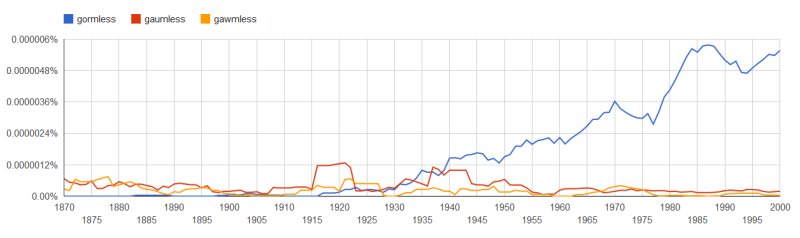 |
| click to enlarge - gormless,gaumless,gawmless 1870-2000 |
Did I ever look so stupid: so "gaumless," as Joseph calls it?... the "gaumless" / "gawmless" forms appear from the early 19th century in a number of northern English regional dialect glossaries and the occasional work of regionally-set fiction (Google search on "gaumless" OR "gawmless").
- Heathcliff
I thought for a moment I'd beaten the OED's first citation (1883) for the form "gormless" - Google Books produced a handful of earlier hits. But I soon found that the majority of 19th century hits arose from a murk of amusing optical character recognition errors, mostly for "germless":
- ... Addison's daughter by the Gormless of Warwick ...
- ... they would not be able to sit out-of-doors and enjoy the free and comparatively gormless air as already described.
- ... pots and kettles, timeless clocks, and gormless seeds ...
- ... if I could get him to spend twelve months in the unexciting but gormless atmosphere of our cottage hospital ....
- On the production of Fungi in gormless spaces
- Haeckel distinguishes in these works, for the first time, between gormless protoplasm, consisting only of plastids called cytods by him ...
- Schwann therefore, in another set of experiments, allowed the boiled (and consequently gormless) infusions to communicate freely with the atmosphere.
- ... and so on.
Addendum:
By complete coincidence, this ties in with the current Language Log post by Mark Liberman, Ngram morality. When Google Ngram Viewer was launched - see Google Books N-gram - wow! - one of the aspects that was hyped was its potential for "culturomics": quantitative research into social trends as reflected in language: this was outlined in the paper Quantitative Analysis of Culture Using Millions of Digitized Books (Science, 14 January 2011: Vol. 331 no. 6014 pp. 176-182).
This is a powerful idea, when the results are interpreted with a lot of caution (I described previously - When pufh comef to fhove - how an apparently robust pre-Victorian era when it was OK to use the word "fuck" in print is entirely an artifact of the word "suck" being printed with a long-s as "ſuck").
But as Professor Liberman and others have discussed, there are those, often seeking confirmation for some world-view, who are ready to wade in with no such caution. One of the dubious forms of analysis is the completely simplistic conclusion that the frequency of a concept mentioned in print is a direct indicator of how that concept applies in society. By that line of argument, the steady rise of "gormless" over the past century means society has become more gormless over that time.
Ngram morality looks at a current op-ed column by the NY Times pundit David Brooks, who applies precisely the same reasoning, based on several like-minded papers, to conclude that society is going to the dogs, as evidenced by the rise and fall of certain words.
Addendum 2:
Martyn Cornell of Zythophile has offered in the comments a theory on the rise of "gormless".
It may or may not be a coincidence that the rise of "gormless" begins at about the same time as the rise of BBC radio: could it be because Northern English comedians were introducing the word to southerners, who took it up with enthusiasm? More research needed ...This looks a very good start. I don't have any evidence of his using it, but the comedy persona of the immensely popular George Formby was regularly described as "gormless".
- Ray
Wednesday, 15 May 2013
Windows 8: inexplicable language
Windows 8: Beautiful and fast
Sorry to be a vector for viral marketing, but I just love these Windows 8 ads for the East Asian market, originally released under the collective title Windows 8 Training Camp (there is a third, Multitask, that's mildly amusing but rather flat compared to these other two, which make perfect use of the "rule of three" construction).
Windows 8: The power of touch
The humour being chiefly visual, they work perfectly well even if you don't know the language - except that it seems no-one does, not even people from East Asia.
Victor Mair analyses the language at Language Log - The enigmatic language of the new Windows 8 ads - and the article and ensuing discussion covers theories including its being some obscure minority dialect of Chinese; some East Asian language mangled by non-native speakers; ditto by illiterate local speakers contracted in cheaply; or some well-constructed Sino-gibberish, with a certain amount of Mandarin embedded, made to sound like an East Asian tonal language. All Microsoft has said of the videos is this ...
We created these online-only social videos for the Asian market, where they were well-received.... although they work so brilliantly minus language that even this is a trifle suspect; maybe they always were meant for the Western market.
- Ray
Saturday, 27 April 2013
Passing English - and James Redding Ware

It's extremely interesting reading. Unlike many compilations of now-historical slang, it isn't a retrospective view on slang terms that "made it" into established language, but a collection of ephemeral and highly local expressions, generally annotated by date and location. From an initial dip into the book, the majority of its wonderfully colourful expressions I'd never encountered before. For example:
Church a Jack, To (Thieves'). To remove the works of a watch from its case, and put them in another, of course with the view of destroying the identity of the article.The book is online at the Internet Archive: Passing English of the Victorian era (Ware, James Redding. Pub. London: Routledge; 1909. Internet Archive ID passingenglishof00wareuoft).
Devonshire compliment (W. Country except Devonshire). Doubtful politeness: e.g. Do 'ee 'ave this cup o' tea in the pot; t'ull on'y be thrawed away!'
Oysterics (Mid.-class, 1900-04 on). A coined word, suggesting hysterics, to satirize the panic in reference to oysters creating typhoid fever.
Pusserspock (Naval). Corruption of 'purser's pork' - bad, hard salt-meat, name being given to it because the purser was the purchaser.
Quartern o' Bliss (Low London, 1882). A taking small woman. Diminutive of 'Pot o' Bliss' - a fine woman.
James Redding Ware, the London-born author of the book, is also interesting. He's better known by his pseudonym Andrew Forrester, in which role he was a wide-ranging jobbing writer. His particular innovation was in writing stories of Miss Gladden, one of the first female detectives in fiction (though definitions vary): see The Female Detective (Paul Di Filippo, Barnes and Noble), and No1 in ladies' detective tradition back in print after 150 years (Alison Flood, The Guardian).
He also wrote many magazine articles, plays, at least one novel - The fortunes of the House of Pennyl: A Romance of England in the Last Century (James Blackwood, 1860), and a number of potboiling books, including The Road Murder. Analysis of this Persistent Mystery (1865), The Modern Hoyle; Or, How to Play Whist - Chess - Cribbage - Dominoes - Draughts - Backgammon, and Besique (1870, co-written), The Isle of Wight (1871), Before the Bench: Sketches of Police Court Life (1880), Life and Speeches of His Royal Highness Prince Leopold (1884), Wonderful Dreams of Remarkable Men and Women (1884), Famous Centenarians (1886), Mistaken Identities: Celebrated Cases of Undeserved Suffering, Self-deception, and Wilful Imposture (1886), and The Life and Times of Colonel Fred Burnaby (1886). And these are just the ones under his own name.
- Ray
Thursday, 14 February 2013
MWDEU gone from Google Books!

Alongside the full Oxford English Dictionary (which I can access via Devon Library Services) MWDEU is probably my favourite reference book. As the introduction says, it arranges in dictionary format a collection of "common problems of confused or disputed English usage" from a historical background and present-day usage. Despite being an American reference, it covers US and UK usage equally, and the neat aspect of it is that it's resolutely descriptive, often with page-long lists of citations to well-known authors to demonstrate that an allegedly wrong usage has actually been used widely by writers who knew their craft.
I've noted over the years a few examples:
- Its demonstration that a list of notable writers - Swift, Byron, Thackeray, Lewis Carroll, Robert Frost, Noam Chomsky - have used "if I was" for the hypothetical form where traditional grammar says it should be "if I were".
- The evidence of many respectable writers using the non-possessive form ("Do you mind me eating chips?") rather than the 'possessive with gerund' ("Do you mind my eating chips?").
The construction, both with and without the possessive, has been used in writing for about 300 years. Both forms have been used by standard authors. Both forms have been called incorrect, but neither is. - The evidence, with a long list of prestigious examples, of the use of "whose" for inanimate entities.
The notion that "whose" may not properly be used of anything except persons is a superstition: it has been used by innumerable standard authors from Wycliffe to Updike, and is entirely standard as an alternative to "of which the" in all varieties of discourse. - A description of the use of "off of":
"Off of" is an innocuous idiom ... that has been in use since the 16th century ... Ayres 1881 seems to have been the first to question the phrase ... It is an idiom that occurred naturally in the speech of William Faulkner, Flannery O'Connor, Harry S. Truman, and James Thurber, among others. If it is part of your personal idiom and you are not writing on an especially elevated plane, you have no reason to avoid "off of". - The evidence on preposition stranding:
recent commentators — at least since Fowler 1926 — are unanimous in their rejection of the notion that ending a sentence with a preposition is an error. - An analysis of the equal correctness, depending on register, of "It is me" and "It is I" (where traditional grammar says "It is I" is solely correct):
Clearly, both the "it is I" and "it's me" patterns are in reputable use and have been for a considerable time. "It is I" tends to be used in more formal or more stuffy situations; "it's me" predominates in real and fictional speech and in a more relaxed writing style. - On the use of "oldest" for one of two:
The rule requiring the comparative [for two] has a dubious basis in theory and no basis in practice. - Split infinitive:
the objection to the split infinitive has never had a rational basis. - The evidence for the use of "that" for people:
In current usage, "that" refers to people or things. - On the idea that it's wrong to use "can" to ask permission:
we are dealing with a pedagogical tradition. The "can"/"may" distinction is a traditional part of the American school curriculum. The fact that the distinction is largely ignored by people once out of school is also a tradition. - On the vague perception of wrongness that attaches to the verb "to get":
One of the more important verbs in English, "get" is handled with considerable diffidence in the handbooks. Part of the problem, as the handbooks see it, is the large number of vigorously expressive idioms get enters into; the "Choice English" — to use the term of Roberts 1954 — that college freshmen are expected to cultivate much prefers colorlessness to vigor. Vigorous expressions are often suspected by usage critics of being "colloquial" — that is, slightly improper in some way or other not easily specified. If you are writing with the idea of getting your point across, however, you will not avoid the rich fund of idomatic phrases with "get". - and so on ...
MWCDEU explains what actually occurs, shows you some of the evidence, tells you what some other usage books say, and then leaves you to make your own reasoned decision. It won't tell you either that you should split infinitives, or that you shouldn't. But it will give you a number of examples of writers who do, and point out that the construction has always occurred in English literature over the last six or seven centuries, and that nearly all careful usage books today agree it is entirely grammatical, and it will then leave you to decide.I'm not sure this is strictly true; though it's ostensibly neutral, at times its studied acerbic commentaries quietly drip with hostility toward the prescriptivist position. It's a delight to read.
I don't know why it's been removed from Google Books - perhaps too many people like me were using it rather than buying the print version? - but it's a loss.
- Ray
Addendum: Stan Carey has commented that he's told that the issue appears to be at Google Books' end. More on this later, perhaps.
Thursday, 31 January 2013
Exeter hosts National Dialect Day 2013
A cross-post from the Devon History Society: I've just been in correspondence with Bill Murray about this year's National Dialect Day. The weekend event - the fifth - will be hosted in Exeter.
From the site:
- Ray
From the site:
Devon is delighted to be hosting National Dialect Day 2013See National Dialect Day 2013 for ongoing details.
Now in its fifth year, the National Dialect Day, actually a whole weekend (!), will take place in the glorious county of Devon at the Barnfield Theatre in historic Exeter. We are looking forward to celebrating the diversity of our regional dialects on the 18th, 19th and 20th of October 2013. We hope that you will want to join us and will put these dates in your diary straight away!
And there’s a chance to win prizes! Have a look at the Competitions pages to see how you can win yourself (and your dialect) a trophy.
We’d love to hear from you in the run-up to National Dialect Day 2013 and there are opportunities for you to comment in lots of different ways on the site, please join in.
The competitions, whose entry details are on the site, are for the performance of a fie-minute piece - prose, poetry or song or a combination - in three categories: Devon dialect performed by the piece’s author, English region dialect performed by the piece’s author, and English region dialect piece from any source, modern or historic.
- Ray
Tuesday, 29 January 2013
Spammers' name blindness
I just had a Russian spam offering this:
- Ray
Let's try our chance to be together? I am a sweet and friendly Lady and my dream in life is to meet the favorite man for me. Thousands of miles dividing us, but this isn't an obstacle to my love... I want to be a loving wife, mother, keeper of the family hearth. My eyes are always shine. I am womanly, romantic, smiling and active. My favorite man should be attractive, kind and faithful. I hope that, we'll necessarily find each other.The alleged name of the spammer: Alderman R Jacobs. Isn't the delightful image dispelled by the thought of the portly Johnsonesque elderly man evoked by the name?
- Ray
Sunday, 27 January 2013
Chieftain o' the pudding-race

I completely forgot Friday was Burns Night; I like haggis a lot, and it's the one solid excuse in the year to eat it. As luck would have it, however - presumably down to the recent cold weather - I managed to bag a wild one perching in next door's fig tree.
A couple of haggis snippets. Firstly, it's worth reposting the haggis section from Ronald Wright's excellent A Scientific Romance, in the archaeologist protagonist David Lambert, via the HG Wells time machine, travels to 2500AD, and finds the only remaining occupants of a post-apocalyptic Britain to be a tribe of feudal and devoutly religious black Scots, who have an annual mystery play that conflates Christ's passion with Scottish tradition. Their iconography contains a white blond Jesus, whose role Lambert is conscripted to play.
On stage was a table spread with bread, jugs of palm toddy (a new one on me; antique Scotch wasn't the only tipple), and a central plate containing a dark trussed object like a Christmas pudding in bondage. The crowd swarmed at the edge of the platform: wild, eager, fanatical faces, a dark flood from the streets.This verse leads me to QI, and a nice translation anecdote.
In my nervousness, suppressed but not banished by draughts of usquebaugh, my lines deserted me. My eyes flew around in panic, alighted on the crowning ornament of the board. Not a Christmas pud. Nor, exactly, a paschal lamb. It was a haggis - the first - the first I'd seen in Nessie - and Burns came to my rescue. I got to my feet, beamed on the crowd with what I hoped was an expression of
Christly gemütlichkeit, summoned the best stage Scots I could, and stretched out my hand to the blob of dubious meat:
Fair fa' your honest sonsie face,
Great Chieftain o' the pudding-race!
Aboon them a' ye tak' your place,
Painch, tripe, or thairm:
Weel are ye worthy o' a grace
As lang's my arm.
The first stanza of Address to a Haggis is very well-known, but the poem's not often quoted in its entirety. Here it is:
Fair fa' your honest, sonsie face,In case anyone's still unclear what goes into haggis, a classic recipe (the first known to appear in print) is in Susanna MacIver's 1787 Cookery and Pastry.
Great chieftain o' the pudding-race!
Aboon them a' yet tak your place,
Painch, tripe, or thairm:
Weel are ye wordy o'a grace
As lang's my arm.
The groaning trencher there ye fill,
Your hurdies like a distant hill,
Your pin was help to mend a mill
In time o'need,
While thro' your pores the dews distil
Like amber bead.
His knife see rustic Labour dight,
An' cut you up wi' ready sleight,
Trenching your gushing entrails bright,
Like ony ditch; And then,
O what a glorious sight,
Warm-reekin', rich!
Then, horn for horn, they stretch an' strive:
Deil tak the hindmost! on they drive,
Till a' their weel-swall'd kytes belyve
Are bent like drums;
Then auld Guidman, maist like to rive,
Bethankit! hums.
Is there that owre his French ragout
Or olio that wad staw a sow,
Or fricassee wad make her spew
Wi' perfect sconner,
Looks down wi' sneering, scornfu' view
On sic a dinner?
Poor devil! see him owre his trash,
As feckles as wither'd rash,
His spindle shank, a guid whip-lash;
His nieve a nit;
Thro' blody flood or field to dash,
how unfit!
But mark the Rustic, haggis-fed,
The trembling earth resounds his tread.
Clap in his walie nieve a blade,
He'll mak it whissle;
An' legs an' arms, an' hands will sned,
Like taps o' trissle.
Ye Pow'rs, wha mak mankind your care,
And dish them out their bill o' fare,
Auld Scotland wants nae skinking ware
That jaups in luggies;
But, if ye wish her gratefu' prayer
Gie her a haggis!
A Good Scotch Haggies.
Make the haggies-bag perfectly clean; parboil the draught; boil the liver very well, so as it will grate; dry the meal before before the fire; mince the draught and a pretty large piece of beef very small; grate about half of the liver; mince plenty of the suet and some onions small; mix all these materials very well together, with a handful or two of the dried meal: spread them on the table, and season them properly with salt and mixed spices; take any of the scrapes of beef that is left from mincing, and some of the water that boiled the draught, and make about a choppen of good stock of it; then put all the haggies-meat into the bag, and that broath in it: then sew up the bag; but be fare to- put out all the wind before you sew it quite close. If you think the bag is thin, you may put it in a cloth. If it is a large haggies, it will take at least two hours boiling.- pages 72-73, Cookery and Pastry, 1787
The "haggies-bag" is the stomach, the "draught" offal - typically heart and lungs. Some modern haggis doesn't follow Mrs MacIver's use of beef meat, and uses offal alone, but the MacSween one, which I prefer and recommend, does.
Contrary to many claims, the origin of the name "haggis" is unknown. The OED says:
Etymology: Derivation unknown. The analogy of most terms of cookery suggests a French source; but no corresp. French word or form has been found. The conjecture that it represents French hachis ‘hash’, with assimilation to hag, hack, to chop, has apparently no basis of fact; French hachis is not known so early, and the earlier forms of the English word are more remote from it. Whether the word is connected with hag vb. [to cut, hew, chop], evidence does not show.
Streps. The devil they do! why now the murder's out:- Ray
So was I serv'd with a damn'd paunch, I broil'd
On Jove's day last, just such a scurvy trick;
Because, forsooth, not dreaming of your thunder,
I never thought to give the rascal vent,
Bounce! goes the bag, and covers me all over
With filth and ordure till my eyes struck fire.
Sunday, 23 December 2012
Scots cyberpunk
 |
| The Scottish archipelago as depicted Map via www.floodmap.net |
As SF, its genre is cyberpunk - "high tech and low life" - but with an unusual setting: an inundated Scotland in 2090 after God's Flood, a melting of the polar ice leaving only the highest mountain-tops above sea-level, most of the population living in Port, a floating megacity tethered to the sea-bed above the submerged Greenock. Disease is rife, from sun-induced skin cancer to the endemic "Mowdie", a virus that turns into a lethal form, "Senga", if carriers have actual sex (though virtual sex is possible in the cyberspace environment .
The protagonist is Paolo Broon, an ex-soldier who works as a "third-class cyberjanny", a kind of enforcer who retrieves data and captures errant employees for "Clart Central". His wife Nadia is incarcerated in a medical unit with Senga - a consequence of an affair with another unknown man. Paolo breaks from his routine life when Nadia's medical insurance runs out, losing the only legal routes to finding the DNA contact that can neutralise her virus. But he suspects that the contact is his estranged father, Diamond Broon, a vastly rich criminal mastermind incarcerated in a luxury prison, "Inverdisney", and resolves to seek him out. As it happens, Diamond - an ailing grotesque who has to be carried around by a giant Inuit bodyguard - is also seeking out Paolo, and via messages received through their respective shady contacts on VINE, their paths converge. Diamond escapes from prison to his luxury island hideout, But n Ben A-Go-Go, as Paolo, now pursued by keen young police lieutenant, swims 200km and braves the dangers of the arid 'Drylands' - sunstroke, renegade American survivalists, and mutant kelpies - to confront his father there.
I've delayed tackling But n Ben A-Go-Go for a long time because I thought it would be hard going: the unusual aspect of the novel I haven't mentioned so far is that it's written entirely in a vigorous broad Scots. A sample from the beginning, where Paolo is visiting Nadia in the Rigo Imbeki Medical Center:
Paolo’s ile-stoor resistant bitts squealed on the ceramic flair as he stepped back an glowered west alang Gallery 1083. It wis a summer Sunday forenoon the clatty end o January an the mile lang visitors’ corridor wis toom. A singil lawyer an her lycra-leggit secretary intromittit the silence, shooglin past on a courtesy electric caur. An indie-pouered germsooker jinked inconspicuously in and oot o Paolo’s personal space, dichtin up microscopic clart as it drapped aff his body.As it happened, it turned out to be very readable: about on a level with Russell Hoban's Riddley Walker and Anthony Burgess's A Clockwork Orange. The author does help us along. As he mentions in the slightly too earnest intro, it is to some extent written in a contrived Scots, where unfamiliar words and any number of neologisms - "stoorsooker", "incendicowp", and so on - are well-framed by context. But on reflection, I'd quite forgotten the degree of familiarity I have from childhood: my grandmother had Scottish roots, subscribing to the Sunday Post and getting me Oor Wullie and The Broons annuals every year (before the days when they anglicized the captions); and my stepfather's family were fairly broad Scots speakers. I think that whatever the context provided, it helps with But n Ben A-Go-Go to have some familiarity with Scots vocabulary: no amount of context will tell you that "coup" (a rubbish dump) is pronounced "cowp", not "coo".
A quarter mile doon, the wersh blinterin sun forced itsel in throu the UV filter gless at the corridor heid, illuminatin the faces an keek panels o the first fifty Omegas. An as he skellied intae the white bleeze, a troop o droid surveillance puggies advanced in heelstergowdie formation alang the corridor roof, skited by owre his heid an wi a clatter o mettalic cleuks, skittered awa eastwards doon the shadowy vennel. The toomness o the visitors’ corridor offered Paolo nae bield fae the buildin’s oorie atmosphere; Gallery 1083 wis an eerie airt wi or wioot passengers.
There's a certain level of pastiche to the whole novel. For anyone reasonably familiar with Scottish culture, it's hard not to associate Paolo Broon's name with Pa Broon of The Broons. And the portrayal of the floating city of Port has a lot in common with Megacity One in the SF comic 2000AD (which has considerable Scottish roots - see Scotland's influence on 2000AD's Judge Dredd). It has a similar style in its naming of buildings and institutions after contemporary figures; there's an Evelyn Glennie Music Faculty; a Lorne Gillies Square; and a sports team called Portic Thistle.
However, the novel isn't just an extended Scots joke. Its world is a very dark one, where a tropical storm can sink a city suburb, and characters are forced to unusual motivations: a tight legal system, and a powerful taboo about murder, constrain Paolo from any obvious and lethal solutions to his problems, and point up the sheer unpleasantness of his criminal father. Diamond's sole justification for refusing the DNA sample that will release Nadia from years of torment is "Ah am an awfie, awfie bad man".
If you like SF and languages, I highly recommend it.
 |
| Eurasis and Africa as depicted Map via www.floodmap.net |
- Ray
Wednesday, 3 October 2012
Fake prescriptive poppycock
 |
| Cosmo (a he-cat) and Phoebe (a she-cat) - or, being neutered, are they both it-cats? - are pissed off at my joke at their expense |
In honour of the long history of grammatical discourse being poisoned by bogus rules invited by peevologists, the MacMurray professor Allan Metcalf invites readers to come up with new but venerable-sounding bogus rules. See A New Contest, Centered Around Usage.
It's not great, but I came up with:
"He" and "she" are not appropriate as pronouns for animals; as they are of an entirely non-human class, all animals should be "it".I possibly could have woven into the yarn Cordwainer Smith's nice constructions to designate names of animal-derived underpeople in his Instrumentality mythos, where a prefix designates the animal origin: C'Mell is of cat stock, B'Dikkat of bull stock, and the eagle-derived E'telekeli.
If it's necessary to specify the sex, use either the precise and long-standing term for the particular animal of that sex ("Where is Kittikins? The tom is on the mat") or expand the definition ("Where is Kittikins? It, the male, is on the mat" - or "The he-cat is on the mat").
Addendum: Ever since I posted this, I've had a horrible nagging feeling that my rule is stupid enough for someone to have actually proposed it in real life. A quick search of Google Book suggests not. But the sexist personification rules for animal gender in Richard Hiley's 1837 English Grammar and Style are almost as silly when you think them through:
c. When speaking of animals, the sex of which is not regarded by us, we frequently assign to them gender suited to their particular characteristic properties. The strong and bold ones being considered the masculine, and the weak and timid of the feminine gender; thus, we say of the horse, that he is a useful animal; of the hare, that she is timorous.The mind boggles at the semantic difficulties in deciding if a particular species of animal is macho enough to be a "he".
d. Insects, small quadrupeds, birds, and fishes, are frequently spoken of as neuter.
- page 21, Richard Hiley, English Grammar and Style: To which is Added Advice to the Student, on the Allainment and Application of Knowledge, 1837
Hiley was a Leeds schoolmaster, with, like many authors of "me too" grammar books in the 1800s, no particular qualifications for commenting on English grammar other than wanting to correct what he saw as deficiencies in Lindley Murray's English Grammar. Although his aim was nominally descriptive, he nevertheless completely failed to understand fundamental linguistic points such as the inevitability of usage change. This led him to diss the grammatical correctness of earlier highly-educated and well-known writers, rather than recognising them as data points for the mainstream correctness conditions of their time, a century or more before Hiley was writing.
But, if a knowledge of Latin and Greek does induce a habit of correct English diction, how comes it to pass that the writings of many distinguished classical scholars of the last century are lamentably deficient in grammatical accuracy? Dr. Bentley is a well-known instance. Nor will it be difficult to point out numerous violations ot grammar in the pages of Addison and Swift. Who, in these days, would admire, as specimens of graceful composition, the once reputed elegant pages of Locke, Barrow, and Tillotson? Yet these men had, in addition to their classical attainments, frequented the best company, and had attended, as far as the low state of grammatical knowledge would then allow, to correctness of expression.- Ray
- preface, page v, English Grammar and Style.
Subscribe to:
Posts (Atom)