Sunday, 6 September 2009

Early spaceships: JJ Astor and Percy Greg


The combat with the dragons - JJ Astor's A Journey in Other Worlds

I recently mentioned searching for print citations for "spaceship". The 1894 one mentioned in the OED comes from JJ Astor's A Journey in Other Worlds. This book is online - Gutenberg EText-No. 1607 - and is not at all unreadable despite the cheesiness of characterisation and dialogue.

"Come in!" sounded a voice, as Dr. Cortlandt and Dick Ayrault tapped at the door of the President of the Terrestrial Axis Straightening Company's private office on the morning of the 21st of June, A. D. 2000. Col. Bearwarden sat at his capacious desk, the shadows passing over his face as April clouds flit across the sun. He was a handsome man, and young for the important post he filled--being scarcely forty--a graduate of West Point, with great executive ability, and a wonderful engineer. "Sit down, chappies," said he; "we have still a half hour before I begin to read the report I am to make to the stockholders and representatives of all the governments, which is now ready. I know YOU smoke," passing a box of Havanas to the professor.

Prof. Cortlandt, LL. D., United States Government expert, appointed to examine the company's calculations, was about fifty, with a high forehead, greyish hair, and quick, grey eyes, a geologist and astronomer, and altogether as able a man, in his own way, as Col. Bearwarden in his. Richard Ayrault, a large stockholder and one of the honorary vice-presidents in the company, was about thirty, a university man, by nature a scientist, and engaged to one of the prettiest society girls, who was then a student at Vassar, in the beautiful town of Poughkeepsie.
The main story concerns the trip of Professor (or Dr. - Astor can't seem to decide) Cortlandt, with his colleagues Bearwarden and Ayrault, to Jupiter and Saturn aboard the Callisto, a spacecraft propelled by "apergy" beams. What's immediately interesting is its vision of its 2000AD setting. As outlined in Chapter IV (Prof. Cortlandt's Historical Sketch of the World) and Chapter V, it's a very Green future making extensive use of wind and solar power, electric cars, gliding ornithopters, and so on, but a world with an English-speaking joint hegemony, split between the Americas and the British Empire. There's an ongoing project to reduce the Earth's axial tilt to reduce climatic extremes near the poles. The off-world section starts out in Lost World vein; the travellers land on Jupiter, where they have to fight off prehistoric beasts. But then it takes a mystical turn. On Saturn, amid more adventures fighting monsters, they encounter the spirits of the dead and have various instructive visions; Ayrault has an out-of-body experience that takes him back to Earth. Strange cross-genre stuff. The author JJ Astor is, by the way, John Jacob Astor IV, who died in the sinking of the RMS Titanic.

Anyhow, I was pleased to find a citation antedating the OED's by 14 years
"The Apergy once mastered, it was comparatively easy to anticipate and improve upon the ideas of a trifler like Jules Verne, and build a space-ship".
- A STRANGE JOURNEY, The Pall Mall Gazette, London, England, Tuesday, January 20, 1880; Issue 4652
found via 19th Century British Library Newspapers
This is from a review of Percy Greg's 1880 novel Across the Zodiac: The Story of a Wrecked Record (Gutenberg EText-No. 10165); the term doesn't appear in the novel itself. I've passed the citation on to the OED's Science Fiction Citations project. In some respects Astor's book appears to be strongly derivative of this: he definitely nicked the apergy propulsion idea. The storyline of Across the Zodiac is rather different, however; the "wrecked record" refers to a found account of an unnamed protagonist who has gone to Mars on a ship called the Astronaut - the first OED citation for this word. He finds the "Martialists" to be small but humanoid.
He was about four feet eight or nine inches in height, with legs that seemed short in proportion to the length and girth of the body, but only because, as was apparent on more careful scrutiny, the chest was proportionately both longer and wider than in our race; otherwise he greatly resembled the fairer families of the Aryan breed, the Swede or German. The yellow hair, unshaven beard, whiskers, and moustache were all close and short.
He subsequently marries a Martial woman, Eveena 1 but things go pear-shaped when he gets involved in a local power struggle, and fighting ensues. It's more or less a prototype for the "sword and planet" genre of Edgar Rice Burroughs' "Barsoom" novels. Neverthless, it's also technological - some Martial technology is well ahead of Earth's - and has mystical aspects such as telepathy. There's an extended description in Free Energy Pioneer: John Worrell Keely by Theo Paijmans, which discusses the cross-talk between other works and ideas of the time. Greg's Martial culture is essentially feudal, a system adopted after a failed Communist revolution, and appallingly sexist
...The advocates of female equality made a very hard fight for equal culture; but the physical consequences were perfectly clear and perfectly intolerable. When a point was reached at which one half the girls of each generation were rendered invalids for life, and the other half protected only by a dense stupidity or volatile idleness which no school punishments could overcome, the Equalists were driven from one untenable point to another, and forced at last to demand a reduction of the masculine standard of education to the level of feminine capacities. Upon this ground they took their last stand, and were hopelessly beaten. The reaction was so complete that for the last two hundred and forty generations, the standard of female education has been lowered to that which by general confession ordinary female brains can stand without injury to the physique. The practical consequences of sexual equality have re-established in a more absolute form than ever the principle that the first purpose of female life is marriage and maternity; and that, for their own sakes as for the sake of each successive generation, women should be so trained as to be attractive wives and mothers of healthy children, all other considerations being subordinated to these. A certain small number of ladies avail themselves of the legal equality they still enjoy, and live in the world much as men. But we regard them as third-rate men in petticoats, hardly as women at all. Marriage with one of them is the last resource to which a man too idle or too foolish to earn his own living will betake himself. Whatever their education, our women have always found that such independence as they could earn by hard work was less satisfactory than the dependence, coupled with assured comfort and ease, which they enjoy as the consorts, playthings, or slaves of the other sex; and they are only too glad to barter their legal equality for the certainty of protection, indolence, and permanent support."
One might suspect Swiftean satire, but this is undoubtedly the author talking. The Suffolk-born Greg (1836-1889) was a talented journalist who wrote prolifically, but turned increasingly flaky and "rabidly conservative" towards the end of his life. As the ODNB says:
In his youth Greg became known as a secularist, in middle age as a spiritualist, and in his later years as a champion of feudalism and absolutism. His violent opposition to the Unionist side in the American Civil War was made public in his History of the United States to the Reconstruction of the Union (1887) and earned him the reputation of political hard-hitter on the Penny Press. His more eccentric political and religious convictions were forcefully urged in two collections of his essays ... as well as in imaginative novels
Contemporary British papers were quite laidback about his works - The Graphic's obituary called his History of the United States a "meritorious history" - but Burton J Hendrick's 1939 Statesman of the Lost Cause - Jefferson Davis and His Cabinet says that Greg's "hatred for America knew no bounds, and his History of the United States is one of the most violent polemics ever committed to paper". That hatred was specifically directed at the Union, which he viewed as intolerant Puritans ganging up on the aristocratic south (see Normans and Saxons: southern race mythology and the intellectual history of the American Civil War). His 1880 novel Errant: A Tale of Latter-Day Chivalry and the 1883 Sanguelac ground the same axe, and even Across the Zodiac starts with a framing story involving a rude Yankee contrasted with the brave and courteous ex-Confederate officer who found the space traveller's account at the Astronaut's crash site. (Funnily enough, Burroughs' John Carter of Mars was also a Confederate officer).

Among Greg's other novels, The Verge of Night (1885) featured an embattled hero in the form of a Conservative politician whose father and wife try to commit him to an asylum for his political views. Ivy: Cousin and Bride (1881) is the nearest he wrote to a non-polemical novel; while it does feature a Tory journal editor, it's largely a human interest novel about the consequences when a man is forced to marry his cousin for the sake of family honour. Two collections of essays, The Devil's Advocate (1878), and Without God: Negative Science and Natural Ethics (1883), also expressed Percy's reactionary views; the first was satirical dialogues dissing modern developments of his era (such as universal suffrage, female suffrage, the pace of life, the Union), the second targeted agnosticism.

Addendum According to the narrator, Eveena "might possibly have completed her tenth year". No paedophilia is involved: a Martian year being about 687 Earth days, this makes her nearly 19 Earth years in biological age. Nevertheless, the narrator's attitude to her is distinctly parent-child and rather creepy: constant flirtation about chastising her. I vaguely wondered about the similarity between Eveena/Weena; a quick Google finds others who consider an influence on HG Wells likely (see Science Fiction Studies, #3, Volume 1, No. 3, Spring 1974, the HG Wells and earlier SF section, as well as Google Books).

Addendum 2 (July 7, 2010) Upgraded from comments: Bill Higgins - aka Beamjockey - kindly sent me a link to his weblog mentioning that Percy Greg has had a Martian crater named after him: see Hot Martian News: Craters Named for George Pál & Percy Greg. Thanks! Bill's post links to a shory obituary of Greg in The Academy and Literature, Volume 37, 1890, which confirms Greg's career and beliefs:

Mr Percy Greg, who died on Christmas Eve, was a native of Manchester, where he was born in 1836. His father was Mr. William Rathbone Greg, the well-known writer on social and economical questions. Mr. Percy Greg devoted himself to literature and journalism; and, after serving ou the Manchester Guardian, removed to London, where he wrote leading articles for the Standard and other papers. Some of his earliest work appeared under the name of Lionel H. Holdreth. Two volumes, entitled Shadows of the Past and The Spirit of Inquiry, were radical in their tone, as to both theology and politics. The list of books published under his own name is lengthy: Interleaves in the Workday Prose of Twenty Years (1875), The Devil's Advocate (1878), Across the Zodiac (1880), Errant (1880), Ivy, Cousin and Bride (1881), Sanguelac (1883), Without God (1883), The Verge of Night (1885), The History of the United States (1887). Mr. Greg was to the last a fierce partisan of the South in the war of the Secession, and the "Lost Cause " had no advocate on the other side of the Atlantic so warm and so implacable. Perhaps his best book is Interleaves—a little volume of verse that is very little known. Here too the Southern Confederacy is heroically sung; but, apart from these mistaken efforts, it contains "The Martyr of Doubt," "The Martyr of Faith," " Why should the Atheist fear to Die ?" " Thy Kingdom come," and "Hallowed be thy Name." These pieces are expressive of widely different sentiments; but all are marked by strong poetic feeling. The two last-named have been included in the recent Hymnal edited by the Rev. John Hunter. - W. E. A. A.
- Ray

Friday, 4 September 2009

Kells surprise!

Upgraded from out-takes: Researcher uncovers secrets of Kells 'angels'. This PhysOrg piece summarises Cisne J L, 2009, "Stereoscopic comparison as the long-lost secret to microscopically detailed illumination like the Book of Kells’" Perception 38(7) 1087 – 1103, whch postulates a simple stereo-viewing trick as the means for drawing the detailed illuminations in the famous Book of Kells transcribed by Celtic monks around 800CE. The abstract:

The idea that the seventh- and eighth-century illuminators of the finest few Insular manuscripts had a working knowledge of stereoscopic images (otherwise an eighteenth- and nineteenth-century discovery) helps explain how they could create singularly intricate, microscopically detailed designs at least five centuries before the earliest known artificial lenses of even spectacle quality. An important clue to this long-standing problem is that interlace patterns drawn largely freehand in lines spaced as closely as several per millimeter repeat so exactly across whole pages that repetitions can be free-fused to form microscopically detailed stereoscopic images whose relief in some instances indicates precision unsurpassed in astronomical instruments until the Renaissance. Spacings between repetitions commonly harmonize closely enough with normal interpupillary distances that copying disparities can be magnified tens of times in the stereoscopic relief of the images. The proposed explanation: to copy a design, create a pattern, or perfect a design’s template, the finest illuminators worked by successive approximation, using their presumably unaided eyes first as a camera lucida to fill a measured grid with multiple copies from a design, and then as a stereocomparator to detect and minimize disparities between repetitions by minimizing the relief of stereoscopic images, in the manner of a Howard–Dolman stereoacuity test done in reverse.

The Book of Kells, which lives at the Old Library, Trinity College Dublin, is iconic both as Christian and Celtic art, and central to the Celtic revival; there are plenty of images online, and many nice books with facsimiles (at the bookshop, for instance, we have a copy of the 1914 The Book of Kells / described by Sir E.Sullivan, and illus. with twenty-four plates in colours). But despite the exposure, the techniques to produce it are still an enigma. As the PhysOrg intro says:

The Book of Kells and similarly illustrated manuscripts of seventh- and eighth-century England and Ireland are known for their entrancingly intricate artwork -- geometric designs so precise that in some places they contain lines less than half a millimeter apart and nearly perfectly reproduced in repeating patterns -- leading a later scholar to call them "works not of men, but of angels".

The phrase comes from the Welsh historian Giraldus Cambrensis, referring in the 12th century to the now-lost Book of Kildare:

Fine craftsmanship is all about you, but you might not notice it. Look more keenly at it and you will penetrate to the very shrine of art. You will make out intricacies, so delicate and subtle, so exact and compact, so full of knots and links, with colours so fresh and vivid that you might say that all this was the work of an angel and not of a man.

I've often suspected that strongly myopic artists must have played a part. I've moderate short sight (I need -8.00D glasses) and find this gives a very useful "hi mag"mode for looking at things about 12cm away, enough for sub-millimetre detail such as halftone rosettes. I'm sure someone worse affected could manage the resolution of the Kells artwork. But Cisne's paper also notes that the Book of Kells shows this kind of resolution between duplicates of the same design, suggesting some means of visual comparison with a template. The mechanism is essentially that used when viewing random dot stereograms.

But precision aside, even at manageable size the complexity of Book of Kells designs is quite baffling, particularly the interlacings of Celtic knotwork. One handy fact - while I don't pretend to understand knot theory - is that some of it is self-working. If you draw a continuous loop, following it and assigning a simple over-under alternation at each crossing automatically assigns consistent interlacing (a feature known across multiple cultures). Forgive the crudeness of this diagram:


While I think that's pretty cool theory, the practice to produce aesthetically good designs requires astonishing powers of draughtsmanship, and the key and classic book is George Bain's Celtic Art: The Methods of Construction, originally published in 1951 to not much acclaim, but reissued in 1971 to become central to the revival of Celtic artwork. See Celtic Interlace; An Overview (Stephen Walker, orig. in Dalriada Magazine). Bain's contribution was to document Celtic art from standing stones and other artefacts, and reinvent low-tech humanly feasible algorithms for drawing them and creating original designs.


click images to enlarge

The above images show Bain's reconstruction and the original of a roundel featuring stylised and interlaced birds, beasts and plants from The Book of Kells, Folio 188r, Incipit to the Gospel of Luke. "Quoniam quidem multi" (see full page at Wikimedia Commons). The actual roundel is just one-and-a-third inches across.

For a bit about Bain himself, see Groam House Museum and George Bain - A Highland Homecoming.I'm sorry to say that he comes across as a somewhat irritating presence in the book. Quite apart from his evident dislike of the modern art of his time, his commentary has a rather tiresome tone, not uncommon with autodidacts with off-the-wall theories, to the effect that everyone else is closed-minded, especially those who acquired knowledge through academic routes

... By minds already stored with information, whether it be acquired by instruction of others or by dint of personal application, prospective books will frequently be rejected. What has been diligently attained is too often assiduously hoarded; and pride and envy co-operate with avarice to render the process of knowledge difficult and expensive
- Anonymous 1795 1

... holders of Art College diplomas ... resenting the introduction of the study of a form of Art of which they knew nothing...

The two above examples show the gross travesties of Pictish Art in Publications by supposed authorities that have been for the past fifty years the only source of information for Students and others in the libraries of every university and centre of art education in the civilised world.

... writers who have been blinded by the "classical" education that still claims to be the basis of all European artistic achievements,

Maybe he's right, but parading the gripe in his book doesn't do him credit as a person. I can't over-emphasise, however, his skill as an artist and draughtsman, and the remarkable body of design techniques he devised. After his death in 1945, his work was continued by his son Iain Bain, a civil engineer who revised his father's techniques to simplify areas dependent on intuition, and published books including Celtic Knotwork and Celtic Key Patterns.

To Bain, by the way, we owe every Celtic knotwork tattoo you've ever seen (many are ripped off straight out of his book).

1. Any ideas on source? It's a distinctive quote, but Google Books finds no sign of it. I suspect Bain made it up.

Addendum For those who can fuse crossed-eye stereopairs, here's one I prepared earlier. Click to enlarge, as usual.


- Ray

Monday, 31 August 2009

Vampires, lesbian and otherwise

In the previous post I mentioned Coleridge's Christabel. The story in brief: the virtuous Christobel goes into the woods to pray and encounters another young woman, Geraldine, who tells the rather implausible story of having been abducted by a band of rough men who brought her to the forest then ... went away. Taking pity on her, Christobel takes her to the castle of her dad, Sir Leoline. The dog, ominously, since dogs can detect evil, howls in its sleep. At bedtime, Geraldine goes all lesbian, then puts Christobel under a spell not to report that bit, only the abduction story. Next morning, Leoline arrives and is instantly besotted with Geraldine. His bard Bracy tells of a spooky dream he had of Christobel being in danger, but Leoline won't hear it, nor Christobel's warnings, which he takes as jealousy - and in any case Geraldine's spell zaps her into a trance that stops her explaining in detail. And there it ends.

I suspect whatever was going on with Coleridge was satisifed by writing the sexy bit, hence his failure to complete it. Tupper's Geraldine is bit ghastly, but provides a rationale in Geraldine being the daughter of an evil hag, Ryxa, and that she has it in for Christabel for stealing her boyfriend. A deal has been written about what Coleridge might have meant by Christabel (see Coleridge's "Christabel" and the Phantom Soul and Samuel Taylor Coleridge's Christabel: Vampires and Transsexualism) but it boils down to being the first lesbian vampire story. Geraldine may not drink blood, but she's certainly a psychic vampire of some sort. Christabel is widely credited as the inspiration for Sheridan Le Fanu's 1872 Carmilla. Apart from in turn inspiring Bram Stoker's Dracula, Carmilla herself inspired a long line of largely naff lesbian vampire movies of which the 2009 comedy thriller Lesbian Vampire Killers is the latest (for others see Top 10 lesbian vampire movies at Den of Geek). Wikipedia's Lesbian vampire article cites Vampires & Violets: Lesbians in Film (Andrea Weiss, 1993) - see review - in viewing the trope as a coded means of handling the taboo theme of lesbianism outside the heavily censored realm of social realism. I don't know. That seems plausible for early cinema, but the persistence into the period of exploitation genre doesn't seem to be anything as subtle.

This is mainly an excuse to segue into a list of my personal favourites in the vampire movie genre. Emphatically not Interview with the Vampire: The Vampire Chronicles (I found the film a drag and the Anne Rice book even more so), nor Bram Stoker's Dracula (highly competent as an adaptation but suffering from Hollywood's perpetual obsession to add backstory and upbeat endings). I've no opinion of Twilight or the original Stephenie Meyer book, having seen neither; but I'm happy to accept the recommendation by Olivia (who works here, and is not stupid) who tells me the book is very good, a thoughtful novel using vampirism as a metaphor for teenage alienation. The list, then, is of movies that break away from the usual vampire-movie fare. All of them, except Mr Vampire, weren't box office successes on initial release, but have since acquired cult status.

  • Mr Vampire (1985). A highly inventive comedy horror made in Hong Kong, merging martial arts, Chinese mythology and Western vampire tropes (for instance, sticky rice replaces garlic, and the vampires are hopping Jiang Shi). See trailer.
  • Near Dark (1987). The vampire mythos transplanted to modern rural US Midwest, with vampires (never named as such) as a travelling group of outlaws into which a farmboy is initiated when he is "nipped". It's directed by Kathryn Bigelow, who wanted a Western that broke away from convention, and the strong cast is drawn from James Cameron regulars (Lance Henriksen, Jenette Goldstein and Bill Paxton). Again, it's fresh and inventive: caught in a motel during a shootout, the band find themselves in deadly danger not from the police bullets but the shafts of sunlight let in by the bulletholes. See trailer.
  • Shadow of the Vampire (2000). A lovely conceit retelling Murnau's filming of the classic Nosferatu, in which Max Schreck (playing Count Orlok) really is the vampire he portrays. Murnau keeps this from his cast and crew with the fiction that Schreck is an obsessive method actor. See trailer.
  • The Hunger (1983). OK, a bisexual vampire is a central character, but that's incidental to this beautifully stylish, modern-set examination of the ennui of eternal life. It introduced me to Schubert's Trio in E flat, Opus 100, and I've yet to hear a better arrangement. See trailer.
  • Lifeforce (1985). Much ridiculed for actress Mathilda May's permanent nudity as an alien vampire, it bears not too much resemblance to its source Colin Wilson's novel The Space Vampires (itself drawing more than a little on AE Van Vogt's Asylum). Nevertheless, Lifeforce is a taut Quatermass-style SF thriller about an apocalyptic contagion designed to funnel life energy from the whole of London to feed the occupants of an alien spacecraft. See trailer.
I guess the trailers mostly count as examples for my "lurid" list in their invariable focus on the action sequences. The Hunger particularly is far less energetic a film than you'd imagine from its trailer.

(This topic surfaced from the sludge in response to twin themes of vampires and squid raised in the fossil squid story. The umbrella-like section of the alien ship in Lifeforce is rather clearly based on the tentacle section of the Vampire Squid. Its name, Vampyroteuthis infernalis - "vampire squid from hell", not to be confused with HG Wells' Haploteuthis ferox - is rather undeserved; while it's a bit scary in appearance, it's a marvel in its multiple adaptations to live in dark, cold, and almost foodless and oxygenless waters. See videos from Planet Earth and National Geographic).
- Ray

Google Books broken

The Oxford English Dictionary currently has the first citation for "spaceship" (aka "space-ship" or "space ship") as

1894 J. J. ASTOR Journey in Other Worlds I. vi. 93 ‘What sort of space-ship do you propose to have?’ asked the vice-president.

Suppose I want to investigate online texts to see if I can antedate this. It looks straightforward: go to Google Books, advanced search, and search for spaceship OR "space-ship" OR "space ship" with a date bracket 1800-1900. Here's the search. A few of the results:

  • Fodors Walt Disney World With Kids 2008. Kim Wright Wiley, 1899 [?]
  • Gravity from the ground up. Bernard Schutz. 1899 [No, this is a 2003 book]
  • Soviet Literature, Vols 1-4 - 1870 [except the found text refers to cosmonauts and astronauts, so the date is clearly wrong]
  • Sky Doll Spaceship 1, Canepa / Barbucci, 1899 [A modern comic]
  • The publishers weekly, Volume 162, 1873 [except the result refers to The Space Ship Under the Apple Tree (1952)

And so on. Some errors are so systematic that you can see what's happened. Hits for journal articles commonly give the journal founding date rather than that of the actual article. 1899 appears to be a standard placeholder for unknown dates. The problem, however, is sporadic. For example, researching the post on Victorian waterbeds last year, a similar search appeared fine - but knowing the possibility of error, I didn't trust the dates except when I could click through and confirm in the texts themselves (granted, this is what one should do for rigour when chasing citations, but the date errors shouldn't contaminate the initial search so much as to make it hard even to find candidate texts).

I've been noticing problems like this for some time, so I'm pleased to see Geoff Nunberg at Language Log tackling the issue: Google Books: A Metadata Train Wreck. Nunberg produces evidence - see his PDF presentation for the Google Books Settlement conference - that Google has been considerably slack in the processes for gathering metadata about its online historical texts (ie dates, categories, authorship, etc). For me, it's merely a nuisance; but it makes Google Books - despite being a marvellous resource if you're just generally seeking a text - pretty unfit for purpose for serious researchers such as historians, philologists and linguists. Nunberg is concerned that this should be the case for

what will probably wind up being the universal library for a long time to come, with no contractural obligation, and only limited commercial incentives, to get it right.

Addendum The comments to Geoff Nunberg's LL post are worth reading. Jon Orwant of Google has just added - with a generous admission that the metadata is indeed very faulty - a detailed analysis of Nunberg's examples showing that in the majority of cases the bad data was in the source information.

Addendum 2 I found an earlier citation for "spaceship", but via the 19th Century British Library Newspapers database.

"The Apergy once mastered, it was comparatively easy to anticipate and improve upon the ideas of a trifler like Jules Verne, and build a space-ship".
- A STRANGE JOURNEY, The Pall Mall Gazette, London, England, Tuesday, January 20, 1880; Issue 4652

This is from a review of Percy Greg's 1880 novel Across the Zodiac, concerning a trip to Mars. "The Apergy" is an energy source. See the update Early spaceships and Percy Greg.

- Ray

Saturday, 29 August 2009

Her worship the sheep-driver


As reported in the Express & Echo - Topsham alderman's sheep drive rights - Topsham Carnival Day events began with Mary Evans, recently elected an honorary alderman of Exeter, exercising the archaic right to drive sheep through the streets. What more appropriate a literary link than His Worship The Goosedriver, the lead story of Arnold Bennett's 1905 Tales of the Five Towns (Gutenberg EText-No. 13293).

The "Five Towns" are Bennett's fictionalised version of the towns (actually six) comprising the conurbation of Stoke-on-Trent: Stoke-upon-Trent, Hanley, Burslem, Tunstall and Longton became Knype, Hanbridge, Bursley, Turnhill and Longshaw. Bennett omitted Fenton because he felt it had less of a separate identity and thought "Five Towns" was more euphonious (for more about their context in Bennett's works, see Arnold Bennett - Son of Stoke-on-Trent).

His Worship the Goosedriver is a story about small-town political spin. After a session at the pub, Josiah Curtenty, Deputy Mayor of Bursley, gets into banter with a goosedriver and foolishly buys a flock of geese. Forced to drive them home himself, he leaves a trail of escaped and dead geese. The exploit becomes known around the Five Towns, so that when he is elected Mayor, he is nicknamed "His Worship the Goosedriver". But his ambitious wife, worried that this will affect his career, enlists the help of an ex-suitor to spin the goose escapade as a bet in aid of charity.

- Ray

Monday, 24 August 2009

Fossil squid ink story has whiskers

After 150m years as a fossil, Belemnotheutis antiquus takes up its pen (Simon de Bruxelles, The Times, August 19, 2009) is one of many "fossil squid ink" stories in the papers recently: the nice tale of a Jurassic belemnite fossil found in Wiltshire whose ink was so well preserved that it could be reconstituted and used for a drawing.

But ... this story rang distinct bells from my geology undergrad days, so I backtracked with Google Books.

One may thus draw pictures or write letters with squid "ink" and a squid "pen." Most remarkable of all, this is even possible with the ink and pen of fossil squids which lived millions of years ago.
- Bulletin of the Charleston Museum (1907)

The ink is not readily decomposed; onthe contrary it is occasionally found fossil in the rocks along with the remains of the animal which produced it. So well has it been preserved that in one celebrated instance a naturalist drew the portrait of a fossil squid with the sepia derived from its fossil, but not fossilized ink-bag.
- p363, The standard natural history, Volume 1, John Sterling Kingsley, Friedrich von Hellwald, Elliott Coues, 1884

It was discovered by Dr Buckland that in many specimens of fossil cephalopods, called scientifically Geoteuthis, i.e. Earth Squid, the ink-bag remained in the animal untouched by its long sojourn within the earth, and even retaining its quality of rapid mixture with water. A drawing was actually made by Sir F. Chantrey, with a portion of "sepia" taken from a fossil species, and the substance proved to be such excellent quality that an artist, to whom the sketch was shown, was desirous of learning the name of the colourman who prepared the tint.
- The illustrated natural history, Volume 3, John George Wood, 1863.

This tracks it down to the original account: see Dr Buckland's Bridgewater Treatise, The Monthly Review, Volume 3, 1836, for Buckland's report of the experiment, which was conducted in 1826. He probably got the idea from Elizabeth Philpot - a weathy Lyme Regis fossil collector who befriended the young Mary Anning - who also used the fossil sepia for drawings (see The Dragon Seekers: How an Extraordinary Circle of Fossilists Discovered the Dinosaurs and Paved the Way for Darwin, Christopher McGowan, Da Capo Press, 2002, ISBN 073820673).

A similar drawing, of the head of an ichthyosaur, was done by Henry De la Beche in 1834. See below: it's even captioned "Painted with fossil sepia".


Click to enlarge: image by "Cetae", Photobucket

So, the "sepia drawing" angle on the current news story is less radical than it appears. It's still interesting and a nice homage to the roots of modern palaeontology, but it's a pity that these precursors aren't credited. I've no idea if they were in the original BGS press release.

See The Fossil Treasure Hunt for the real story: the interesting rediscovery near Christian Malford, Wiltshire, of a deposit of fossiliferous clays, where conditions gave rise to remarkable preservation of soft tissue detail. 1 The so-called "Christian Malford Squid Bed" was discovered in the 1840s during the excavation of borrow pits dug for gravel during the construction of the Great Western Railway, and subsequently lost when the pits became flooded. See "Preserving the unpreservable: a lost world rediscovered at Christian Malford", UK, Philip R. Wilby, Keith Duff, Kevin Page & Susan Martin, Geology Today, Volume 24 Issue 3, Pages 95 - 98, Published Online: 6 May 2008.

PS: the fossil sepia drawing meme even turns up in HG Wells' 1895 The Time Machine:

In the universal decay this volatile substance [camphor] had chanced to survive, perhaps through many thousands of centuries. It reminded me of a sepia painting I had once seen done from the ink of a fossil Belemnite that must have perished and become fossilized millions of years ago.
- Chapter 8 (in which the Traveller explores the Palace of Green Porcelain) - spotting credit to Phil, TONMO.com forum.

Nor is this the only literary reference:

And the sweet milk of the heart's fountain,
Choked and crushed by a heavy mountain,
All curdled, and hardened, and blackened, doth shrink
Into the fossil sepia's ink.
- Geraldine, Martin Farquhar Tupper, 1838

This amazingly mixed metaphor of fossilisation, referring to the effect of jealousy, is discussed here in The Living Age. Geraldine is Tupper's continuation/sequel to Coleridge's unfinished poem Christabel.

1. NB: soft tissue detail - a number of creationist sites are enthusing about this find in the mistaken belief that the soft tissues themselves are preserved (implying the fossils to be recent). They're not; their structure is preserved, replaced by mineral - calcium phosphate. At least some of the mechanism for the surprising preservation in three dimensions of the solidified liquid content of the soft ink sac is known: check out the work of Larisa Doguzhaeva et al. It appears that the melanin in cephalopod ink rapidly reacts with water to form a solid under neutral or acidic conditions. See Oldest use of ink.

Addendum I knew the De La Beche ichthyosaur painting reminded me of something. It just surfaced: Salvador Dali's "Sleep".

- Ray

Sunday, 23 August 2009

EW Haslehust ... and artfight!

I couldn't reproduce the exact viewpoint, which is somewhere now in mid-air, the location of a no-longer-extant pier.

A rather nice image I just found online; a watercolour c. 1912 of the still-recognisable shoreline of Ferry Road, Topsham, by EW Haslehust, from Sidney Heath's Exeter (Blackie, 1912, Gutenberg EText-No. 24635). The picture was in the old Steam Packet pub, now Route 2; I'm not sure if it was the original or a good print, but I know the current owner of the picture, and will ask. I was interested in finding more about the artist, and the Times obit supplied the details:
Mr EW Haslehust, RI, RIBA, a prolific painter of landscapes in watercolour, died at Blackheath on July 3.

Ernest William Haslehust was the eldest son of William Henry Haslehust, of Lee, Kent, and was born at Walthamstow, Essex, in 1866. He was educated at Felsted and studied art at the Slade School under Legros. A man of wide interests, his recreations included gardening, carpentering, and the making of scientific instruments, and he belonged to a bewildering number of societies, both artistic and scientific. Besides taking part in the exhibitions of the societies of which he was a member, Haslehust was a regular exhibitor of water-colours at the Royal Academy. In 1932 a picture of his was given a place of honour in the water-colour section and was afterwards purchased by the Newport Corporation, Monmouthshire, for their public gallery. He is also represented in the permanent collections of Oldham, Bootle, Huddersfield, Lincoln, Sheffield, Swansea, Bristol, Port Elizabeth, Colombo, Vancouver City, and Auckland. He designed landscape posters for the LNER, and in 1932 a one-man show of his water-colours was held at the Greatorex Gallery. He also contributed 60 illustrations in colour to a book on "The Silvery Thames", and water-colours by him have been reproduced in the Illustrated London News, the Studio, the Tatler, and many other magazines. Haslehust was a capable landscape artist, chiefly in water-colour, with a good eye for a subject. Like most professed lovers of nature he was inclined to prettify his subjects, particularly in colour, but the clearness and directness of his method won professional respect and made him an excellent guide to the fumbling amateur. Haslehust was very prolific. He was probably most familiar to the general public as an illustrator of books in colour, having contributed pictures to no fewer than 36 volumes in Messrs. Black's "Beautiful Britain" series. Haslehust was not a great artist, but his work gave pleasure to a great many people. He knew his limited job thoroughly, and his scientific habit of mind enabled him to explain it clearly to others.
- Obituary, The Times, Friday, Jul 08, 1949
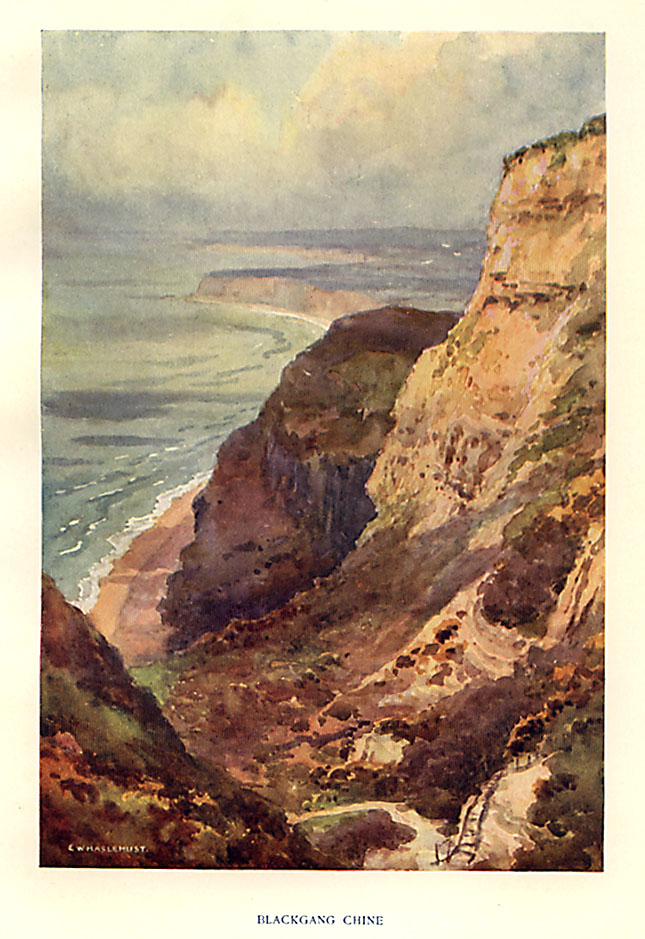
A number of the Blackie "Beatiful England" series ilustrated by Haslehust are on Project Gutenberg (the HTML versions include images) and the Internet Archive. Just dipping, I very much like his paintings of Branksome Chine, Poole Harbour, Chalk (the house where Dickens spent his honeymoon), Rochester from Strood, and Mol's Coffee House, Exeter. There are many more online - do a Google image search - such as this moody Folkestone - Above the Fishing Harbour in the collection of Auckland Art Gallery. The Picture Parlour, which sells prints on eBay, has a large collection of Haslehust topographic images: the Isle of Wight ones are interesting, such as Blackgang Chine while it still existed as a topographic feature, and Newport from the Medina, a surprisingly unprettified view showing it warts-and-all as an industrialised river port.

BTW, a number of sources mistakenly correct Haslehust's surname to "Haslehurst". It ain't: both the signatures on his paintings and the credits in multiple books he illustrated are "Haslehust".

Addendum Unsurprisingly, given the genre in which he worked, Haslehust was a traditionalist in art. Digging in newspaper archives finds a juicy arts controversy of the 1940s, when he was a co-signatory to a letter to the Times criticising CEMA (Council for the Encouragement of Music and the Arts - which became the Arts Council after World War II).
C.E.M.A. And Modern Art

Sir, - On February 15 a question was asked in the House of Commons [see Hansard] by Captain Alan Graham. It asked whether, in view of the poor quality and debasing effect of the pictorial art evinced at the exhibitions provided by C.E.M.A., the yearly grant from the Treasury to this institution of £100,000 could be reduced, or, at least, that any future financial support could be confined to the musical and dramatic activities.

We, the undersigned, are of opinion that Captain Graham has postulated a state of things true to the facts. For the most part the exhibitions comprise paintings devised to carry on the baleful influence of what is known as "modernistic" art. This is a subversive movement which, with its several "isms", has been for many years endeavouring to undermine the traditional glories of painting and sculpture, thus to lower the standards of artistic ideas and technical performance. The exhibitions alluded to in the question seek to promulgate these disastrous ideas by means of attendant lecturers engaged to persuade the public who visit these shows that the works they repudiate and protest against, orally and in the Press, are nevertheless admirable.

In view of the amount of public money spent on this promulgation of objectionable painting and sculpture, we declare ourselves in sympathy with Captain Graham's laudable attempt to amend the evil by the double means of reducing national expenditure and openly opposing the aforesaid organized activities for a lowering of art standards.

Yours, &c.
DY Cameron, Richard Garbe, Oliver Hall, Ernest W Haslehust, John Hassall, Robert Little, J Thoburn McGaw, AJ Munnings 1, Charles Pears, Frank O Salisbury 2, Frank Short, John Stirling-Maxwell
- The Times, Saturday, Mar 11, 1944
The letter got a robust response a few days later.
Sir, - The letter under the heading "C.E.M.A. and Modern Art" came as a shock. Of course the average age of the signatories of the letter must be biblical three score years and ten, but years do not seem to have added wisdom.

That at this date "modernistic" art should still be dubbed "subversive" shows that the childish mentality of Doctor Goebbels and his "Bolshevist bogy" is also prevalent elsewhere. The exhibitions organized by C.E.M.A. have done most excellent work in educating the public to think about and comprehend all phases of art, including the latest developments. Lecturers have told me that the public is keen and intensely interested (that is, at least, those under 50 years of age). The questions asked have been intelligent and the attendances constantly increasing.

The artists represented in the C.E.M.A. exhibitions have included all types now creating individual work in this country. The selection has been wide and catholic. There are various points of policy from time to time that one may disagree with, but the new effort of the Government through the Board of Education and C.E.M.A. should have the wholehearted cooperation of the artists of the country and not be crabbed by out-of-date criticism, based on no solid foundation, but on talk of subversion and "undermining the glories of painting and sculpture".

The so-called "modern" artists of to-day are genuine, sincere, creative painters whose work, however experimental it may seem to the narrow-minded experimentalist, is based on intellect and contains sound painting qualities of a far more subtle standard than most of the Victorians and Edwardians.
I am, Sir, yours truly,
RO Dunlop
- The Times, Wednesday, Mar 15, 1944
A bit of a fail on Godwin's Law there. But what a clash of cultures. Alan Graham must have been one of the last British MPs to use military rank as a title in civilian life, shades of the village squire; it'd be considered deeply ostentatious nowadays.

1. Sir Alfred Munnings. Wikipedia: "an outspoken enemy of Modernism ... Munnings was elected president of the Royal Academy of Art in 1944, a post he held until 1949. His presidency is most famous for the departing speech he gave in 1949, attacking modernism. The broadcast was heard by millions of listeners to BBC radio. An evidently inebriated Munnings claimed that the work of Cézanne, Matisse and Picasso had corrupted art".
2. Frank O Salisbury. Wikipedia: "His art was steadfastly conservative and he was a vitriolic critic of Modern Art – particularly of his contemporaries Picasso, Chagall and Mondrian".


Addenda:
August 2012: see Haslehust mystery painting.
November 2012: see Haslehust mystery painting #2.

- Ray

Saturday, 22 August 2009

BibliOdyssey: 1000 today

Via Ptak Science Books, I see that the gorgeous weblog of beautiful and/or eccentric illustration, BibliOdyssey has reached its thousandth post. "Peacay" a.k.a. Paul K, its unsung Sydney-based curator, is celebrating with a best-of list, such as Zoomorphic Calligraphy, Industrial Anatomy, The Visual Context of Music, Secret Rosicrucian Symbols and Dogs of War.

For general description and praise, see The Phantom of the Optical: An Online Illustration Trove ("BibliOdyssey gives entrée to a gorgeous and idiosyncratic gallery of rare art"), Damien B.M. English, Edutopia. There's also a book, BibliOdyssey: Amazing Archival Images from the Internet.
- Ray

Friday, 21 August 2009

Explosions

Among the M.O.D. heritage buildings open to the public at Gosport is the Royal Navy's former armaments depot of Priddy's Hard: the museum is called Explosion! The Museum of Naval Firepower. Not at all my kind of thing, but in Googling I ran into yet another book I want to read: The Explosionist (Jenny Davidson, HarperTeen, 2008, ISBN: 9780061239755).

A series of mysteries.

An explosion of truths.

The Explosionist: Someone sets off a bomb outside fifteen-year-old Sophie's boarding school, but no one can figure out who.

The Medium: Soothsayers and séance leaders are regular guests at her great-aunt's house in Scotland, but only one delivers a terrifying prophecy, directed at Sophie herself.

The Murder: When the medium is found dead, Sophie and her friend Mikael know they must get to the bottom of these three mysteries in order to save themselves—even as the fate of all Europe hangs in the balance.

The part I've omitted is that in the world of The Explosionist, Napoleon won the Battle of Waterloo. In 1938, when the novel is set, Scotland is independent and allied with the New Hanseatic League, which is comprised of Scandinavian countries and Russia. Spiritualism is a science. Oscar Wilde is known as the eminent obstetrician who invented the incubator. Freud is a crazy radio show host nicknamed "Thanatos". And so on. It looks great fun, and a skim of the extensive HarperTeen preview shows that it doesn't clumsily lay this this background on us in one information dump, but introduces it piecemeal through conversation and events, so that the reader is progressively drawn into a world that has diverged from our own.

Unlike most grown-ups, the professor did not tell Sophie that she was too young to understand the sort of thing she liked talking aboout, whether it was the theology of Count Tolstoy, the novels of Richard Wagner, the verse of Albert Einstein, or the operas of James Joyce

This is no mere substitution joke: these are feasible might-have-beens. Tolstoy wrote considerably on theology, Richard Wagner was a prolific writer, Einstein wrote poetry, and Joyce was "a passionate musician as well as a writer [who] grew up hearing his father sing opera arias and for a time aspired to become a singer himself" (Joyce's Grand Operoar: Opera in Finnegans Wake, Hodgart & Bauerle).

Must find it. It looks a fine example of what I've discussed on and off with Felix Grant of The Growlery: the sophistication of adolescent-readership novels these days.

Jenny Davidson's blog, The Explosionist, has ongoing links to discussion, reviews and news. This too looks fun: the forthcoming sequel is a loose retelling of The Snow Queen. Jenny Davidson, by the way, is an associate professor in the Department of English and Comparative Literature at Columbia University. She's written a previous novel, Heredity: see Clones, Criminals, and Plotted Sex, Andrew Lawless, Three Monkeys Online, March 2005.

Addendum Unfortunate, as discussed in the comments, that The Explosionist is only in hardback so far. From reading the intro, in which a school chemistry lesson on explosives is interrupted by a terrorist explosion, I strongly suspected allusions to Joseph Konrad's The Secret Agent, with its terrorism-by-explosion theme. A quick Google confirms that Jenny Davidson is well aware of the book: see The dynamite romance at one of her other blogs, Light reading, which recommends this Tom Armitage article about a forgotten genre that focused on dynamitards of the late 19th / early 20th century Illegalist anarchists and other political movements (this is the same era that gave us the cartoon stereotype of anarchist with bowling-ball bomb). Only The Secret Agent and GK Chesterton's The Man Who Was Thursday (both published in 1907) are generally known. Another is The Dynamiter (Gutenberg EText-No. 647, Robert Louis Stevenson and Fanny van de Grift Stevenson, 1887), a sequence of short stories about various characters connected by a bombing campaign in aid of Irish independence. Many more are listed and discussed in chapter 8, Dynamite romances of Barbara Arnett Melchiori's 1985 Terrorism in the late Victorian novel. Typical plots involved a young woman in love with a dynamiter and attempting to reform him through lurve, as in Matilda Betham-Edwards' 1885 The Flower of Doom and Grant Allen's 1886 For Maimie's Sake: A Tale of Love and Dynamite. This wasn't just an arbitrary fad: from the late 1800s into the early 1900s there was a cultural scare about dynamite - highly akin to modern post-9/11 paranoia and fear of suitcase nukes - following Fenian dynamite attacks on English cities in the 1880s, and the realisation of dynamite's portability

The 1867 attack on Clerkenwell Prison had involved barrels of gunpowder which, because of the amount needed to produce the desired effect, was an unwieldy substance for subversion. But with Alfred Nobel's inventions of dynamite in 1863, and the fulminate mercury detonating process in 1867, the possibility of carrying out successful, clandestine operations was greatly increased.
- Terrorism and modern literature, from Joseph Conrad to Ciaran Carson, Alex Houen, Oxford University Press, 2002. ISBN 0–19–818770–X

There's further discussion of the historical and literary context in "Homeland Insecurity: Dynamite Terror and the Textual Landscape of London", a dissertation draft by Sarah McLemore, University of California.

Addendum 2 Coincidentally, via MetaFilter, see the works of Evelyn Rosenberg, who makes ornate bas-reliefs by "detanography": a technique using plastic explosive to force metal on to a carved substrate. Swords into ploughshares again.
- Ray

Wednesday, 19 August 2009

Fortifications ... and Gosport

Thoughts around a couple of chance details crystallised into memories worth exploring. Firstly there was Quest for Kim's description of Lahore Railway Station whose on-the-surface-fanciful castellated design is functional; it was built after the 1857 Indian Mutiny to be defensible as a fort. Then there's Ptak's Science Books' Snowflakes and Fort Construction--Scamozzi & Palmanova, which mentions the remarkable "star fort" of Palmanova, Italy.

Though I didn't remotely understand it at the time, I grew up among similar structures, the relics of a Victorian Cold War. Portsmouth harbour - see map -


View Larger Map
is a strategic naval port, and was historically even more so. The Portsmouth side housed the dockyard; Gosport (where I was born) was a garrison town that also handled the infrastructure of victualling and materiel. The 1850s saw a particularly tense period in its history. According to The Story of Gosport (Leonard White, various eds. including Barrell, 1966)

During the 1850-60 period there was constant rivalry between England and France and the danger of open warfare with a French invasion was constantly in the minds of English service chiefs. The aggressive diplomacy of Lord Palmerston, the rise to power of Napoleon III and the frequent clashes of policy between the two countries led people to quote the famous words of the Duke of Wellington: "I am bordering on seventy-seven years passed in honour. I hope that the Almighty may protect me from being a witness of the tragedy I cannot persuade my contemporaries to take measures to avert". The tragedy he contemplated was a full scaled French invasion of the south coast.

As a result of such concerns, Palmerston (as First Lord of the Treasury - i.e. Prime Minister) instigated the 1859 Royal Commission on the Defence of the United Kingdom, which concluded that fortifications should be upgraded for key locations. One of these was Portsmouth Harbour, with an especial focus on securing the weakly defended Gosport side against attack from landward; the town had relatively simple ramparts around its core harbour section. The upgrade took the form of a line of forts across the full width of the peninsula. These, and their contemporary fortifications - see the Palmerston Forts Society - became later known as "Palmerston's Follies". They were built on a new design that replaced the former "bastion system" (essentially, star-shaped fort designs optimised for defence against close-range attack) in favour of the "polygonal system": heavily-armed low-profile forts also designed to prevent attackers getting close, furthermore arranged according to the "Prussian system" where adjoining forts provided each other supporting cross-fire. (See Fort Brockhurst and the Gomer-Elson Forts, David Moore, Solent Papers No. 6, 1990, ISBN 0 9513234 3 1).

How effective they would have been is moot, as is whether they were actually follies or provided a deterrent. The similarly-designed Belgian fortresses (such as Fort Liezele) didn't significantly impede German advance in World War 1 (they were vulnerable to the latest heavy mortars) which was why the French didn't bother to much defend the also similar Verdun forts.


View Larger Map

Most of the Gosport forts are still extant: No. 2 Battery, Fort Grange (now occupied by a football pitch and tennis courts - swords into ploughshares!), Fort Rowner, Fort Brockhurst (which is open to the public and used as a store for English Heritage reserve collections) and the overgrown Fort Elson (which is being allowed to decay, being inside an M.O.D. facility). There are a number of others to the north, such as Fort Fareham, which houses an industrial estate. A final one, Fort Gomer, the first of these new forts, was here; I just remember it, shortly before its demolition in the early 1960s for the housing estate where we lived. The only physical reminder of its existence is a cul de sac on the estate called Moat Drive, and the adjoining Gomer Lane (whose name pre-dates the fort).

Another of my early memories is of seeing steam trains at Gosport Station (which closed to traffic in 1969). This too has a history I didn't know: like that at Lahore, it was designed to be defensible, the only one of its kind in Britain. This design feature was the result of a lengthy dispute in 1840-41 over its building location: the Board of Ordnance considered it too close to the ramparts of the Gosport Lines, and so required it to become part of the defenses. See The Battle of Gosport Railway Station. The sea forts in the Solent must be unique too (see My Gosport); at low tide, the Isle of Wight FastCat ferry travels quite close to one, Spitbank Fort.

I must visit these places some time. They were enigmatic and inaccessible when I was a child, being M.O.D. occupied. Now that that role for the district has declined, many are open to the public. Looks interesting. In rather the same vein, I'll definitely check out June Hampson's "Daisy Lane" series. These are crime novels set in Gosport, starting in 1962 (when I was six and the town looked like this) and I'm rather taken by the in-joke of the heroine's name: Daisy Lane is a lane in Gosport. Judging by previews I've seen, the location is thoroughly authentic: Daisy runs a cafe that "encompassed the corners of North Street and North Cross Street". It's all redeveloped now, but as late as the 1960s, this was one of the scruffier areas of Gosport, still showing wartime bomb damage with large gaps and the adjoining houses braced with wooden supports. As the Orion Publishing interview reveals, it's based on a location where the author lived ("Daisy’s view was my view, even down to the ironmongers’ shop where she goes to get all her bits and pieces from"). I remember that, as well as the cafe, and the folksy radio spares shop in North Street, Speedy's, where I used to get wire to wind induction coils ("Speedy" wore a ghastly wig). The Fox Tavern still exists. (This section of the town is described vividly in Norman L Edward's autobiographical The Times In My Life, although a few decades before I or June Hampson knew it).

Compared to many places, Gosport seems not to have a great number of literary connections, whether as birthplace of authors or as a setting. That's a bit surprising, considering the scope for storytelling about its robust history as a port town, which gave rise to at least one shanty, "Gosport Nancy". However, it features as a location in Benjamin Leopold Farjeon's 1894 indictment of antisemitism, Aaron the Jew, of which the main character is a Gosport shopkeeper. Arthur Upfield (creator of the aboriginal detective "Boney") was born in Gosport, as was the novelist Lilian Harry a.k.a. Donna Baker. Rudyard Kipling would have known Gosport well in his later boyhood. As he wrote:

[Captain Holloway] ... with whom as a small boy I perambulated all Portsmouth, Gosport and Fratton
- Kipling and the Royal Navy, quoting letter of 22 October 1919, The Letters of Rudyard Kipling, Volume 4, Ed. Pinney

(This was "Captain Hollaway" of the Captain and Mrs Holloway in whose Southsea house Kipling lodged for six years and where, as recounted in a number of his books, he was psychologically abused after the kindly Captain's death). A number of literati were among the guests at Bay House (now a school) when it was a minor stately home in the mid-1800s; they included Jane Carlyle (wife of Thomas Carlyle, and a considerable writer in her own right), Tennyson, Thackeray and Macaulay. See Bay House: a nobleman's seaside residence, by Jane Lewendon. A further indirect novelist connection is that one of Jane Austen's brothers, Charles, lived in Gosport for a time.

Addendum: For something of the flavour of the town historically, check out the landscape artist Martin Snape, 1852-1930, who painted many locations around Gosport, Hampshire, about a century ago. Recording the changing scenes of the semi-rural creeks and shores around Gosport in the early 20th century, they have a gloomy atmospheric quality that, for me, evokes a spine-tingling nostalgia. The above site by Gosport Discovery Centre, which recently assimilated Gosport Museum, has 188 images in a searchable database, Snape Online. The Richard Martin Gallery, Gosport, specialises in local artists and keeps a biographical page. There are a few more on the Martin Snape page - largeish images - at My Gosport.

- Ray