Tuesday, 7 June 2011

Donald McGill Museum


Ryde, Isle of Wight (mentioned in passing, previously) is a place I normally never see except in transit; it being the FastCat terminus for Portsmouth, we're usually in a hurry, carrying luggage, en route to or from Newport. On our recent IOW visit, however, Clare and I fitted in a half-day there.

It's a slightly odd town. The sea-front is a long draughty north-facing promenade - with a beach that was very smelly when we visited, allegedly due to rotting seaweed - that hasn't altered in essence since the 1960s, and the very steep main street is mostly an unexceptional town shopping street with the usual complement of charity shops. There's a slight air of neglect, the paint peeling on deco and Victorian villas whose construction suggests a lot of smart money in the town - but a century or more ago. But amid all this, Ryde does have a degree of redevelopment, and a good selection of quirky and interesting independent shops; for example, in the refurbished Royal Victoria Arcade there are some good music, memorabilia and book shops (I managed to find a copy of Isle of White Ghosts III, which features my great aunt's house).

More or less opposite the arcade is another highlight: the Donald McGill Museum. It's behind the Orrery Café, which is interesting in itself for the giant grasshopper on the roof, the trompe-l'œil globe hanging outside (which looks like a mirrored sphere until you notice that it isn't reflecting you, and contains a Tyrannosaurus), and the Alice in Wonderland / astronomical decor done in association with Greaves & Thomas, the Ryde-based commercial globemakers.


McGill - see Wikipedia - was the classic exponent of double-entendre seaside postcard art, producing some 12,000 postcards.  The one-room museum behind the cafe documents his life and work from its successful era, via a nadir in the 1950s that saw his prosecution and police destruction of cards, to a modern revival where his original works are worth thousands of pounds. I'd never previously seen his wartime anti-Nazi propaganda cards, nor the homophobic ones that invariably depict gay men as wearing makeup, pageboy hairstyles and exaggerated Oxford bags trousers. Whether you find the works quaint and inoffensive by modern standards, or reflective of a ghastly era with multiple prejudices, the museum is very worth a visit.

Personally, I don't find them very troublesome; the redeeming feature is that everyone is insulted; for every card with a sexist depiction of women, you can find one depicting lecherous men as buffoons. George Orwell, despite not knowing whether McGill was a person or a house name, wrote an an astute analysis in 1941, "The Art of Donald McGill" (Wikipedia / article online) that argued McGill's work to be an authentic expression of an irrepressible side of working-class human nature that rebels against high-minded middle-class values.

Society has always to demand a little more from human beings than it will get in practice. It has to demand faultless discipline and self-sacrifice, it must expect its subjects to work hard, pay their taxes, and be faithful to their wives, it must assume that men think it glorious to die on the battlefield and women want wear themselves out with child-bearing. The whole of what one may call official literature is founded on such assumptions. I never read the proclamations of generals before battle, the speeches of fuhrers and prime ministers, the solidarity songs of public schools and left-wing political parties, national anthems, Temperance tracts, papal encyclicals and sermons against gambling and contraception, without seeming to hear in the background a chorus of raspberries from all the millions of common men to whom these high sentiments make no appeal.
...
They stand for the worm's-eye view of life, for the music-hall world where marriage is a dirty joke or a comic disaster, where the rent is always behind and the clothes are always up the spout, where the lawyer is always a crook and the Scotsman always a miser, where the newly-weds make fools of themselves on the hideous beds of seaside lodging-houses and the drunken, red-nosed husbands roll home at four in the morning to meet the linen-nightgowned wives who wait for them behind the front door, poker in hand. Their existence, the fact that people want them, is symptomatically important. Like the music halls, they are a sort of saturnalia, a harmless rebellion against virtue.


See the official museum site - www.donaldmcgill.info - for more background. The British Cartoon Archive has a couple of hundred McGill cards.

- Ray

Saturday, 28 May 2011

Richard Rosny

Continuing the Maxwell Gray project, I just finished her 1903 novel Richard Rosny, which is essentially a family saga focusing on the unhappy marriage of the protagonist, who is forced to give up his promising naval career and go into business to support his extended family.

The book begins with Richard at nine, an only child brought up by his mother Edith in the village of Wimbury. He's initially upset at her remarriage to the apparently OK Horace Belton, but gets over this when they're away on honeymoon; they move to a larger house called The Pines, Richard's favourite half-brother Gerald is born, and Richard grows up without much incident and joins the Navy. Horace, however, despite helping produce Richard's four other half-siblings, goes downhill over the next decade, graduating from just being careless with money via being brought home dead drunk to acquiring an opium habit.

At home on leave at 21, Richard gets a man-to-man talk with Godfrey Belton of the banking firm Belton (Horace's uncle), who warns him the Horace is a financial train wreck.  Richard's own uncle, Adrian Rosny, doesn't disagree. Thus warned, Richard returns to sea. On his return, he gets engaged to Kathleen (Kitty) Musgrave, the cousin of his navy friend Ronald Musgrave. His mum isn't pleased, but ultimately everyone accepts the match. Horace, however, is getting worse. He's started being violent, and spends Christmas sipping laudanum in his den as the rest of the Beltons enjoy a family gathering around the tree. Everyone starts wishing he would just FOAD, especially when Gerald reveals that he has been hitting Edith.

Various younger members of the Belton and Rosny families enjoy a fancy-dress ball, but Richard arrives late in a sulk, saying that he fell off his bike. The day after, he cycles to The Pines, to be greeted by the news that Horace has been found dead in the nearby gravel pit. The coroner says Accidental Death, and the Rosnys go into collective guilt. Godfrey Belton brings Richard worse news; Horace wasn't merely inept with money, but criminal. Due to his embezzlement, Belton, Laking & Co.; and the Rosny family are in major debt. But Godfrey has spotted  Richard's financial aptitude, and argues that it's in everyone's best interests that Richard should leave the Navy and join the firm. Richard meets Kitty on the downs. They've discussed something heavy we're not party to (though this being a MG novel, it's totally predictable that he must have killed his stepfather) and as a result Kitty breaks off their engagement.

Some years later, via a trio of rustic characters, we find that Richard took the offer he couldn't refuse, and has made a success of running Belton, Laking etc. and supporting his family. He's big in ship's biscuits and lifesaving equipment, and has even launched a chain of semi-temperance gastropubs. Now a care-worn 33, he visits The Pines and announces that he is engaged to Evelyn Arbury, the daughter of an old shipmate he met on the river at Richmond.

Richard and Evelyn are married at Wimbury, and they move into his childhood home there. From the start, Richard behaves like a total stiff, and spends all hours working, leaving Evelyn depressed and lonely. Things get worse when she finds Richard hasn't told her the new vicar's wife is his ex, Kitty, and he admits he married Evelyn on the rebound. Not unnaturally, when the charismatic Ronald Musgrave joins the local social set, Evelyn falls for him. Richard is too busy to notice anything going on - he's doing stuff like working and being a hero rescuing people from a shipwreck - but local gossip is thoroughly aware of several meetings between Evelyn and Ronald.

Enter Nancy Rosny, a young academic and relative, who's staying in the area with her professor sort-of-boyfriend Basil. She happens to overhear Ronald and Evelyn making plans to elope. Meanwhile, Richard's old rustic pal Gatrell goes to the mainland branch of Belton, Laking & Co. in "Shackleton" (ie Southampton) and tells Richard about the risk to his marriage. Richard gets on the steamer hotfoot.

Nancy meanwhile has turned sleuth, and shadows Evelyn en route to her assignation, bribing the fly driver so that Nancy gets to the steamer terminus first. There she confronts Musgrave with news of the death of another woman he'd promised marriage to, appealing to his better nature to let Evelyn go. While this is happening, Richard has arrived at the same terminus (he doesn't see them in the fog) and sets off to cycle the 15 miles to Wimbury, where he's devastated to find Evelyn gone. After getting Musgrave off the scene, Nancy intercepts Evelyn, who has been fuming en route as the fly driver removed fictitious stones from his horse's hoof, and persuades her not to leave. The next morning, the two women arrive back at Wimbury with the fiction that they went to a lecture and had to stay over. However, no-one's fooled, and Richard and Evelyn have to do some hard talking, both admitting their grave errors in not being open with their feelings.

At this inconvenient point, Richard gets a note from Gerald, saying "I have found the man". Gerald, in between army postings overseas, has been on a long-standing project to prove Horace's death to be suspicious. He's about to sic the police on an innocent bookmaker, so Richard is finally forced to admit that he did it. (He'd hit him, and Horace being a severely ill druggie, died).  It seems everyone except Gerald already knows. Richard argues that he's atoned many times: losing Kitty, suffering years of guilt, and compensating with bigtime philanthropy. Gerald nevertheless wants to settle it the legal way.

After some months, Richard returns home after six months doing hard labour for manslaughter, and is reunited with Evelyn. They get news that Gerald, estranged from Richard since it all came out, has been killed in the Boer War, but not before sending a letter forgiving him.

Richard Rosny has the whole toolkit of Maxwell Gray motifs: army/navy characters, a family dispute, a drunken head of the family, long-concealed crime, a Mary Sue in the form of the feminist academic Nancy, and a quick visit to the author's then home in Richmond. Nevertheless, I rather enjoyed it. The psychology of the main characters is very well-drawn, especially Richard's gormless state of denial about his poor marriage, and the syndrome of wanting someone dead then feeling guilty when it happens. There's a certain amount of pathetic fallacy - the big confrontation when Ronald asks Evelyn to leave Richard takes place in a storm - but MG has reduced her early habit of excessive purple landscape description.

While the location is less explicit than, say, The Silence of Dean Maitland, this is an Isle of Wight novel. "St Ann's", with its steep streets down to the esplanade and long pier with trams to the steamer terminus, is clearly Ryde.  The description of "Sandycombe" fits Sandown. There's a shipwreck at "Caster Cove" (undoubtedly Puckaster Cove). There's a good description of the Undercliff at what's evidently St Catherine's Point, and general distances and details (e.g. that there's a railway station, and it's about 15 road miles from Ryde) are moderately consistent with "Wimbury" being Whitwell.

- Ray

Wednesday, 25 May 2011

Tangrams: Hanzi Smatter?

Language Log just covered a 1700s-1800s example of "Hanzi Smatter", a generic term for use of faux-Chinese script in Western culture (the term derives from the weblog of that name).

That reminded of a probable example from my copy of Henry Ernest Dudeney's 1917 Amusements in Mathematics, which happens to be online both on Project Gutenberg and Google Books.


Discussing a correspondent's copy of an old Tangram book, Dudeney writes:

I reproduce the Chinese inscription [above, figure labelled 8] for this reason. The owner of the book informs me that he has submitted it to a number of Chinamen in the United States and offered as much as a dollar for a translation. But they all steadfastly refused to read the words, offering the lame excuse that the inscription is Japanese. Natives of Japan, however, insist that it is Chinese. Is there something occult and esoteric about Tangrams, that it is so difficult to lift the veil? Perhaps this page will come under the eye of some reader acquainted with the Chinese language, who will supply the required translation, which may, or may not, throw a little light on this curious question.

Addendum: I should have Googled more assiduously; Donald C Read's 1965 Tangrams: 330 Puzzles has an explanation. Read actually had a copy of the book in question, and found that the mysterious logo isn't on the cover, but on the second-to-last page.


Apparently it's just the caption to the illustration, saying roughly "Two men facing each other drinking. This shows the versatility of the seven-piece puzzle".

The Dudeney version appears to have undergone considerable degradation in copying; perhaps this explains the failure of Dudeney's contacts to read it.

- Ray

Monday, 23 May 2011

Best ever squirrel photo ...


... or at least the best I've ever managed to take. Clare and I regularly take a detour from shopping in Exmouth to feed the squirrels on Bath Road, the wooded parkland at the foot of the cliffs under the Beacon (see Google Maps). No special camera - just my inexpensive GE compact - but I managed to distract the squirrel with enough peanuts to get it in macro range.

I never get tired of Bath Road, with its restful sheltered parallel footpaths; it's one of the pleasanter parts of Exmouth seafront. William John Wesley Webb's 1872 Memorials of Exmouth mentions that the plantations and public walks on and under the Beacon are down to Exmouth's major benefactors, Lord and Lady Rolle.

The road name is a historical fossil from the late 1800s, when it led to a seafront bath-house owned and run by Thomas Burridge and Thomas Burridge Jnr. (according to the Rootsweb listings, the father was a master builder, the son a builder and the manager of a water company). Bradshaw's Shilling Handbook says the establishment provided both hot and cold baths. The building is now a pub, The Bath House (formerly called the Deer Leap). I can't immediately find much about its history, beyond it having been extensively developed; according to the pub-explorer entry:

One of the only original features remaining are two pillars behind the bar which formed the original doorway of the first building. Also, unseen underneath the Ladies and Gents toilets, are parts of the flooring and tiles from the baths.

- Ray

Friday, 20 May 2011

Arden v. Columbia Pictures

Last year - see Déjà view - I mentioned the contentious legal history surrounding Groundhog Day. Further to that, via the Paralegal Programs Blog, I've just been reading Arden v. Columbia Pictures Industries, Inc., 908 F. Supp. 1248 - Dist. Court, SD New York 1995, the summary of the case judgement arising when author Leon Arden brought a copyright infringement suit over the alleged plagiarism of his novel One Fine Day.

It's quite enlightening in explaining how a work may have close points of similarity without that constituting proof of copyright infringement. The details are complicated, but a key concept is that of Scenes a faire ...

- those elements of a work "that necessarily result from the choice of a setting or situation,"

For instance, if I set a story involving a man stranded on a desert island, scenes a faire might include his trying to catch fish, trying to break open a coconut, growing a long beard, trying to signal a passing ship, and building a raft. As they're highly likely developments from the scenario, I wouldn't be infringing the copyright of, say, Castaway. I suspected this would be how it worked, and I'm sure much the same applies if the core scenario is a person living the same day over and over: it's fairly predictable that any competent writer would have the protagonist trying to capitalise on the situation of having no consequences beyond the day (e.g. commit a crime, try to seduce someone, etc).

Given the existence of scenes a faire, the issue of plagiarism-or-not hinges on the differences between two works rather than the similarities, and the differences were what swung the decision in the Arden v. Columbia case.

- Ray

Wednesday, 18 May 2011

Letts: a relic

Shakespeare Memorial Fountain: Oct 29, 2011
I find the Blackgang Undercliff - see previously - fascinating for its post-apocalyptic flavour. What would Macaulay's New Zealander, wandering into an overgrown relic of civilisation amid geological desolation, make of an enigmatic and eroded plaque saying "-TAR AND THE RO-"?

As described at Chine Cats' page on Flickr, this is the now-dry Shakespeare Fountain. We know from records and old postcards that the inscription is actually from Two Gentlemen of Verona, Act 2, Scene 4: "The water nectar, and the rocks pure gold".


Behind it was a folly in the form of a Doric temple - see the British Listed Buildings entry Shakespeare Memorial in Grounds of South View, Chale - and both were built in the grounds of South View House, the residence of Thomas Letts, to commemorate the tercentenary of the birth of Shakespeare. The memorial is regularly mentioned in guidebooks well into the 20th century; it wasn't destroyed by landslip, but dismantled at some point post-1950. There are various rumours about where the bits went; Headley & Meulenkamp's 1999 Follies, Grottoes & Garden Buildings tells
Reports filtered through about destruction by 'some lads on scooters' and the subsequent removal of the remains to Godshill. Others said it was still there in the undergrowth but collapsed. The last report, however, was that it was, indeed, continually under attack by vandals, but the owner of the temple eventually took it down himself and removed it to a garden in Ryde, although the base is still in its place.
Thomas Letts was one of a number of Victorian enterpreneurs who acquired houses in the southern Isle of Wight's Undercliff (I've already mentioned Walter Spindler, of Old Park, and John Morgan Richards, of Steephill Castle). The others, however, lived on the mostly stable St Lawrence Undercliff. I've no idea if Letts was fully aware of the geological setup at Blackgang; there had been signs of instability with a collapse in 1799 that destroyed a farm called Pitlands, and further landslides in 1810 and 1818. His home too - Southview House - is long gone, but its adjacent coach house remained as the only significant intact building left standing in the slip zone until Christmas 2011, when it was destroyed by fire.

Letts was a stationer, part of the dynasty behind the still-extant Letts Diaries - a product so ubiquitous that we don't tend to think that at some point they were invented.  I can't really improve on the Wikipedia biography:
Thomas Letts (1803 – 1873) was an English stationer and printer who popularised the diary. He was born at Stockwell, London, the son of John Letts, a bookbinder and printer of the Royal Exchange. In 1816 his father published, ‘Letts's diary or bills owed book and almanack’ as the first commercially-produced diary, which Thomas developed into of dozens of differently-printed and bound, annual publications.

Thomas took over the family-owned company in 1835, printing a range of diaries that stretched from small pocket diaries to commercial foolscap folio one-day-per-page editions. Additionally, his factories at North Road, New Cross printed interest tables, specialist clerical and medical diaries, calendars, parliamentary registers, ledgers, and logbooks.

Letts' publications became ubiquitous, being used by many of the well-known Victorian writers and diarists who were well-acquainted with the product range. For example, writing in the Cornhill Magazine, William Makepeace Thackeray noted he preferred a Letts No. 12 diary.

Thomas was joined in the family business by his son, Charles, and together they raised capital for expansion into a limited company in 1870, trading as 'Letts, Son & Co.' However Thomas died soon afterwards, being buried in West Norwood Cemetery in a Grade II listed monument.

The public company lost direction and went into liquidation in 1885. Charles reformed the company privately as Charles Letts & Co., trading profitably for the next century. In 2001, Letts acquired the Filofax Group.
Thackeray's testimonial is impressive ...
Mine is one of your No. 12 diaries, three shillings cloth boards; silk limp, gilt edges, three-and-six; French morocco, tuck ditto, four-and-six. It has two pages, ruled with faint lines for memoranda, for every week, and a ruled account at the end, for the twelve months from January to December, where you may set down your incomings and your expenses.
- William Makepeace Thackeray, On Letts's Diary, Cornhill Magazine, 1862

... and gives a clue to the groundbreaking nature of Letts's products. Pre-computing, there was a vast demand for specialist data-keeping stationery, not just for record-keeping but appropriately structured for analysis of that data. Fortune's Epitome of the stocks & public funds (E F Thomas Fortune, 1851) has a full catalogue (page 322 onward), and it's amazing list of ultra-specialised products, with diaries in hundreds of layout formats, customised for trades such as clergymen and physicians, and for tasks from winecellar management to records of sermons.

Addendum: At the end of October 2011, I visited the Fountain - see On the lost road.

- Ray

Tuesday, 17 May 2011

IOW (3): Return to Blackgang

*
View Larger Map

... and so our walk ended at Blackgang. Near the southern tip of the Isle of Wight, the geology becomes more complicated, with higher cliffs and a succession of Upper Greensand rocks overlying soft clay.

Walking from Whale Chine toward Blackgang

The whole succession is easily eroded by streams, and two centuries ago Blackgang was the location of a "steep gaunt ravine", Blackgang Chine, which features in many contemporary prints. For instance, there's this image in George Brannon's 1840s Brannon's Picture of the Isle of Wight (The Expeditious Traveller's Index to Its Prominent Beauties & Objects of Interest. Compiled Especially with Reference to Those Numerous Visitors Who Can Spare but Two or Three Days to Make the Tour of the Island), and the excellent "Black Gang Chine, Isle of Wight" drawn and engraved by Charles Cousen, published in The History of Hampshire, 1869.

The Victorian entrepreneur Alexander Dabell saw the opportunity in 1842 and opened what was probably the first British theme park, charging an entrance fee to see the chine and the skeleton of a beached whale. The park still exists - see its website - with a continued succession of ownership by Dabell's descendants, and its entrance has long been guarded by a giant smuggler (below), alluding to the possibly exaggerated connection of the the chine with smuggling. Its flavour I recall from childhood was quaint and rather dry - there was a whale skeleton that formed the ceiling of the curio room, peepshow machines showing innocuous things such as the inside of an ants' nest, a wishing chair, a "electric shock chair" (I never had the nerve to try it, so have no idea if it genuinely shocked you or simulated it with vibration), and, chiefly, gardens and scenic paths. But over the latter part of the 20th century it has focused more on appeal to children with themed rides and entertainments. YouTube has some nice footage of the park approximately in the era I remember: 1960, 1965 and 1966

Entrance to Blackgang Chine theme park

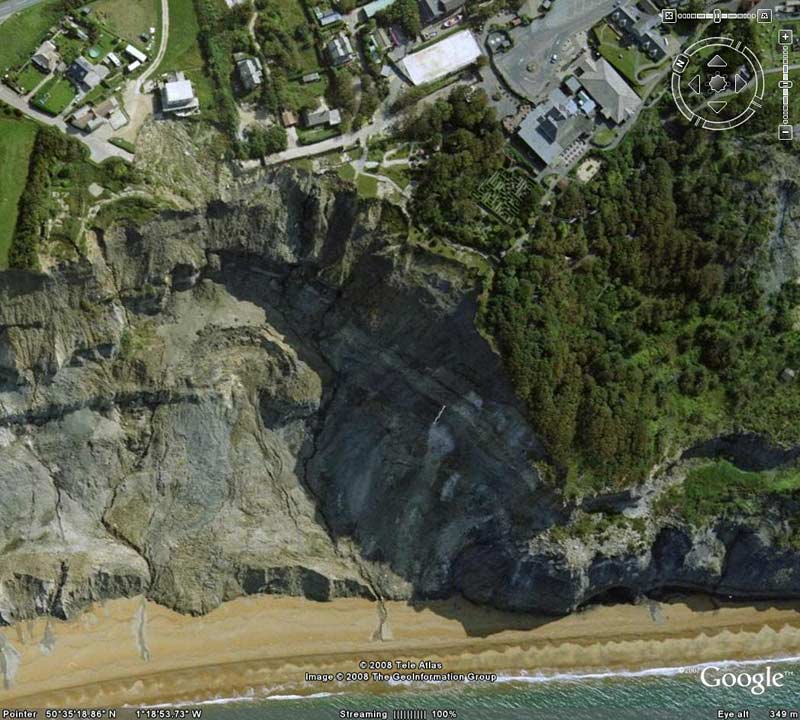
However, the geology - hard rock over soft clay - also means that Blackgang is an active landslip zone. Over two centuries, and particularly the 20th, the chine has eroded away entirely, as has a large portion of the adjacent land belonging to the park (see the Google Earth aerial view). The owners, understandably, have added a string to their bow with an inland park, Robin Hill, but have also incorporated the process of coastal destruction into their theme with a more adult-focused presentation, Blackgang: The Disappearing Village.  We didn't have time to go in, but made do with a restful moment feeding bread to the crows on the tearoom lawn.

One place I did want to explore was the east side of Blackgang, where a lane leads down from the theme park entrance. Originally this was a low-level route east, connecting with the "Sandrock Road" to Niton, but it was broken by a landslip in 1928. However, for many years after, the Blackgang end was largely intact, a track across a small landslip giving access to a section of road running through woods at the foot of Gore Cliff for half a mile or so. I just about remember this from childhood. But much of this section was obliterated in a major slip in 1978; there's a good map on page 191 of Slope stability engineering: developments and applications (1991), and the paper starting at page 189 - The recent history and geotechnics of landslides at Gore Cliff, Isle of Wight - is an interesting overall account.

The end of the road

It's very different now. The lane descends just a few hundred yards before narrowing to a path, still on overgrown tarmac, then the tarmac becomes cracked, and shortly you reach the cliff edge, with the last piece of road still showing its double yellow "no parking" lines. There is a rough footpath leading on over the slipped rock into a typical jumbled and overgrown undercliff landslip; unfortunately we didn't have time to explore further. I've seen undercliff areas before, but I found it quite chilling to see such literal erasure of a whole landscape I remember.

Gore Cliff and the Blackgang Undercliff

An intriguing aspect is that if you look at Google Maps (here) you can see that within the disrupted landscape of the Blackgang Undercliff, beyond the 1978 slip, there's an isolated section of woodland with the road intact, and signs of buildings and caravans. Time apart, we weren't kitted out to cross the landslip and investigate, but a number of explorers have done so, and documented it on YouTube (it reminds me of Pripyat). There are a number of unusual points, particularly the Shakespeare Fountain, which was in the grounds of Southview House - the nearby temple is gone; and the remains of a nudist holiday camp, The South View Sun Club, with quaint murals. See Blackgang Chine abandoned village & landslip exploration; Blackgang Chine,The Lost Village, I.O.W; and Walking over the lost Blackgang Road, Niton Undercliff, IoW, July 2006 (below).


Note: this post is an update to The disappearing Chine, August 2008.

Addendum: I've mentioned Mimi Khalvati's poem The Chine a couple of times. Sorry to mention it again, but every time I read it I find more layers; it encapsulates so powerfully the "double exposure" experience of returning to a place changed by time, and all the more so for being the same kind of place that's in my own early memories. It's online in full here (scroll down - it's below the French translation) at Poezibao, Florence Trocmé's online poetry journal.

Addendum 2: At the end of October 2011, I revisited the Blackgang again, and did the walk into the Undercliff - see On the lost road.

- Ray

Monday, 16 May 2011

IOW (2): Llamas and chines

Looking across the "Back of the Wight" from Pyle toward Tennyson Down
Despite the relative smallness of the Isle of Wight, the south-western coast - the "Back of the Wight" - retains quite a degree of isolation. The coastal A3055 (aka Military Road) has no regular bus service, and there are no shoreline villages because the sandstone plateau between the chalk downs and the sea ends abruptly at a crumbly 150-foot cliff. From the shape of trees and bushes you can see how windswept it can be - the coast has a long history of shipwrecks - but last Friday was clear and sunny with a light onshore breeze, and Clare and I managed to get sunburnt as we rambled from Chale Green down the lanes via the hamlet of Pyle to the coast, then along the coast path to Chale and Blackgang (see Google Maps).


Where the lane from Pyle meets the Military Road, we were pleased to make the acquaintance of Bruce (above) and his colleagues Manuel, Ebenezar, Kipper and Spotty, who all work for Wight Llama Treks. From there, it was a short walk to the coastal path.  Due to a nicety of geology, coastal erosion rates and stream flow, this section of cliff is cut by a succession of chines, sharply-incised miniature ravines.

New Chine (crossed-eye stereopair)
click to enlarge

Most of them, such as the above New Chine, are quite small, but Whale Chine is the most spectacular: a deep vertical slice that cuts almost to sea level down through the clifftop farmland.


View Larger Map


I've been here once before, around 40 years ago, on a geological tour with a schoolfriend. I remember that visit as being on an overcast drizzly day with seaspray blowing up the chine, and the wooden steps down to the beach dangerously slippery. Now, it's much greener and brighter than I remember, but the steps are in disrepair (temporarily, according to the notice at the top) and you can't get down at all. Mimi Khalvati's poem The Chine - quoted previously - although written about Shanklin Chine, seems very fitting:

Every childhood has its chine, upper world
and lower. Time itself seems vertical
and its name too implies both bank and stream.
To be back on the island is to walk
in both worlds at the same time, looking down
on talus, horsehair fern notched through the Ice Age,
Stone Age, Bronze Age and still here at our heels;
...
Every path brings us back to the beginning.
Shanklin Chine is closed for the winter, both ends
barred with notices. But the mind is not.
Or memory. And time is spinning backwards
with the mainland out of sight and the great plain
where herds roamed the floor of the English Channel
and were drowned by it flush again with valleys.

- from The Chine, Mimi Khalvati

- Ray

IOW (1): Oddfellows


Clare and I just spent a few days in the Isle of Wight to go to my father's 80th birthday party, and as usual, multi-tasked: we visited relatives in Newport and Carisbrooke, we got in some walking, and I pursued a few Maxwell Gray leads. In aid of the latter, while passing through St Thomas's Square (Newport's central square around St Thomas's Church, a.k.a. Newport Minster) on impulse I dropped into Unity Hall, the Vecta Lodge of the Newport branch of the Oddfellows Friendly Society.

I was specifically interested in the possibility that they might have group photos of members, as I've been looking for a photo of Frank Bampfylde Tuttiett (MG's father, who was a long-standing member of the Oddfellows, being lodge surgeon for the Earl Yarborough Lodge (the old name of the Vecta Lodge - I assume the name refers to Charles Anderson Pelham, Earl Yarborough, 1780 - 1846, who is commemorated by an obelisk on Culver Down).  Dr Tuttiett is mentioned several times in the Oddfellows magazine in the late 19th century, mostly for his attendance of anniversary dinners for the Earl Yarborough Lodge, including one in April 1887 when he was toasted for having filled the office of surgeon for 43 years to the satisfaction of all.

The Vecta Lodge did indeed have group photos, but unfortunately none for the 1800s. However, the visit wasn't wasted, as Prue Osborne, the Secretary, extremely kindly showed us the meeting rooms. A notable observation was that the Oddfellows seem to have been considerably ahead of their time in having female members and officers at the beginning of the 20th century.

In the 19th century, the Earl of Yarborough Lodge must have seen some highly sumptuous junkets. You can get the flavour from this account of its 32nd Annual Dinner at the Star Hotel, Newport, in the Hampshire Telegraph for March 17, 1866:

The table was most excellently and liberally supplied with the good things of this life, doing the greatest credit to the landlord (Mr M Newman). The table having been cleared, the following toasts were given and received enthusiastically, being occasionally interspersed with good songs (accompanied on the pianoforte by Mr Mew) - "The Queen", "Prince and Princess of Wales, and the rest of the Royal Family", "Army, Navy, Milita and Volunteers", "Board of Directors and the M.U.", "I of W. District", "Early Yarborough Lodge and the Presiding Officers", "The Honorary Members", "The Surgeon, F. B. Tuttiett, Esq.", "The Secretary, Mr. William Sutton," "The Relieving and Visiting Officers", "Kindred Societies", "The Sick Brothers", "Trade of the Island", "The Host and Hostess", "The Press", "The Chair and Vice-Chair".

That's a lot of toasts. But the society had more a serious role than annual booze-ups; in the days before the National Health Service, subscribing to such sub-Masonic membership organisations provided support for members at times of hardship: medical care, sickness and accident insurance, funeral expenses, and so on.

Oddfellows logo and motto:
Amicitia, Amor et Veritas
(Friendship, Love and Truth)
As described in History of the Oddfellows  / Oddfellows over the years and The Rise and Progress of the Manchester Unity of the Independent Order of Oddfellows, 1810-1904, the Oddfellows have a long history, with various schisms; it's also a surprisingly controversial history. In the paranoid years of the late 18th century, when the government saw any kind of labour solidarity as a precursor to revolution, membership was criminalised. Even in the early 19th century, friendly societies were seen as an attack on landowners' and employer's interests, and the Oddfellows had to alter their practices to avoid the same scammy use of a 1797 law against oath-taking organisations that had been invoked against the Tolpuddle Martyrs.  For more background, see Behind closed doors: the power and influence of secret societies (Michael Streeter, New Holland Publishers, 2008).

The Vecta Lodge is a branch of the largest present-day incarnation of the Oddfellows in the UK, the Manchester Unity Order of Odd Fellows, which celebrated its bicentennial in 2010.  In the heyday of the Oddfellows, the late 19th century, there were several lodges on the Isle of Wight including the Earl Yarborough, East Medina (based in Ryde), Northwood (in West Cowes), Hambrough (in Ventnor), and Culver (in Sandown). The Vecta in Newport is the only remaining on the Island.

- Ray

Wednesday, 11 May 2011

Behind Barnacle Bill


Via a Yahoo! Answers enquiry, I just dug up some background on the Blue Peter theme (the earliest - 1958 - embedded above). A hornpipe-style piece called Barnacle Bill, it's a very popular fixture of the 'Proms' concerts (it was played 24 times in the decade 2000-201) and I'd always assumed it to be trad - but on reflection most of it is far too chromatic and "English light classical" in style. There is a trad song called Barnacle Bill, a bawdy American drinking song derived from a precursor called Bollocky Bill the Sailor - check out this clean version by Sourdough Slim. But no, the Blue Peter Barnacle Bill turns out to be a fairly modern composition by a Herbert Ashworth-Hope.

While the main motif is original to Ashworth-Hope, the introduction is clearly a quotation of the traditional tune variously known as The Sailor's Hornpipe, The College Hornpipe or Jack's the Lad.  Any number of composers have similarly quoted it, such as William Walton in the Hornpipe segment of the 1923 Façade (see williamwalton.net for lyrics) and in the extremely catchy Hoagy Carmichael & Orchestra foxtrot version of Barnacle Bill the Sailor.

Ashworth-Hope (maybe 1880 - July 11th 1962) looks to have been an interesting polymath. Collating various music library and newspaper sources finds him to have been a successful solicitor and company chairman with several offices around the north-west of England. For part of his career he worked overseas with interests in tin and rubber; he was also one of the co-founders of the still-extant Gibb & Co. There's a photo of him - here, lower left - in Arnold Wright's Twentieth century impressions of British Malaya.

He ... returned to retire in Somerset in the 1930s to a home large enough to have a music-room that the BBC in the West used for broadcasts of concerts featuring the likes of Campoli and others. For the last years of his life he regularly watched Blue Peter marvelling perhaps that a harmless little hornpipe he had written in the 1930s would become as familiar to the nation as the National Anthem itself.
- Philip Lane, Naxos.com

Ashworth-Hope's home was the now-listed Marston Court in Marston Magna, Somerset. In fact he did anything but retire on his return to England, and he became chairman of Malayan Tin Dredging Limited and Southern Malayan Tin Dredging Limited, companies prominent in the 1930s-1950s. Barnacle Bill was just one piece in his small but solid corpus of light musical compositions: there are 25 on the Boosey & Hawkes list.

- Ray