Monday, 16 July 2012

This goodly frame, the earth

Globus Biler globe, Silkeborg, Denmark
image by Thomas Bredøl, reproduced under
Creative Commons Attribution 2.5 Denmark license.

On the subject of monumental constructions, I'm just in the process of purging my old blog, The Apothecary's Drawer, of posts that have succumbed to link rot, and rescued this.


This goodly frame, the earth

What's the world's biggest globe of the world? Depends what you mean. For sheer size, it's the Unisphere at Flushing Meadows-Corona Park, Queens, NY: "one of the few remaining artifacts from the 1964-65 New York World's Fair". Ingo Gunther's Exosphere sculpture (bigger images here) may be the largest suspended globe, although it's not representational. Another contender, which I don't know much about, is the Globus Biler (Globe Cars) globe pictured above; a converted gas tank at a car dealership in Silkeborg, Denmark. You might count buildings, such as the Ericsson Globe (formerly the Stockholm Globe Arena - billed as "the world's largest hemispherical building") or Mira on the Living Mall, Taipei, the largest spherical department store.

But if you bring in the proviso that it must turn and be a naturalistic representation of the world, since 1999 (when it was officially accepted by the Guiness Book of Records) it's been the 42-foot Eartha, the "World’s Largest Revolving / Rotating Globe" built by Maine mapmaking firm DeLorme (more on the background at PC World: Building the world's biggest globe).

This is unfortunate for Orfeo Bartolucci, the craftsman who constructed the previously largest revolving globe, as his story is in many ways the most interesting. He built the 33-foot "Mappamondo della Pace" ("Globe of Peace") over a period of six years near the small Italian town of Apecchio.

Mappamondo della Pace, Apechie, Italy
Public domain image by "Wolfra", Italian Wikipedia

I've taken the liberty of posting a translation, as best I can manage it, of the October 1999 news item by the Italian pipe manufacturers Centraltubi. It's a very nice and underpublicised story of a labour of love (or interesting obsession) that would be better known if it hadn't been done in rural Italy. (Translations that stumped me are in italics).
The largest globe of the world in the world
Apecchio is a small town in the interior of the Pesaro region. In its way, it's a capital, an important centre. It features in the Guinness Book of Records: it accommodates the largest globe of the world in the world. The statistics: 10 metres diameter, 30 cubic metres of wood, a ton of nails, 25 quintals of special putty [a quintal = 100 kg], 170 quintals in weight, room for 500 persons inside, and it's the result of six years of work by a single man: 75-year-old Orfeo Bartolucci.
      Artificer, constructor, factotum, a man who loves impossible bets, he says: "How did the idea come to me to construct the greatest globe of the world in the world? I had the inspiration during a visit I made in the 70s with my sons to Venice. We were visiting the Ducal Palace with a guide who showed us through hall after hall. He explained the paintings to us. He told us the history. Until, our having seen a hall that was the largest in the world, he took us into a place where there was a globe of the world two metres in diameter. This astonished me more than many of the other things, and it remained impressed in my mind, the idea to construct one like it, and indeed larger.
      "The plan began to nag at me constantly. Since a passion for carpentry, for hammering in nails, has always been much attached to my trade - as a mason, then a small building contractor - I thought I could do likewise with a sphere, and the idea began to mature of constructing one of 6 metres diameter. I wanted to make one that didn't exist elsewhere. For a little while I had doubts. If I constructed a 6-metre one, might there be another in the world of greater dimensions? I asked Mondadori of Verona if there were useful indications in the Guinness Book of Records that they publish. They answered that a globe of the world more than 8 metres existed in the United States, in Massachusetts. If I didn't make it larger, my project would be pointless. I determined to make it with a superior diameter of 10 metres.
      "Alone, without saying anything to anybody, I set to work. By night I planned; by day I executed what I'd thought and worried about. I did this punctually from 5 in the morning until dusk, for six long years. For the enterprise, I relied on my pension and collected all my savings, taking care not to get into debt. From information I received from America, I knew that their 'stars and stripes' globe had been instigated by the editor of a major newspaper, in order then to donate it to the University. They were very kind, the Americans. They informed me that it had defects: a tendency to fall over, as it was constructed with materials with little resistance to bad weather. Moreover, in order to bring it to fruition would need an investment of well over half a billion [lire, presumably]. That information I used in the selection of my own materials".
       But for Orfeo Bartolucci the globe of the world was not alone in his thoughts; there were also his ten sons who time after time told him they were starting a family. To all he has sbancato the land, in fact the foundations and many other habitations. From land acquired in the 70s, today [the site] has become like a village that joins to Colombara, the part of Apecchio where Bartolucci was born and where he means to remain as long as destiny wants. His story continues: "For this work I have received a tide of congratulations. Seven thousand onlookers and a representative of the State took part in the day of its inauguration".
       Bartolucci in his special notebook has written other superlatives [of the project], large and small. He has constructed a miniature globe of the world 5 millimetres of diameter. Through a magnifying lens can be admired seas, gulfs, meridians and parallels. A micromotor and in grado di fargli to effect its beautiful daily revolution. On the titanium facade, the Marchigian has chiselled a 130-metre long rosary, with 59 beads of 80 centimetre diameter. The total weight: 300 quintals.
- Immagini Centraltubi newsletter,#15, October 1999. Author uncredited (see Internet Archive for Italian text)
The Massachusetts globe Mr Bartolucci refers to is probably the 30-foot stained-glass Mapparium in the Mary Baker Eddy Library for the Betterment of Humanity, Boston.

- slightly edited version from The Apothecary's Drawer, 1st July 2004


When I wrote the blog post eight years ago, the Immagini Centraltubi article was about the only nontrivial online reference to the Mappamondo della Pace. I'm pleased to see, although Mr Bartolucci died in 2011, that it's getting a little more attention. This post at the blog Outsider Environments Europe, Orfeo Bartolucci, Mappamondo della pace/Globe of peace, is interesting in itself, but it links through to a good illustrated feature in Italian, Parco artistico: Orfeo Bartolucci (1924-2011), at the website Costruttori di Babele (Builders of Babel) - of which more later.
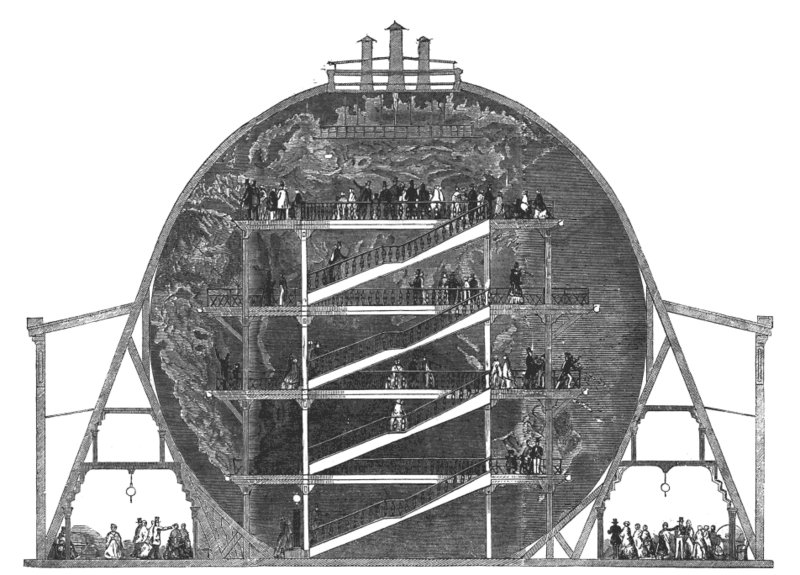
Wylde's Great Globe - Illustrated London News 7 June, 1851
Addendum. And don't forget Wyld's Great Globe, the 60-foot diameter static globe that was a public attraction in London's Leicester Square from 1851-1862. Like the modern Mapparium in Boston, it was a concave globe; the mapped surface was viewable from the inside. See the excellent Wikipedia article Wylde's Great Globe: this is the kind of geeky and uncontroversial article where the Wikipedia model excels.

- Ray

Saturday, 14 July 2012

The Great Tower, London, 1890

D Vernon's tower design
click to enlarge
Pertaining loosely to the recent opening of the Shard, John Ptak of Ptak Science Books kindly sent me a nicely apposite link to Descriptive illustrated catalogue of the sixty-eight competitive designs for the great tower for London (compiled and edited by Fred. C. Lynde for the Tower Company, Limited, St. Stephen's Chambers, Westminster, London, S.W. Published 1890 by "Industries", London - Internet Archive ID descriptiveillus00lynd).

The designs were submissions to a competition run by The Tower Company Limited of Westminster, which was set up to fund and build a London equivalent of the Eiffel Tower on the high ground of Wembley Park.

A contemporary publication commented:
Eighty-six designs in all have been sent in for competition. Of these, however, only sixty-eight fall within the scope of the specification. All of the designs, are now on exhibition to the public free of charge in the Hall of the Drapers’ Company, Throgmorton Street, London, E.C.

It would be remature to pronounce any opinion upon the merits of the designs, as the jurors have not yet delivered their award. The designs exhibit considerable range of style. The Eiffel Tower design, more or less modified, appears in several of them. Some are apparently suggested by the conventional pictures of the Tower of Babel, others are ecclesiastical towers whose proportions have simply been expanded, others are magnified screws, while some are glass fumaces of monstrous size. The lure of £500 has brought into the net not a few curiosities. There is the Chinese lantern design, the design on half a. sheet of note paper, the factory chimney design, the gigantic mast design, the candelabrum design. More than one of the designers aim at a tower of 2,000ft. in height. One of these proposes that the base of his tower shall occupy sixty-four acres, or about twenty times the area of the Albert Hall.
- Industries and Iron, 2nd May 1890
The seriously weird ones include, for instance, Design No. 6, S Fisher's "monument of hieroglyphics" served by a spiral railway; J Horton's Design No. 17, also spiral; the positively scary Design No. 19, JW Coucham's skinny single-vertical "Century Tower"; Design No. 29, Albert Brunel's scaled-up granite replica of the Tower of Pisa; and Design No. 38 by AF Hills (Arnold Hills of the London Vegetarian Society) which was to feature an "aerial colony" and to be capped by a one-twelfth scale replica of the Great Pyramid. Quite a few are modern in concept and, like the Shard, wouldn't just be a skeleton but would also incorporate residential and office space.

The first prize of 500 Guineas was awarded to Design No. 37 by Messrs. A. D. Stewart, J. M. McLaren and W. Dunn, of London: a 1200-foot octagonal tower "of Oriental character" which would feature a principal stage at 200 feet, containing an octagonal central hall and a 90-bedroom hotel. Work on this "Watkin Tower" - so nicknamed after its instigator, the railway magnate Sir Edward Watkin - started in 1893, not using the winning design, but that of a simpler copy of the Eiffel Tower.

It was a project that revolved tightly around the financial interests of its creator. As described in The Infernal Tower at London Particulars, the whole thing was centrally a scheme to drive money toward the Metropolitan Railway Company, of which Watkin was chairman. Its line ran next to the Wembley site, and it conveniently opened a new station serving the site in 1893. Watkin's own company The Tower Company Limited (aka the Wembley Park Tower Company) was the ground landlord of Wembley Park, and it  received rent from another company of his, the Metropolitan Tower Construction Company Limited, set up to organise the building (and which, at his direction, received payments from the Metropolitan Railway Company).

The whole scheme went belly-up with the liquidation of the Metropolitan Tower Construction Company Limited in 1899, and the completed base - the "London Stump" - was demolished over 1904-1907. There's a good account of the whole saga at the Giles Milton blog: A tale of two towers: the fabulous folly of Edward Watkin. The site is now occupied by Wembley Stadium.

John Ptak also noted a Topsham connection: Design No. 2 is by a "D Vernon, Topsham, Devon". I haven't been able to find who D Vernon was, or what qualification he/she had for designing a tower.


Incidentally, I like the picture on page 4 of the catalogue, comparing different buildings. It's reminiscent of the architectural capriccios I mentioned a while back: see Architectural fantasies.

- Ray

Friday, 13 July 2012

Majorfield then and now

Majorfield Road, Topsham - click to enlarge

Just a quick photo post: Wayne Tracey sent me the above scan (left) from Eric R Delderfield's 1949 The Raleigh Country ("a brief history of Exmouth, Budleigh, Salterton, East Budleigh, Otterton, Bicton, Lympstone and Topsham, with a short life story of that great Englishman, Sir Walter Raleigh"). It refers in passing to Topsham, and has a sketch of Majorfield Lane (now Majorfield Road). I thought I'd take a comparison photo. The sketch is by Harry A Powell, who regularly illustrated Delderfield's travel books from the Exmouth-based Raleigh Press. It takes some liberties with perspective and layout.

- Ray

Thursday, 12 July 2012

The Last Generation

click to enlarge
Department of Where London Stood: by an entirely accidental Google hit, I just ran into this curious little post-apocalyptic novelette The Last Generation: A Story of the Future by the poet, novelist and playwright James Elroy Flecker.

A fable directed at human hubris, told through the vehicle of the narrator being contacted by the time-travelling "Wind of Time", it tells of the extinction of humanity: not through external disaster, but through a dictator's plan - out of his disillusionment with human progress - for a collective suicide pact.

A visionary Birmingham politician, Joshua Harris, attains world domination as "King Harris". Through a scheme of female sterilization, with death sentences for non-compliance, the discovery of a universal contraceptive, "Smithia", and a fostering of cheerful acceptance among a hedonistic intellectual elite, he succeeds in fulfilling his aim that that this will be the last generation of humanity.

The Wind takes the narrator through the decades of decline that follow until he finds the last man, who dies at the altar of "a massive half-ruined Dome that had been used for the worship of some God" (the book cover suggests it to be St Paul's). But then, it's implied, the whole cycle starts again:
I saw the vast Halls and Palaces of men falling in slowly, decaying, crumbling, destroyed by nothing but the rains and the touch of Time. And looking again I saw wandering over and above the ruins, moving curiously about, myriads of brown, hairy, repulsive little apes.

One of them was building a fire with sticks.
The Last Generation: A Story of the Future (JE Flecker, London / New Age Press, 1908, Internet Archive ID lastgenerationst00flec).

- Ray

Wednesday, 11 July 2012

Phillpotts censorship drama!

Cold Comfort Watchett Hill Farm, setting of The Secret Woman

Kevin Dixon, at the always interesting Torquay's Other History section of The People's Republic of South Devon, recently mentioned Eden Phillpotts' 1912 spat with the Lord Chamberlain over the dramatisation of his Dartmoor-based tragic melodrama The Secret Woman: Torquay’s Other History: Eden Phillpotts upsets the Censors.

I'd heard about this before, but never bothered to chase up the details. A spot of background: inthe UK, censorship of theatre by the Lord Chamberlain's office came about with the Licensing Act 1737, a piece of political gaming to suppress criticism of Robert Walpole's government. The Lord Chamberlain's power were reduced in the Theatres Act 1843 to censorship of plays not " fitting for the preservation of good manners, decorum or of the public peace", and this was the situation that still applied in 1912.

 Anyhow, the Lord Chamberlain refused permission for the staging of The Secret Woman unless a few sentences were altered; Phillpotts, on a point of principle, refused to give in. Most accounts describe it thus far, but don't elaborate. However, I just found the details in the 1924 book The Place of Eden Phillpotts in English Peasant Drama by Charles William Meadowcroft.
What were these passages to which the Chamberlain objected? It was impossible to find out without writing to Mr. Phillpotts and he has kindly furnished me with the passages in dispute. These thoroughly support Mr. Phillpotts in the position he took at the time.

The censored passages in The Secret Woman show, as Phillpotts says, that only principle was involved and that the passages themselves were nothing out of the way except in the pudding mind of the authorities.

The passages are as follows:-

p. 31
"I saw the two of them thicken into one" [deletion]

p. 36
"The way of a man's body
My flesh and blood's a bit too much for you"—to—"a bit too much for me sometimes."

Act IV p. 72 (bottom)
"I only nursed my flesh" to end of sentence [I only nursed my flesh an' kept it plump an' sweet for him]
It all seems pretty trivial even by the standards of the time, but Phillpotts digging his heels in turned it into a Cause. The allegedly controversial nature of the content was countersunk by the cryptic references to it in a House of Commons question:
Mr. LYNCH asked the grounds on which leave was refused to Mr. Eden Philpotts to produce a play entitled "The Secret Woman"?
Mr. McKENNA [Home Secretary] Leave has not been refused to produce the play "The Secret Woman." On consideration, and after consulting his Advisory Board, the Lord Chamberlain licensed this play to the manager of the Kingsway Theatre on the 5th instant, subject to the elimination of five short passages, which were considered objectionable.
Mr. LYNCH Will the right hon. Gentleman, for the benefit of the Members of this House, kindly read those passages which were struck out as objectionable?
Mr. McKENNA I shall be very happy to show the passages in question to any Member of the House privately, but I should be most unwilling to read out in public passages of so objectionable a character.
- Hansard, HC Deb 19 February 1912 vol 34 cc286-7 286
A group of respected writers wrote a letter to Times, of which the gist was the following:
"We, Mr Phillpotts's fellow-writers, have read this play, and find it to be the conscientious work of an artist doing his best in his own way. . . . To our mind the play is worthy work, such as a stage of high aims should ever be ready to welcome, and we feel a warm indignation over the stigma cast by the Lord Chamberlain upon an author whom his fellow-writers and the English-speaking world generally have for many years held in admiration and esteem. Never in all these years of novel- writing has a word been breathed by any responsible person or paper against his fair fame ; but the moment he has the ambition to write a play in the same spirit that inspired his novels he is at the mercy of an official who knows no better than to serve him thus. "

Mr Phillpotts is the victim to-day, but of course it may be any of us to-morrow. Many of us have never written plays, though most of us would like to do so. There is not perhaps another field so fine in the England of to-day for a man or woman of letters, but all the other literary fields are free. This one alone has a blind bull in it.

" We who sign this letter may be otherwise engaged ; some of us may be old and done, and no longer matter. Our chance has gone by. But there are men and women who are coming — are they also to be warned off? Can we strike no blow for the young ?

William Archer. Henry James.
J. M. Barrie. Jerome K. Jerome.
R. C. Carton. George Moore.
Joseph Conrad. Gilbert Murray.
Arthur Quiller-Couch. John Masefield.
W. L. Courtney. Alfred Noyes.
Arthur Conan Doyle. Arthur Wing Pinero.
John Galsworthy. Elizabeth Robins.
Frederic Harrison. G. Bernard Shaw.
Anthony Hope Hawkins. Alfred Sutro.
Maurice Hewlett. H. G. Wells.
W. H. Hudson. I. Zangwill."

- quoted from Censorship in England (Fowell, Frank; Palmer, Frank, 1913, Internet Archive ID censorshipinengl00foweuoft)
Thomas Hardy, interestingly, declined to be a signatory. Michael Millgate says in his 2001 book Thomas Hardy's Public Voice: The Essays, Speeches, And Miscellaneous Prose: "He thought The Secret Woman undistinguished as a play, the changes demanded by the Lord Chamberlain easy to accommodate, and the letter of protest overstated". Nevertheless, the play attracted attention as a data point in an ongoing censorship debate at the time, and a telling one because when it was staged uncut as a free performance, nobody could even pinpoint the problem.
When the play was actually produced at a private performance in February 191 2, it met with a good reception, and the critics were unable to discover what the objectionable lines might have been. The Times wrote : " No one who obtains an invitation in the hope of finding prurience or blasphemy will be paid for his trouble '; and another journal stated, absolute truth, " that the average playgoer, after hearing the piece, would admit that he failed to guess which were the passages in question, or to recollect any one of them." There are in the play passages of healthy passion and of broad farmyard humour, without which the characters could not possibly have been true to life, and the Censor probably took offence at these passages because they were not couched in drawing-room periphrases. After all, to expect an author to put the double-entendres of Mayfair into the mouths of Dartmoor is no more absurd than forbidding him to use the word " thighs," as Colman did, on the ground of indecency.
- Censorship in England [ibid]
Steve Nicholson's The Censorship of British Drama, 1900-1968 - Volume 1: 1900-1932 (University of Exeter Press, 2005) sheds further light on the background. It seems heels were being dug in on both sides of the debate, as Sir Douglas Dawson, Comptroller of the Lord Chamberlain's Department (who seems to have been a military-aristocratic control freak) viewed it as part of a conspiracy by disgruntled authors to bring down the whole censorship system. He'd advised the pro-censorship MP Sir Edward Carson, for instance:
There are four or five authors whose plays have been rejected in the last ten years, and four or five MPs who I hear are disappointed authors. These eight or ten people are on the warpath to abolish the censor.
- Censorship in England [ibid]
Dawson's no-compromise view prevailed. But the ban was rescinded in 1922, when the then Lord Chamberlain, the 8th Duke of Atholl, found nothing to worry about. His view on the "thicken into one" sentence, for instance, was:
Any one who has been in the mist on a hill and has seen two objects making towards each other and meeting can easily understand this phrase, and I do not for one moment accept the interpretation which appears to be put on it.
- quoted in The Censorship of British Drama, 2005, ibid.
The whole institution of stage censorship in the UK was abolished under the Theatres Act 1968.

The Secret Woman (Eden Phillpotts, New York / Macmillan, 1905, Internet Archive ID secretwoman01philgoog).
The Secret Woman; a play in five acts (Eden Phillpotts, New York / Brentano's, 1914, Internet Archive ID secretwomanplayi01phil).

I've had a quick skim, and it seems "loam and lovechild" melodramatics of exactly the type satirised by Stella Gibbons in Cold Comfort Farm. I'm coming round to the conclusion that Phillpotts, though he tends to be idolised in this part of the country as a regional author, was really not that good a writer. He's a bit like a Thomas Hardy clone, but in comparison to Hardy, I find his descriptive prose uncomfortably dense, his characters unmemorable, and his style overall rather impersonal, in a way that fails to engage my interest in either landscape or story.

- Ray

Tuesday, 10 July 2012

Aleister Crowley as writer


Crowley satirised by Roger Mann of Lee & Herring as the ineffectual Roger Crowley.

Angela Williams at Literary Places just sent me a link to a recent news item: Aleister Crowley: Torquay's Warlock and James Bond's arch-enemy (Dr Kevin Dixon, This is SouthDevon, June 26th 2012).

It's an interesting short biography that covers lesser-known aspects of Crowley's strange life (that is, beyond his media-created reputation as the occult 'Great Beast') including his work as a writer. It quotes a truncated piece of this wonderfully lush passage about an encounter in Torquay:
CHAPTER EIGHTEEN
OF A LADYE MINE, AND OF THE DREAM SHE HAD

'Twas at Torquay in Devon, land of stream and cream, 'o scaur and tor, o' moor gorse-golden, merry maids and proper men, tall fellows and bold, o' dells and coombes, and of cider stronger and sweeter than your Norman can make for all his cunning; and this girl was a play-actress, rosy as the apples, and white as the cream, and soft as the air, and high-spirited as the folk, of that enchanted dukedom. I know her name was langourous and lovely; but only the devil her master knows what it was; I shall probably remember it if I live to be eighty; but whether it's worth while to go through another forty years or so of European war in order to recall this detail is a matter rather for my readers than myself. The deuce take politics!

Whatever her name was, she was out walking. She was as pretty as a picture of Spring, for 'twas that which had got into her blood -- the good Sun grant it gets into mine this night, and stays there! So she was restless, so she walked up and down by the Sea, feeling the Sea's mood hers. I think she walked till moonset, but I'm not writing by the calendar, thank the Lord! We call it moonset; we declare moonset trumps. Good. Then she wandered on the face of the cliff for a while, and sought to tire her limbs. At last she came to a meadow; and there she called upon the Earth, lying upon the cool grass, and plucking out great handfuls. The daisies stared at her with great golden eyes, like Balzac's `Fille'. And so she dreamed that she was Earth itself, and a daughter of Earth, Titan, a giantess in the prime o' the planet. She lay like a great range of mountains athwart the plains, snow domes upon green alps. May the Lady of Dreams be ever near us, awake or asleep, with her hands full of loveliness. Carry your apron full, Our Lady, with cherry dreams, peach dreams, plum dreams, pear dreams, strawberry dreams, apple dreams, dreams that are clusters of the heaviest grapes! And fly also South and East upon occasion for we need tropical dreams, like mangoes, dates, pomegranates, lychees and mangostems!
- Not the Life of Sir Roger Bloxam

See Not the Life of Sir Roger Bloxam for the rest of this unfinished novel. It's worth a look; while rather overblown in style, it's nevertheless an intelligent piece of work, with strong allusions to Tristram Shandy, a lot of very lyrical writing (as above), flashes of Joycean punning, and an overall self-parody suggesting he wasn't taking himself that seriously:
Now you’ve mixed me all up, and we must broach a fresh hogshead of absinthe.
Crowley, for all his reputation, didn't just write anti-establishment stuff. As I mentioned earlier (see The Titanic verses) in 1913 he wrote this commemoration of the sinking of the Titanic.
FORTH flashed the serpent streak of steel,
Consummate crown of man's device;
Down crashed upon an immobile
And brainless barrier of ice.
Courage!
The grey gods shoot a laughing lip: ---
Let not faith founder with the ship!

We reel before the blows of fate;
Our stout souls stagger at the shock.
Oh! there is Something ultimate
Fixed faster than the living rock.
Courage!
Catastrophe beyond belief
Harden our hearts to fear and grief!

The gods upon the Titans shower
Their high intolerable scorn;
But no god knoweth in what hour
A new Prometheus may be born.
Courage!
Man to his doom goes driving down;
A crown of thorns is still a crown!

No power of nature shall withstand
At last the spirit of mankind:
It is not built upon the sand;
It is not wastrel to the wind.
Courage!
Disaster and destruction tend
To taller triumph in the end.

- Aleister Crowley, The Equinox, the official organ of the A∴A∴ The review of scientific illuminism, v. 1, no. 9 - 1913.

Aside from literary and esoteric work, he also wrote for Vanity Fair, pieces such as the pseudonymous humorous article A Hindu at the Polo Grounds, purportedly written by a visiting swami who thinks a baseball match is a religious ritual; The Hokku - a new verse form, in which he played a part in the Western popularization of the haiku; and The Three Great Hoaxes of the War, a sceptical article about the role of myth and mysticism in the popular consciousness during World War 1.

Hermetic.com's The Libri of Aleister Crowley is an excellent collection of Crowley's writings,and it's worth checking out. It's kind of a pity he devoted so much energy to the occult flakiness; he was a clever, literate and witty writer who should have a better reputation.

Thelemapedia - Aleister Crowley - also has a list of his writings, mentioning other little-known ones such as his occult novel Moonchild (online at Hermetic.com) and his many stories collectively called The Investigations of Simon Iff, mystery stories featuring the occult/psychological detective Simon Iff.

- Ray

Sunday, 8 July 2012

Southview goes west


Ruin is always overstated; it is part of the ruin-drama staged perpetually in the human imagination, half of whose desire is to build up, while the other half smashes and levels to the earth.
- Rose Macaulay

I just found out, via a Facebook post by Richard Edney (one of my Isle of Wight relatives), about the irreparable damage by a fire sometime over Christmas to the last extant house in the "lost road" segment of landslip between Niton and Blackgang (see previously On the lost road). It's unknown if the fire was down to arson or a feckless squatter; but according to YouTube comments, the site had a history of theft and vandalism.

This tract of land, since it became disconnected from the road, has a depressing track record of properties burning. The owner who had been renovating it must be devastated, even though its situation made it uninsurable, and it could have succumbed to landslip damage at any time. It's a reminder that ruins, however temptingly evocative they can be (an aesthetic going back at least to the 18th century), are generally the result of traumatic changes in lives: whether caused by individual circumstance, environmental change, or geopolitical events.

I posted this in part to clarify identification of this house. Recent accounts tend to call it Southview, and some identify it with the Southview House (aka South View House) occupied by the Victorian entrepreneur Thomas Letts, who installed the Shakespeare folly and fountain by the road above (see Letts: a relic). It isn't. One of the commenters to this other YouTube video - Urban Exploring Blackgang Isle Of Wight Southview House remains - says that it was the adjoining coach house.

Historical maps bear this out. See Old Maps for OS sheets, which identify the original Southview House as a much larger building a little to the west: one highly identifiable in pictures by its Italianate tower. The now-ruined house of square cross-section at the foot of the steps down from the road is unnamed on the map.

Southview House, 1898 OS map. Historic map data is (© and database right
Crown copyright and Landmark Information Group Ltd. (All rights reserved
2009). Low-resolution image reproduced for small-scale non-profit
use under the terms described in the Old Maps FAQ.
Southview was built at some point shortly before 1845. An advertisement appears in the Hampshire Telegraph and Sussex Chronicle for Saturday, April 5, 1845, offering it for sale or let as "that new, substantial and convenient family residence":
SOUTH-VIEW HOUSE
NEAR BLACKGANG CHINE, UNDERCLIFF,
ISLE OF WIGHT.
To be SOLD or LET,—All that new, substantial
and convenient FAMILY RESIDENCE called
"SOUTH-VIEW HOUSE," completely Furnished;
containing on the ground floor, drawing room, 20 feet
by 13 feet, 9 feet high; dining room 10 feet by 13 feet,
9 feet high; breakfast room 10 feet by 9 feet; butler's
pantry, kitchen, fitted up with every requisite; larder,
scullery, coal house. On the First Floor—A best bed
room, 16 feet by 13 feet; dressing room adjoining; a
bed room, dressing room adjoining, nursery, water
closet, three servants' bed rooms. Second Floor—The
Tower. Under-ground cellars. Commodious and con-
venient out-offices. Detached are double coach-houses
and stables. The whole plentifully supplied with good water.
   The House stands on the summit of a bold slope,
springing directly from the shore, backed by magnifi-
cent rugged Cliffs in the breast of a down rising nearly
900 feet from the sea, crowned by ruined light-houses,
and a signal station, and environed by scenery where
nature sports in sublime grandeur or luxuriates in her
richest beauties. There is seen hill and dale covered
with bare colossal rocks, "the fragments of an earlier
world," tossed about in the wildest disorder; and here
gracefully clothed in a soft mantle of the richest verd-
ure, presenting new charms with every change of posi-
tion. In front, the vast ocean, blending with the sky,
and gemmed with countless ships, is spread in all its
boundless magnificence; while the delightful views of
the coast carry the eyes of the spectator over the pearly
cliffs of Freshwater even to the azure hills of Dorset.
   This valuable property is placed in a district, admit-
ted by the faculty to possess a climate more mild and
genial than perhaps any other in Great Britain, and
also adjoins the celebrated Sandrock Chalybeate Spring,
the waters of which have proved of the greatest efficacy
in the cure of many disorders, whilst the scenery and
prospects are of such a character as to divert the mind
and engage the fancy of the invalid, and to gratify the
taste of every lover of nature.
   Excellent roads lead to every part of the Island; and
there is a good carriage drive down to the shore. Good
bathing.
   For particulars apply to the proprietor, Mr I. Morris,
Builder, Redhill, near Niton; Mr. J. Spary, Post
Officem Ventnor; or to Messrs. H. and R.B. Sewell,
Solicitors, Newport, Isle of Wight; and, in London,
to Mr. A. Trimen, Architect, 9, Adam-street.

- Hampshire Telegraph and Sussex Chronicle, Saturday, April 5, 1845
This overblown ad being posted by the builder and the London-based architect suggests that Southview was built as part of the early 19th century boom in speculative property building on the south coast of the Isle of Wight. "Fashionable List" entries for this upmarket house in the Isle of Wight Observer find early occupants to have been a "Mr Pringle and family", "Mr Wheatson and family", and "The Rev & Mrs Goold & family"; Thomas Letts moved in late in 1854; he died in 1873, but the Fashionable List has a "Mr & Mrs Letts and family" for July 1874, and the house finally went up for sale in 1885.

Coming back to the 20th century: the 1991 compilation Slope Stability Engineering has a paper that I've mentioned in the past, The recent history and geotechnics of landslides at Gore Cliff, Isle of Wight, has a good map of the landslide zone as Fig 3, page 191, and explains:
The landslide of 1978 led to the destruction of the remaining properties in the area: three directly as a result of the landslide (Cliff Cottage, Sandrock Spring and Sandrock Spring Cottage). Southview House, slightly damaged by encroachment of the toe of the landslide, was destroyed by fire shortly afterwards.
Southview House proper must have been an imposing property. The Times on Wednesday, Apr 18, 1951, has a description accompanying its sale following the death of its previous owner, the banker Sir Frederick Eley.
By order of the executors
FOR SALE PRIVATELY, OR AUCTION 8th JUNE
South View House, Chale, Isle of Wight

SUPERBLY SITUATED FREEHOLD MARINE RESIDENCE, facing due South, with wonderful sea views and grounds down to the beach; 3 reception rooms, sun lounge, 7 bed rooms, 3 bath rooms; main electricity; own water (main supply available); cesspool drainage; garage and stabling with 5-roomed flat over; charming gardens, and grounds about 17 acres (much requiring no upkeep); low rates. Vacant possession.
Even at the time, the failure to mention it was sitting on the edge of a landslip seems pretty disingenuous, as there had already been ominous signs with the landslip of 1928 that broke the Niton-Blackgand road.
Happily the area of disturbance shows no sign of widening. It is confined to the space between the gap at Windy Corner and the opposite point on the Blackgang side, where Southview House, the residence of Sir Frederick Eley, stands on a sort of promontory. Fissures have appeared in the garden here, but neither Southview House nor any of the residences near it seems to be in any immediate danger.
- The Isle Of Wight Landslip. Widening Fissures, The Times, September 25, 1928


Addendum: I just found this picture of Southview House, dating from the 1920s, at Wight Memories. I haven't been able to ask permission; it's a very old Angelfire free site with no contact details; the creator describes having had a liver transplant in 1995, so could conceivably even be dead. "Mero", if you're extant and see this, could you contact me?

Addendum 2, October 31, 2013
I've just had a very interesting series of e-mail conversations with Steve from the newly-launched Wight Heritage forum site, and Keith from Isle of Wight Scooter Archives, comparing notes on these now-vanished houses. As Steve says, "There is confusion regarding the houses at Blackgang, and people are always debating which house is which".

This is the area of interest (the map is from The recent history and geotechnics of landslides at Gore Cliff, Isle of Wight, mentioned above): the houses in question are Southland(s) House (bottom left, close to sea), and South View House (centre right, slightly inland by fork in road).


Keith sent me this image; you can just see, when it's zoomed, the house at top right with a tower. This matches both my photo above and the vendor's description, and must be Southview.


Steve sent these, scanned from a booklet about Blackgang Chine. The first ...

 ... despite the caption "Southview House 1880s built by Professor Letts", nevertheless matches neither the location or appearance of Southview (with its prominent Italiate tower). The position suggests it's actually Southlands, which was destroyed by landslip around 1908. Nor was Thomas Letts of Southview a professor: see Letts lineage: a clarification.

The second ...


(The consensus of comments is that this identification is correct).

Update, 1 Nov 2014
I've found a deal more about Lowcliffe and Southlands: see Lowcliffe and Southlands: from cradle to grave.

Update, 5 Dec 2014
detail from image below
Heres another small image of Southview, from GeoScenic, the BGS geological photo archive. The house appears at the top centre of an image of the talus at the foot of the 1928 landslip.

Below Windy Corner, Gore Cliff. Mass of fallen material and lakelet. Jackson, J.F., Entry in BAAS
Report for 1930. British Geological Survey, National Archive of Geological Photographs, GeoScenic,
Cat. No. P253110 - permitted non-commercial reproduction. Not for re-use.

The Great Landslip at Rockenend
with the bold termination of the Undercliff near Black Gang
facing page 70, The Vecta Garland, Albert Midlane, 1860

It also features, along with Southlands, in one of the engravings in Albert Midlane's poetry anthology The Vecta Garland. In all such pictures, the tower clearly identifies it.

- Ray

Thursday, 5 July 2012

Priddy's Hard

Burrow Island and Priddy's Hard: click to enlarge
Further thoughts relating to a post I wrote in August 2009, Fortifications ... and Gosport.

I've never had any major nostalgie for the town where I grew up (Gosport, Hampshire). But it had some aspects of landscape that have become much more interesting with the hindsight of a better overview of history and geography: particularly that it's a town massively imprinted with the legacy of a 19th century Cold War.

This impressed me quite forcibly during my recent revisit to the Spinnaker Tower. Suburban development of the town has covered much of the peninsula on which Gosport stands, but the greenspace surrounding the town centre still gives away the almost mediaeval setup of the mid-19th century: the area was a largely agricultural tract of land dotted with hamlets, with Gosport Town crammed into a tiny harbourside enclave behind star-shaped earth ramparts. (There's a nice sketch map here at the Gosport page of Fortified Places - and aerial views show some sections of the ramparts are still extent. See Google Maps: here, here (complete with moat), and here.

I was interested in the view heading this post. It doesn't look much in the photo, but it's the outlier of the fortifications at Priddy's Hard, that formerly was Gosport's Royal Naval munitions depot. It now houses Explosion! The Museum of Naval Firepower, whose website outlines the history (the name comes from Jane Priddy, from whom.the Board of Ordnance bought the land).

The aerial view - check out Bing Maps too for a birds' eye view with rotatable viewpoint - is especially striking. Though there's housing development inside the complex andon land to the north-west adjacent to it, you can still see the ramparts, and a couple of interesting circular copses, containing buildings, that I've been wondering about for some time.


View Larger Map

I wasn't clear how exactly to 'read' this landscape, but it's very well explained in the set of documents Site PHG04/20, Priddy's Hard, Gosport, by Thames Valley Archaeological Services. The one particularly to read is the August 2004 Priddy’s Hard, Gosport,Hampshire- An Archaeological Desk-Based Assessmentfor Crest Nicholson (South) Ltd, by Jennifer Lowe.

The images alone explain most of the structures you can see. This annotated 1914 Admiralty plan shows that the round copses have grown up around the earth ramparts surrounding magazines (for obvious reasons away from the main depot); the larger was a cordite magazine. The rectangular building inside the main ramparts is another magazine (see Google Maps and the street view of its entrance on Heritage Way).


The report also has a very nice 1947 aerial photo of the depot, which shows the many small sheds dotting the open space outside the ramparts. From the similar appearance of firework factories, I'd assume these are munitions manufacturing sheds for filling shells and such like, separated so that any accidental explosion would be limited to that building and not set off the entire store.

(I've requested permission for image use, but pending that I've posted low-resolution images under the terms of the copyright statement: "This report may be copied for bona fide research or planning purposes without the explicit permission of the copyright holder" - I view this post as historical research).

I'd love to have a mooch around the derelict ramparts in the sections of the site as yet undeveloped. But unfortunately the end of military secrecy just led into an era of security-conscious landowners, and it looks solidly fenced off. However, 28DL (28DaysLater.co.uk - The UK UE Urbex Urban Exploration Forums) has several visit reports: Priddy's Hard, Gosport 17/05/07 shows a daytime visit to the main complex; Priddy's Hard, Gosport records a 2008 night-time visit; Hidden Ammo Dump-Priddys Hard - Hampshire June 2010 has photos of the magazines inside the circular copses.

Judging by the commentary, demolition and redevelopment is ongoing (the Google Maps images are already out of date - for example, the sheds in the shell-filling bays here are already gone, and the bays themselves may even have been demolished). The structures are probably not vastly significant archaeologically, but their destruction seems a pity, and not just because they appeal to my Ruinenlust. Gosport has taken a major blow economically with the withdrawal of military and naval presence, and its unique fortress heritage seems to me an asset that seems unwise to destroy (one fort that I just about remember, Fort Gomer - see photos - was completely obliterated for housing development in 1964, an action one would like to think wouldn't happen so readily nowadays. Even so, Fort Elson, despite being a Scheduled Monument and on the Buildings at Risk register, is being allowed to collapse under the English Heritage 'Controlled Ruination' policy due to mixed factors - its very poor state, and its position on a long-term military establishment, the MoD being exempt from rules requiring landlords to reinstate such properties.

Forts Fareham, Grange and Gilkicker are examples of what could be done in the way of preserving the structure of the forts while adapting them to alternative uses: Fort Fareham, though neglected in the past, finds use as a civilian industrial estate surrounded by wildground, Fort Grange contains sports fields for the HMS Sultan cadet corps, and Fort Gilkicker (hopefully- see Fortgilkicker.com) is due to be preserved by what looks like a very sympathetic conversion into residental apartments. Fort Brockhurst, the only one open to the public - though insufficiently often, in my view - is used as a store for English Heritage's reserve collections.

- Ray


Tuesday, 3 July 2012

Spinnaker Tower revisited

Spinnaker Tower, September 2010
On Sunday May 27th, Clare and I were at the Gunwharf Quays, Portsmouth, on the way back from visiting my father on the Isle of Wight.  The haziness of the early weekend had cleared quite a bit, and I couldn't resist giving the Spinnaker Tower another visit. It has stunning views over Portsmouth Harbour, Portsmouth, Gosport, and across the Solent.

I highly recommend the Gunwharf Quays complex in general. While its general thrust is to cater for shopping, eating and entertainment, it offers a varied range (we always have lunch there on the way to the Isle of Wight) and is a stylish and sympathetic redevelopment of defunct admiralty dockland that nevertheless retains its use as a busy harbourside.

Click to enlarge any image
Sorry if the colours are a trifle funny; the thick glass has an intense cyan cast, and I've had to do my best at correcting it.
Returning, May 2012

looking 100m (328ft) down through glass floor panel

View Deck with that glass floor

View Deck 2: 'Cafe in the Clouds'

View east over Gunwharf Quays, canal, East Side
Plaza Tower ("The Lipstick") and Southsea
View south over The Camber car ferry dock and Old Portsmouth (top right)

Old Portsmouth with Isle of Wight car ferry

View approx. S, Portsmouth Harbour entrance

Fort Blockhouse, Gosport side of harbour entrance

View approx. SW: Gosport Marina, Seaward Tower, Haslar Lake, Solent, and Isle of Wight on horizon

Gosport: ferry terminus, Ferry Gardens, town centre

Gosport, view approx. NW: Burrow Island, Royal Clarence Marine, Priddy's Hard

Gosport: Burrow Island, Priddy's Hard

View approx. N: Portsmouth Dockyard, with HMS Warrior (foreground) and HMS Victory (centre)

Detail: Portsmouth Dockyard with HMS Victory
- Ray

Sunday, 1 July 2012

The Desire of the Moth

After a bit of a break to catch up on various writing chores, I've resumed the project to read the entire works of Maxwell Gray (Mary Gleed Tuttiett).

1913 brings me to Something Afar (published in the USA as The Desire of the Moth), which in some blurbs has the subtitle A Romance of the Italian Lakes. You wouldn't immediately know this is what it's about, as MG, I think, was stuck in the conventions of the 19th century three-volume novel where she started out, and is very prone to astonishing amounts of framing before the actual plot begins.

The book starts with a chapter whose title, The Omnibus Horse, reflects metaphorically the situation of the protagonist. Ronald Leith is a middle-aged low-grade bank clerk who lives in London suburbia in a lacklustre marriage to Blanche; the only high point in his life is his beloved teenage daughter Beatrice. Within the characteristic (for MG) pathetic fallacy of a dark and stormy night, Leith's introspections lead to a flashback of how he came to this situation: how, some years before, he had discovered Blanche's cousin embezzling money from the bank where they both worked. Rather than report him, Leith had repaid the money out of his own pocket and let the man flee the country. The deception, however, was discovered during an audit, and Leith's involvement had permanently blighted his career.

It gets worse: Leith is superannuated (i.e. retired with a pension), and his further gloomy introspections reveal 1) the suicide decades previously of his father, Major Leith, following a scandal; 2) the fact that he and Blanche married each other on the rebound from their separate great loves of their lives; and 3) Leith's own exotic past - as a young army officer, he had been shot in Sicily due to the betrayal of a young Contessina he loved. All he has as mementos of the affair are the bullet scar, a precious ring in a drawer, and the letter of betrayal that sent him to the ambush. However, while re-reading the letter, he spots what he has missed for decades: a cipher that reveals the word dettato ("dictated"), evidence that she wrote the letter under duress. There ends the framing intro.

At this point, I'll leave it there for the evening.

It promises to be interesting biographically. As I mentioned in a recent post, I just found direct evidence that Maxwell Gray had been to Italy (she stayed in the Villino Trollope) and there may be something that 'connects'.

Both forms of the book title are allusions to a segment in Shelley's poem of devotion One Word is Too Often Profaned:
...
The desire of the moth for the star,
Of the night for the morrow,
The devotion to something afar
From the sphere of our sorrow?
Continued in The Desire of the Moth #2.

- Ray