Friday, 14 August 2009

If...

Still on the subject of Kipling: Must the nation's favourite poet really be Kipling? The Guardian Books blog looks at the current BBC Nation's Best Poet poll, for which Kipling is a likely favourite (his If—, from the anthology Rewards and Fairies, was voted Nation's Favourite Poem in 1995 in a similar pseudo-poll 1).

If—, written in 1895, rapidly became the standard litany in praise of British stiff upper lip. Obviously it's an "author is dead" situation, but the background is interesting; in Kipling's autobiographical Something of Myself, he describes it as alluding to the Jameson Raid. This was a nasty piece of military-political manoevering, a British-supported attempt to destabilise the Transvaal Republic that was, ultimately, one of the factors precipitating the Boer War. The poem's advice is evidently to the expedition's leader, Dr Leander Starr Jameson, who was covertly supported by the British government, but disavowed when the attack failed (although newspapers spun it as a victory).

If— has attracted many ripostes and pastiches. For instance, Shackleton's last voyage. The story of the Quest (Internet Archive shackletonslastv00wilduoft) tells how Sir Ernest Shackleton had two verses of If— put on brass plate by the bridge of his ship, The Quest. His crewman Leonard Hussey, after a gruelling stint coaling the ship in bad weather, wrote:

If you can stand the Quest and all her antics,
If you can go without a drink for weeks,
If you can smile a smile and say, "How topping!"
When someone splashes paint across your "breeks";

If you can work like Wild and then, like "Wuzzles," 2
Spend a convivial night with some "old bean,"
And then come down and meet the Boss at breakfast
And never breathe a word of where you've been;

If you can keep your feet when all about you
Are turning somersaults upon the deck,
And then go up aloft when no one told you.
And not fall down and break your blooming neck;

If you can fill the port and starboard bunkers
With fourteen tons of coal and call it fun.
Yours is the ship and everything that's on it,
Coz you're a marvel, not a man, old son....

Witha less macho flavour, the Jamaican feminist Una Marson wrote her version of If— about the role of a wife in the sexist culture of 1930s Jamaica


(from see 20th-century Caribbean literature, Alison Donnell). Or there's Rudyard Kipling as a Job Consultant from Frank Jacobs' 1994 Pitiless parodies and other outrageous verse. Or HAC Evans' version about business ethos, If Not, in New Statesman in 1975. The list is probably endless.

There's an excellent story, "The Man Who Would Be Queen", with some vicious Kipling parodies, in the National Lampoon's The Book of Sequels. This untold Kipling tale, an account of a soldier's impersonation of a Maharani to gain possession of a prized ruby, includes several pseudo-Kipling poems from the character Old Ruddy's best-selling anthology Jingo Doggerel Ditties.

Old Ruddy began to recite from memory:

O, the 'eathens of the 'indu Kush
They stank like a 'erd o' goats,
And when they weren't grovellin' at our boots,
They was slashin' at our throats.
We'd come to teach 'em the Rule of Law
But for all the thanks we got,
We might 'ave been dealin' with Micks or Spics
Or the bone-rained 'ottentot.
An' 'alf the time they was 'umble an' meek,
An' 'alf the time they was snoooty,
So we shot 'em down like a pack o' curs,
As is a soldier's dooty,
And we shouted in battle frenzy
Through lips that were flecked with foam,
'If you don't like it in Injah,
Why don't you go bloody 'ome?'

There's also a version of If— that I hope is ridiculing sexism.

If you can fix your hair when all about you
Are tearing theirs out, blaming it on you;
If you can tell him he can go without you,
The pout, because you wanted to go, too;
If you can wink, and sigh, and be vivacious,
And paint your lips and eyes and scent your bust,
And after acting utterly flirtatious,
Take great offense at man's unseemly lust;

If you can dress in feathers, fur, and leather
While swooning over kittens, fawns, and chicks;
If you can never quite remember whether
A half a dozen is the same as six;
If you confuse 'withdrawal' with 'deposit'
When dealing with the bank account you share,
If you can shop for clothes and fill your closet,
and never have a decent thing to wear,

If you can picket, bluster, march, and bellow
For equal rights—protest and suffragette it—
Demanding the same treatment as a fellow,
Then wail and weep and blubber when you get it;
If you can fill with guilt the hearts and spouses
For everything they've done—or haven't done
You'll wind up with both town and country houses,
And—which is more—you'll be a WOMAN, son!

1. I use the term because you don't actually get to vote for your favourite, only for your favourite out of a set of options pre-selected by the poll creators (in this case, the list was "compiled in consultation with The Poetry Society and The Arts Council". So no luck that I like the work of RS Thomas and David Dabydeen. It's pretty elitist too that the popular poet Pam Ayres isn't on the list.
2. The Captain, Frank Worsley.


- Ray

Monday, 10 August 2009

1935 Dante's Inferno


Dante's Inferno (1935) - Hell sequence

Further to Dante's world, December 2007: I mentioned then the stunning Hell dream sequence in the 1935 Spencer Tracy movie, Dante's Inferno (Leslie Hallewell described it as "one of the most unexpected, imaginative and striking pieces of cinema in Hollywood's history" - see ‘It will burn itself into your memory forever!’ at The Big Whatsit).

The 1935 film is fairly unmemorable apart from this 8:46 segment, which was remarkable for its time and would be a major challenge to film even nowadays with CGI facilities. Some sources say it comes from an otherwise lost 1924 film, but whatever the origin, the designer and post-impressionist painter Harry Lachman clearly modelled it on the classic Gustav Doré engravings for Dante's Inferno.

- Ray

The Giant Swing

A musical curiosity. I've just re-read The Giant Swing (1932), a hardboiled romance by William Ripley Burnett, whose output was prolific though he remains best known for his debut novel Little Caesar.

The Giant Swing
, filmed in 1941 as Dance Hall, is set initially around a Midwest dance hall where its hero, Joe Nearing, plays jazz piano. The book didn't get good reviews, possibly because readers were expecting it to be as gritty as Burnett's first two books. It's actually a perceptive novel about a common cultural phenomenon: Joe's talent and interest in classical music make him a misfit in the provincial working-class circles where he starts out, but his lower-class roots leave him also uncomfortable in the higher-flying world where that talent takes him.  (It's quite tempting to read Burnett's own situation into it, as a writer who had been working as a night clerk in a seedy Chicago hotel before achieving instant success and a ticket to a Hollywood career when Little Caesar was published).

THE GIANT SWING—W. R. Burnett— Harper. Author Burnett, who has sung hitherto only of sidearms and hard men, has changed his key a little. The Giant Swing's hero, never a tough boy, rises from jazz pianist to nationwide genius, a combination George Gershwin-Ziegfeld.

Joe Nearing played the piano in the jazz band at "Spanish" Strapp's amusement park. "Spanish" only managed the Park but he owned the owner's wife. A bully without bluff, he took men and women as they came. Joe admired Spanish, wished he were like him, knew he could never be. When Joe acquired a girl and Spanish saw her, Joe feared the worst. It happened. Joe left town. The story drops out nine years and back he comes in a flurry of flashlights, publicity and obsequious old acquaintances, as a musician not only great but rich and popular, author of a musical extravaganza that was a smash hit all over the country. One by one he looked up his old friends, his one-time girl, his old dreaded hero, Spanish. Time had not improved any of them. Joe was glad he had come back, especially the way he had come; sorry, too.
- Books: Jazz to Genius, Time, Sep. 05, 1932

Joe has been inspired to greater ambitions by hearing Debussy's En Bateau (he thinks it's "Debewski's On Battoe"). His original compositions are inspired by the sounds of railway yards. With the help of a more sophisticated mentor, Sorel, he writes a musical called The Giant Swing (no relation to Sao Ching Cha in Bangkok) which succeeds despite an initial panning from a reviewer who describes it as a "mixture of Irving Berlin, Gershwin, Stravinsky and Debussy".

Unusually, we can actually hear Joe's first unpolished composition that impresses Sorel, as Burnett included the score in the book. There's no indication who wrote it in reality, but here it is, a minute-long piano solo: click for MP3.
- Ray

Sunday, 9 August 2009

The Great Game and other adventures #2

Further to The Great Game and other adventures, a book recommendation: Quest for Kim: in search of Kipling's Great Game (Peter Hopkirk, 1996 - various editions inc. John Murray, ISBN-0-7195-5560-4). There's an extensive preview at Google Books. Its genre is travelogue / literary detection in which Hopkirk explores the roots of Kim, which is itself available in various editions at the Internet Archive and as Gutenberg EText-No. 2226. To recap briefly, Kim concerns an orphaned boy of Anglo-Irish parentage who grows up as a resourceful and multilingual street urchin in Lahore, until he is recruited and educated as a member of the British Secret Service, simultaneously acting sidekick to a wandering lama who is searching for the sacred "River of the Arrow".

Quest for Kim starts with historical context from Hopkirk's earlier The Great Game (espionage arising from British concern at the Russian empire's closer and closer encroachment toward the frontiers of India) as well as the origin of Hopkirk's own lifelong interest in the subject, formed while browsing in the Oriental book and antiquarian shops around the British Museum, such as Arthur Probsthain and those of Cecil Court. Hopkirk finds Kim to be strongly based on real persons and locations, While some are ambiguous and/or untraceable, others are clear, such as Kim's teacher Lurgan Sahib, who is based on the charismatic Simla jewel merchant Alexander M Jacobs (who also appeared as the subject of F Marion Crawford's 1907 Mr Isaacs, and as "Mr Jacob" in Newnham-Davis's 1898 Jadoo). Such bibliographic tips abound. For instance, Timeri N Murari's two sequels, The Imperial Agent and The Last Victory - which tell their stories extremely well, Hopkirk says - continue Kim's story, in which he becomes disaffected with British rule and ultimately dies in the Amritsar Massacre in 1919.

Quest for Kim is also rich in general historical background on India. Kim's journey from Lahore to Benares (now Varanasi) crosses what is now the Pakistan-India frontier and the locations of horrific massacres of refugees (fleeing in either direction) during Partition. The identification of Kim's school, "St Xavier's" with La Martinière, Lucknow, naturally leads to the latter's role during the 1857 uprising; and Hopkirk's search (unsuccessful) for Lurgan Sahib's shop in Simla (now Shimla) has many digressions to Simla's crucial role during the Raj as the summer seat of government, with its bizarre system of annual migration to and from Simla. I read Kim decades ago, too young to appreciate the cultural context, but it's not vital for reading Quest for Kim, which talks you through the story in enough detail to whet the appetite to read it in full. Definitely worth finding.

On Kiplingesque matters, the Telegraph just carried a story - "Alexander's army and the blondes of the Himalayas", also in the Irish Indepedent as Experts in bid to uncover a Great mystery - on the Himachal Pradesh village of Malana. This is one of various places said to have a population - "fair-haired and blue-eyed" - descended from soldiers of Alexander the Great's army, like those of the Kafiristanis in Kipling's The Man Who Would Be King. The news item tells of a Swedish-Indian initative to find out their origins, genetically and linguistically. Their language at least seems to have nothing to do wth Ancient Greek: although entirely different to that spoken in the region, it's a hybrid of Sanskrit and Sino-Tibetan languages (see Experts to study Alexander's 'last descendants' in Himachal, Jagdish Bhatt, Times of India, 29 July 2009).

Malana has a unique and highly insular culture whose basics haven't changed since it was documented in the 1911 A glossary of the tribes and castes of the Punjab and North-West frontier province. There's a modern documentary at Culture Unplugged, Malana A Lost Identity by Aparna Katara Sharma. Malana is certainly no Shangri-La, with fierce winters, and difficult interactions with the outside world arising from its various cultural taboos (centrally, the belief that all outsiders are unclean) - complicated by its reputation for producing high-quality cannabis. As described in this Guardian report, Valley of shadows (Adrian Levy and Cathy Scott-Clark, Guardian, 20 April 2002), this has created extreme tensions in the area.

I notice from the documentary, incidentally, that the Telegraph appears to be exaggerating. The blonde Malani woman in the photo illustrating its story - unfortunately not online - appears to be non-representative; although considerably paler-skinned than Indians in general, few Malanis are actually blonde, and they're generally less European in appearance than the people of Nuristan and the Pamirs, regions that saw far more extensive contact with eastward migrations.

- Ray

Thursday, 6 August 2009

Lurid covers 5: Dell Books

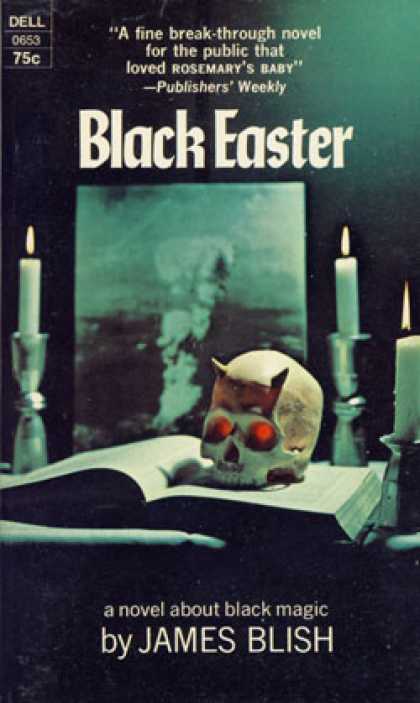
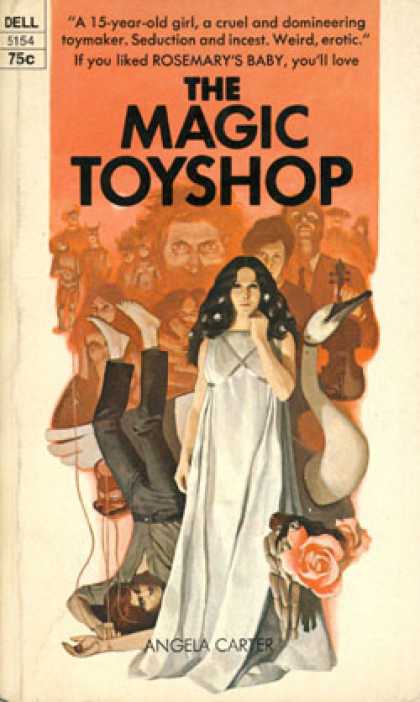
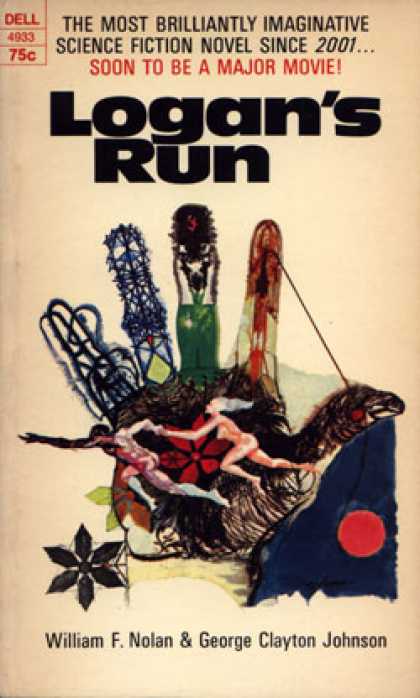
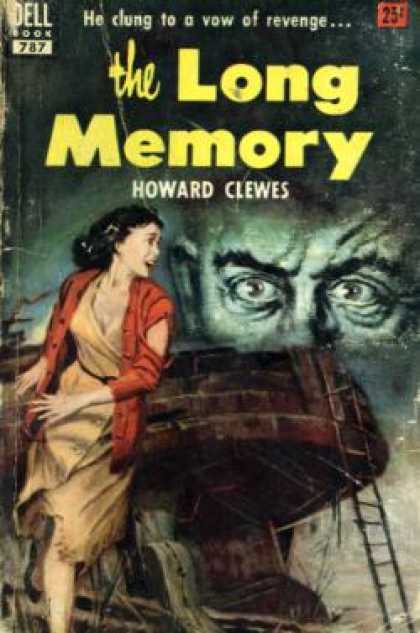
I just encountered by accident a site where I could fritter away hours: Cover Browser, a compendium of "450,000+ covers of comics, books & more". The books section alone is vast, or even just the couple of thousand Dell Books covers, which are generally sensational.

Unlike some publishers of this era, they did mostly manage to drop out of lurid mode for the occasional classics they published, though you wouldn't quite get the flavour of James Blish's Black Easter from this. The cover design is a bit naff but not wildly wrong about the content, but the blurb portrays Blish's tight and theologically literate SF thriller (nuclear Armageddon played out taking the premise that the divine and satanic pantheon exists, and that the magic of mediaeval grimoires works as hard technology) merely as "a novel about black magic" that'll appeal to to readers of Rosemary's Baby. Those readers would also be surprised/baffled by the sparkling literary fireworks of Angela Carter, whose The Magic Toyshop gets the same miscomparison. Logan's Run: good marks apart from the inexplicable nudity of the runners. Brideshead Revisited: some kind of fountaining passion is implied, and the description - "A major novelist's famous best-seller" - suggests the blurb-writer didn't have much idea how to sell Waugh's saga of aristocrats and Catholic angst. Ubik: this is the one Dr C posted a while back, fairly incomprehensile pyschedelia apart from the identifying Ubik spray-can.

I ran into Cover Browser looking for Howard Clewes' novel The Long Memory (Dell cover here). I enthused about the film a while back - see Noir and the North Kent marshes - but just ran into a nice addendum, the full-chapter Google Books preview on the book and film from The cinema of Britain and Ireland (Brian McFarlane, Wallflower Press, 2005, ISBN-10: 190476438X).

- Ray

Tuesday, 4 August 2009

"I'll die before the endgame"

Book-related, I guess: I'll die before the endgame, says Terry Pratchett in call for law to allow assisted suicides in UK.

The author Sir Terry Pratchett was diagnosed with Alzheimer's disease in 2007, and he wants the option of out, at a time of his own choosing before he's incapable of making that choice.

Now, however, I live in hope - hope that before the disease in my brain finally wipes it clean, I can jump before I am pushed and drag my evil Nemesis to its doom, like Sherlock Holmes and Moriarty locked in combat as they go over the waterfall.
...
'I intend, before the endgame looms, to die sitting in a chair in my own garden with a glass of brandy in my hand and Thomas Tallis on the iPod.

I normally abhor the Daily Mail, where this piece appeared, but this powerful article presents a strong argument for the rights of people to make an intelligent and informed decision to take their own lives in situations of terminal illness, with no penalty to those who help them.

Heavy stuff aside, a bit about Pratchett (of whom both my wife and I are fans). He's immensely popular - but critically under-rated. The majority of his books are essentially pastiche, set in a Flat-Earth world called Discworld that provides a mirror of our own history, mythology and culture. Wyrd Sisters for instance, is a cross-breed between Hamlet and Macbeth. Pyramids satirises Ancient Egypt. Guards! Guards! explores the lives of the unsung spear-carriers in fantasy works. Carpe Jugulum is a dig at the tropes of vampire fiction. And so on.

Pratchett is a superb prose stylist. Philip Pullman tends to get more press coverage: he's darker, rather more literary in style, and he has a known anti-religious stance that attracts attention. But Pratchett, I think, excels in his combination of affectionate satire with a general sympathy for the human condition. He is just so much more fun than Pullman. My personal favourites among his works are Wyrd Sisters and Guards! Guards! Clare (Mrs Ray) agrees, with the addition of Mort.

Check out Pratchett's official sites: terrypratchettbooks.com and terrypratchett.co.uk.

(And I hope he gets his wish).
- Ray

Sunday, 2 August 2009

Pelmanism (or Poehlmannism)

"Mr CL Pelman in his study" - The Review of Reviews, v.25, 1902

Department of Near-Forgotten Fads. Via discussions at Ptak's Science Books blog, I was just browsing the beautifully quaint ads in the August 1930 Popular Science, now with full view in Google Books, and ran into "Are You afraid to Face the Truth About Yourself?" (top left, here), advertising The Pelman Institute of America.

From way back I recall "Pelmanism" as one of the many names of "Concentration", a memory card game. But this alludes to a historical mental training and self-help system, particularly focused on memory development, of which this game was an integral exercise. It was named after Christopher Louis Pelman, who was apparently a British psychologist, though the sheer absence of sources outside advertising copy makes one almost suspect him to be a fiction of the documented founder of the Pelman Institute, William Joseph Ennever. More on this in a moment.

From its origins in the late 1890s, Pelmanism flourished in the early 20th century - the Pelman Institute could afford a number of full-page Times ads in 1919. Like similar modern advertising, it depended strongly on dubious celebrity citation. It claimed a following among professionals at the highest level, such as politicans and high-ranking military figures, An advert in Knowledge and Scientific News, February 1907 cited these endorsements:

Mr WT Stead: "I consider Mr Pelman a benefactor of the human race"

Rev EG Roberts, MA Oxon: "I prepare my lectures on Pelman principles, recalling them with ease.

Major-General Baden-Powell: "I am convinced a good memory can be obtained by cultivation"

Signor G Marconi: "I think that the development of memory is much neglected"

Judging by the shrinking size of the advertisements, the Pelman Institute's budget diminished after World War One, and it and its offshots finally fizzled in the early 1950s (Ennever himself was already out of it, having gone bankrupt in 1941 and died in 1947). It's an interesting saga with strong modern resonances. Psychological Subjects: Identity, Culture, and Health in Twentieth-Century Britain, Mathew Thomson, Oxford: Oxford University Press, 2006) has a section on Pelmanism telling how it obtained a strong establishment foothold and influential backing, due to offering a route to national efficiency during the critical period of a world war. The educationalist Sir James Yoxall MP praised it, writing an advertorial for The Times, Wednesday, Feb 13, 1918 - "The Will and the Way, Pelmanism as an educational factor". There were even proposals for every schoolchild to take the course, and for a "Ministry of Pelmanism". All rather familiar: it's the sort of craze like "Brain Gym" that Bad Science would cover nowadays.

For an extremely well-researched study and compilation of Pelmanism materials, see Barry Ennever's pages:
* The Pelman School of Memory, The Pelman Institute and Pelmanism
* William Joseph Ennever (1869-1947), founder of The Pelman Institute and Pelmanism
* The Man with Half a Million Followers (the life of W.J. Ennever).

This does leave us with the puzzle of who Pelman was and what happened to him. Marie Corelli's My Little Bit (1919, Internet Archive mylittlebit00coreiala) takes a sharp dig at Pelmanism, telling how she was offered - she refused - 50 guineas to write a promotional piece. She also gives an interesting aside that might explain the elusiveness of Pelman: the claim that he was German, and called Poehlmann. There are one or two online documents corroborating this, particularly this French monograph that calls him Christoph L Poehlmann, and this page, which calls him Christoph L. Pöhlmann, saying

Prof. Pöhlmann came from humble beginnings. His parents were German. He was born in the second half of the 19th century. Even as a student he was fascinated by psychology. He completed his studies in philosophy and psychology in England. Once he had promoted his ideas through books and publications, he founded the Institute in 1900 in London, together with John W. Ennever [sic].

Just thinking around what the German original for "Louis" might be, I tried "Alois" and "Ludwig", and rapidly found a hit in the Tagebücher (Diaries) by Oscar A. H. Schmitz, ed. Wolfgang Martynkewicz (the 2006 edition of Schmitz's 1896-1906 diaries) which has this footnote:

Der Privatgelehrte Christof Ludwig Poehlmann (1867 bis ?), Autor zahlreicher Ratgeber über Gedächtnis- und Konzentrationslehre, uber Willensstärkung und Redekunst. 1909 erschien von ihm "Das Gedächtnis und seine Entwicklungsfähigkeit".

The privately educated Christof Ludwig Poehlmann (1867 to ?), The author of numerous guides on memory and concentration lessons, about strengthening the will and elocution. In 1909 he published "The development of memory and its ability".

Google Books finds this Poehlmann wrote many other German-published self-help and psychological books, such as:

* The 1905 Gedächtnislehre: ihre Regeln und deren Anwendung aufs praktische Leben (Memory teaching: its Laws and their application to practical life - the German equivalent of booklets mentioned at the Ennever site as published in the 1880s-90s with author Christopher Louis Pelman)
* 1911 Die Kunst zu denken: richtig, erfolgreich zu denken (The art of thinking: true, successful thinking)
* 1914 Poehlmann's Geistes-Schulung und -Pflege (Poehlmann's mind-training and maintenance)
* 1914 Erfolge: Lebenserfahrungen eines alten Mannes, niedergeschrieben für solche, die etwas erreichen wollen (Successes: life experiences of an old man, written for those who want to achieve something).

These are so remarkably close to the Pelman agenda that I feel sure it's the same guy. It would be conceivable that they're merely translations, with the author name rebadged for the German market, but the full Worldcat bibliography shows Poehlmann wrote a few books on specifically German topics, such as the 1914 Munich-published Die deutsche Frau nach 1914, that would be unlikely to be written by a non-German. "CL Pelman" disappears from Pelmanism ads around 1907 and, if he is Poehlmann, his origins would hardly be a selling point for the Pelman Institute immediately prior to, and during, World War One.

There is, just to confuse matters, a "C Pelman", also German, who wrote about psychological matters around this period. He, however, is Carl Georg Wilhelm Pelman.

Addendum: Barry Ennever just contacted me, and we've compared notes on a further bit of the picture. Who was "Foster" in the "Pelman-Foster System", as Pelmanism was sometimes marketed? A Times display ad for Tuesday, Mar 20, 1906 gives his name as RF Foster, and given the card game connection, an immediate candidate is the card game expert Richard Frederick Foster (1853 - 1945). A number of reliable sources confirm, such as:

Foster, Robert Frederick
Authority on card games, b. Edinburgh, Scotland, May 31 1853. s. Alexander Frederick and Mary E (Macbrair) F. m. Mary E Johnson, 1891. Author: Cab No. 44 (fiction) and some 68 books on card games. Joint author of Pelman-Foster System of Mind Training. Card editor of NY Sun, 1895, NY Tribune 1919. Contributor short stories to mags. Inventor self-playing cards 1 for bridge and whist and the whist makers. Originator "eleven rule" at bridge.
- Who's who among North American authors, v. 6 - 1929

Foster's novel Cab No.44 is online (Internet Archive cabno44foster00fostiala).

Addendum 2: There was one other person involved with the founding of Pelmanism: a Professor Alphonse Loisette. He's covered well at The Pelman School of Memory, The Pelman Institute and Pelmanism page, and was probably the most overtly scammy of the bunch, being no more French than I am, but an American, born Marcus Dwight Larrowe. The Yale obit in Obituary record of the graduates of the undergraduate schools, deceased 1860-70--1950/51 charitably says he assumed the name Professor Alphonse Loisette "in deference to his father's strong opposition to his project". His memory system slightly pre-dated Pelmanism, but is virtually identical; as the Ennever article says, it's unclear if this was from collaboration or plagiarism.

The backstory is a little clarified by "Loisette" exposed (Marcus Dwight Larrowe, alias Silas Holmes, alias Alphonse Loisette) (George S Fellows, New York, G. S. Fellows, 1888, Internet Archive loisetteexposed01larrgoog). This hostile account reveals Loisette's system, arguing it to be an inferior and plagiarised version of earlier systems, especially that of Edward Pick (see his On memory and the rational means of improving it, 1861). 2 However, it has revealing correspondence to show that the abovementioned RF Foster worked as Loisette's business manager from 1877-78, before quitting and denouncing him as "a fraud and a humbug". Loisette exposed goes into a frenzy of name-dropping to show the purity of Foster's motives.

Mr. Foster is a native of Edinburgh, Scotland and is connected with some of the best families in Great Britain. Lord Kinlooh, for many years Lord Provost of Scotland, was his first cousin, and he numbers among his immediate relatives the Bishop of Kildare, the Rev. Dr. Moody Stewart, and the Sandfords, of whom Sir Herbert is well known in America, having been British Commissioner to our Centennial in 1870. Knowing these facts, it was not surprising, on meeting Mr. Foster, to find that he was thoroughly ashamed of ever having had any connection with Loisette.

But it's still a trifle suspicious to quit working for someone you think a charlatan, then immediately go into the same line of business with closely similar instruction texts.

Loisette got what was probably his best publicity from Mark Twain, who became an enthusiastic pupil for a time (see Mark Twain, a Biography, Albert Bigelow Paine, 1912). He ultimately withdrew his testimonial on feeling the system too complex to benefit the race at large. "Later he decided that the whole system was a humbug", Bigelow writes. More on this, if you have JSTOR access, at "Mark Twain and the Art of Memory", Thomas M. Walsh and Thomas D. Zlatic, American Literature, Vol. 53, No. 2 (May, 1981), pp. 214-231. It says that Loisette "raided a dozen other mnemotechnicians' ideas and developed them into one of the most absurdly cumbersome of all mnemonic systems". 3

1. According to the ad in Foster's Common sense in whist, "The cleverest and most practical invention for teaching good whist. One, two or three persons can play with these cards exactly as if four were present. At the same time these cards will indicate to each player, at every stage of the game, the manner in which such combinations of cards as he may happen to hold would be played by an expert, if he were present and held them." A table-based AI, in effect.
2. There were an astonishing number of mnemonists about in the 19th century teaching similar techniques. See the huge list in Mnenomics, 1911 Britannica.
3. Paradoxically, this was probably a factor behind why people stuck with it. It's a classic setup of "cognitive dissonance" that people are reluctant to give up beliefs that they've invested a great deal (time, money, effort) buying into.


- Ray

Thursday, 30 July 2009

Kookaburra fossil exposed

A couple of months ago Felix at The Growlery had a post, Kookaburras and other fossils, about the words of an Australian folksong that was current in English schools in our childhood. Felix's version was this:
Kookaburra sits in the old gum tree
King of the whole wide bush is he.
Laugh! Kookaburra, laugh!
How gay your life must be.
Small world: see BBC News for Men At Work face plagiarism case, concerning the highly recognisable quote from the Kookaburra song (which, in the variant I know, sounds like this - reproduced as fair use) in a flute riff in Men at Work's number one hit Down Under (listen at 0:52 and 1:55 in the video here).

I'd always assumed the kookaburra tune to be traditional, but the legal issues arise from it being relatively modern, written by Marion Sinclair for a competition run by the Girl Guides in 1934 (see Wikipedia). There are many variants, including parodies, but this one appears to be definitive. Larrikin Music claimed copyright breach. As this Sydney Morning Herald article said - Riff row leaves Men at Work up a legal gum tree - it initially seemed moot who actually owned the copyright, but today the Federal Court of Australia ruled that Larrikin owns the rights to Kookaburra: a preliminary ruling that allows the case to proceed. Seems overkill to go to litigation over a witty in-quotation of a theme that isn't central to Down Under, and which has become so ubiquitous in the English-speaking world (see YouTube) that ownership is virtually never considered. LawFont.com goes into the ruling in more detail - Kookaburra sits in the courtroom - noting that it's remarkable that it took 27 years for anyone to notice, particularly given that Down Under was "immensely successful" while Sinclair was still alive and asserting her own ownership of the copyright. As a commentator notes, this raises the possibility of a defence of laches: the argument that an opposing party has "slept on its rights" and is no longer entitled to make the claim.

Such situations can be very convoluted. See the Social Sciences Research Network paper Copyright and the World's Most Popular Song (Robert Brauneis, George Washington University - Law School, GWU Legal Studies Research Paper No. 1111624) - click Download link for full PDF paper - about the musical and copyright history of Happy Birthday to You. Despite Warner/Chappell Music claiming hefty royalties in cases of performance for profit, Brauneis makes a strong argument that the copyright trail is so messy that Happy Birthday to You

is almost certainly no longer under copyright, due to a lack of evidence about who wrote the words; defective copyright notice; and a failure to file a proper renewal application.


Addendum: Whatever the rights and wrongs of this case, I'm fairly baffled by the number of people saying they hear no resemblance (for instance, in the comments to this news item on YouTube). Maybe they're listening to the wrong part? Maybe it's confusing that the backing has been shifted to the relative minor? It's a clear quote of the first two lines of the Kookaburra song.

Update, February 2010: Men at Work plagiarised 'Down Under' riff ("Flute melody taken from 1935 'Kookaburra' children's song, Australian court rules", Kathy Marks, The Independent, 5 February 2010). This means Men at Work potentially owe millions to the copyright owners, Larrikin Music. See the previous Kookaburra fossil exposed for background. Personally I think the result stinks, and that the quotation in question, a tiny riff between verses, was nothing more than a nice homage to a tune that had become de facto public domain due to its obscure copyright status. Quoted in The Age, the founder of Larrikin Records and original owner of Larrikin Music, Warren Fahey, says exactly this:

He recommends the copyright owner, Larrikin Music, should "gift" the song to Australia, arguing that most Australians believe they already have public domain ownership of the song anyway.

"The past week has seen thousands of emails, letters to the editor, radio commentary and internet forums criticising the judgment," says Fahey, who sold Larrikin Music to Music Sales Corporation in 1988 and whose folk band is called the Larrikins.

"Many of these incorrectly criticise Larrikin Records and myself as the protagonist, asking, 'How could someone so dedicated to Australian music do such a thing?' The Larrikin brand has certainly been tarnished by what many see as opportunistic greed on behalf of Larrikin Music/Music Sales."

- Ray

Wednesday, 29 July 2009

To the Deep Web ... in search of Maxwell Gray

Maxwell Gray, image reproduced by kind permission of the Hathi Trust.

"Deep Web" isn't a term you see much these days, but it's quite a nice description of the vast amount of material online that isn't found by the obvious search engines (primarily Google). One common gripe is the failure of Google Books to provide full view of many texts that are clearly out of copyright, and the snippet view shows the scan exists. This is often a regional issue: in the UK, a naughty person might find accessing Google Books through a proxy server ups the access privilege. But keeping within legal/ethical options, last year Benjamin Zimmer at Language Log enthused: "All hail the Hathi Trust".

This is an initiative by a group of US university libraries, including that of the University of Michigan, where much of the Google Books scanned content was created, to coordinate search and hosting of historical texts. You can do title and author searches through portals such as Mirlyn or Miryln2, or go direct through the Hathi Trust catalog page or its experimental full-text search. There are nice facilities such as the ability of users to create customised collections of works (such as Gothic literature or Beer & Wings). A limitation is that many texts are still search-level only, but the level of full access is considerably higher than Google Books or the Internet Archive.

An example. A while back I wrote about the Isle of Wight novelist Maxwell Gray (Mary Gleed Tuttiett, author of The Silence of Dean Maitland). It's been remarkable difficult to find what she looked like: an artist's impression (left) in Book News, No. 134, vol 12, October 1893, was findable through the Internet Archive, but I wanted a photo. However, Google Books showed the existence of a number of biographical sketches of Gray in The Bookman; a review of books and life. The Bookman is online in the Hathi Trust connection, and I rapidly tracked down this nice photo of Maxwell Gray from The Bookman; a review of books and life. v.3, March 1896 (which heads this post). I cleaned up raster patterns with a FFT plugin, but it's still rather grainy. Enlightening, though: she looks nothing like the pinched, ill individual as drawn in Book News. I've expanded on this in the addenda to The Silence of Dean Maitland post.

- Ray

Tuesday, 28 July 2009

Värttinä again


Nothing to do with books, but just a current enthusiasm: Värttinä, a distinctly feminist Karelian folk-rock trio. I gather "Värttinä" means "spindle" - although personally I think "distaff", with its double meaning, is a translation more in the spirit of these deeply cool ladies who sing modern arrangements of material from women's Finno-Ugric singing traditions.

Knowing the translations helps understand the choreography. With Tauti (above), they're miming pain, and later relaxation, because "tauti" = "disease": the song is a traditional charm to cure illness. Nahkaruoska (below) = "leather whip". This isn't a fetishy thing but a "girl power" song about a philandering husband going through all the farm girls in town. His wife decides it's got to stop, so kicks him out, sending him on his way with a leather whip - "Nahkaruoska" - and hitting him with a cane ("vivi" = "whack"). I just love that Charlie's Angels pose at the end. It's their outro number: the "Kiitos" they say at the end = Thank you".


- Ray