Re the previous Monkey! post, BBC Sport have revealed their Olympics animation: see Meet Monkey.
Monkeys, with their physical resemblance to humans and their behaviour that's easy to anthropomorphise as negative human traits, must have always been creatures of abiding curiosity, and it's no accident that they turn up in Eastern mythology and literature, Journey to the West's Sun Wukong being the classic exposition of monkey nature as a mirror on human nature (the intro to Alison Waley's Dear Monkey explicitly identifies Monkey with mankind).
In the West, where we don't generally find monkeys and apes, they didn't take off in fiction until Darwin's Origin of Species. Since then, the interface between human and ape nature has been a regular topic. Charles Kingsley's The Water Babies makes a number of references to the contemporary debates on Darwinism, such as the parable of the Doasyoulikes, who through laziness devolve into apes. Darwinian nature vs nurture issues can also be viewed as the central thrust of Edgar Rice Burroughs' Tarzan series, where I think Burroughs deserves credit for being far more sophisticated than the many movie makers in anticipating a reality of cognitive development: that Tarzan couldn't learn to speak as an adult if brought up by non-speaking apes. In the original story, then, he is raised by Kala, a female of a fictitious species of speaking ape, the Mangani.
The 1920s saw an especially peculiar theme. Conan Doyle's The Adventure of the Creeping Man is well-known, a late-canon (some say substandard) Holmes story in which an elderly professor about to marry a younger woman takes an ape-based serum to obtain more vigour, with disastrous consequences. What's less known is that it was one of a number of works based on a treatment then in vogue, Serge Voronoff's monkey gland implants, which were claimed to have a rejuvenating effect. (Aside: John R Brinkley pioneered a similar treatment with goat glands; one of the segments of Accordion Crimes by Annie Proulx tells of the fate of one such recipient).
Though arguably such experiments paved the way toward genuine applications of endocrinology (i.e. hormone replacement), Voronoff is considered a quack now, but at the time was notable enough to make it into Time magazine, May 12th 1924 (see Dr. Voronoff). While the concept now seems somewhat lacking comic in potential, it inspired at least one comic novel: Bertram Gayton's The Gland Stealers - see cover image - in which a bunch of elderly gentlemen go on safari to collect gorilla glands. In France, Voronoff inspired even stranger explorations, as told in the novels of the pulp author Félicien Champsaur. His 1923 Ouha, roi des singes (Ouha, King of the Monkeys) concerns a Voronoff-like doctor and its heroine's miscegenation with a King Kong like orangutan. His 1929 Nora, la guenon devenue femme (Nora the She-Monkey Becomes a Woman) features a monkey who receives human gland implants and evolves into an alluring dancer closely modelled on Josephine Baker. Brett Berliner attributes these themes to a complex mix of anxieties about race, sex and cultural change in Jazz Age France: see Berliner, Brett A., 1960- Mephistopheles and Monkeys: Rejuvenation, Race, and Sexuality in Popular Culture in Interwar France (Journal of the History of Sexuality - Volume 13, Number 3, July 2004, pp. 306-325).
Post-Voronoff, works have tended to be less lurid, but the theme of monkey/ape as mirror to human nature continues. Examples include, of course, the Planet of The Apes series, with their strong edge of satire of racism; Keith Laumer's The Other Side of Time (not strictly involving apes, but a wonderfully convoluted parallel-reality story where the hero meets a multicultural society of hominids); and Will Self's Great Apes (NY Times review here) whose hero finds himself in a chimpanzee's body in a chimpanzee world. The book Aspects of Metamorphosis: Fictional Representations of the Becoming Human, David Barry, Desmond Asker, Rodopi, 2001, ISBN:9042012250) has a whole chapter discussing modern fiction that similarly questions human nature through being, or interacting with, apes. There's John Collier's satirical His Monkey Wife; Or Married to a Chimp (that Fuchsoid kindly mentioned in the comments); Bernard Malamud's God's Grace (a post-apocalyptic creation fable - see NY Times review); and Peter Hoeg's The Woman and the Ape (see the Penguin Reading Guide).
Self's take on the subject I find particularly telling, in that the bullying hierarchical culture is the same whether its characters are human or apes. I think that humans, singly and collectively, do far too little introspection into the "chimpy" side of their nature, which has some benefits (curiosity, adaptability and ability to work in groups toward a task) but with a downside of very chimp-like hierarchies (e.g. the urge to follow 'alpha' leader figures even when it's patently against our best interests, as well as the pressure on such leaders to appear alpha). I'm thinking of displays such as the Bush/Blair Power Walk, and the phenomenon of concealing leaders' illnesses that could affect their judgement - see Transparency with Respect to the Health of Political Leaders, Avinoam Reches, IMAJ 2006;8:751–753).
Anyhow, enough of philosophical griping. For general interest: A sampler of monkey/ape stories, in different moods, from the Web: Conan Doyle's The Adventure of the Creeping Man; Saki's The Remoulding of Groby Lington (in which the title character acquires the nature of whatever pet he keeps); and Pat Murphy's Rachel in Love (a touching story about a chimp whose perceptions are partly human due to having the transplanted personality of a scientist's dead daughter).
- Ray
Addendum: see comments for further monkey business. Also, another one I missed: Kafka's A Report for An Academy.
Showing posts with label apes. Show all posts
Showing posts with label apes. Show all posts
Friday, 25 July 2008


Sunday, 1 June 2008
Monkey!
From the BBC press site: BBC Sport collaborates with Jamie Hewlett and Damon Albarn for Beijing Olympics. Hewlett and Albarn are the creators of the virtual band Gorillaz, and have brought a similar visual style to the BBC's Olympic credit sequences (larger image here) , which will be based on the classic folk epic Journey To The West aka The Monkey King. (They have already produced, under the direction of Chen Shi-Zheng, a spectacular musical stage adaption, Monkey - Journey to the West).
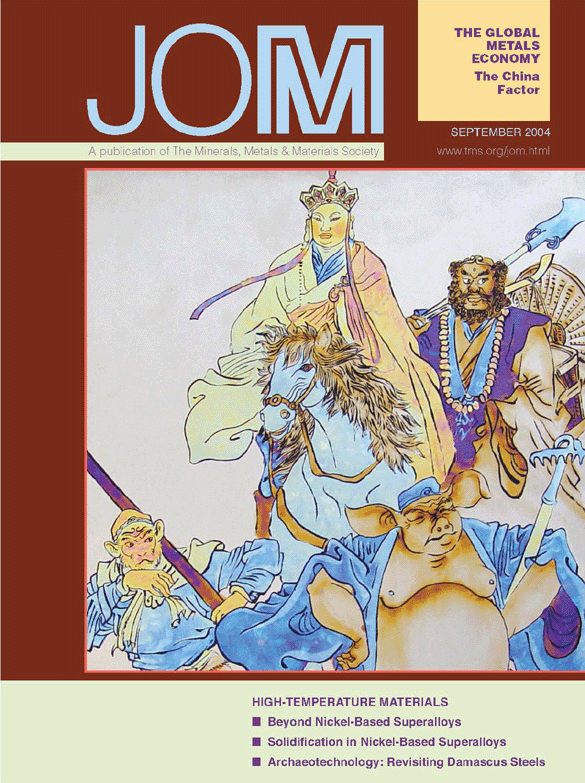
Journey to the West is Wu Ch'eng-en's vastly mythologised and embroidered fantasy, written in the mid-1500s, on the real-life journey of the 7th century Chinese monk Xuan Zang, who travelled to India and brought Buddhist scriptures back to China. A while back I found another nice picture, in anodised titanium, of the chief characters on the September 2004 cover of the materials journal JOM (like the BBC, I assume, JOM chose the story as an metaphor for East meeting West). The priest Xuanzang is escorted by Sun Wukong (Monkey, a powerful trickster-god constrained to aid him), and his companions Zhu Bajie (Pigsy) and Sha Wujing (Sandy), who are also divine and forced to atone for misdeeds by demeaning reincarnations - the former as a pig, the latter as a cannibal sand monster. Tripitaka is, incidentally, a misnomer for Xuanzang; it's not actually his name, but an honorific for priests who had mastered the Buddhist scriptural canon called the Tripitaka - "three baskets" in Sanskrit.
 The story has been retold many times. A very accessible book version I recommend is Alison Waley's Dear Monkey , which abridges down to handy paperback size the partial translation (30 of the 100 chapters) by her father, Sinologist Arthur Waley. Online, China-on-site.com has a summary and illustrated retelling. I'm not ashamed to admit that I know the story primarily from the cult Japanese TV series starring Masaaki Sakai - see Monkey Heaven and YouTube). Despite the dire special effects and peculiar English dubbing, the series was remarkably faithful to the original stories; for instance, Monkey's bizarre powers, as described in this appreciation by Matthew Craig, or the Five Pillars at the End of the Universe incident, are perfectly authentic.
- Ray
Addendum: the animation is now up at BBC Sport - see Meet Monkey.
- Ray

Journey to the West is Wu Ch'eng-en's vastly mythologised and embroidered fantasy, written in the mid-1500s, on the real-life journey of the 7th century Chinese monk Xuan Zang, who travelled to India and brought Buddhist scriptures back to China. A while back I found another nice picture, in anodised titanium, of the chief characters on the September 2004 cover of the materials journal JOM (like the BBC, I assume, JOM chose the story as an metaphor for East meeting West). The priest Xuanzang is escorted by Sun Wukong (Monkey, a powerful trickster-god constrained to aid him), and his companions Zhu Bajie (Pigsy) and Sha Wujing (Sandy), who are also divine and forced to atone for misdeeds by demeaning reincarnations - the former as a pig, the latter as a cannibal sand monster. Tripitaka is, incidentally, a misnomer for Xuanzang; it's not actually his name, but an honorific for priests who had mastered the Buddhist scriptural canon called the Tripitaka - "three baskets" in Sanskrit.

- Ray
Addendum: the animation is now up at BBC Sport - see Meet Monkey.
- Ray
Subscribe to:
Posts (Atom)