Showing posts with label lurid. Show all posts

Thursday, 6 January 2011

Lonely Road


I suppose this comes under the lurid cover category: the rather vigorous Pan Books cover for Nevil Shute's 1932 Lonely Road, one of his early novels. It's somewhat cross-genre - a thriller, with elements of tragic romance, set against the discovery of a conspiracy:
She was a dance Hostess in a grimy Northern town, a professional partner for lonely men—
He was rich, an ex-Naval Officer and a bachelor—
Linking their fates, a burning lorry that had carried a cargo of guns...
Malcolm Stevenson is a ex-naval officer, a loner haunted by his experiences during the sinking of his Q Ship in World War 1, who runs a small fleet of schooners out of Dartmouth. On a drunken night drive, he stops to stroll down to the seashore near Slapton, and sees a boat being unloaded. He speaks briefly to a young woman, who evidently thinks he's someone else, but is then knocked on the head, and wakes up in hospital to be told he had a motor accident. Pursuing the incident via family and Intelligence contacts, he learns of other associated incidents - particularly the find of a burnt-out lorry containing unbadged guns - that suggest he ran into a gun-running plot. By extreme coincidence, on a visit to Leeds, he befriends Molly Gordon, a young dance hall hostess nicknamed "Sixpence", whose lorry-driver brother has been involved in some shady dealings, and he suspects a connection. He takes her to Devon, initially as a possible information source, but as his investigations proceed, he falls in love with her, while realising that an even deeper conspiracy exists, apparently to land agents in Britain. This leads to an attempt on his life by shooting, which leaves him unscathed but injures Molly and one of his colleagues. Stevenson pursues the perpetrators by boat under worsening sea conditions, and deliberately manoeuvres them into a position where they are wrecked. Returning, he finds Molly severely ill, and she dies of an infection. Later, he confronts the mastermind of the plot - a Professor Ormsby at Cambridge who wishes to rig the British election in favour of the Conservatives - and offers him the choice of exposure or suicide. Ormsby chooses the latter. Stevenson, content with the political outcome at least, returns to work; but, the framing device tells us, goes on to die prematurely at 39 ... perhaps of his war injuries, but (it's implied) more likely of a broken heart.

Shute attempts some innovative writing quite successfully, when in the first chapter Stevenson, on the drunken evening out that leads to his encounter with the smugglers, goes through stream-of-consciousness scene shifts between present and past. In the preface he writes:
The first chapter was quite frankly an experiment, and one which pleases me still. It was a dangerous experiment, however, for a young writer to make in the first pages of a book, for it defeated a good many readers who might have enjoyed the story if they had been able to read on. In spite of this the book did moderately well in this country and in America. In 1936 a film was made from it at the Ealing Studies, starring Clive Brook and Victoria Hopper.
It's also, for location spotters, a novel of Devon interest, especially if you like maritime matters. Unfortunately I've lost the correspondence, but a few years back I discussed with a Nevil Shute enthusiast possible locations for the incident in the first chapter: a bend in the Dartmouth to Slapton Road where pasture leads down to sandhills and the sea. The road and beach profile has almost certainly changed from the time Shute wrote it - pre-WW2 - but somewhere near Strete Gate looks plausible.


View Larger Map

- Ray

Wednesday, 10 March 2010

Best of times... (1)

I've been re-reading John Brunner's 1962 Times Without Number - an example of the many excellent books that are out of print. It's a take on the SF set-piece of a time-travelling empire: a world in which the Spanish Armada wasn't defeated and in 1988 the world is dominated by a Spanish Empire under His Catholic Majesty Philip IX. Time travel (but only into the past) has been discovered, and is closely guarded by a Jesuit-like order, the Society of Time. Its research use is intermingled with the ritual: inaugurated Popes are taken back to see Jesus (from a safe distance where their presence won't interfere with Biblical events), and one of the Society's sacraments is a mass attended by all its members, past and present.

It rapidly becomes clear that this setup is an extremely shaky edifice, revealed progressively though the three novellas forming the book (a  revision and expansion of the 1962 Ace version, itself a compilation of segments that first appeared in Science Fiction Adventures). The first introduces the hero, Don Miguel de Navarro, as he investigates the illicit removal of a golden Aztec mask from its maker's workshop in the past, and finds there is considerable corruption in the use of the time apparatus. In the second, a royal reception is disastrously interrupted by the appearance of a group of lethal Amazon warriors from the court of "King Mahendra the White Elephant" in an alternative timeline. This forces the revelation to Don Miguel that the Society of Time conducts dangerous secret experiments in altering the past, then changing it back. In the third, Two Dogs, a disgruntled nationalist from the Mohawk Nation, threatens to break the Treaty of Prague - an international moratorium on time warfare - putting the whole fabric of the Empire at risk by striking at its key historical event, the Armada.

As I said, the basic time-empire premise isn't wildly uncommon in SF, and this is essentially a paste-up pulp SF novel. But Brunner puts a superior spin on it, not least through the implied comparison between his world and the real one. There is, for instance a deep irony in that we know that the Mohawk Nation fared considerably worse in the future Two Dogs wants (in fact our real-world history) than in the Times Without Number one, where it retains far more of its culture as an ally of the Spanish Empire. There's even the suggestion that a time war may already be happening; like one or two other reviewers, I strongly suspect that the enigmatic "Earl of Barton" who masterminded the Armada's success might himself be from the future. Nor is the ending entirely closed.

click to enlarge

The variants in cover art are interesting. Personally I find the 1969 Ace one (main image and above right) the best of the bunch. Of the other Ace editions (see Coverbrowser.com here and here) the one of the Conquistador in the time apparatus - in the book this is a lattice of iron and silver bars - with the golden mask vaguely shown behind, isn't bad; the one showing what appears to be an Aztec warrior among badly-organised washing poles is pretty lame (as is the Beware of the Masters of "If" teaser used for both). The Hamlyn one focuses on the Amazon warrior episode, though completely inaccurately, as in the book they're not Goth Satanists; one in the book wears skimpy blue feathers, yellow skin-paint, beaded wristbands and red shoes (indeed it's hard to see why Ace, specialists in lurid covers, didn't spot the opportunity). The Ballantine Roman-on-a-racehorse one loses the plot completely.

- Ray

Monday, 31 August 2009

Vampires, lesbian and otherwise

In the previous post I mentioned Coleridge's Christabel. The story in brief: the virtuous Christobel goes into the woods to pray and encounters another young woman, Geraldine, who tells the rather implausible story of having been abducted by a band of rough men who brought her to the forest then ... went away. Taking pity on her, Christobel takes her to the castle of her dad, Sir Leoline. The dog, ominously, since dogs can detect evil, howls in its sleep. At bedtime, Geraldine goes all lesbian, then puts Christobel under a spell not to report that bit, only the abduction story. Next morning, Leoline arrives and is instantly besotted with Geraldine. His bard Bracy tells of a spooky dream he had of Christobel being in danger, but Leoline won't hear it, nor Christobel's warnings, which he takes as jealousy - and in any case Geraldine's spell zaps her into a trance that stops her explaining in detail. And there it ends.

I suspect whatever was going on with Coleridge was satisifed by writing the sexy bit, hence his failure to complete it. Tupper's Geraldine is bit ghastly, but provides a rationale in Geraldine being the daughter of an evil hag, Ryxa, and that she has it in for Christabel for stealing her boyfriend. A deal has been written about what Coleridge might have meant by Christabel (see Coleridge's "Christabel" and the Phantom Soul and Samuel Taylor Coleridge's Christabel: Vampires and Transsexualism) but it boils down to being the first lesbian vampire story. Geraldine may not drink blood, but she's certainly a psychic vampire of some sort. Christabel is widely credited as the inspiration for Sheridan Le Fanu's 1872 Carmilla. Apart from in turn inspiring Bram Stoker's Dracula, Carmilla herself inspired a long line of largely naff lesbian vampire movies of which the 2009 comedy thriller Lesbian Vampire Killers is the latest (for others see Top 10 lesbian vampire movies at Den of Geek). Wikipedia's Lesbian vampire article cites Vampires & Violets: Lesbians in Film (Andrea Weiss, 1993) - see review - in viewing the trope as a coded means of handling the taboo theme of lesbianism outside the heavily censored realm of social realism. I don't know. That seems plausible for early cinema, but the persistence into the period of exploitation genre doesn't seem to be anything as subtle.

This is mainly an excuse to segue into a list of my personal favourites in the vampire movie genre. Emphatically not Interview with the Vampire: The Vampire Chronicles (I found the film a drag and the Anne Rice book even more so), nor Bram Stoker's Dracula (highly competent as an adaptation but suffering from Hollywood's perpetual obsession to add backstory and upbeat endings). I've no opinion of Twilight or the original Stephenie Meyer book, having seen neither; but I'm happy to accept the recommendation by Olivia (who works here, and is not stupid) who tells me the book is very good, a thoughtful novel using vampirism as a metaphor for teenage alienation. The list, then, is of movies that break away from the usual vampire-movie fare. All of them, except Mr Vampire, weren't box office successes on initial release, but have since acquired cult status.

  • Mr Vampire (1985). A highly inventive comedy horror made in Hong Kong, merging martial arts, Chinese mythology and Western vampire tropes (for instance, sticky rice replaces garlic, and the vampires are hopping Jiang Shi). See trailer.
  • Near Dark (1987). The vampire mythos transplanted to modern rural US Midwest, with vampires (never named as such) as a travelling group of outlaws into which a farmboy is initiated when he is "nipped". It's directed by Kathryn Bigelow, who wanted a Western that broke away from convention, and the strong cast is drawn from James Cameron regulars (Lance Henriksen, Jenette Goldstein and Bill Paxton). Again, it's fresh and inventive: caught in a motel during a shootout, the band find themselves in deadly danger not from the police bullets but the shafts of sunlight let in by the bulletholes. See trailer.
  • Shadow of the Vampire (2000). A lovely conceit retelling Murnau's filming of the classic Nosferatu, in which Max Schreck (playing Count Orlok) really is the vampire he portrays. Murnau keeps this from his cast and crew with the fiction that Schreck is an obsessive method actor. See trailer.
  • The Hunger (1983). OK, a bisexual vampire is a central character, but that's incidental to this beautifully stylish, modern-set examination of the ennui of eternal life. It introduced me to Schubert's Trio in E flat, Opus 100, and I've yet to hear a better arrangement. See trailer.
  • Lifeforce (1985). Much ridiculed for actress Mathilda May's permanent nudity as an alien vampire, it bears not too much resemblance to its source Colin Wilson's novel The Space Vampires (itself drawing more than a little on AE Van Vogt's Asylum). Nevertheless, Lifeforce is a taut Quatermass-style SF thriller about an apocalyptic contagion designed to funnel life energy from the whole of London to feed the occupants of an alien spacecraft. See trailer.
I guess the trailers mostly count as examples for my "lurid" list in their invariable focus on the action sequences. The Hunger particularly is far less energetic a film than you'd imagine from its trailer.

(This topic surfaced from the sludge in response to twin themes of vampires and squid raised in the fossil squid story. The umbrella-like section of the alien ship in Lifeforce is rather clearly based on the tentacle section of the Vampire Squid. Its name, Vampyroteuthis infernalis - "vampire squid from hell", not to be confused with HG Wells' Haploteuthis ferox - is rather undeserved; while it's a bit scary in appearance, it's a marvel in its multiple adaptations to live in dark, cold, and almost foodless and oxygenless waters. See videos from Planet Earth and National Geographic).
- Ray

Thursday, 6 August 2009

Lurid covers 5: Dell Books

I just encountered by accident a site where I could fritter away hours: Cover Browser, a compendium of "450,000+ covers of comics, books & more". The books section alone is vast, or even just the couple of thousand Dell Books covers, which are generally sensational.

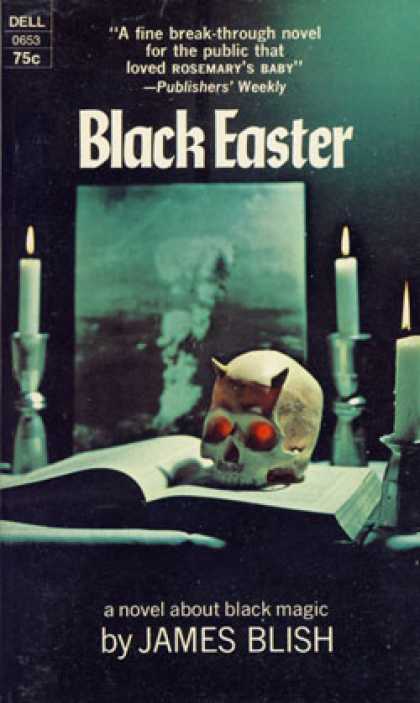
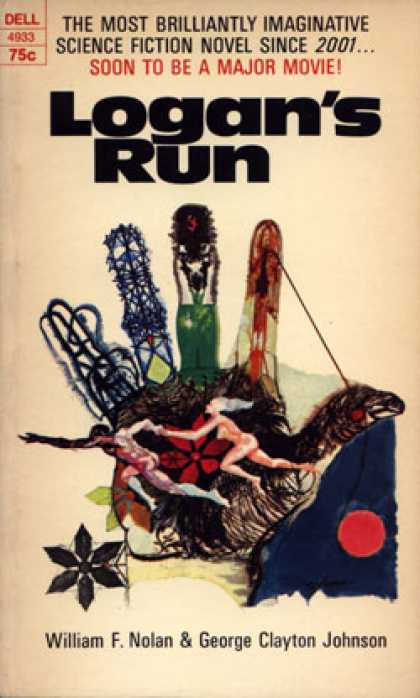
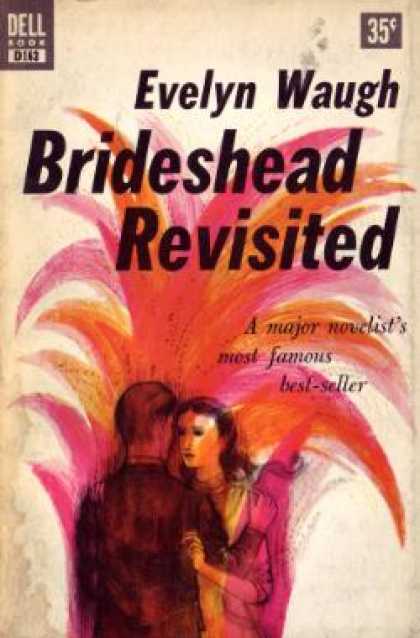
Unlike some publishers of this era, they did mostly manage to drop out of lurid mode for the occasional classics they published, though you wouldn't quite get the flavour of James Blish's Black Easter from this. The cover design is a bit naff but not wildly wrong about the content, but the blurb portrays Blish's tight and theologically literate SF thriller (nuclear Armageddon played out taking the premise that the divine and satanic pantheon exists, and that the magic of mediaeval grimoires works as hard technology) merely as "a novel about black magic" that'll appeal to to readers of Rosemary's Baby. Those readers would also be surprised/baffled by the sparkling literary fireworks of Angela Carter, whose The Magic Toyshop gets the same miscomparison. Logan's Run: good marks apart from the inexplicable nudity of the runners. Brideshead Revisited: some kind of fountaining passion is implied, and the description - "A major novelist's famous best-seller" - suggests the blurb-writer didn't have much idea how to sell Waugh's saga of aristocrats and Catholic angst. Ubik: this is the one Dr C posted a while back, fairly incomprehensile pyschedelia apart from the identifying Ubik spray-can.

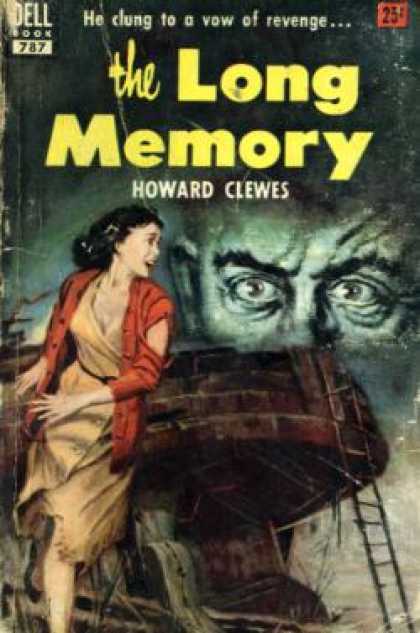
I ran into Cover Browser looking for Howard Clewes' novel The Long Memory (Dell cover here). I enthused about the film a while back - see Noir and the North Kent marshes - but just ran into a nice addendum, the full-chapter Google Books preview on the book and film from The cinema of Britain and Ireland (Brian McFarlane, Wallflower Press, 2005, ISBN-10: 190476438X).

- Ray

Thursday, 4 June 2009

Lurid covers 4: legs and other cliches

An Unreal Nature's post Covering anatomy, led me to the online edition of Print

a bimonthly magazine about visual culture and design. Founded in 1940 by William Edwin Rudge, Print is dedicated to showcasing the extraordinary in design on and off the page.

The back issues of Print have a nice selection of articles on books, culture, design and typography. See, for instance, The Law of the Letter (typography's role in shaping nations); Stereotypes (the role of "ethnic typography"); Extraordinary Meeples (design in post-WWII German boardgames); and Cover Girls (the ongoing rebranding of young-adult novels for new generations of readers). Anyhow ... the Unreal Nature link was to One Leg Leads to Another (Steven Heller, Print, June 2008) which documents a cliche of graphic design that Heller calls the "A-frame": covers and posters using the device of framing a scene with someone's spread legs. More discussion on this at She's Got Legs. (So Does He) in the Boston Globe's Brainiac column. Between My Legs, at the generally interesting TV Tropes (Television Tropes & Idioms) notes that it happens in TV format too.

The A-frame is one of many design viruses. See Swoosh! There It Is. In Fact, Swooshlike Logos Are Everywhere for another that many web designers for dotcoms were guilty of a few years back. The Papyrus font is yet another, current, one.
- Ray

Tuesday, 26 May 2009

Lurid covers 3: Leonardo

"The first and only novel written by one of mankind's ranking geniuses..." - San Francisco Chronicle

From the monumental works of Leonardo da Vinci have come some of the most thrilling discoveries of all time - among them the manuscript for The Deluge, a powerful and violent story of life and love in a time of blazing turmoil and savage upheaval.

One man... Two women... haunted by terror, pursued by destruction, caught up in the coils of desperate mob frenzy, of unfulfilled desires, of the primal hunger for survival...


This - click image to enlarge - is the blurb of The Deluge, Leonardo da Vinci, edited by Robert Payne, Lion Books, 1955. For those who missed out on this particular work of Leonardo, the small print for this curiosity says that it was put together by fleshing out material from Leonardo's enigmatic letters to "Diodario di Soria": see The Notebooks of Leonardo da Vinci, Drafts of Letters and Reports referring to Armenia, 1336 / 1337. These provide an outline and sketchy plot details of the destruction of a city by a deluge.

THE DIVISIONS OF THE BOOK

* The praise and confession of the faith
* The sudden inundation, to its end.
* The destruction of the city.
* The death of the people and their despair.
* The preacher’s search, his release and benevolence
* Description of the cause of this fall of the mountain
* The mischief it did.
* Fall of snow.
* The finding of the prophet.
* His prophesy.
* The inundation of the lower portion of Eastern Armenia, the draining of which was effected by the cutting through the Taurus Mountains.
* How the new prophet showed that this destruction would happen as he had foretold.

Payne appears to have filled this out with further detail from the variety of notes and drawings on the concept of a deluge that Leonardo made toward the end of his life. See, particularly, The Notebooks of Leonardo da Vinci, VIII Botany for Painters and Elements of Landscape Painting, Of depicting a tempest, items 606 / 607 / 608.

In the editor's note, Robert Payne writes that other material came from the fictional Sir John Mandeville's account of the use of carrier pigeons between Syria and Cilicia. The three main characters, Thresylla, Cecilia and Andreas, "are, of course, imaginary, and Father Anastasio has been introduced on the basis of a single sentence in the notebooks". The cover has a slight resemblance to Leonardo's sketch Deluge over a city, and the book is actually quite readable, seriously intended, and a clever (if short) execution of Leonardo's idea.

See the Robert Payne Collection, Stony Brook University, for more on Payne, who was a prolific and erudite writer on historical topics. His Times obituary on Feb 23, 1983 says of him, "He was, more than anything, a phenomenon of prolificity; probably no author of this century has produced so many books at such a relatively high level of scholarship" (see the bibliography). Cool guy...

Pierre Stephen Robert Payne was born on December 4, 1911 in Saltash, Cornwall, England; came to the U.S. in 1946; attended Diocesan College, Rondebosch, South Africa (1929-30), University of Capetown (1931-32), University of Liverpool (1933-36), University of Munich (1937), and Sorbonne, University of Paris (1938); was shipwright's apprentice, Liverpool (1932-33), shipwright (1939-41) and armament officer (1941), Singapore Naval Base; translator, British Ministry of Information in Chungking, China (1941-42); professor of English poetry and lecturer in naval architecture (1943-46); head of English department, Alabama College, Montevallo (1949-54); war correspondent in Spain (1938), and correspondent for the Times of London in Changsha, China (1942); was founding director of Columbia University Translation Center; wrote more than 100 books in a variety of subjects; publications include Love and peace (1945), Forever China (1945), China awake (1947), The rose tree (1947), A house in Peking: a novel of 18th-century China (1956), and Lawrence of Arabia: a triumph (1962); he died on February 18, 1983.

- Finding Aid for the Robert Payne Papers, 1946-1964, Online Archive of California

... and perhaps it's a pity The Deluge was packaged in that way. Then again, would I have spotted it and read it?

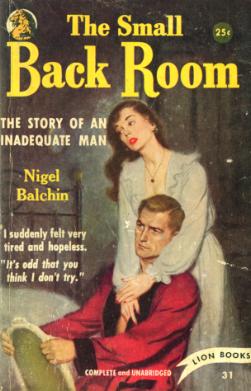
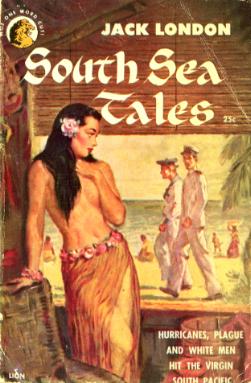
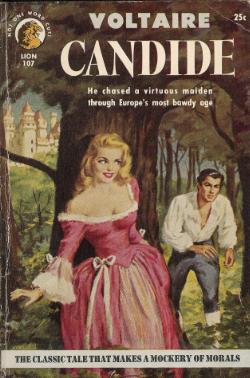
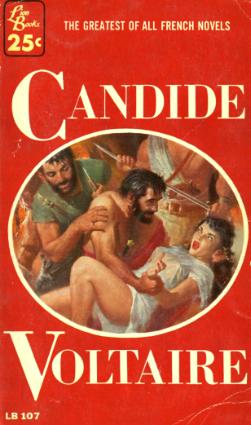
See BookScans for many more examples of pulp covers from Lion Books, which mostly focused on sensational novels, but occasionally tackled classier works, such as Shirley Jackson's The Lottery, Nigel Balchin's The Small Back Room, Erich Maria Remarque's All Quiet on the Western Front, Jack London's South Sea Tales, Voltaire's Candide (a quite restrained cover), Mary Shelley's Frankenstein, Fritz Leiber's Conjure Wife, Graham Greene's Nineteen Stories, and Candide again (less restrained version). The Deluge (Lion #233) appears to be the last published title in its 25cents series.
- Ray

Monday, 25 May 2009

Lurid covers 2: SF

click to enlarge
In response to an ongoing discussion of 60s paperback covers and their surreal/lurid misrepresentation of contents - see Dr C's Front Covers - and Felix Grant's Judging a sardine by its can - here are a few more.

Top: Babel-17, Samuel R Delany, Sphere Books, 1969. This one's at the level being able to see the relevance once you know which book it is. The scenario is one in which the Sapir-Whorf Hypothesis - "language shapes thought" - turns out to be literally true when the poetess and linguist Rydra Wong is asked to investigate Babel-17, an enemy code which appears linked to acts of sabotage. The linguistic theme explains the A-Z overlay, but Rydra Wong never gets naked.

Middle: Robert Silverberg's Hugo-winning Nightwings (Sphere Books, 1974). This is a superb novel about a group of pilgrims to "Roum" in a far-future world disrupted by a man-made climatic apocalypse. Silverberg skilfully evokes the long passage of time through the erosion of placenames - Roum, Perris, Stralya, Hind, Agupt, Jorslem, and so on. The cover isn't wildly inaccurate; it depicts Avluela, a genetically altered "Flier" who can only fly at night (hence the book's title) and has to divest herself of all weight to do so. This modification, however, is achieved at the expense of being more than anorexically thin, so the cover Avluela is considerably overweight. The cowled character is the Prince of Roum, who has cybernetic eyes after being blinded.

Bottom: Keith Laumer's A Trace of Memory (Mayflower Paperbacks, 1968). This one is just plain surreal, apparently inspired by memories being in the head, but to be fair, I think the book is quite difficult to encapsulate in a single image.

It's one of Laumer's more interesting ones. After a prologue, in which a space traveller is marooned among primitives, it moves to the present and introduces Legion, a typical Laumer hardboiled clever loner, who is hired by a Mr Foster. The latter has two problems, amnesia and being pursued by some kind of sentient ball-lightning. The story takes an epic turn when it turns out that Foster is the marooned traveller, who has been around a long time, long enough to have tried to fast-track human civilisation by modelling it on that of his own planet, Vallon, where the Rthr rules from the Great Ringboard at Okk-Hamiloth. With Legion's help, he manages to call the shuttle of an orbiting starship to its landing ring (Stonehenge - see the cover of the collection Legions of Space) and returns home; but Legion, forced to follow after his marketing of Vallonian technology attracts goverment attention, finds everything on Vallon has changed. Its space-faring civilisation has collapsed to medium-tech feudalism after loss of the technology that kept a continuity of memory across Vallonians' periodic memory-wipe rejuvenations, and Legion finds he has to work his way up from slave status. The scenario doesn't bear terribly close examination: for instance, is Legion really doing the Vallonians a favour? Their society, though feudal, is egalitarian: anyone can work their way by skill/talent up the social pyramid to the highest level. But he has restored a static culture based on a fixed feudal hierarchy and near-immortality (nice for the Rthr and his cronies, but not for the guy who's the permanent stable-sweeper). But it's a good yarn.

- Ray

Wednesday, 13 May 2009

Lurid covers 1: classics

click to enlage
To be fair, one of the commenters on William Moulton Marston’s OTHER pastime warns that we shouldn't judge a book by the trashy cover style of its era. Point taken. As examples - found variously on the Web - check out the adjacent pulp versions of a few classics. There may, however, be more to these than meets the eye: the Frankenstein appears to allude to Fuseli's The Nightmare, and the Brave New World to many "expulsion from Eden" paintings; I can't see any justification for the 1984 interpretation, though.

I found the slightly lower-key, but still pulpy, 1960 Signet 1984 at Survival Arts, and some others at the Three Farms culture blog: Arthur Miller's Focus and Salinger's The Catcher in the Rye. With such real-world efforts, it seems scarcely necessary for Slate magazine to have commissioned a series of spoof covers, The Pulp Canon. Does anyone know of any other real examples?

To rinse away the pulpy flavour, check out the much-publicised The Art of Penguin Science Fiction site for its showcase of the striking and stylistically varied artwork of Penguin SF over the decades. Some are iconic, such as David Pelham's cover for the 1972 edition of A Clockwork Orange; others are not quite there, such as the John Griffiths The Day of the Triffids cover; I can't decide if the triffids look more like kiwi fruit, testicles or ... whatever the plural is of gömböc. (Ed: "Gömböcok", I'm told).

By the way (see left) the 1984 pulp cover is interesting for a number of reasons: I'm pretty sure the little figure staring into Julia's cleavage is a cameo appearance by Orwell himself. The hairstyle in particular is is pretty distinctive. Does anyone have a larger scan?

Talking of 1984, see George Orwell: An Exhibition from the Collection of Daniel J. Leab for a nice Orwell bibliographic collection. See also: Predictions. I'm still looking (unsuccessfully so far) for a confirming example of the claimed Bennett Correspondence College "Let me be your big brother" ad. (To Anon: yeah, I know Burgess says it existed, and the "Let me be your father" version is verifiable: I'm looking for a primary source of the "big brother" variant).


Addendum: sorry, having seen the efforts at Slate, I couldn't resist.

- Ray