
Showing posts with label dawlish. Show all posts
Showing posts with label dawlish. Show all posts
Monday, 4 May 2015
Thomas Dalling Barleé in Dawlish and elsewhere

Saturday, 2 May 2015
South Devon Railway: 1844 NIMBY list

Sunday, 11 January 2015
Shell Cove - development?

Thursday, 25 September 2014
Langstone Rock - to the smugglers' caves (perhaps)

Monday, 22 September 2014
Langstone Rock - live visit

Tuesday, 5 August 2014
Legend Land: another Barham

Tuesday, 13 May 2014
Billie Millin / Dawlish Museum
I can't remember the precise date on this, but I visited Dawlish Museum some time mid-summer 2014, and a very good town museum it is.
With 11 rooms over 3 floors, the museum is most famous for its display of Piper Bill Millins D-Day bagpipes. The displays in Dawlish Museum are regularly updated and depict life past and present in the town and notably tell the story of the February storm of 2014 which severely damaged the railway line. A vast archive of 100's of rare historical photographs can be seen in both album form or on the new library P.C.As may be well-known by now, the celebrated bagpiper and soldier William "Bill" Millin - the personal piper to Simon Fraser, 15th Lord Lovat, commander of 1 Special Service Brigade at D-Day - retired to Dawlish in 1988, and his bagpipes and an associated display form a central part of Dawlish Museum.
Children as well as adults are well catered for and there are many fun activities just for them such as the dressing up outfits and the Black Swan Trail. The Museum is entirely run by volunteers, is self funding and recently proudly gained official accreditation.
Dawlish Museum's collections of topographic material, such as old photographs and postcards, are excellent. Although the Museum has a no-photo policy, I had a very useful discussion with Andrew Wright, one of the Museum volunteers, about the use of a virtually uncredited postcard image of the "Clerk" a.k.a. Shag Rock for a debunking pamphlet. (I'm now confident that the "Parson and Clerk" legend has no precursor or basis in folklore, but comes entirely from a very literary anonymous short story in the 1848 anthology Legends of Devon - one of a series of which a Notes & Queries correspondent described as: "each and all original whims of the moment, and not reproductions of popular legends").
- Ray
Friday, 14 March 2014
Parson's Tunnel and The Ocean Sleuth
 |
| The Parson from Lea Mount - 4th March 2013 |
Tuesday, 11 March 2014
Sea Lawn Gap: déjà vu at Dawlish
 |
| Sea Lawn Terrace, Dawlish, 4th March - click to enlarge |
Friday, 19 July 2013
Coast: Teignmouth to Dawlish
Further to Shaldon: sea, sand, and subterranea: a few more impressions of Teignmouth. Like many southern resorts, it's a mix of styles; once you get away from the obvious resort frontage, it has a much older section at its southern end, leading to its working harbour and Back Beach, where houses back directly on to the Teign's shore. I've been meaning to visit for a long time, and was pleased to find it hadn't been concreted over; the recently-completed tidal flood defences looked pretty unobtrusive. I won't write in any detail on this: instead, I recommend checking out Angela Williams' detailed accounts at her Literary Places blog: In the footsteps of John Keats / Keats at Teignmouth / More on Keats at Teignmouth.
Click any image to enlarge
Considering the temperature being well over 80°F, a walk perhaps wasn't the greatest of ideas, but I stocked up with plenty of water and finished the afternoon by following the South West Coastal Path to Dawlish. It's a slightly fragmented section, diverted inland by general terrain, the railway, and residential development (various upmarket clifftop houses), but it's still of interest.
The first stretch runs along the sea wall, parallel to the railway, as far as the promontory Hole Head. There the railway goes into Parson's Tunnel, and the Coastal Path diverts inland up Smuggler's Lane. A number of accounts - I've not been able to track a primary source - have variants on this ...
There is a slight literary connection here: Maurice Drake's 1915 The Ocean Sleuth is a crime novel concerning, in part, the switch of a batch of real and counterfeit notes from a train stopped in the Parsons Tunnel. It's worth checking out for the detailed description of the narrator's exploration of the railway and its tunnels in aid of solving the mystery: see the Internet Archive ID oceansleuth00drakrich.
Click any image to enlarge
Smuggler's Lane ascends steeply up to the main Teignmouth-Dawlish road; you follow that for a little, past the private enclave of Holcombe Drive, and then you can either follow the road (I did) or rejoin a coastal section that soon returns to the road. Just before you reach Dawlish, the path leads into a little park at the top of Lea Mount, which has great views back to the Parson and Clerk, and forward toward Dawlish.
Click any image to enlarge
From the park at Lea Mount, you can then take various landscaped paths down to the sea wall at Dawlish, and then on to the railway station.
Click any image to enlarge
A geographical/historical note: it's interesting as a contemplation on changing attitudes to consider the reaction if someone suggested nowadays cutting a major railway route - this is the classic 'Riviera Line' - through coastal scenery, and considerably unstable coastal scenery at that. Brunel's route ran into problems from the start - the Morning Chronicle documented a landslide blocking the line near Smuggler's Lane in December 1852 - and this has continued ever since. See Landslips on the Teignmouth to Dawlish Line at Devon Heritage: part 1 / part 2 / part 3.
The railway wasn't all that's been affected. These are more or less the same strata as those which collapsed with the destruction of Ridgemont House at Babbacombe (see An afternoon in Torquay #1), and there's been repeated coverage of a similarly threatened house above Horse Cove in Dawlish (see Huge landslip leaves £1.75 million luxury cliff-top mansion closer to the edge, This is Cornwall, February 10, 2011). I don't know what Horse Cove looks like now, but I visited it in August 2007, before the recent landslips. It's not normally accessible on foot, but at low tide I waded round from the public beach at Coryton Cove. Apart from a sea cave and various drainage outflows, it had an interesting, but inaccessible, entrance in the cliff. I've no idea of its purpose, but I'm not assuming smugglers.
The landscaped paths down Lea Mount to the sea wall at Dawlish date from the late 19th century and remodelling to stabilise the cliff after a tragedy. This pre-1885 view - Dawlish, Rocks and beach, Coryton's Cove - from Francis Bedford's Devonshire Illustrated stereoscopic series shows an accident waiting to happen: a high-tide path, running under an overhang, used by swimmers visiting the "gentlemen's cove", as it was called (bathing was segregated) . The 1869 Cornelius's guide - Dawlish has a contemporary description of the spot (see page 46).

Following unheeded warnings from the Reverend RHD Barham, rocks above the overhang collapsed in 1885, killing three of a party of women and children preparing for a picnic lunch.
See the Devon History Society weblog - 1885: Dawlish "death trap" - for a fuller account.
- Ray
Click any image to enlarge
|
|
||||
|
|
||||
|
|


Considering the temperature being well over 80°F, a walk perhaps wasn't the greatest of ideas, but I stocked up with plenty of water and finished the afternoon by following the South West Coastal Path to Dawlish. It's a slightly fragmented section, diverted inland by general terrain, the railway, and residential development (various upmarket clifftop houses), but it's still of interest.
The first stretch runs along the sea wall, parallel to the railway, as far as the promontory Hole Head. There the railway goes into Parson's Tunnel, and the Coastal Path diverts inland up Smuggler's Lane. A number of accounts - I've not been able to track a primary source - have variants on this ...
According to local folklore there is a cave down near the Parson and Clerk rocks that leads to a tunnel which has an exit in the grounds of this house, Sunnylands. Rumour has it that when the railwaymen were building Parson’s Tunnel they blocked off the entrance to the smuggling tunnel.... but as I've said, I don't buy into this smuggler obsession. Historically, the well-off regularly had tunnels dug for practical and fanciful reasons (check out, for instance, the 5th Duke of Portland, the Williamson Tunnels, Undermount, and the previously-mentioned Lord Clifford of Ugbrooke). In the 19th century Hole Head saw the building of a string of large villas - Sorrento, Derncleugh, Holcombe House, Edencliff and Peak House (see Holcombe Conservation Area - Character Appraisal) - the owners of any of which might have seen the opportunity for beach access via a private tunnel.
- South Devon Railway - Discovering Britain
There is a slight literary connection here: Maurice Drake's 1915 The Ocean Sleuth is a crime novel concerning, in part, the switch of a batch of real and counterfeit notes from a train stopped in the Parsons Tunnel. It's worth checking out for the detailed description of the narrator's exploration of the railway and its tunnels in aid of solving the mystery: see the Internet Archive ID oceansleuth00drakrich.
Click any image to enlarge
|
|
||||
|
|


Smuggler's Lane ascends steeply up to the main Teignmouth-Dawlish road; you follow that for a little, past the private enclave of Holcombe Drive, and then you can either follow the road (I did) or rejoin a coastal section that soon returns to the road. Just before you reach Dawlish, the path leads into a little park at the top of Lea Mount, which has great views back to the Parson and Clerk, and forward toward Dawlish.
Click any image to enlarge
|
|
||||
|
|
||||
|
|
||||
|
|


Click any image to enlarge
|
|
||||
|
|
||||
|
|
||||
|
|


The railway wasn't all that's been affected. These are more or less the same strata as those which collapsed with the destruction of Ridgemont House at Babbacombe (see An afternoon in Torquay #1), and there's been repeated coverage of a similarly threatened house above Horse Cove in Dawlish (see Huge landslip leaves £1.75 million luxury cliff-top mansion closer to the edge, This is Cornwall, February 10, 2011). I don't know what Horse Cove looks like now, but I visited it in August 2007, before the recent landslips. It's not normally accessible on foot, but at low tide I waded round from the public beach at Coryton Cove. Apart from a sea cave and various drainage outflows, it had an interesting, but inaccessible, entrance in the cliff. I've no idea of its purpose, but I'm not assuming smugglers.
 |
| Horse Cove, Dawlish - see Geograph for attribution |

Following unheeded warnings from the Reverend RHD Barham, rocks above the overhang collapsed in 1885, killing three of a party of women and children preparing for a picnic lunch.
 |
| Fatal accident thro' the fall of earth from the rock at Dawlish Illustrated Police News, Sept 12, 1885 |
See the Devon History Society weblog - 1885: Dawlish "death trap" - for a fuller account.
- Ray
Wednesday, 21 December 2011
Downman's Infancy
Further to the previous post, Keats at Dawlish, I just managed to track down Dr Hugh Downman's 1776 poem Infancy, whose section on Dawlish ...
... makes an appearance in a number of early 19th century gazetteers whenever Dawlish is described. It's more than a little highbrow, but a testimonial is a testimonial.
To my slight surprise, Infancy turns out not to be a work of topographic or romantic poetry, but to be a medical treatise on baby and childcare in verse - Infancy, or, The management of children: a didactic poem in three books - by Hugh Downman, MD. Check it out at Google Books or at the Internet Archive, which has the 1809 six-book edition printed by Trewmans of Exeter (ID infancyormanage00downgoog).
It's pretty heavy going as a poem, and there's a good summary in this paper: Hugh Downman, MD (1740–1809) of Exeter and his poem on infant care (P M Dunn, Arch Dis Child Fetal Neonatal Ed 2003;88:F253-F254 doi:10.1136/fn.88.3.F253). From the account of the author, Professor Dunn of the Department of Child Health, University of Bristol, Infancy looks a sensible and enlightened work, that stresses breastfeeding, proper examination, avoidance of superstition, and the importance of smallpox inoculation. The paper also has a brief biography of the Devon-born Downman, whose family included his admiral nephew Hugh Downman and the artist John Downman A.R.A. WHK Wright's 1896 West-Country Poets has a fuller biography and bibliography:
I notice that the abovementioned 1809 edition of Infancy scanned by the Internet Archive has a handwritten dedication on the front page showing it changed hands in Topsham at some point in its history.
Can anyone make out those first two words?
- Ray (finding credit for the topic: Weird Materialism).
O Dawlish, though unclassic be thy name,
By every muse unsung ; should, from thy tide,
To keen poetic eyes alone reveal'd,
From the cerulean bosom of the deep,
(As Aphrodite rose of old) appear
Health's blooming goddess, and benignant smile
On her true votary; not Cythera's fame,
Not Eryx, nor the laurel boughs that wav's
On Delos, erst Apollo's natal soil,
However warm, enthusiastic youth
Dwelt on these seats enamour'd, shall to me
Be half so dear. To thee will I consign
Often the timid virgin to thy pure
Encircling waves; to thee will I consign
The feeble matron ; or the child on whom
Thou mayest bestow a second happier birth
From weakness into strength. And should I view,
Unfetter'd, with the firm sound judging mind,
Imagination to return array 'd
In her once glowing rest, to thee my lyre
Shall oft be tun'd, and to thy Nereids green,
Long, long unnotic'd in their haunts retir'd.
Nor will I cease to prize thy lovely strand,
Thy towering cliffs, nor the small babbling brook,
Whose shallow current laves thy thistled vale.
... makes an appearance in a number of early 19th century gazetteers whenever Dawlish is described. It's more than a little highbrow, but a testimonial is a testimonial.
To my slight surprise, Infancy turns out not to be a work of topographic or romantic poetry, but to be a medical treatise on baby and childcare in verse - Infancy, or, The management of children: a didactic poem in three books - by Hugh Downman, MD. Check it out at Google Books or at the Internet Archive, which has the 1809 six-book edition printed by Trewmans of Exeter (ID infancyormanage00downgoog).
It's pretty heavy going as a poem, and there's a good summary in this paper: Hugh Downman, MD (1740–1809) of Exeter and his poem on infant care (P M Dunn, Arch Dis Child Fetal Neonatal Ed 2003;88:F253-F254 doi:10.1136/fn.88.3.F253). From the account of the author, Professor Dunn of the Department of Child Health, University of Bristol, Infancy looks a sensible and enlightened work, that stresses breastfeeding, proper examination, avoidance of superstition, and the importance of smallpox inoculation. The paper also has a brief biography of the Devon-born Downman, whose family included his admiral nephew Hugh Downman and the artist John Downman A.R.A. WHK Wright's 1896 West-Country Poets has a fuller biography and bibliography:
HUGH DOWNMAN, M.D. was the son of Hugh Downman, of Newton House, St. Cyrus, Exeter, and was educated at the Exeter Grammar School. He entered Balliol College, Oxford, 1758, proceeded B.A. 1763, and was ordained in Exeter Cathedral the same year. His clerical prospects being very small, he went to Edinburgh to study medicine, and boarded with Thomas Blacklock. In 1768 he published The Land of the Muses; a Poem in the Manner of Spenser, by H. D. In 1769 he visited London, for hospital practice, and in 1770, after proceeding M.A. at Jesus College, Cambridge, he practiced medicine at Exeter, where he married the daughter of Dr. Andrew. A chronic complaint, in 1778, compelled him to retire for a time. His best-known poem, Infancy; or, The Management of Children, was published in three separate parts, in 1774, 1775, 1776; a seventh edition was issued in 1809. In 1775 appeared The Drama, An Elegy written under a Gallow, The Soliloquy, etc. During his retirement he also published Lucius Junius Brutus, in five acts (1779); Belisarius, played in Exeter Theatre for a few nights; and Editha, a Tragedy (1784), founded on a local incident, and performed for sixteen nights. These plays appeared in one volume, as Tragedies by H. Downman, M.D., Exeter, 1792. He also published Poems to Thespia (1781), and The Death-Song of Ragnar Lodbrach, translated from the Latin of Olaus Wormius (1781). He was one of the translators of an edition of Voltaire's Works, in English. In 1791 he published Poems, second edition, comprising the Land of the Muses. He was also a contributor to Polwhele's Collections of the Poetry of Devon and Cornwall.
Downman seems to have resumed medical practice at Exeter about 1790, and in 1796 he founded there a literary society of twelve members. A volume of the essays was printed [Essays by a society of gentlemen, at Exeter, 1796], and a second is said to exist in manuscript. In 1805 Downman finally relinquished his practice, on account of ill-health, and in 1808 the literary society was discontinued. He died at Alphington, near Exeter, September 23, 1809, with the reputation of an able and humane physician and a most amiable man. Two years before he died, an anonymous editor collected and published the various critical opinions and complimentary verses on his poems, Isaac D'Israeli (1792) being among them.
- pp 158-159, West-Country Poets, WHK Wright, 1896: Internet Archive ID westcountrypoet00wriggoog
I notice that the abovementioned 1809 edition of Infancy scanned by the Internet Archive has a handwritten dedication on the front page showing it changed hands in Topsham at some point in its history.
[words unclear] respectful compliments to Mrs Hoskins, and begs her acceptance of this poem. Topsham, July 1820.
Can anyone make out those first two words?
- Ray (finding credit for the topic: Weird Materialism).
Tuesday, 20 December 2011
Keats at Dawlish
Wayland Wordsmith just featured a nice poem - The Rosy bosom'd Hours - by the little-known Coventry Patmore, which tells of the rail journey of the newly-wed Patmore his second wife from somewhere in southern England (probably from East Grinstead, where Patmore had an estate) via Havant, Salisbury and Dawlish, down to Penzance.
Sunday, 6 March 2011
Dawlish coves
 |
| Horse Cove, Dawlish |
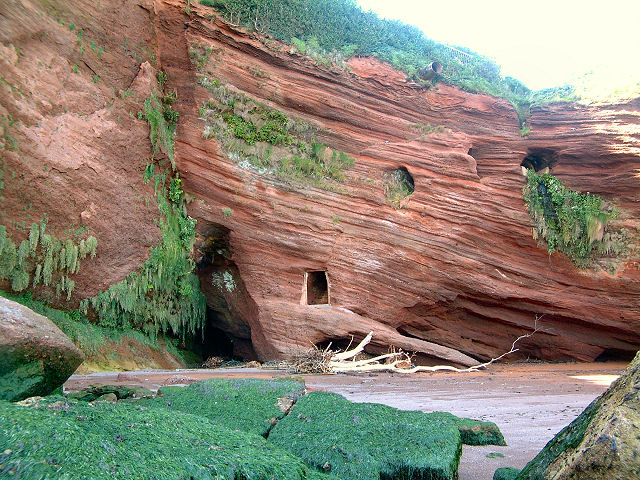
Another spot of local geography: Horse Cove is a small and usually inaccessible cove at Dawlish between Coryton Cove and Shell Cove. I took the above picture (now at Geograph) when I walked round at low tide four years ago.
I just spotted that the newspapers had some excellent aerial shots in February, notably the Daily Mail - see the second image in The £1.7m house whose sea view just got closer: Home at cliff edge as 15ft garden disappears after landslide (10th February 2011) - concerning the precarious position of a clifftop house above the cove following recent cliff falls.
The whole changeability of the coast extends to placenames. A look at Ordnance Survey maps up to the mid-1900s - see Old Maps - shows the above location unnamed, and Horse Cove is what is now called Shell Cove. Shells do figure in older accounts: an article on Teignmouth and Dawlish in The Bristol Mercury and Daily Post for June 16, 1884, says:
The Cowrie cove, or shell beach, just beyond Coryton Cove, is a favourite for ladies; it can only be reached at low water, or through the private tunnel.
Shell Cove just seems to have solidified as a placename over the past century. Other location names have been more durable: Coryton Cove (aka Coryton's Cove) was named after the Corytons, landowners who lived at Cliff Cottage above the cove (see page 308, A complete parochial history of the county of Cornwall). As I mentioned at the DHS blog - 1885: Dawlish "death trap" - Coryton Cove was also called the Gentlemen's Cove, because of its historical use for segregated male bathing. The three railway tunnels nearest Dawlish were similarly named after the respective landowners: the Coryton tunnel after Jane Coryton; the Phillott after the Rev. Charles Phillott, of the Clevelands; and the Kennaway after Mark Kennaway, who owned Lea Mount, the promontory through which the tunnel runs (see the Dawlish Community Trust flyer).
A feature of Horse Cove that intrigues me is the rectangular tunnel entrance with steps leading up. At the time I visited it wasn't accessible; the ledge leading up to it had eroded too badly. Where does it go? Is it to do with the railway or was it the abovementioned "private tunnel" to the beach?
- Ray
Friday, 3 December 2010
Mackenzie Edward Charles Walcott
It's one of my mild bibliographic ambitions to identify the anonymous authors of the 1848 Legends of Devon, the book that kicked off the locally-set story (now enshrined as regional legend) of the Parson and Clerk at Dawlish (see Parsons unknown). No luck so far, but in passing I ran into the works of Mackenzie Edward Charles Walcott, 1821-1880.
A particular work, available in full through Google Books, is his 1859 A guide to the South coast of England, from the Reculvers to the Land's end, and from Cape Cornwall to the Devon foreland. It's highly readable, sometimes entertaining, sometimes geeky and completist. In skimming the local sections, I noticed the cold dead hand (then warm, I guess) of Legends of Devon in a couple places, as in the section on Dawlish where The Legend of the Parson and Clerk - a "legend" written only 11 years previously - gets an outing (page 428) and the sub-Shakespeare The Legend of Babicombe Bay gets upgraded to "fairy tale" (page 443). In both cases, the source is uncredited despite the specifics showing Legends of Devon to be the primary source.
According to the Oxford Dictionary of National Biography, Walcott was a career clergyman with a strong sideline in antiquarian and ecclesiological subjects:
Nevertheless, I'm overall inclined to like Walcott's work. I couldn't agree more with the outro in all of his regional guides, where Walcott quotes these lines - further good advice to any weblog maintainer - in praise of finding continuing fascination close to home.
A particular work, available in full through Google Books, is his 1859 A guide to the South coast of England, from the Reculvers to the Land's end, and from Cape Cornwall to the Devon foreland. It's highly readable, sometimes entertaining, sometimes geeky and completist. In skimming the local sections, I noticed the cold dead hand (then warm, I guess) of Legends of Devon in a couple places, as in the section on Dawlish where The Legend of the Parson and Clerk - a "legend" written only 11 years previously - gets an outing (page 428) and the sub-Shakespeare The Legend of Babicombe Bay gets upgraded to "fairy tale" (page 443). In both cases, the source is uncredited despite the specifics showing Legends of Devon to be the primary source.
According to the Oxford Dictionary of National Biography, Walcott was a career clergyman with a strong sideline in antiquarian and ecclesiological subjects:
Walcott contributed articles on his favourite topics to numerous magazines and to the transactions of the learned societies, and he was one of the oldest contributors to Notes and Queries. His works mainly comprised historical accounts and guides to the English cathedrals and other ecclesiastical buildings in the British Isles ... William of Wykeham and his Colleges (1852) ... He contributed to the Revd Henry Thompson's collection Original Ballads (1850) and ... presented to the British Museum manuscript materials for a history of cathedrals and conventual foundations in England.See Google Books - inauthor:"Mackenzie Edward Charles Walcott" - for more of his extremely prolific output, which includes the companion volume The east coast of England from the Thames to the Tweed. It's interesting to read, however, the footnote in Nigel Yates's Anglican ritualism in Victorian Britain, 1830-1910:
- ODNB
Walcott was described by Dean Hook of Chichester as 'a grandiloquent as well as an inaccurate writer ... He has much miscellaneous archaeological information but is very inaccurate', A. McCann, 'Archives and Antiquaries', in M, Hobbs (ed.), Chichester Cathedral: an historical survey, Chichester, 1994, 199The full letter from Dean Hook is online at the National Archives here. Hook notes that Walcott had been "severely castigated" in the Saturday Review, and concluded:
- page 123, ibid.
I do not think that the Sussex Archaeological Journal will gain much if he shall [sic] be appointed editor. He is, however, an amiable man and I am always glad to have him as my guest.Although it's not strictly a scholarly work, the same doubts apply to A guide to the South coast of England: virtually none of the content is credited. Walcott's not alone in this fault; the book is typical of a style of Victorian learned compilation: a mixture of fact, factoid, hearsay and outright invention. Modern critics of the Internet rightly point out the risks of using indiscriminate Web results for research, but the problem really is nothing new. Some writers have always been slack in their attribution and sourcing.
Nevertheless, I'm overall inclined to like Walcott's work. I couldn't agree more with the outro in all of his regional guides, where Walcott quotes these lines - further good advice to any weblog maintainer - in praise of finding continuing fascination close to home.
'Tis ever what's within our ken,- Ray
Owl-like, we blink at, and direct our search
To furthest Inde, in quest of novelties;
Whilst here at home, upon our very coasts,
Ten thousand objects hurtle into view,
Of interest wonderful.
- unknown - more later
Wednesday, 21 July 2010
Parsons unknown
 |
| Parson and Clerk, from Teignmouth Pier, August 2013 |

The story involves a very well-trodden motif of unwise cursing; it tells of an ambitious parson in a hurry to get to Dawlish to ingratiate himself with a dying bishop. He calls on the Devil for help, and gets it with the usual sting in the tail. I remember first reading it in Chips Barber's Around and About the Haldon Hills, and the story is much-retold and much-embroidered. Not that this is unusual or even to be decried: most of the classic and popular versions of fairy-tales arose precisely in this way via Perrault and the Brothers Grimm. However, WW's comment about the apparent recency of the Parson and Clerk story - "now that it is over a hundred years old I suppose it must be considered a genuine antique" - inspired me to see how far back it could be traced.
A quick Google initially found a fairly standard retelling of the story dating from 1881, in Popular romances of the west of England; or, The drolls, traditions, and superstitions of old Cornwall:
Near Dawlish stand, out in the sea, two rocks, of red sandstone conglomerate, to which the above name is given. Seeing that this forms a part of Old Cornwall, I do not go beyond my limits in telling the true story of these singular rocks.
The Bishop of Exeter was sick unto death at Dawlish. An ambitious priest, from the east, frequently rode with his clerk to make anxious inquiries after the condition of the dying bishop. It is whispered that this priest had great hopes of occupying the bishop's throne in Exeter Cathedral.
The clerk was usually the priest's guide; but somehow or other, on a particularly stormy night, he lost the road, and they were wandering over Haldon. Excessively angry was the priest, and very provoking was the clerk. He led his master this way and that way, but they were yet upon the elevated country ot Haldon.
At length the priest, in a great rage, exclaimed, "I would rather have the devil for a guide than you." Presently the clatter of horse's hoofs were heard, and a peasant, on a moor pony, rode up. The priest told of his condition, and the peasant volunteered to guide them. On rode peasant, priest, and clerk, and presently they were at Dawlish. The night was tempestuous, the ride had quickened the appetite of the priest, and he was wet through, —therefore, when his friend asked him to supper, as they approached an old ruined house, through the windows of which bright lights were shining, there was no hesitation in accepting the invitation.
There were a host of friends gathered together—a strange, wildlooking lot of men. But as the tables were laden with substantial dishes, and black-jacks 1 were standing thick around, the parson, and the clerk too, soon made friends with all.
They ate and drank, and became most irreligiously uproarious. The parson sang hunting songs, and songs in praise of a certain old gentleman, with whom a priest should not have maintained any acquaintance. These were very highly appreciated, and every man joined loudly in the choruses. Night wore away, and at last news was brought that the bishop was dead. This appeared to rouse up the parson, who was only too eager to get the first intelligence, and go to work to secure the hope of his ambition. So master and man mounted their horses, and bade adieu to their hilarious friends.
They were yet at the door of the mansion—somehow or other the horses did not appear disposed to move. They were whipped and spurred, but to no purpose.
"The devil's in the horses," said the priest.
"I b'lieve he is," said the clerk.
"Devil or no devil, they shall go," said the parson, cutting his horse madly with his heavy whip.
There was a roar of unearthly laughter.
The priest looked round—his drinking friends were all turned into demons, wild with glee, and the peasant guide was an arch little devil, looking on with a marvellously curious twinkle in his eyes. The noise of waters was around them ; and now the priest discovered that the mansion had disappeared, and that waves beat heavy upon his horse's flanks, and rushed over the smaller horse of his man.
Repentance was too late.
In the morning following this stormy night, two horses were found straying on the sands at Dawlish ; and clinging with the grasp of death to two rocks, were found the parson and the clerk. There stand the rocks to which the devil had given the forms of horses—an enduring monument to all generations.
- Popular romances of the west of England; or, The drolls, traditions, and superstitions of old Cornwall, Robert Hunt, 1881 (1908 reprint at Internet Archive).
However, a further search found an enlightening discussion in the Notes & Queries journal in 1868, when P Hutchinson sounded a note of caution:
"Legends Of Devon" (4th S. ii. 345, 478.) — In 1853, I bought a copy of this little book at the shop of Mr. Westcott, in the Strand, Dawlish. I was amused with it at the time, and since it has been mentioned in "N. & Q." I have been skimming over my copy again. Besides the introduction and terminal address to Luscombe (in verse), it contains the legends of—The Parson and Clerk Rocks; Bradley's Height; Blue Bird of Horna Wood ; The Man who Maltreated a Ghost, or the Legend of Littleham; Linton Castle; Kent's Cavern; Berry Pomeroy; and Babbicombe Bay. In a book like this, perhaps, we must not look for historical accuracy on every occasion, nor etymological accuracy, where etymologies are probably only jokingly thrown out. But knowing something of Devonshire, and being interested in what concerns the county, I have a curiosity to know whether these legends were merely invented by the writers, or whether the writers had first collected them as current among the country people in the different districts to which they refer, and then committed them to paper. If the latter, their value would be greatly enhanced. And finally, why should the names of the writers be withheld if they are known?
- P Hutchinson, Notes and Queries, December 19, 1868
The version in Legends of Devon (1848, Anonymous, pub. London: Whittaker and Company, Exeter: Holden - Wallis, Dawlish LA Westcott) is findable online, and as far as I can tell it's the first version of the story to appear in print. It begins:
Cecy (dit Frère Jean), riest pas matière de Breviaire.
A certain degree of ambition is both natural and laudable in every walk of life: and there is no doubt that an individual may rationally desire a moderate increase of his honest gains, without incurring the charge of covetousness. There is, however, nothing which we regard with more aversion than an unseemly eagerness, on the part of one devoted to the clerical profession, to attend to the concerns of his temporal income rather than the spiritual interests of the flock or flocks committed to his charge. Many and lamentable modern instances might be cited of the unfortunate excesses into which clergymen have been hurried by their anxiety to occupy high places in the establishment; and much obloquy hath been thereby undeservedly brought upon the church to which they belong. The sin, however, is one of far earlier date than our present ecclesiastical system; and the awful history detailed in the following pages will attest at once its ancient prevalence, and the dreadful retribution with which it hath occasionally been visited.
This intensely literary story clearly wasn't jotted straight down from the oral tradition! Nevertheless, it's a good story and picks up once it gets into the action, and it has some nicely scary touches that are not in the regular modern versions. The parson doesn't just encounter a pub, but thinks he has arrived at the bishop's house in Dawlish. He's entertained to supper and is increasingly worried on getting the impression that the other guests are clergymen he knows to be dead, and on noticing that the sea-food platter is rather more active than you'd like:
High and loud was the feasting, and the unhappy invalid was soon forgotten by his boisterous guests. Church and State, with their concomitant bumpertoasts, were done honour to in Bordeaux and Malvoisie, until strange fancies began to float in the Parson's mind, interrupting the gorgeous dreams of mitres and crosiers which occupied his imagination. He seemed, among the faces of the Bacchanalians around him, dimly to distinguish the features of some of his clerical acquaintances, long since removed, as he had believed, from this world of pluralities and sinecures. He thought, too, the roaring of the ocean was borne unusually far inland by the east wind; or else it was but the vivid impression of past dangers which made the breakers still sound so close at his ear. It was strange, too, that although this was not one of the Church's meagre days, fish seemed to be the only article of food set before them; nay, the lobsters and crabs appeared as if endued with life ; they crawled with their unsightly legs, and snapped their claws at the fingers of those who sought to devour them; the prawns and shrimps twisted about, cockles and muscles [sic] gaped before his eyes, and limpets and periwinkles seemed to adhere to the walls: the very floor seemed crowded with small fishes, creeping among the cold, clear waters which welled in on every side.
Naturally, all ends horribly. It's highly readable, and I recommend it: see Legend of the Parson and Clerk (anon, 1848).
This still leaves open the question of whether or not the anonymous author based it on some core of a real collected folktale. However, other stories in the volume bolster the theory that it's original fiction: The Legend of Berry Pomery, for instance, is full of learned verse; and The Legend of Babicombe Bay is a piece of pseudo-Shakespearean whimsy featuring Ariel, a Caliban-like creature called Hideous, and Titania, the story ending with a piece of joke etymology:
The Prince of Fire, Earth and Air had accompanied her from Fairy Land, under the form of a boy, —" Hideous " cried he, waving his creating wand, " I have fulfilled my promise, here is Queen Titania, —the bay is mine."
The Rocks retreated, they sloped gently to the beach, Trees and Cottages sprang up, and Birds warbled in this Fairy Combe,—Titania opened her arms, uttering a cry of joy, and her beautiful Floiscus, leaving Pomona and her fruits, nestled in his Mother's bosom, and soon, very soon the chrystal gates of Fairy Land opened to them.
Hideous, the victim of ambition and vanity, fell in the retreat of the Rock, from his fissure, and died unseen, even by Titania; Ariel and Pomona stood on the Cliff enriching the Bay.
"BABICOMBE BAY it shall be called," said the Spirit, pointing with his wand to the Queen and her boy, now high in air, "for has not the Queen found her Babe again"?
The rest of the discussion thread in Notes and Queries did get responses:
"Legends Of Devon."—Who is the author of Legends of Devon, Dawlish, 1848 ? I have heard it attributed to a gentleman named Curzon,* but do not know on what authority it was done.
- Strange-ways. W. E. A. A (October 11, 1868)
* F Curzon, author of Lays and Legends of Devon [sic], 1817.
Legends Of Devon (4th S. ii. 345.)—The little volume printed at Dawlish in 1848 under the title of Legends of Devon was, as the publisher informed me at the time, a selection from a number of papers prepared for the literary recreation of a private circle. Both ladies and gentlemen contributed, and they included amongst their number at least one writer of established eminence.
- R. Dymond. Exeter (November 14, 1868)
"Legends Of Devon " (4'" S. ii. 345,478, 592.) It happens singularly enough that I can answer your correspondent P. Hutchinson's query respecting this little volume ...The legends in question were severally composed by members of a very agreeable little private society, some thirty years ago, of whom I was one. The lady who collected and printed them, and was also one of the contributors, is dead, and so are some of her associates; and to give the names (even if I had permission), would interest few now. But I can say pretty confidently from memory, that they were each and all original whims of the moment, and not reproductions of popular legends.
- Jean Le Trouveur. 2
That, I think, pretty well clears up the origin, if not the precise authorship, of the Parson and Clerk legend: it's a modern fiction that has now acquired the status of folklore.
The rocks themselves appear simply to have been named after their appearance, with no complicated backstory. As Francis Pitt Greenwood wrote in his diary in 1821:
That part of the coast which extends along the south, is lined with dark red cliffs, and diversified by seaworn caves and projecting masses of rock, which, from fancied resemblances, have acquired the curious names of "The Parson and Clerk," "The Bishop's Parlor," &c.1. A black-jack is a tarred leather tankard.
- The miscellaneous writings, 1846, Francis William Pitt Greenwood
...
Half-way from Dawlish, at the little Village of Holecombe, a lane conducts to the shore. Here the sea hath worn the cliff into caverns, beating hard against a promontory, and separating the looser parts from the more solid rock; this is a distinguishing point, from the singularity of a wide opening, like the arch of a rustic bridge, and of an high mass of rock which stands detached and as a pillar amid the waves, marking the country, and known to it by the vulgar appellation of "The Parson and Clerk." This latter I have known more than twenty years; and, though it is incessantly buffeted by the waves, there appears to be no sensible diminution.
Sese multis circum latrantibus undis
Mole tenet! scopuli nequicquam et spumea circum
Saxa fremont, laterique illifa refunditur alga.
[RG - This is some complicated quotation from Virgil about the waves making a barking noise - see ref]
- Letter to Mr. Urban, Oxton-house, August 5, The Gentleman's Magazine, Volume 63, Part 2, September 1793.
2. Undoubtedly a pseudonym: Jean Le Trouveur is the title of a forgotten French picaresque novel by Paul De Musset, whose antihero makes a pact with the Devil.
- Ray
Sunday, 13 September 2009
Atmospheric history

Brennan's site is very worth exploring if you like railway / architectural history and subterranea: see also Abandoned Stations, Beach Train, and Dunderberg Spiral Railway.
In the same territory, check out capsu.org - Capsule pipelines: an old technology still going strong. An SF reference that springs to mind: the scene in Harry Harrison's Bill, the Galactic Hero where the hero, who has fallen in with a band of outlaws in the depths of the planet-city Helior, is helping them steal food from such a pipeline.
Two blows did it; the top part of the severed pipe bent out of alignment with the bottom and from the opening began to pour an endless stream of linked green frankfurters. Litvok grabbed the end of the chain and threw it over Bill's shoulder then began to coil loops of the things over his shoulders and arms higher and higher. They reached the level of Bill's eyes and he could read the white lettering stamped all over their grass-green forms. CHLORA-FILLIES, they read, and THERE'S SUNSHINE IN EVERY LINK! and THE EQUINE WURST OF DISTINCTION and TRY OUR DOBBIN-BURGERS NEXT TIME!
"Enough..." Bill groaned, staggering under the weight. Litvok snapped the chain and began twining them over his own shoulders when the flow of shiny green forms suddenly ceased. He pulled the last links from the pipe and pushed out the door.
"The alarm went, they're onto us. Get out fast before the cops get here!" He whistled shrilly and the lookouts came running to join them. They fled, Bill stumbling under the weight.
- Ray
Subscribe to:
Posts (Atom)