
Showing posts with label miscellany. Show all posts
Showing posts with label miscellany. Show all posts
Saturday, 18 April 2015
Damnation trolley

Wednesday, 26 March 2014
1000
 |
| Me in "Oldport" |
- Ray
Tuesday, 18 March 2014
Mysterious superwhatevers #5

Firstly, we have "One weird trick to relieve joint pain". This one's a stock photo of the massive fruit of Kigelia - the Sausage Tree ("The fresh fruit is poisonous and strongly purgative; fruit are prepared for consumption by drying, roasting or fermentation ... The tree is widely grown as an ornamental tree in tropical regions for its decorative flowers and unusual fruit. Planting sites should be selected carefully, as the falling fruit can cause serious injury to people, and damage vehicles parked under the trees").
Tuesday, 4 March 2014
Book link purge
 |
| Annie T. Benthall's painting of Dawlish Warren in Eden Phillpotts' 1920 A West Country Pilgrimage. |
Thursday, 12 December 2013
Bookmark purge
One of an occasional purge of bookmarks that I've found very interesting, but not sufficient to build a blog post around.
- Red Letter Days of my life (1892, volume 1 / volume 2), the memoirs of Cornelia Crosse, wife of Andrew Crosse, 'Wizard of the Quantocks'; see also Memorials, Scientific and Literary, of Andrew Crosse, the Electrician (1857).
- Frances Mary Minns, Victorian Artist, Born on the Isle of Wight ("Frances 'Fanny' Minns trained in Gernany as a painter. Book illustrations, postcards, watercolours, oils and still life won her awards, but who was she?"). One of a number of historical articles, many with Isle of Wight interest, by Jan Toms.
- Humorous and other poetic pictures, legends and stories of Devon (Frederick Thomas, c. 1883). Occasionally interesting historical/geographical travelogue in ponderous verse.
- Mandelbox trip: Krzysztof Marczak's beautiful animation of the Mandelbox fractal: like a fly-through of a beautiful mechanism of crumbling brass filigree. One of the many pleasant science/aesthetic posts at Ephemeral Curios.
- Dead Reckonings: Lost Art in the Mathematical Sciences. Ron Doerfler's journal that "attempts to capture my occasional encounters with the technically elegant but nearly forgotten in the mathematical sciences—artistically creative works that strike me as particularly brilliant".
- Parodies of the works of English & American authors (Walter Hamilton, 1884-, volume 1 / volume 2 / volume 3 / volume 4 / volume 5, volume 6). Monumental collection, for anyone interested in literary parody.
- Hindenburg's march into London, being a translation from the German original (trans. Louis G Redmond-Howard, 1916). A translation of Paul Georg Münch's WW1 polemical/propaganda story.
- The vulgarities of speech corrected: with elegant expressions for provincial and vulgar English, Scots, and Irish; for the use of those who are unacquainted with grammar (Anon, 1829). One of many 19th century "me-too" prescriptivist grammar guides - but the social subtext of anxieties about grammar that led to prescriptivism is blatant in this one.
- Upper limb disorders in musicians. Oo-er. And Assessing the Instrumentalist Interface: Modifications, Ergonomics and Maintenance of Play is scary too.
- Poetical letters tu es brither Jana, and A witch story, tha old humman way tha urd cloke, ur tha evil eye, in the Devonshire dialect, by Nathan Hogg [pseud.] - follow link to full view. Hathi Trust page for Henry Baird's 1865 book. See also New series of poems in the Devonshire dialect (1866) and Letters & Poems Tu Es Brither Jan, in the Devonshire Dialect (1902).
- Poetry Blindness: Alexithymia and Metaphor. Interesting, but I'm not sure what to make of it. Its general thrust is that you have some cognitive disorder if (for instance) you don't see metaphorical meaning in Walt Whitman's line "Shut not your doors to me, proud libraries"..
- The Comic Blackstone (1876); wonderful satirical parody on William Blackstone's Commentaries on the Laws of England.
- No Robots - "A student film, from San Jose State University, which is directed by Kimberly Knoll (USA) and 張永翰 Yunghan Chang (Taiwan)".
- The Dennis Wheatley Project: "I am endeavouring to read every novel Dennis Wheatley ever wrote, in the order in which he wrote them".
- Paved with gold; or, the romance and reality of the London streets (1858) - a more upbeat take on Victorian London by Augustus Mayhew, brother of the better-known Henry Mayhew.
- A glossary; or, Collection of words, phrases, names, and allusions to customs, proverbs, etc., which have been thought to require illustration in the works of English authors, particularly Shakespeare and his contemporaries. A new ed., with considerable additions both of words and examples (1888) - reprint of Robert Nares' 1822 dictionary of Elizabethan terms.
Wednesday, 20 November 2013
Mysterious superwhatevers #4
Yahoo! advertising has showcased another rich crop of biological oddities, this time drawn from a mix of plant and animal kingdoms. I say "oddities", but they're not - eggs and seeds are commonplace biologically - but they're certainly odd when used irrelevantly in advertising something completely different. The ads all have the slogan "Eat THIS, Never Diet Again" and lead to the blurb for the latest fad weight-loss nostrums: "Garcinia Cambogia" (which has mysteriously changed its name almost overnight from the same advertiser's "Garcinia Gambogia") and "Green Coffee Bean".
 This first one appears to be the eggs of some species of Apple Snail, probably the invasive Pomacea canaliculata. I haven't been able to identify the source image, but there are plenty of images of its distinctive pink eggs online.
 This, as I described at Mysterious superfruit #2, is a Finger Lime (Citrus australasica), the fruit of a thorny shrub native to Australia; it has lately acquired a reputation as a gourmet "lime caviar".
 Google Images didn't find this one (I wonder if the advertisers are getting sneaky and trying to avoid identifiable images). But I'm pretty sure it's Alaska Salmon roe - see the image at Alaska Fish Radio.
 This one: I don't know. It might be more roe.
 I couldn't identify this one ... but (24th November update) Emily at Ephemeral Curios has a likely identification that it's a salp (or, I think, two of them). See the comments section below.

These are slug eggs: image cropped from a Dutch Flickr photo by "Jolle" (eitjes van 'n naaktslak).
 More fish eggs: these are eggs of Arctic grayling, an image from a series by the brilliant photographer Paul Vecsei showing the developing embryos. See Inside the egg at the blog Way Upstream.
 One I recognise: these are the edible fruit of the longan (Dimocarpus longan), a tree of the soapberry (Sapindus) family, closely related to the lychee. They're rather nice - while very similar to the lychee, they have a pleasant aromatic muskiness - and our local greengrocer occasionally has them in.
 These I recognised too. They're wasabi peas, a hot (spice-hot, not temperature-hot) snack made by dusting dried cooked peas with a seasoning powder containing the very pungent brassica, wasabi (aka Japanese horseradish). The image seems to come from this Romanian online food magazine.
 More salmon roe, I think
 A third I recognise: a raw cocoa pod (the fruit of Theobroma cacao). The image tracks to a stock photo from Visuals Unlimited.
 No luck, but it looks like some kind of fish eggs on seaweed.

 Most likely slug or snail eggs again ...
... and finally, more slug or snail eggs, the image cropped from this Flickr photo - teeny tiny eggs - by "Luckybon".
Whatever the dubious merits of the advertised products, these guys certainly provide interesting biological quizzes ...
- Ray


These are slug eggs: image cropped from a Dutch Flickr photo by "Jolle" (eitjes van 'n naaktslak).


 Most likely slug or snail eggs again ...
... and finally, more slug or snail eggs, the image cropped from this Flickr photo - teeny tiny eggs - by "Luckybon".
Whatever the dubious merits of the advertised products, these guys certainly provide interesting biological quizzes ...
- Ray
Thursday, 14 November 2013
Mysterious superwhatevers #3
Emily at the excellent Ephemeral Curios, which largely focuses on biological curios, just commented in response to Mysterious superfruit #2 with another good example of advertising using weird biological images completely unrelated to the product advertised:
"Glaucus atlanticus (commonly known as the sea swallow, blue angel, blue glaucus, blue dragon, blue sea slug and blue ocean slug) is a species of small-sized blue sea slug, a pelagic aeolid nudibranch, a marine gastropod mollusk in the family Glaucidae." - Wikipedia
Google images of it: "Glaucus atlanticus". It's an absolutely amazing little creature.
This one is just some species of squid.
This one you're unlikely to find; it's a well-circulated image of a mutant nine-tentacled octopus that "was spotted at the Marusan Seafood Shop in Marugame, Japan (Kagawa
prefecture) on October 26, one day after it was caught in the Seto
Inland Sea. Masa Koita, the 60-year-old shop manager, noticed the
abnormal Common Octopus (Octopus vulgaris) after he had boiled it in preparation for market."
 This one is just calamari salad (Insalata di calamari) from the Angela's Italian Organic Oregano website.
 This one is amiyaki surume: a Japanese seasons and dried squid snack. The image appears to have been ripped off from the Snack Attack blog.
 This one is a California sea hare (Aplysia californica). The image comes from the Gray Whales of San Ignacio Lagoon weblog (text by Tom O’Brien, photos by Karen Capp).
Go figure...
Edit: Dan Schwab of Keytoons explains at Weird Food (for yout heart!). There is a partial pertinence, in that the ads are for a new supplement in vogue, partially based on calamari oil; that at least explains the squid.
- Ray
Possibly even weirder are these ads for a "weird food" that "kills blood pressure." It's a Glaucus nudibranch! I think they're actually toxic.

Actually, these advertisers don't seem to be very picky about what marine organism they use. A quick Google image search for "weird food" "blood pressure" finds these.
 |
| Glaucus atlanticus |
Google images of it: "Glaucus atlanticus". It's an absolutely amazing little creature.
 |
| Squid |
 |
| Nine-tentacled octopus |
This one is just calamari salad (Insalata di calamari) from the Angela's Italian Organic Oregano website.Go figure...
Edit: Dan Schwab of Keytoons explains at Weird Food (for yout heart!). There is a partial pertinence, in that the ads are for a new supplement in vogue, partially based on calamari oil; that at least explains the squid.
- Ray
Monday, 16 September 2013
The mysterious superfruit

The excellent Google Images, which Felix Grant recommended to me a while back, identifies the thing: it's just a picture of an abnormally formed hen's egg, posted originally on a Canadian poultry forum in 2009 (Weird looking egg, 11th April 2009) and later, in higher resolution, by the hen's owner on her blog My Mountain Garden Gleanings (Weird Eggs, January 27th 2011).

How this egg image came to be ripped off for a slimming ad I can't really imagine. Perhaps it's a teaser to make people click on the ad out of curiosity? Perhaps it's a "stupidity filter" to select for punters who don't get alarm bells ringing about a weird advert whose picture has no relation to the product sold. But then you'd have to be pretty stupid not to spot the ridiculous non-sequitur in the advertising text:
You may have heard of the enormously popular Ketone Extract in the news. It's a completely organic fruit found deep in the Congo rainforest of Africa.What? There's a fruit called a Ketone Extract? I must look for it in the greengrocers next to the nice ripe Aldehyde Concentrates, which are just coming into season alongside the deliciously juicy Terpene berries.
- Ray
Sunday, 5 May 2013
The Dreadnoughts
More YouTube serendipity: while listening to the Dropkick Murphys (see, previously, Celtpunk!) I just ran into another band so far unknown to me, The Dreadnoughts.
They're a Canadian folk-punk band who have been described as "One part roaring sea shanty, one part haunting Irish melody, and a solid chaser of gut-crunching street punk". Their influences are highly eclectic: English folk, Eastern European and klezmer, polka, and even a spot of Finnish 'humppa' (an ultra-fast foxtrot). Check out Gintlemen's Club, a song of London low-life; The Cruel Wars, a raw a capella fusion of Johnny I hardly Knew Ye and High Germany; the wistful Avalon; the shanty Old Maui, a straight a capella cover of the traditional Rolling Down to Old Maui (the tune is very close to The Miller of Dee); Amsterdam (a kind of grim modern shanty / cautionary tale with Russian-influenced music); the Eastern European influenced Sleep is for the Weak; (one commenter says, "This song makes me wanna binge on vodka while dancing"); the laidback instrumental Clavdia's Waltz; the French-Canadian Poutine (a reference to the heart attack inducing Quebec dish); the frenetic Goblin Humppa; and the humppa-meets-Wurzels West Country Man.
I'll travel far and wide
Yes, I will, yes, I will
With comrades at my side
Yes, I will, yes, I will
West Country is a place that you can find
But furthermore, a state of mind
So drink thee cider down
An' pass the jug around,
listen the Wurzels when you can
Live loud and free, soon enough you'll be
A real West Country Man.
- West Country Man, The Dreadnoughts
- RG
Thursday, 28 July 2011
"Sparrow" tattoos
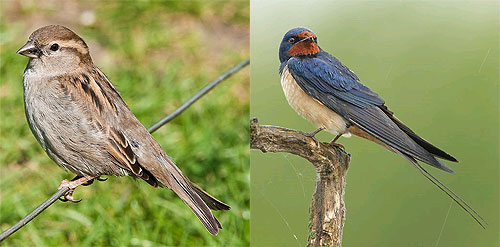
OK, so this is a going to be a terminological peeve. The above images show: (left) a sparrow, which is a chunky, short-tailed and typically brown garden bird; and (right) a swallow, a streamlined migratory bird, brightly coloured in many species, with a long forked tail. How could anyone confuse them?
And yet, I've noticed lately a highly prevalent misnomer of referring to the trad swallow tattoo design - most commonly based on the red-and-blue North American barn swallow - as a "sparrow tattoo".

Very occasionally it really is a sparrow. But (judging by a sample) in the vast majority of the 110,000 Google images hits for "sparrow tattoo", the bird depicted is clearly a swallow - the colourful bird with a forked tail - exactly the same as in the 146,000 Google images hits that correctly describe it as a "swallow tattoo".

I can't at this instant fathom the genesis of this. Did it arise merely from the phonetic similarity; or was it helped along by association with Jack Sparrow in Pirates of the Caribbean, who as a mariner has a swallow tattoo (above)?
Addendum: And I quite forgot another piece of terminology in the same territory. A Monroe piercing is a piercing above the left upper lip, named after the location of Marilyn Monroe's
- Ray
Monday, 13 June 2011
In the dark
In 2009 (see Echoes of SF) I mentioned Daniel F Galouye's SF novel Dark Universe, in post-apocalypse survivors live in a cave system in total darkness, finding their way by echolocation using "clickstones". At the time, I'd only just encountered the reality that human echolocators exist in the real world. At the time, a Times article - Blind taught to ‘see’ like a bat - mentioned that no scientific research had been done on the technique. However, Felix Grant just sent me the 2011 paper "Neural Correlates of Natural Human Echolocation in Early and Late Blind Echolocation Expert" 1, which reports functional brain scan results on blind users of the technique, showing that they actually use the primary visual cortex to process the sound data. As the work of Daniel Kish shows, the method is teachable, but it appears unclear if it's generally learnable or if you need a innate aptitude to excel at it.
Addendum: PLoSBLOGs has a very good overview of the subject: Getting around by sound: Human echolocation, by Greg Downey.
This brings me to an Exeter connection: James Holman FRS, aka "The Blind Traveller". An Exeter-born naval officer, he went blind at 25. Kicking against the restrictions of being pensioned-off to a ghastly ritual posting at Windsor Castle that involved twice-daily church attendance, he instead went to university, then on a Grand Tour of Europe, and then on extensive and intrepid world travels. He's the historical poster boy for human echolocation, and is said to have accomplished this using a tapped cane or ambient sounds such as the hoofbeats of horses.
I say "said to" because while his echolocation methods are mentioned in many modern books and articles, I can't find mention of them in any of Holman's travelogues, nor in other contemporary accounts of him; William Jerdan's 1866 Men I Have Known, for instance, just talks of his other senses being intensified in a general way, and Holman's own preface to his 1834 The narrative of a journey, undertaken in ... 1819, 1820 & 1821, through France, Italy, Savoy, Switzerland, parts of Germany bordering on the Rhine, Holland, and the Netherlands says
But however he did it, the achievement is remarkable. His travel works are online at the Internet Archive.
Such extensive travel journals require notes, and a point of of interest is how Holman made them. Mostly, as you'd expect, by dictation, but described in A Voyage round the World: Volume 1, pages 6-7, he also used a device he called the "Nocto via Polygraph", shown in the frontispiece of the fifth edition of The Narrative of a Journey (here). Invented and sold by Ralph Wedgwood of London, the device - variously called a Noctograph or Noctopolygraph ("nocto" for night, "poly" because it produced duplicates) comprised a rectangular frame crossed by parallel brass wires, that held two sheets of plain paper with carbon paper sandwiched between. The user wrote with a stylus, guided by the wires, the carbon creating the prints (one original, one reversed copy) on the plain paper. The top-of-range modes had stretchy spring grids so that you could write proper descenders on letters. There's an detailed account of the device , and its advantages and difficulties, on pages 117-118 of George Ticknor's 1864 Life of William Hickling Prescott.
Although Wedgwood's device was a well-known, and patented, one, the idea wasn't wildly original. The Catholic Encyclopedia's section Education of the Blind has a good historical overview of the many similar devices assisting the blind in writing:
These gadgets weren't solely for blind users. One with a literary connection is the Nyctograph, a fairly low-tech version devised by Charles Lutwidge Dodgson (a.k.a. Lewis Carroll) for making notes in the night. This constrained the writing even more into a shorthand, each letter written in a square pigeonhole in a card grid.
It's an odd thought that over a century later, I'm still using a very similar setup; the Graffiti input system on my Palm M100 organiser, which uses a cut-down shorthand alphabet written with a stylus in a square area, doesn't seem conceptually far different.
- Ray
1. Thaler L, Arnott SR, Goodale MA (2011) Neural Correlates of Natural Human Echolocation in Early and Late Blind Echolocation Experts. PLoS ONE 6(5): e20162. doi:10.1371/journal.pone.0020162.
Addendum: PLoSBLOGs has a very good overview of the subject: Getting around by sound: Human echolocation, by Greg Downey.
This brings me to an Exeter connection: James Holman FRS, aka "The Blind Traveller". An Exeter-born naval officer, he went blind at 25. Kicking against the restrictions of being pensioned-off to a ghastly ritual posting at Windsor Castle that involved twice-daily church attendance, he instead went to university, then on a Grand Tour of Europe, and then on extensive and intrepid world travels. He's the historical poster boy for human echolocation, and is said to have accomplished this using a tapped cane or ambient sounds such as the hoofbeats of horses.
I say "said to" because while his echolocation methods are mentioned in many modern books and articles, I can't find mention of them in any of Holman's travelogues, nor in other contemporary accounts of him; William Jerdan's 1866 Men I Have Known, for instance, just talks of his other senses being intensified in a general way, and Holman's own preface to his 1834 The narrative of a journey, undertaken in ... 1819, 1820 & 1821, through France, Italy, Savoy, Switzerland, parts of Germany bordering on the Rhine, Holland, and the Netherlands says
... it must, however, not be forgotten, that the loss of one sense, is uniformly compensated by superior powers of those that remain unimpaired, in consequence of their being more called into action; and it is well known, that the sense of touch, in particular, acquires so great a delicacy, as to afford degrees of information, which under ordinary states it is incapable of: besides this advantage, he acquired an undefinable power, almost resembling instinct, which he believes in a lively manner gives him ideas of whatever may be going forward externally.
But however he did it, the achievement is remarkable. His travel works are online at the Internet Archive.
Such extensive travel journals require notes, and a point of of interest is how Holman made them. Mostly, as you'd expect, by dictation, but described in A Voyage round the World: Volume 1, pages 6-7, he also used a device he called the "Nocto via Polygraph", shown in the frontispiece of the fifth edition of The Narrative of a Journey (here). Invented and sold by Ralph Wedgwood of London, the device - variously called a Noctograph or Noctopolygraph ("nocto" for night, "poly" because it produced duplicates) comprised a rectangular frame crossed by parallel brass wires, that held two sheets of plain paper with carbon paper sandwiched between. The user wrote with a stylus, guided by the wires, the carbon creating the prints (one original, one reversed copy) on the plain paper. The top-of-range modes had stretchy spring grids so that you could write proper descenders on letters. There's an detailed account of the device , and its advantages and difficulties, on pages 117-118 of George Ticknor's 1864 Life of William Hickling Prescott.
Although Wedgwood's device was a well-known, and patented, one, the idea wasn't wildly original. The Catholic Encyclopedia's section Education of the Blind has a good historical overview of the many similar devices assisting the blind in writing:
... the tablets of Généresse (1807) and of Bruno, the typhlograph of Passard, Dr. Nord's skotograph, Dr. Woizechowsky's amaurograph, Count de Beaufort's stylograph, Wedgewood's noctograph, and the writing-frames of the Elliot brothers, of Thursfield, Dooley, and Levitte.
...
line-cell frames or tablets, the best known are those devised by the Rev. Joseph Engelmann of Linz (1825), James Gall of Edinburgh, Mercier-Capette, Hebold, Dr. Llorens of Barcelona, by C. E. Guldberg of Copenhagen (1858), Galimberti of Milan, Martuscelli of Naples, Moon of Brighton, England, Kemps of Grave, Holland, Ballu, Brother Isidore of Woluwe-Saint-Lambert, Belgium, and Mlle Mulot of Angers, France.
These gadgets weren't solely for blind users. One with a literary connection is the Nyctograph, a fairly low-tech version devised by Charles Lutwidge Dodgson (a.k.a. Lewis Carroll) for making notes in the night. This constrained the writing even more into a shorthand, each letter written in a square pigeonhole in a card grid.
Any one who has tried, as I have often done, the process of getting out of bed at 2 a.m. in a winter night, lighting a candle, and recording some happy thought which would probably be otherwise forgotten, will agree with me it entails much discomfort. All I have now to do, if I wake and think of something I wish to record, is to draw from under the pillow a small memorandum book containing my Nyctograph
- Lewis Carroll, letter to The Lady magazine, October 29, 1891
It's an odd thought that over a century later, I'm still using a very similar setup; the Graffiti input system on my Palm M100 organiser, which uses a cut-down shorthand alphabet written with a stylus in a square area, doesn't seem conceptually far different.
- Ray
1. Thaler L, Arnott SR, Goodale MA (2011) Neural Correlates of Natural Human Echolocation in Early and Late Blind Echolocation Experts. PLoS ONE 6(5): e20162. doi:10.1371/journal.pone.0020162.
Tuesday, 8 February 2011
Chathuringmes and other non-riddles
A rather strange meme I just encountered. On Q&A forums and elsewhere, this puzzle/riddle repeatedly turns up, of which this is a typical variant:
The answer given is "chathuringmes", alleged to be the scientific name for a worm (i.e. used as bait / disliked as a parasite / and eaten by children as the "jelly worm" sweet). The trouble is, there's no reliable verification whatsoever for this term. Why and how the yarn got started is pretty murky. The best suggestion I can find, via Answerbag, is this Times of India piece from 2006 - You said SMS? How puzzling! - that refers to a whole genre of insoluble/hoax riddle-format questions circulating via SMS. Another example cited is:
Not that the idea is new. Nik Kershaw's pop song The Riddle attracted a deal of speculation as to the meaning of
As Wikipedia explains:
See also The Straight Dope for an even older example: Lewis Carroll's Why is a raven like a writing desk? which, as originally invented, had no answer. (I have to admire Sam Loyd's solution: "Because Poe wrote on both").
- Ray
I am a 13-letter word, _H_T_ _ _I_ _ME_. Fishermen like me, doctors hate me, kids love to eat me. What am I?
The answer given is "chathuringmes", alleged to be the scientific name for a worm (i.e. used as bait / disliked as a parasite / and eaten by children as the "jelly worm" sweet). The trouble is, there's no reliable verification whatsoever for this term. Why and how the yarn got started is pretty murky. The best suggestion I can find, via Answerbag, is this Times of India piece from 2006 - You said SMS? How puzzling! - that refers to a whole genre of insoluble/hoax riddle-format questions circulating via SMS. Another example cited is:
Your left side is your right side, Your right side is your wrong side. The right side, for your back side is the front side. What is it?
Not that the idea is new. Nik Kershaw's pop song The Riddle attracted a deal of speculation as to the meaning of
Near a tree by a river
There's a hole in the ground
Where an old man of Aran
Goes around and around
As Wikipedia explains:
The "riddling" lyrics caused much puzzlement and speculation among listeners as to their meaning, which was further fuelled by record company MCA's decision to run a competition to work out the meaning - without either telling Nik or even bothering to ask him what the meaning was. Had they done so, they would have discovered that there is in fact no meaning at all - the lyrics were nothing but gibberish thrown together to fit the music, or in Nik's own words: "nonsense, rubbish, bollocks, the confused ramblings of an 80s popstar".
See also The Straight Dope for an even older example: Lewis Carroll's Why is a raven like a writing desk? which, as originally invented, had no answer. (I have to admire Sam Loyd's solution: "Because Poe wrote on both").
- Ray
Friday, 24 September 2010
Literary limekilns

A Lime Kiln at Coalbrookdale, c.1797, Joseph Mallord William Turner: see william-turner.org
Wayland Wordsmith just featured a post on limekilns by the Exe Estuary - see Limekilns - that proved quite thought-provoking. Around this district there are quite a few examples of these arched cliffside structures whose purpose - local production of lime (for agricultural and building) - is so completely obsolete that it's hard to imagine their environmental impact. Their three-day coal-fired burns, calcining limestone or shells to quicklime (see the South Devon AONB leaflet) emitted copious smoke and carbon dioxide; as Wayland Wordsmith says, they were a regular cause of death.
Dr. O'Connor, of Carlow, has recently directed attention to another prolific source of destruction to health and life which especially exists in rural districts and in the neighbourhood of small towns. The kilns for burning lime, dotted everywhere over the face of the country, directly cause the death, in every ten years, of between two hundred and three hundred persons. Their warmth attracts to them wayfarers, who, falling asleep, so die, from the poisonous fumes of carbonic acid emitted, of which an admixture of only one-sixth renders the atmosphere unfit to support life. All this would be at once remedied by a law requiring lime-kilns to be surrounded by a fence. The attention of Parliament was directed to the subject fourteen years ago, and it has been repeatedly urged on their notice during the interval. Surely the evil has attained a sufficient maturity to entitle it to notice, even though the sufferers by it be only the homeless and friendless poor.
- page 551, The Lancet, Volume 2, Medical Annotations, November 15, 1856
As such - ubiquitous, intrusive, and scary features, a kind of pocket hell-mouth - they seem to have acquired enough metaphoric symbolism to appear in literature, going back at least to Shakespeare. A search of Project Gutenberg - here - finds hundreds of occurrences, either as passing locations or as now-defunct similes/metaphors for dryness. However, it's interesting to take a brief look at more specific occurrences:
FALSTAFF: Thou mightst as well say I love to walk by the Counter-gate, which is as hateful to me as the reek of a lime-kiln.
- The Merry Wives of Windsor
THERSITES. Why, his masculine whore. Now, the rotten diseases of the south, the guts-griping ruptures, catarrhs, loads o' gravel in the back, lethargies, cold palsies, raw eyes, dirt-rotten livers, wheezing lungs, bladders full of imposthume, sciaticas, limekilns i' th' palm, incurable bone-ache, and the rivelled fee-simple of the tetter, take and take again such preposterous discoveries!
- Troilus and Cressida
Nathaniel Hawthorne's short story Ethan Brand—A Chapter from an Abortive Romance, was inspired by the sight of a limekiln on a walk - see his Passages from the American Note-Books. A fine little Gothic tale, it makes full use of the limekiln as a setting and as instrument of destiny for its eponymous protagonist, who is guilt-ridden from his "Unpardonable Sin" of a having made a young woman, a circus performer, "the subject of a psychological experiment, and wasted, absorbed, and perhaps annihilated her soul, in the process". Ethan Brand's fate is that of many villains, such as Malitius in the story of Fulgentius and the Wicked Steward, who end up being burnt in the kiln.
A little after the Hawthorne story, there's Great Expectations, in which the unpleasantness of the limekiln figures in Pip's confrontation with Orlick, and in the later metaphor for the confusion of Pip's fever.
It was another half-hour before I drew near to the kiln. The lime was burning with a sluggish stifling smell, but the fires were made up and left, and no workmen were visible. Hard by was a small stone-quarry. It lay directly in my way, and had been worked that day, as I saw by the tools and barrows that were lying about.
Coming up again to the marsh level out of this excavation,—for the rude path lay through it,—I saw a light in the old sluice-house. I quickened my pace, and knocked at the door with my hand. Waiting for some reply, I looked about me, noticing how the sluice was abandoned and broken, and how the house—of wood with a tiled roof—would not be proof against the weather much longer, if it were so even now, and how the mud and ooze were coated with lime, and how the choking vapor of the kiln crept in a ghostly way towards me.
...
"... I left her for dead, and if there had been a limekiln as nigh her as there is now nigh you, she shouldn't have come to life again..."
...
But the vapor of a limekiln would come between me and them, disordering them all, and it was through the vapor at last that I saw two men looking at me.
On a different note, a burning limekiln gets centre-stage as a kind of sexual metaphor in an episode in Bayard Taylor's 1864 John Godfrey's fortunes: related by himself. A story of American life. Here, in "the episode of the lime-kiln", the schoolteacher protagonist thinks he's being invited to a cosy gathering by the kiln, where he hopes to meet the woman he is attracted to; instead he finds he has been conned into courting Verbena, sister of the gruff lime-burner Tom Cuff, so has to make a getaway from the top of the kiln, chased by Cuff's dog. And later, as described on pages 109- in Robin Hackett's Sapphic primitivism: productions of race, class, and sexuality in key works of modern fiction, an encounter with the kilnman and "the red winking eye of the lime-kiln" serve as pagan and sexual motifs in Sylvia Townsend Warner's 1963 Summer Will Show.
In rather less heated form, limekilns figure in poetry too, as in Francis Skurray's topographical poem Bidcombe Hill (much ridiculed in Blackwood's Magazine, September 1828) ...
In looking round to catch the varied scene
Which seem to crave admittance to my song,
A rival hill appears, rais'd as it were
By magic hands, amid the level plain;
Against its shelvy side the lime-kiln leans,
And stains with pitchy smoke the azure sky.
- Bidcombe Hill
... as well as John Bradshaw Kaye's Songs of Lake Geneva: and other poems (written in 1881, his The Old Lime Kiln on the Lake Shore isn't at all bad as an elegy on the past); and Jervis McEntee's rather sanitised The Lime Kiln, from Sarah Carter Edgarton Mayo's 1855 The Rose of Sharon: a religious souvenir.
Night by night,- Ray
The fire from the lime-kiln, burning bright,
Illumines the solemn gloom ;
Leaping and waving, its wonderful light
Seems like a fire of doom.
Through the night,
When the resting pond lies breezeless and still,
It gleams on its silver tide,
And it lights the end of the gloom-buried mill
And the willow standing beside.
In the night,
When the moon is low, and the stars are gone,
And the road is lonely and drear,
The driver, winding his midnight hour,
Blesses its kindly cheer.
All the night,
The murmur of voices is heard to chime
With the roar of the leaping flame,
And the tardy traveller, time after time,
Has wondered whence it came.
The livelong night,
Who nourish the fires and tend the blaze,
And watch the wonderful light ?
Are they spirits that hide through the long bright days,
And meet at the lime-kiln at night?
Friday, 30 April 2010
Out-takes: newspaper clippings
A purge of notes from my organiser, mostly items spotted in the newspapers in library / pub / cafe.
We need a dug-out canoe to navigate the net (Ben Macintyre, The Times, 28 January, 2010) on the "fox vs. hedgehog" (generalisation vs. specialisation) approaches to knowledge, and its application to the Internet. Southmouth doesn’t exist. Thank the Green Belt (Tristram Hunt, The Times, 28 January, 2010): celebrates British 'Green Belt' land policy. Sweet, sour, salty, bitter... and now it's the fifth taste (Cahal Milmo, The Independent, 9 February 2010): the rather well-trodden story of umami, and the recent launch of Taste No 5, a commercial umami paste (as if we can't get it from trad inexpensive sources such as cheese, tomatoes, soy sauce, anchovies, etc). Maps - the new rock’n’roll (Andrew Pettie, The Telegraph, 16 Apr 2010): a nice taster for the Britsh Library's recent Magnificent Maps: Power, Propaganda and Art exhibition. Read my lips (James Fenton, The Guardian, 29 July 2006 - found via more recent comment): debunking the common myth that the ancients, apart from a handful of Great People, were incapable of silent reading. Mysterious snake appears in painting of Queen Elizabeth I (The Telegraph, 4 Mar 2010): news from the National Portrait Gallery (see press release) of how an artist appears to have got cold feet over painting Queen Elizabeth I holding a snake. Verse that will make you feel better (Jeremy Laurance and Amanda Hall, The Independent, 24 Mar 2010): on the Hippocrates Prize for Poetry and Medicine. Campaign to restore Burton mausoleum (The Times, 26 April 2010): regarding the explorer Sir Richard Burton's unusual 'Arab tent' tomb at Mortlake (see the church page and Borough of Richmond site). What happened when Albert Einstein met Charlie Chaplin? (John Walsh, The Independent, 28 April 2010): "When giants of science, literature and culture get together, we expect to feel the earth move. But these stellar gatherings are as likely to disappoint as dazzle".
We need a dug-out canoe to navigate the net (Ben Macintyre, The Times, 28 January, 2010) on the "fox vs. hedgehog" (generalisation vs. specialisation) approaches to knowledge, and its application to the Internet. Southmouth doesn’t exist. Thank the Green Belt (Tristram Hunt, The Times, 28 January, 2010): celebrates British 'Green Belt' land policy. Sweet, sour, salty, bitter... and now it's the fifth taste (Cahal Milmo, The Independent, 9 February 2010): the rather well-trodden story of umami, and the recent launch of Taste No 5, a commercial umami paste (as if we can't get it from trad inexpensive sources such as cheese, tomatoes, soy sauce, anchovies, etc). Maps - the new rock’n’roll (Andrew Pettie, The Telegraph, 16 Apr 2010): a nice taster for the Britsh Library's recent Magnificent Maps: Power, Propaganda and Art exhibition. Read my lips (James Fenton, The Guardian, 29 July 2006 - found via more recent comment): debunking the common myth that the ancients, apart from a handful of Great People, were incapable of silent reading. Mysterious snake appears in painting of Queen Elizabeth I (The Telegraph, 4 Mar 2010): news from the National Portrait Gallery (see press release) of how an artist appears to have got cold feet over painting Queen Elizabeth I holding a snake. Verse that will make you feel better (Jeremy Laurance and Amanda Hall, The Independent, 24 Mar 2010): on the Hippocrates Prize for Poetry and Medicine. Campaign to restore Burton mausoleum (The Times, 26 April 2010): regarding the explorer Sir Richard Burton's unusual 'Arab tent' tomb at Mortlake (see the church page and Borough of Richmond site). What happened when Albert Einstein met Charlie Chaplin? (John Walsh, The Independent, 28 April 2010): "When giants of science, literature and culture get together, we expect to feel the earth move. But these stellar gatherings are as likely to disappoint as dazzle".
Sunday, 25 April 2010
Pure bosh: a media scare
We have a cafe bar in Topsham, Route 2, that serves a very nice toffee-chocolate ice cream called "Topsham Mud".
While Googling it for a shop visitor who asked if it was available elsewhere, I ran into something thematically connected but decidely not nice: the Times Archive Blog report The most disgusting Times article ever?, which reports on Times coverage of what appears to be a 19th century urban myth.
The yarn originally kicked off early in March 1870, when a number of publications reprinted a scare story from the South London Press reporting that fat was being extracted from mud at Battersea, to be processed and sold as butter.
Punch, March 12 1870, took up the story:
The context is rather interesting, making it understandable why such a story could spring up. Victorian London was rather like a modern third-world megalopolis: extremely dirty, with a variety of scavenging trades recycling a variety of waste. Fat from the Thames was in reality collected and recycled to make low-grade grease for lubricating machinery. This fact, however, seems to have become cross-fertilised with a general (and probably justified) paranoia about food adulteration, and public distaste for inferior butter substitutes - prototype margarines - that went under the generic name of "bosh".
The name "Bosh" derived from "Bosch-butter", referring to the Dutch town 's-Hertogenbosch 1, one place where butter-substitute was made, and many descriptions of it are pretty derogatory. For instance, from Samuel Fallows' 1835 The Progressive Dictionary of the English Language:
This skates around the actual nature of the product. "Bosh" was made from animal fat: one formulation notoriously involved horse fat, collected in England and shipped to Hamburg for processing before coming back to England. Its sale was legal as long as it wasn't labelled as butter, but it frequently was. Nevertheless, not all bosh was poor quality. Whether under the name Butterine, Bosch, Oleomargarine or Artificial Butter, the better varieties were thoroughly palatable. It seems quite significant that the butter-from-mud story virtually coincides with the first commercial impact of margarine proper, patented in 1869 by the French chemist Hippolyte Mège-Mouriés. It was the start of an era of considerable infighting between butter and margarine lobbies that persisted for at least a century. In Britain, the fraudulent sale of margarine/bosh as butter was a constant issue in the late 19th century (see the many references in Hansard to the Margarine Act 1887, whose chief purpose was to kill the term "butterine" in the UK). Looking further afield, you can gauge the hostility toward butter substitutes from this 1886 US book by TL McAlpine, Oleomargarine and Butterine: A Plain Presentation of the Most Gigantic Swindle of Modern Times (Internet Archive oleomargarinean00unkngoog).
Whatever the reason, the butter-from-mud story trundled on for years. After an initial debunking in 1870, it resurfaced in late 1876 in more detailed form with purported proof: observation of the work of "mudlarks" and their process of collecting river grease, allegedly for processing into butter substitute marketed as "mild Dorset" or best Brittany". This led to an investigation by a reporter for the Sanitary Record, who found that the collection and recycling was perfectly real, but only for the production of inedible low-grade fat.
A few years later, William Mattieu Williams summed up the story in his 1883 Science in Short Chapters:, pointing out that the whole story didn't even make commercial sense:
"Bosh" in the sense of nonsense/humbug is, incidentally, etymologically unconnected with "bosh-butter", pre-dating it by decades. According to the Oxford English Dictionary, the word comes from the Turkish bosh (= empty, worthless) and got into English via the popularity of James Justinian Morier's 1834 novel Ayesha: the Maid of Kars (Internet Archive ayeshamaidkars00morigoog). I'm not entirely sure I believe this. A look in Google Books suggests there to have been a vogue in the 1830s for Orientalist novels, and the word is used in them for local colour: for instance, the 1835 The Pacha of Many Tales by Frederick Marryat, the 1840 The Cashmere Shawl: An Eastern Fiction by Charles White, and the 1839 The Romance of the Harem by Julia S H. Pardoe. I'm sure they all contributed.
- Ray
1. Yes, the one where Hieronymus Bosch came from.
Addendum, 20th April 2010: following up a couple of spinoffs Dr C mentioned in the comments.
In my late teens and a bit after, the big marketing push for margarine was the "Can you tell Stork from butter?" roadshow headed by Lesley Crowther (see YouTube). The whole Margarine Act infighting was still going on - retreaded as the Margarine Regulations, 1967 - and Stork SB fell foul of it for the implication that "SB" stood for "soft butter" and its adverts with visuals of cows , thus getting into the territory of butter impersonation. See this abstract from the British Food Journal Volume 80 Issue 1 1978.
Also:
General opinion - compiling online references and the OED - is that it comes from French slang alboche: a conflation of Allemand (= German) and caboche (= cabbage).
While Googling it for a shop visitor who asked if it was available elsewhere, I ran into something thematically connected but decidely not nice: the Times Archive Blog report The most disgusting Times article ever?, which reports on Times coverage of what appears to be a 19th century urban myth.
The yarn originally kicked off early in March 1870, when a number of publications reprinted a scare story from the South London Press reporting that fat was being extracted from mud at Battersea, to be processed and sold as butter.
Butter From Mud.
A fortnight ago we (South London Press) mentioned the fact that the butter of South London was adulterated with tallow, starch, manganese, salt, and water. We thought then that we had reached the Ultima Thule of adulteration, but an ingenious individual has since added another sophisticating agent. A friend has in his possession a specimen of a pure white fat, tasteless and perfectly inodorous which has been obtained by a clever analytical chemist from — what do our readers suppose? Simply from a portion of the Thames mud, taken from the river at Battersea! And we are afraid that this new discovery of science is no longer a secret, for the owner of a small wharf on the banks of the Thames had an offer this week from a person desirous of becoming the tenant, and on asking the purpose for which the wharf was required he was told it was to be used for manufacturing butter, to be sold to the poor at a shilling per pound! No doubt it was the intention of this philanthropic individual to have supplied the public with dairy butter fresh from the bosom of old Father Thames.
- reprint in Littell's Living Age, Volume 105, page 720
Punch, March 12 1870, took up the story:
OUR OWN MUD IN OUR OWN MOUTHS
Our candle manufacturers complain that they can't live because their raw material has ran up to such a figure. And their raw material has risen in price because it is wanted for making butter. It is a sober fact. It was but the other day that chemistry taught our manufacturers to consolidate and refine all sorts of oils and greases into the raw material of candles. And now science has gone a step farther, and taught us how to turn that, which has but just been made to take form and pressure as dips and moulds, into "prime Irish" and " best Dorset ! " No wonder stearine is going up: fatty matters rising to the surface. Everything with grease in it is worth putting under process. Science will compel its precious oils, and extort its fatness, ut the last discovery, in this direction, is the grandest. It beats what we had hitherto regarded as the triumph of industrial chemistry— the extraction of Champagne out of petroleum. They have actually found out how to turn Thames mud from Battersea reach into butter! And so the whirligig of time brings about its revenges ! We refused to transmute our London sewage into milk on the Maplin sands, through the purifying stages of rye-grass and mangold, and, lo, our sewage, in payment of our stupidity, is coming back to us, via the Thames, in all its naked nastiness, as butter !
It is only fair of Father Thames. We poisoned him, and he means to do his best to poison us ; or, to put it more pleasantly, we turned our fatness into pollution of his bed, and he is giving us back our filth in fatness, whether we will or no !
Here is a triumph for Thwaites, a chance for the Board of Works, a use for the deposits of Barking, a way of turning to account the hundreds of thousands of tons of sewage now poured weekly from the pumps at Abbey Mills. At present they accumulate as Thames mud, and are complained of as a nuisance. You have but to turn that Thames mud into butter, to extract from it a bonus and a blessing ! Write up over the Abbey Mills pumping station "Bazalgette, Butterman to the Board of Works! " and let Thwaites and the Board bind themselves to use their own extract as "the best substitute for butter at breakfast!," And in honour of that reach of Thames where was made the first find of this'choice delicacy for the breakfast table, let Batter-sеа be re-christened and known henceforth as Butter-mere.
The context is rather interesting, making it understandable why such a story could spring up. Victorian London was rather like a modern third-world megalopolis: extremely dirty, with a variety of scavenging trades recycling a variety of waste. Fat from the Thames was in reality collected and recycled to make low-grade grease for lubricating machinery. This fact, however, seems to have become cross-fertilised with a general (and probably justified) paranoia about food adulteration, and public distaste for inferior butter substitutes - prototype margarines - that went under the generic name of "bosh".
The name "Bosh" derived from "Bosch-butter", referring to the Dutch town 's-Hertogenbosch 1, one place where butter-substitute was made, and many descriptions of it are pretty derogatory. For instance, from Samuel Fallows' 1835 The Progressive Dictionary of the English Language:
Bosh-butter - A kind of butter very poor in quality, made in Hamburg, and shipped to England where it is used for adulterating other butters.
This skates around the actual nature of the product. "Bosh" was made from animal fat: one formulation notoriously involved horse fat, collected in England and shipped to Hamburg for processing before coming back to England. Its sale was legal as long as it wasn't labelled as butter, but it frequently was. Nevertheless, not all bosh was poor quality. Whether under the name Butterine, Bosch, Oleomargarine or Artificial Butter, the better varieties were thoroughly palatable. It seems quite significant that the butter-from-mud story virtually coincides with the first commercial impact of margarine proper, patented in 1869 by the French chemist Hippolyte Mège-Mouriés. It was the start of an era of considerable infighting between butter and margarine lobbies that persisted for at least a century. In Britain, the fraudulent sale of margarine/bosh as butter was a constant issue in the late 19th century (see the many references in Hansard to the Margarine Act 1887, whose chief purpose was to kill the term "butterine" in the UK). Looking further afield, you can gauge the hostility toward butter substitutes from this 1886 US book by TL McAlpine, Oleomargarine and Butterine: A Plain Presentation of the Most Gigantic Swindle of Modern Times (Internet Archive oleomargarinean00unkngoog).
Whatever the reason, the butter-from-mud story trundled on for years. After an initial debunking in 1870, it resurfaced in late 1876 in more detailed form with purported proof: observation of the work of "mudlarks" and their process of collecting river grease, allegedly for processing into butter substitute marketed as "mild Dorset" or best Brittany". This led to an investigation by a reporter for the Sanitary Record, who found that the collection and recycling was perfectly real, but only for the production of inedible low-grade fat.
We obtained samples of the materials from the men, and afterwards operated upon them to extract the fat, with a view to determine how far it was practicable to purify the fat so as to render it fit for use in the manufacture of butter as alleged. We subjected it to various purifying processes, but completely failed in rendering the fat bright and free from offensive and disgusting odor, and we can have no hesitation in assuring the public that there need not be the least apprehension of their breakfast table being supplied with ' best Brittany ' manufactured from fat recovered from Thames mud. That the refuse fat from the millions of kitchens in London may in part be recovered and utilized is beyond a question of doubt; but it is equally certain that the fat so recovered can only be purified to such an extent as to fit it for use in the manufacture of the most common kinds of soap and dip candles.
- Sanitary Record, reprinted in the Times, December 16, 1876
A few years later, William Mattieu Williams summed up the story in his 1883 Science in Short Chapters:, pointing out that the whole story didn't even make commercial sense:
Chapter XXXVI
The oleaginous products of Thames mud: where they come from and where they go
introduction snipped
My readers need not be told that there are soapsuds in London as well as in Yorkshire, and they also know that the London soapsuds pass down the drains into the sewers. I may tell them that besides this there are many kinds of acids also passed into London sewers, and that others are generated by the decompositions there abounding. These acids do the Frenchman's work upon the London soapsuds, but the separated fat, instead of rising slowly and undisturbed to form a film upon the surface of the water, is rolled and tumbled among its multifarious companion filth, and it sticks to whatever it may find congenial to itself. Hairs, rags, wool, ravellings of cotton, and fibres of all kinds are especially fraternal to such films of fat : they lick it up and stick it about and amid themselves ; and as they and the fat roll and tumble along the sewers together, they become compounded and shaped into unsavory balls that are finally deposited on the banks of the Thames, and quietly repose in its hospitable mud.
But there is no peace even there, and the gentle rest of the fat nodules is of short duration. The mud-larks are down upon them, in spite of all their burrowing; they are gathered up and melted down. The filthiest of their associated filth is thus removed, and then, and with a very little further preparation, they appear as cakes of dark-colored hard fat, very well suited for lubricating machinery, and indifferently fit for again becoming soap, and once more repeating their former adventures.
Those gentlemen of the British press whose brilliant imagination supplies the public with their intersessional harvests of sensational adulteration panics, have obtained a fertile source of paragraphs by co-operating with the mud-larks in the manufacture of butter from Thames mud.
The origin of these stories is traceable to certain officers of the Thames police, who, having on board some of these gentlemen of the press engaged in hunting up information respecting a body found in the river, supplied their guests with a little supplementary chaff by showing them a mud-lark s gatherings, and telling them that it was raw material from which "fine Dorset" is produced. A communication from "Our Special Correspondent" on the manufacture of butter from Thames mud accordingly appeared in the atrocity column on the following morning, and presently "went the round of the papers."
Although it is perfectly possible by the aid of modern chemical skill to refine even such filth as this, and to churn it into a close resemblance to butter, the cost of doing so would exceed the highest price obtainable for the finest butter that comes ,to the London market. A skilful chemist can convert all the cotton fibres that are associated with this sewage fat into pure sugar or sugar-candy, but the manufacture of sweetmeats from Thames mud would not pay any better than the production of butter from the same source, and for the same reason.
Mutton-suet, shop-parings, and other clean, wholesome fat can be bought wholesale for less than fivepence per pound. It would cost above three times as much as this to bring the fat nodules of the Thames mud to as near an approach to butter as this sort of fat. Therefore the Thames mud-butter material would be three times as costly as that obtainable from the butcher, While the supply of mutton-suet is so far in excess of the butter-making demand that tons of it are annually used in the North for lubricating machinery, We need not fear that anything less objectionable—i.e. more costly to purify—will be used as a butter substitute.
"Bosh" in the sense of nonsense/humbug is, incidentally, etymologically unconnected with "bosh-butter", pre-dating it by decades. According to the Oxford English Dictionary, the word comes from the Turkish bosh (= empty, worthless) and got into English via the popularity of James Justinian Morier's 1834 novel Ayesha: the Maid of Kars (Internet Archive ayeshamaidkars00morigoog). I'm not entirely sure I believe this. A look in Google Books suggests there to have been a vogue in the 1830s for Orientalist novels, and the word is used in them for local colour: for instance, the 1835 The Pacha of Many Tales by Frederick Marryat, the 1840 The Cashmere Shawl: An Eastern Fiction by Charles White, and the 1839 The Romance of the Harem by Julia S H. Pardoe. I'm sure they all contributed.
- Ray
1. Yes, the one where Hieronymus Bosch came from.
Addendum, 20th April 2010: following up a couple of spinoffs Dr C mentioned in the comments.
You'd have to be subjected to the I Can't Believe Its Not Butter tyranny to have really appreciated Bosh.
In my late teens and a bit after, the big marketing push for margarine was the "Can you tell Stork from butter?" roadshow headed by Lesley Crowther (see YouTube). The whole Margarine Act infighting was still going on - retreaded as the Margarine Regulations, 1967 - and Stork SB fell foul of it for the implication that "SB" stood for "soft butter" and its adverts with visuals of cows , thus getting into the territory of butter impersonation. See this abstract from the British Food Journal Volume 80 Issue 1 1978.
Also:
The name Boche also, of course, refers to the German Army in WWI. This doesn't seem to stem from the village in the Nederlands but it is unclear where it did come from.
General opinion - compiling online references and the OED - is that it comes from French slang alboche: a conflation of Allemand (= German) and caboche (= cabbage).
Thursday, 1 April 2010
Songs from the past
Further to the previous post Hardy's poetry: downbeat but great, I just had an e-mail from Ken Trickett Voll of Buena Vista, Wisconsin. His own story is unusual in itself; Ken has part-German, part-Devonian roots, arising from his father Gert being interned at POW Camp No. 42 (Exhibition Field Camp), Holsworthy, during World War II. Ken's mother, Carla Trickett, was a maid in service at Soldon Manor; the two met briefly during one of Gert's several escape attempts and married after the war, emigrating to the USA to avoid prejudice.
Anyhow, to the point of the post: Ken sent me some sound files of partially-restored cylinder recordings and notes belonging to his late mother. According to her diaries, they comprise a trio of songs recorded by Cecil Sharp during a tour of Dorset and Devon in the early 20th century. In his notes Sharp writes of Percy Grainger being present at some of the recording sessions, which places the likely date as 1908, when Grainger is known to have been collecting tunes while on a concert tour of the Westcountry. 2
The first, unnamed, song is performed by Cedric "Brassy" Nupson, a Hampshire-born thatcher and keen fisherman living in Starcross. Unfortunately all but the first two and the last verse were too damaged to recover. "Mr Nupson regaled us with accounts of catches of unlikely size," Sharp wrote, "after which he sang a version of The Unfortunate Rake." This broadsheet song spawned many variants including The Streets of Laredo, and the highly interesting thing in this one is its Exeter setting (it mentions the St James district, near Exe Bridges) which makes it a 'missing link' between the English versions and the American St. James Infirmary Blues.
The second, also by Mr Nupson, is a bawdy song called My Angledog (possibly NSFW); I won't ruin the point of the song by explaining (see footnote 3 for spoiler if you must). It is rather fun because it's a glimpse at the kind of material Sharp obtained as raw recordings; as is well known, he typically bowdlerised his transcripts).
The third, which was the reason Ken got in touch, is a recording of Lydia Garger of Wareham, Dorset, singing a song called Great Things. They recorded in The Angel, Wareham Forest (the pub renamed The Silent Woman after featuring in Thomas Hardy's The Return of the Native). Sharp noted "Liddy" to be a tiny but formidable lady, almost a dwarf, who before singing needed to warm up on a prodigious amount of chewing tobacco, along with pale ale "which she downed with great gusto despite her diminutive stature. As she drank she told us of the folly of her youth, when she had 'left her head and heart on the dance floor'. We soon had no money left, but Percy organised a whip-round and all was well". The lyrics of Great Things are the Thomas Hardy poem of the same name I recently mentioned, showing that Hardy wrote it nearly a decade before its publication in his 1917 Moments of Vision. (Of interest, the Mellstock Band have also set the words to music).
Ken tells me he has severe doubts about the pieces being autochthonous folksong, and I don't disagree. The literary origin of the Great Things lyrics pretty obviously suggest it to be a parlour performance piece; conversely there's something of the flavour of music hall about My Angledog - its title word is the only regional dialect word in the song. Not that this necessarily matters: highbrow songs such as Thomas Moore's Oft in the Stilly Night and faux-rustic ones such as the charmingly naive Buttercup Joe have become well-established on the folk circuit.
A quick search through the British Library 19th Century Newspaper online archives rather confirms my suspicions of non-amateur origins, in that The Era for 8th January 1881 finds a Miss Lydia Garger getting star billing in pantomime at the Theatre Royal, Exeter. It's a sufficiently unusual name and the dates look about right. Then as now, I suppose, pantomime was a valuable, if stereotypical, work opportunity for persons of restricted growth. I've had no luck finding any more about Cedric Nupson or why he was called "Brassy".
However, I'm not too bothered; Ken's find is absolutely fascinating, and I'm sure more background will come to light. Enjoy!
1. Files copyright Ken and Hannah Trickett Voll, 2010.
2. See p.125, Percy Grainger, John Bird, 1999.
3. But if you need a spoiler, see Passing down old Devon dialect, Laura Joint, BBC Devon, for "angledog".
- Ray
Anyhow, to the point of the post: Ken sent me some sound files of partially-restored cylinder recordings and notes belonging to his late mother. According to her diaries, they comprise a trio of songs recorded by Cecil Sharp during a tour of Dorset and Devon in the early 20th century. In his notes Sharp writes of Percy Grainger being present at some of the recording sessions, which places the likely date as 1908, when Grainger is known to have been collecting tunes while on a concert tour of the Westcountry. 2
The first, unnamed, song is performed by Cedric "Brassy" Nupson, a Hampshire-born thatcher and keen fisherman living in Starcross. Unfortunately all but the first two and the last verse were too damaged to recover. "Mr Nupson regaled us with accounts of catches of unlikely size," Sharp wrote, "after which he sang a version of The Unfortunate Rake." This broadsheet song spawned many variants including The Streets of Laredo, and the highly interesting thing in this one is its Exeter setting (it mentions the St James district, near Exe Bridges) which makes it a 'missing link' between the English versions and the American St. James Infirmary Blues.
The second, also by Mr Nupson, is a bawdy song called My Angledog (possibly NSFW); I won't ruin the point of the song by explaining (see footnote 3 for spoiler if you must). It is rather fun because it's a glimpse at the kind of material Sharp obtained as raw recordings; as is well known, he typically bowdlerised his transcripts).
The third, which was the reason Ken got in touch, is a recording of Lydia Garger of Wareham, Dorset, singing a song called Great Things. They recorded in The Angel, Wareham Forest (the pub renamed The Silent Woman after featuring in Thomas Hardy's The Return of the Native). Sharp noted "Liddy" to be a tiny but formidable lady, almost a dwarf, who before singing needed to warm up on a prodigious amount of chewing tobacco, along with pale ale "which she downed with great gusto despite her diminutive stature. As she drank she told us of the folly of her youth, when she had 'left her head and heart on the dance floor'. We soon had no money left, but Percy organised a whip-round and all was well". The lyrics of Great Things are the Thomas Hardy poem of the same name I recently mentioned, showing that Hardy wrote it nearly a decade before its publication in his 1917 Moments of Vision. (Of interest, the Mellstock Band have also set the words to music).
Ken tells me he has severe doubts about the pieces being autochthonous folksong, and I don't disagree. The literary origin of the Great Things lyrics pretty obviously suggest it to be a parlour performance piece; conversely there's something of the flavour of music hall about My Angledog - its title word is the only regional dialect word in the song. Not that this necessarily matters: highbrow songs such as Thomas Moore's Oft in the Stilly Night and faux-rustic ones such as the charmingly naive Buttercup Joe have become well-established on the folk circuit.
A quick search through the British Library 19th Century Newspaper online archives rather confirms my suspicions of non-amateur origins, in that The Era for 8th January 1881 finds a Miss Lydia Garger getting star billing in pantomime at the Theatre Royal, Exeter. It's a sufficiently unusual name and the dates look about right. Then as now, I suppose, pantomime was a valuable, if stereotypical, work opportunity for persons of restricted growth. I've had no luck finding any more about Cedric Nupson or why he was called "Brassy".
However, I'm not too bothered; Ken's find is absolutely fascinating, and I'm sure more background will come to light. Enjoy!
1. Files copyright Ken and Hannah Trickett Voll, 2010.
2. See p.125, Percy Grainger, John Bird, 1999.
3. But if you need a spoiler, see Passing down old Devon dialect, Laura Joint, BBC Devon, for "angledog".
- Ray
Saturday, 27 June 2009
Bubbles
Obligatory Michael Jackson reference aside, I was just reading about a remarkable bit of ingenuity: Tim Kehoe's invention of Zubbles, the world's first coloured bubbles. The product may be ultimately trivial, but the chemistry certainly isn't. It needed an intense dye (bubbles being thin) and bonded to surfactant (so that it would spread evenly over the whole bubble): but one non-toxic, and highly unstable so that it wouldn't stain. The PopSci.com article explains: The 11-Year Quest to Create Disappearing Colored Bubbles.
Ian Waton's QueenMagic, Kingmagic (see previously) , with its magical bubbles that are pocket universes, reminded me of a poem I saw way back: Korfs Verzauberung ("Korf's Bewitching") by Christian Morgenstern (who has been described as "a kind of German Edward Lear"). By pleasant coincidence, I just ran into an English translation while trying to find bubble-related books.
"The Bewitchment"The Morgenstern poem is the preface to The Parsimonious Universe: shape and form in the natural world (Stefan Hildebrandt and Anthony Troma, Copernicus / Springer-Verlag, 1996, ISBN 0-387-97991-3). From the blurb, you'd expect this to be pretty dry:
Von Korf finds out his distant cousin is—
a sorceress
who fashions planets out of herbal fizz;
and so he hurries, yes.
he hurries there to O-de-lée-de-lizz
to see the sorceress.
He finds her on a meadow by her home
and asks he if she be
the one who blows the planets out of foam—
and if she be the Faërie—
the Faërie from the O-de-lée-de-lome?
Ah, yes, indeed, she be!
She offers him the pitcher and the straw;
Korf blows,—and from a gleam,
Behold! A wondrous sphere without a flaw
expands in space supreme,
Expands as if it were a world he saw,
and not just foam and dream.
Detaching from its stalk, the planet veers
aloft, and gently up,
and blends into the music of the spheres
(a Heavenly Choir), floats up...
a strain as from the shepherd's pipe appears...
distant tones push up...
And in the rounded mirror of this world,
von Korf perceives with zest,
of all the happy things that ever swirled
into his mind, the best,—
his mouth agape, beholds his own fair world,
von Korf, possessed.
He names his cousin "Muse,"—von Korf possessed,—
But look! Oh, look again!
For something grabs him by the vest
and leads him far awain,
Abducts him out of O-de-lá-de-lest
toward the new domain.
- Christian Morgenstern, translated by Helen and Hans Lewy, The Parsimonious Universe
The variety of sizes, shapes, and irregularities in nature is endless. Through illustrations and text, the authors of The Parsimonious Universe describe the efforts by scientists and mathematicians since the Renaissance to identify and describe the basic laws underlying the shape of natural forms. Can one set of laws account for both the symmetry and irregularity as well as the infinite variety of nature's designs? Complete answers to these questions are likely novel to be discovered. Still, down through the ages, the investigation of form and pattern in nature has yielded some fascinating and surprising insights. Out of this inquiry comes a specific branch of mathematics - the calculus of variations - which explores questions of optimization (finding designs that maximize or minimize a particular quantity).But far from it: this is a lovely book, copiously illustrated, that weaves together history, mathematics, art and nature in an exploration of the idea that Nature is "thrifty" (as Pierre Louis Maupertuis put it) - that is, natural phenomena repeatedly produce outcomes that minimise some quantity (e.g. area, energy, material used). The minimal-area soap bubble being the classic example, it not unnaturally gets a full chapter, Soap Films: The Amusement of Children and Mathematicians, with lots of beautiful photos of soap film surfaces as well as buildings, particularly those by Frei Otto, using the derived minimal-surface principle. The bubblemeister Tom Noddy gets a mention. One of his best-known effects is using smoke to make visible the nearly cubic bubble formed when a bubble is blown at the core of an octahedral group of six. Nowadays, according to this interview, he wisely uses a non-tobacco cigarette and, if you want to try this at home, there's technology for doing it without human-blown smoke). If this kind of thing appeals, see Soapbubbler.com and BubbleArtist.com.
There are various other books on soap bubbles, but the classic has to be the 1890/1911 Soap Bubbles: Their Colours and the Forces Which Mould Them by Professor Charles Vernon Boys (see Google Books): for its practical interest, it's still rightly popular, despite pre-dating many of the modern insights, techniques (and detergents) that underpin current understanding of bubbles.
Update: See Professor Boys' Rainbow Cup and other marvels, 16th Dec 2014.
- Ray
Update: See Professor Boys' Rainbow Cup and other marvels, 16th Dec 2014.
- Ray
Subscribe to:
Posts (Atom)