
Showing posts with label humour. Show all posts
Showing posts with label humour. Show all posts
Tuesday, 2 June 2015
An Episode at Blackgang Chine

Wednesday, 28 January 2015
The tinkle of the accordion ... and the concertina's melancholy string
The Athenaeum comment on Thomas Duncan's silly translated phrase from Bruges-la-Morte, "the tinkle of the accordion" put me in mind of the above scene from the 1985 A Room with a View.
Monday, 19 January 2015
John Lee's Nursery Ballads ... and two Royal Umbrellas

Monday, 22 December 2014
Banish embarrassing moypish!
 |
| karrimor.com, retrieved 22/12/2014 |
Monday, 25 August 2014
The Cricklewood Greats

Peter Capaldi embarks upon a personal journey to discover the shocking history of the stars of north London's famous film studios. Including clips from rarely seen films and interviews with Marcia Warren and Terry Gilliam.... a graphically and textually brilliant pastiche, written by Peter Capaldi and Tony Roche, telling the century-long history of a small London studio.
Thursday, 24 July 2014
Dean Spanley

Tuesday, 18 February 2014
The Three Old Maids of Lee

This is Old Maid's Cottage, Lee, near Ilfracombe - subject of a large number of historical postcards - which turned up as one of the Mystery Devon images locations in a recent Devon History Society post. The house still exists, as what looks like an extremely pleasant holiday rental.
Sunday, 26 January 2014
Wonders of the Isle of Wight: growth of a meme

Another image from the pleasant booklet, c.1910, Isle of Wight: Forty-one camera studies of the nooks & crannies, bays & chines of the garden isle, produced by the Photochrom Company of London and Tunbridge Wells (see previously, Nooks and crannies - an ill-fated housing boom).
This is one of the many incarnations of the 'Wonders of the Isle of Wight' - "Cowes you cannot milk, Lake you can walk through, Freshwater you cannot drink, Needles you cannot thread, and Newport you cannot bottle" - though the number and choice of locations has been variable.
The earliest precursors I can find appear in the 1850s-60s, where a number of comic journals contain variants on this pun:
A Truism.—There is one remarkable feature in the Isle of Wight, not generally known, which is, that any person who visits there may obtain mutton from Cowes.By 1899, there were three items, as in:
- True Briton: A Weekly Magazine of Amusement and Instruction, Issue 6, Sep 8, 1853
What extraordinary kind of meat is to be bought in the Isle of Wight?Mutton from Cowes!- Puniana: or, Thoughts wise and other-wise, Hugh Rowley, 1867
Why is the Isle of Wight a fraud? — Because there's Cow(e)s you cannot milk, Needles you cannot thread, and Freshwater you cannot drink.A similar joke was widely syndicated in various newspapers worldwide in 1901, expanded to four items:
- Children's Corner, Aberdeen Weekly Journal, March 1, 1899
Why is the Isle of Wight a fraud? Because it has Needles you can't thread, Freshwater you cannot drink, Cowes you cannot milk, and Newport you cannot bottle.In 1908, the concept made the jump to pictorial form in a card by William James Nigh, a Ventnor postcard maker, who produced a "The Five Novelties of the Isle of Wight" card:
- Fun and Fancy, The Star [Christchurch, NZ], Issue 7273, 7 December 1901
Needles without EyesThe copyright registration is in the National Archives:
Saltwater you get from Freshwater
Ryde you can have and not move
Lake without any water
Mutton you get from Cowes
(William Dederich was a fine-art publisher; WJ Nigh & Sons is still extant, now in Shanklin)."Photograph for postcard of an arrangement of views with ornamental design entitled 'The Five Novelties of the Isle of Wight'."Item is a colour postcard and not a photograph. Copyright owner of Work: William James Nigh, 7 Ocean View Terrace, Newport Road, Ventnor, Isle of Wight. Copyright author of Work: William Dederich, Imperial Buildings, Ludgate Circus, London. Form completed 9 July 1908. Registration stamp: 21 July 1908.
- COPY 1/523/345, National Archives
The Wonders of the Isle of Wight page at wightindex.com has a nice collection documenting the various incarnations of the idea on postcards since: "Novelties" became "Wonders" (and occasionally "Contradictions" or "Peculiarities"), and increased to as many as eight.
 |
| Peculiar Properties of the Isle of Wight: J Welch & Sons, Portsmouth |

As seven, the wonders are featured in the somewhat naff murals, created as a community project in 2008, at the Ryde Esplanade bus and rail terminus.
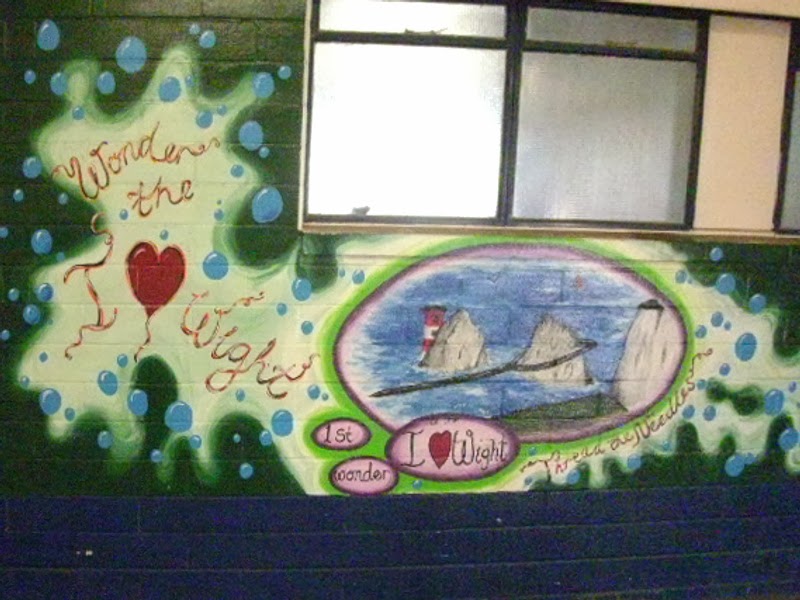 |
| 1st wonder - Thread the Needles |
 |
| 2nd wonder - Newport bottled |
 |
| 3rd wonder - Drink Freshwater |
 |
| 4th wonder - Old Newtown |
 |
| 5th wonder - Milk Cowes |
 |
| 6th wonder - walk in Ryde |
 |
| 7th wonder - Stay dry in Lake |
- Ray
Saturday, 14 December 2013
Paignton Pier fire explained?

- Ray
See Wikipedia if you don't get the allusion.
Wednesday, 13 November 2013
"The Baby was an anachronism"

A while back I mentioned the versatile and prolific Scottish writer Andrew Lang - see Andrew Lang: a sampler - and in particular his 1890 Old Friends: Essays in Epistolary Parody (Internet Archive ID oldfriendsessay00langgoog) which imagines correspondence between various literary characters.
In the light of the current MG project, I re-read "From Mr. Paul Rondelet to the Very Rev Dean Maitland" (see pages 121-125). Dean Maitland we know from The Silence of Dean Maitland: the cleric who gets a young woman pregnant and accidentally kills her father in a fight, his guilt only revealed a couple of decades later. Paul Rondelet is a major character in a distinctly forgotten novel, the social satire The Monks of Thelema (Walter Besant and James Rice, Chatto & Windus,1878, Internet Archive monksthelemaano00ricegoog). Lang has Rondelet - an aesthete turned hack journalist, and apparently based on Walter Pater - escape his responsibilities by doing a runner to a Pacific island, and his letter advises the disgraced Maitland to do the same.
The bit that intrigued me was this footnoted sentence:
[Rondelet writes to Maitland] "And, in your time, no doubt you have loved?" 1Lang is presumably referring to some problem with the chronology of the conception and birth of Alma Lee's baby by Cyril Maitland, and I thought I'd check this out. It wasn't wildly difficult, but nevertheless takes close reading; Maxwell Gray is an author prone to subliminal chronologies that take some piecing together from details chapters apart.
1 Alas, not wisely! But any careful reader of "The Silence of Dean Maitland" will see that the Baby was an anachronism. —Ed.
The novel starts with Alma Lee hitching a wagon ride to Malbourne on an autumn day. We know it's autumn by the cold weather and the clematis being in seed:
the high tangled hedges, draped with great curtains of traveller's joy, now a mass of the silvery seed-feathers which the country children call "old man's beard"On this day, Cyril Maitland first meets Alma Lee in Malbourne - they're mutually attracted (in his case, despite his engagement to another woman) - and offers to escort her home from his sister's regular Bible class. Then:
Rather more than a year after Alma Lee's evening ride in the waggonMaitland (after some months away) returns to Malbourne, where the general gossip is that Alma Lee is now pregnant. It's a few days before the New Year, and another character thinks:
" I shall long remember sixty-two," he thought ; "it has been a good year ..."We're then told the chronology of Maitland's temporary break-up with his fiancée Marion in that year.
Cyril wrote back to release her from an engagement which he said he perceived had become distasteful to her ... This was in March. At Whitsuntide, Everard spent some time at Malbourne, whence Cyril went to Belminster for ordination at Trinity ... and got himself placed on a mission staff in the East of London, where he led a semi-monastic life in a house with his fellow-curates ...On New Year's Day (referred to as that of "sixty-three"), Alma gives birth to a son.
So this connects up to place Alma's first meeting with Maitland as autumn 1861; Maitland's split with his fiancée as March 1862; his leaving Malbourne as Whitsun 1862 (Google finds this to be June 8th); and the birth as January 1st 1863. Thus, given a normal 40ish weeks pregnancy, this timeline easily accommodates Alma's son being conceived in early April 1862. Unless I've missed something, the baby doesn't seem to be an anachronism; I'll probably never know what precisely Lang meant.
- Ray
Saturday, 9 November 2013
None so fast as stroke
An out-take from the Maxwell Gray work: I just ran into a MG reference in a 1923 article, Novelists' sporting blunders, which concerns sporting bloopers in novels.
I can't find any precise origin of the accretion of the story to Ouida. The first citation I can find for the "... none so fast as stroke" line is 1908 ...
Addendum: I find a clue in a contemporary review of Sandford of Merton:
- Ray
Ouida's classic hero, who rowed twice as fast as his fellows in the Boat Race, is the supreme example of the errors into which authors who venture to deal with a phase of sport of which they are ignorant may fall.The Maxwell Gray error is verifiable. The Ouida one is not. A little Googling finds that its attribution to Ouida (the novelist Maria Louise Ramé) seems to have been a popular meme of the early 20th century. The quotation generally took the form"All rowed fast, but none so fast as stroke" ("stroke" being the rower at the stern who sets the pace for the whole crew), and it seems to be an abbreviated paraphrase of this passage ...
...
Maxwell Gray's Boat Race
Maxwell Gray, the author of "The Silence of Dean Maitland," makes a curious reference to the Boat Race in "The Great Refusal," published in 1906.
Once he remembered — on a boat-race day — when every coster cart fluttered light or dark blue ribbons and the colours were in shop windows and ladies' dresses, and expectation was on tiptoe for the result of that five minutes' swift sweep over Thames waters — he remembered thinking that the sixteen god-like youths smiting the river with strokes too swift to count were, after all, of real flesh and blood like himself.These inaccuracies are the more inexplicable as it does not require a knowledge of rowing to know that about twenty minutes is the average time for the race from Putney to Mortlake, and that it is perfectly easy to watch and count the strokes of the oars as they are seen rowing past.
- Novelists' sporting blunders, page 580, T.P.'s and Cassell's Weekly, Volume 1, 1923
The word sounded clear from the mouth of the 'Varsity captain of boats, and at once Ralph exerted the full force of Herculean arms. His blade struck the water a full second before any other; the lad had started well. Nor did he flag as the race wore on… as the boats began to near the winning-post, his oar was dipping into the water nearly twice as often as any other.... which comes from Desmond Coke's 1903 Sandford of Merton. Written under the pseudonym Belinda Blinder, it's a comic novel of Oxford university life, a pastiche of The History of Sandford and Merton - and the howler is of course a deliberate joke.
I can't find any precise origin of the accretion of the story to Ouida. The first citation I can find for the "... none so fast as stroke" line is 1908 ...
In one way and another, however, the crowds which watch the practice of the crews have come to know more about rowing than any earlier generation. ... And there is certainly not a novelist left who could write with a grave face that "all rowed fast and furiously, but none so fast as stroke."... and in the same year, it was ascribed to a female novelist (for no reason I can see beyond sheer sexism):
- The Boat-Race, The Spectator, 28 March 1908
We do not know whether or not it was a lady novelist who wrote gravely that "all rowed fast and furiously, but none so fast as stroke," but we suspect it was.By the 1920s, the story was solidly attached to Ouida (see Google Books hits). Probably the connection was forged because of the female pseudonym of the author of Sandford of Merton, and the easy target that Ouida made as an eccentrically florid stylist known for such inaccuracies. The misattribution has been repeatedly debunked - notably via the correspondence column of The Spectator in 1937, and by Elizabeth Knowles on page 21 of What They Didn't Say: A Book of Misquotations (OUP, 2006) - but it refuses to die, and has been given new currency by the usual quotation websites.
- 'Varsity Howlers, The Press (Canterbury, NZ), 14 Hōngongoi 1908, Page 6
Addendum: I find a clue in a contemporary review of Sandford of Merton:
"The Oxford Magazine" once published a delicious chapter on the Eights extracted from an imaginary novel by Ouida ...If this is accurate, it might be identifiable as the source that kicked off the meme.
- Reviews, The Saturday Review of Politics, Literature, Science and Art, page 817, Volume 95, 27 June 1903
- Ray
Wednesday, 15 May 2013
Windows 8: inexplicable language
Windows 8: Beautiful and fast
Sorry to be a vector for viral marketing, but I just love these Windows 8 ads for the East Asian market, originally released under the collective title Windows 8 Training Camp (there is a third, Multitask, that's mildly amusing but rather flat compared to these other two, which make perfect use of the "rule of three" construction).
Windows 8: The power of touch
The humour being chiefly visual, they work perfectly well even if you don't know the language - except that it seems no-one does, not even people from East Asia.
Victor Mair analyses the language at Language Log - The enigmatic language of the new Windows 8 ads - and the article and ensuing discussion covers theories including its being some obscure minority dialect of Chinese; some East Asian language mangled by non-native speakers; ditto by illiterate local speakers contracted in cheaply; or some well-constructed Sino-gibberish, with a certain amount of Mandarin embedded, made to sound like an East Asian tonal language. All Microsoft has said of the videos is this ...
We created these online-only social videos for the Asian market, where they were well-received.... although they work so brilliantly minus language that even this is a trifle suspect; maybe they always were meant for the Western market.
- Ray
Sunday, 13 January 2013
The serpent that once corrupted man

Where's my card? 'Miss Sapphire — Poses with a Python'. Now don't get the wrong idea — it's right artistic. Costume-wise, I never wear less than the full three tassels, and between shows I am at that python with the Dettox and a damp cloth even if he haven't been nowhere.Never watch Blade Runner — The Director's Cut after seeing Victoria Wood's sketch The Library (see 15:27).
- Ray
Tuesday, 13 November 2012
A Vision in a Dream. A Fragment
I just had to share this. The night before last, I was feeling pretty fretful in the small hours with joint pains from the chemotherapy, so eventually gave in and took a couple of co-codamols (what they call "Tylenol 1" in the USA). They clearly worked, because I woke up around 3pm - but with vague recollections of an interminable dream of being at a pub quiz for hours on end. I remember two of the questions:
- Ray
PS Cautiously good news in respect of all this. See the 14th November 2012 update to It ain't that kind.
- In what sport is the Leaping Grand Cheval tackle permitted?
- On what classical symphony is the song "The Elephant's Covered in Skin" based?
- Ray
PS Cautiously good news in respect of all this. See the 14th November 2012 update to It ain't that kind.
Sunday, 14 October 2012
Cannibal dining ...

- Ray
Monday, 28 May 2012
Shepherd aesthetes and Barry Pain
For a long time I resisted getting an Internet-capable phone, but it has proved invaluable on holiday for pursuing trains of thought that come out of conversation. A couple of days back, on the train to Portsmouth, Clare recalled a snippet of a song she'd had to learn at school. Googling found rapidly it was The Shepherd's Song: one of the Seven Lieder of Edward Elgar, a cycle of songs with lyrics by various authors. Here it is on YouTube sung by Mackay Choral Society's Male Chorus - The Shepherd's Song - and here are the lyrics:
I find it fairly ludicrous; this narrator is in the long tradition of shepherd aesthetes with idyllic lifestyles (this one involves admiring poppies and going for long starlit swims). However, I was interested that the lyrics are by Barry Pain, author of the 1900 Eliza.
If you like observational humour of the style of George and Weedon Grossmith's Diary of a Nobody, Eliza is very much in the same vein, a gentle send-up of late-Victorian social aspiration. It tells of the long-suffering Eliza and her husband, a pushy junior clerk who is trying to get them up the social ladder from working class to lower middle class. Do check it out: Eliza, Project Gutenberg E-Text 23783.
When Barry Pain is remembered, if it all, it's generally for Eliza and its sequels. But I hadn't realised, until I looked at the Wikipedia page and Oxford Dictionary of National Biography entry, the breadth of his writing. As a contributor to Punch and the Cornhill Magazine, much of his work was humour and parody, some of it very barbed (though, like a lot of historical parody) a trifle inaccessible when its targets have been forgotten. A couple of his classics in this area are Marge Askinforit (Gutenberg #26204) , a parody of the self-obsessed and name-dropping autobiography of Margot Asquith ...
This kind of thing wasn't to everyone's taste. Pain was caught up in the controversy over what was characterised as "the New Humour" (as exemplified in the works of Pain along with writers such as Jerome K Jerome, WW Jacobs, Israel Zangwill, JM Barrie and William Pett Ridge). Critics considered it arch, self-conscious and over-written, as described by this critique by Andrew Lang (Mr Andrew Lang on the new Humour, Press, Rōrahi XLVIII, Putanga 8040, 8 Hakihea 1891, Page 2, syndicated from Longman's Magazine).
But humour was just one aspect of Pain's highly varied output. As the ODNB says:
Down the dusty road together
Homeward pass the hurrying sheep,
Stupid with the summer weather,
Too much grass and too much sleep,
I, their shepherd, sing to thee
That summer is a joy to me.
Down the shore rolled waves all creamy
With the flecked surf yesternight;
I swam far out in starlight dreamy,
In moving waters cool and bright,
I, the shepherd, sing to thee
I love the strong life of the sea.
And upon the hillside growing
Where the fat sheep dozed in shade,
Bright red poppies I found blowing,
Drowsy, tall and loosely made,
I, the shepherd, sing to thee
How fair the bright red poppies be.
To the red-tiled homestead bending
Winds the road, so white and long
Day and work are near their ending
Sleep and dreams will end my song,
I, the shepherd, sing to thee;
In the dreamtime answer, answer me,
In the dreamtime answer, answer me.
 |
| The Eliza Stories, the 2002 Prion Classics collected edition |
If you like observational humour of the style of George and Weedon Grossmith's Diary of a Nobody, Eliza is very much in the same vein, a gentle send-up of late-Victorian social aspiration. It tells of the long-suffering Eliza and her husband, a pushy junior clerk who is trying to get them up the social ladder from working class to lower middle class. Do check it out: Eliza, Project Gutenberg E-Text 23783.
When Barry Pain is remembered, if it all, it's generally for Eliza and its sequels. But I hadn't realised, until I looked at the Wikipedia page and Oxford Dictionary of National Biography entry, the breadth of his writing. As a contributor to Punch and the Cornhill Magazine, much of his work was humour and parody, some of it very barbed (though, like a lot of historical parody) a trifle inaccessible when its targets have been forgotten. A couple of his classics in this area are Marge Askinforit (Gutenberg #26204) , a parody of the self-obsessed and name-dropping autobiography of Margot Asquith ...
I was christened Margarine, of course, but in my own circle I have always been known as Marge. The name is, I am informed, derived from the Latin word margo, meaning the limit. I have always tried to live right up to it.... and If Winter Don't (Gutenberg #27375), a parody of the style and format of ASM Hutchinson's family saga If Winter Comes. In the introduction, Pain comments on the fashionable stylistic foibles of the time, ridiculing novelists who would write the tongue-twister (or drunkenness test) “She stood at the door of Burgess’s fish-sauce shop, Strand, welcoming him in” as:
We were a very numerous family, and I can find space for biographical details of only a few of the more important. I must keep room for myself.
My elder sister, Casein—Casey, as we always called her—was supposed to be the most like myself, and was less bucked about it than one would have expected. I never made any mistake myself as to which was which. I had not her beautiful lustrous eyes, but neither had she my wonderful cheek. She had not my intelligence. Nor had she my priceless gift for uttering an unimportant personal opinion as if it were the final verdict of posterity with the black cap on. We were devoted to one another, and many a time have I owed my position as temporary parlour-maid in an unsuspicious family to the excellent character that she had written for me.
Across the roaring Strand red and green lights spelling on the gloom. ‘BURGESS’S FISH-SAU.’ A moment’s darkness and again ‘BURGESS’S FISH-SAU.’ Like that. Truncated. The final —CE not functioning. He had to look though it hurt him. Hurt horrible. Damnably. And his eyes traveled downward.
Suddenly and beyond hope she! Isobel-at-the-last. Standing in the doorway. White on black. Slim. Willowy. Incomparable. Incommensurable. She saw him and her lips rounded to a call. He sensed it through the traffic. Come in. Calling and calling. Come in.
“Come in....
“Out of the rain.”
 |
| Barry Pain, from the 1891 In a Canadian Canoe |
But humour was just one aspect of Pain's highly varied output. As the ODNB says:
... it was his serious writing that earned critical acclaim during his lifetime. He was admired for his narrative ability and economy in a range of books that included novels, fantasies, a theological study, a detective story, and a series of parodies that were widely admired. In all, he wrote over sixty books and a mass of uncollected articles and short stories in every conceivable vein.A sampler of other Barry Pain works online:
- N. T. P. Murphy, ‘Pain, Barry Eric Odell (1864–1928)’, Oxford Dictionary of National Biography, Oxford University Press, 2004 [http://www.oxforddnb.com/view/article/35362, accessed 28 May 2012]
- In a Canadian Canoe, The Nine Muses Minus One, and Other Stories (1891, Internet Archive inacanadiancano00paingoog) - his first collection of stories and essays, many originally in Granta, the style varying through humour, whimsy, reflective essay, and fantasy. This is the work that Andrew Lang so disliked as "the New Humour".
- The Octave of Claudius (1897, Internet Archive octaveofclaudius00painrich) - a macabre fantasy/SF novel about an impoverished young would-be novelist who is given £8000 by a mysterious benefactor as long as he agrees to be the subject of an experiment (which turns out to be along the lines of Dr Moreau).
- De Omnibus (1901, Internet Archive deomnibus00paingoog) - these Cockney humorous stories may not be to everyone's taste, but Pain comes up with the occasional gem, such as his narrator's garbling of the well-known riddle as:
Mothers an' fawthers 'ave I none,
But this man's sister was my brother's son. - Lindley Kays (1904, Internet Archive lindleykays00paingoog) - a then long-awaited serious novel from Pain, telling the story of a man who breaks away from a stultifying trading family to become a successful dramatist.
- The Memoirs of Constantine Dix (1905, Internet Archive memoirsconstant00paingoo) - a collection of crime stories featuring the anti-hero Constantine Dix, a gentleman of leisure whose public life is devoted to helping criminals go straight, while privately he is a successful thief.
- The Exiles of Faloo (1910, Internet Archive exilesoffaloo00painuoft) - a dystopian novel set on a Pacific island, and focusing on the increasingly tense politics within the "Exiles Club", an elite governing group formed of criminals and outcasts from English society.
- The New Gulliver and Other Stories (1913, Gutenberg #33542) - a collection of satirical fantasy stories, the lead one concerning Gulliver's visit to the dystopian Ultima Thule, where the late-Victorian class system has been exaggerated into a society ruled by an intellectual/technical oligarchy.
Saturday, 19 May 2012
Les Visiteurs
 |
| Godefroy and Jacquoille |
I've just been rewatching the DVD of Jean-Marie Poiré's 1993 cult comedy Les Visiteurs (The Visitors) and thoroughly wishing I knew more French. As you probably know, it concerns the misadventures of a mediaeval knight and his servant (played by Jean Reno and Christian Clavier) who are accidentally transported by a spell to modern France (see synopsis). It works very well as broad farce (at the level of the mediaeval characters washing in the toilet bowl and trying to roast meat using an umbrella as a spit), and the English DVD credits predictably liken it to Monty Python and Blackadder. But I began to twig that there's a lot more going on at the level of wordplay and social satire, most of which is lost in translation to subtitles. That it's far funnier to French speakers would probably explain how it become one of the highest-grossing French films ever.
In some areas, the subtitlers made a very good effort. For example, the servant's name, Jacquouille la Fripouille, incorporates a pun on "Jacques" and "couille" (a vulgar term for testicle), so it could be interpreted as something like "Jack Bollock the Crook". This was neatly adapted to Jacquasse la Crasse (i.e. readable as Jack Ass the Crass). They also went to reasonable effort to find equivalents for some of the archaic French used by the knight Godefroy: for instance, rendering "fillot" / "fillote" (archaic words for a young boy / girl) as "youngling", and "ça puire" (the archaic form of "ça pue" - "it stinks") as "it stinketh". Nevertheless, not much else remains of the flavour of Godefroy's speech, which is described within the film as "a mixture of Old French and Latin", but was described by one reviewer - see Les Visiteurs: Dinnnnnngue! - as "un mélange de vieux français et de délire des 2 scénaristes" ("a mixture of Old French and the delirium of two screenwriters").
On top of this is the whole interplay of language and social class. Godefroy speaks some flavour of formal Old French, Jacquouille a more robust slang. In the future, they find the classes inverted: Jacquouille's descendant is the nouveau riche castle owner Jacquard, and Godefroy's is the impoverished (at least to opulent middle class) Béatrice, whose aristocratic speech is peppered with franglais and French Yuppie affectations such as "Okéééééé" and "Dingue!" (i.e. crazy / far out *) that Jacquoille enthusiastically adopts. There's also Ginette, a bag lady who speaks in a downmarket Parisian accent.
A number of accounts intrepret this mix of people and circumstances as a very edgy microcosm of French culture and how it reflects through language. There's a particularly good analysis in this light in Lucy Mazdon's 2001 France on Film: Reflections on Popular French Cinema: see page 41, Anne Jäckel, 'Les Visiteurs: a feelgood movie for uncertain times'. The section on language notes that the film became so popular that phrases such as "fillotes", "ça puire" and the closing line "Mais qu'est ce que c'est ce binz" ("But what is this mess?" **) became national catchphrases.
- Ray
* The subtitles translate "Dingue" as "Freaky". I strongly suspect this to be informed by Un vendredi dingue, dingue, dingue, the French title of the 1976 film Freaky Friday - the standard translation of "dingue" appears to be "crazy" / "far out".
** ... to put it politely. The argot term "binz" is more akin to "foutoir" - a bloody mess or shambles, with sexual connotations. In the content of Les Visiteurs - the modern Jacquard finding himself in 12th century France - "But why is everything so f*cked-up?" might be a better idiomatic translation of "Mais qu'est ce que c'est ce binz".
Addendum: I just found Mortecouille et Tudieu! Le vocabulaire médiéval, a glossary of archaic French with its modern equivalents, at Pauline Laloua's blog. Googling some of the phrases led me to the interesting coincidence (if it is a coincidence and not an in-joke by the screenwriters of Les Visiteurs) that the leading 19th century lexicographer of historical French was also called Godefroy.
Part of his multi-volume Dictionnaire de l'ancienne langue française et de tous ses dialectes du 9e au 15e siècle is on the Internet Archive (see internal search).The full set is on Gallica (see internal search). It's worth a browse if you like words. One I ran into with a distinct connection to the above topic was "couillard". It's a siege engine like a trebuchet, but with two weights. A number of online accounts say of it "Quant à son étymologie, Napoléon III remarqua déjà qu'un seul coup d'œil sur sa silhouette suffisait à la comprendre!" ("As to its etymology, Napoleon III already remarked that a single glance at the shape was enough to understand!").

Friday, 4 May 2012
Cogita ante salis
 |
| Curtius Leaping into the Gulf - Benjamin Haydon |
Suddenly, time just …. stops. It's strange. I feel how I suppose a lark's tongue feels when it's suspended in aspic and heading towards someone's gullet. They say when you're about to die, your whole life flashes before your eyes. So I should be seeing my foalhood, my first mating, my racing triumphs at the Circus Maximus. (PAUSES) But I can tell you, I'm not getting any of that. It's just a quiet moment of crystal clarity. I know it's the end of my life, and I have a long, long second for reflection.
Yes, that's me: the one with the hooves and panicked expression. He's the one wearing the false six-pack and that vague “Did I leave those honeyed dormice in the microwave?” look on his face. And we're here for the stupidest reason. Geology. A great hole opened up, right in the middle of the Forum here in Rome. Some said it was a fissure in a lake bed, others that the spot was zapped by lightning, or that it was an earthquake. I didn't get the full story. But it was clearly geological.
I know, it's a big jump (so to speak) from Earth Sciences to taking a suicidal flying leap, but then that's Romans for you. You know them – good solid chaps if you want complicated grammar, roads, sewers, giant crossbows, walls round cities. Consummate engineers. But their grasp of geology is non-existent. Take Vesuvius. Before that unfortunate Pompeii affair, they thought it was just a mountain. Duh. What about Stromboli? Etna? Didn't they know that mountains with that pointy look tend to spout fire sooner or later? Nope. When Vesuvius blew, it was all (SYLVESTER STALLONE ACCENT) “The Gaaads Are Angry” and someone had to make a grand gesture. And Roman grand gestures involve more than tendering your resignation and handing back the keys to the Senatorial washroom. When you screw up in Rome, you have to do something noble but deranged – Horatius chucking himself off the bridge in full armour, and the like.
And that comes to our present situation. Even to me, this obviously geological hole had an obvious solution: Roman engineering. Why didn't they just pour concrete down it? There must have been some left over from building the Colosseum, and a lot more than some Hibernian would hawk around villas offering to concrete their chariotways. No, to them it was another (SYLVESTER STALLONE ACCENT) “The Gaaads Are Angry” situation. And somebody had to take the rap.
They went to the usual haruspex. You know the score: messy entrails all over the place, and a totally useless answer: (ADOPTS GORMLESS VOICE) “Throw into the ravine,” they said – and I quote - “the thing that constitutes the greatest strength of the Roman people”. And you know my view by now; I prefer concrete solutions. But no, they didn't see the answer as simple as filling the thing in. It need another Grand Gesture: a GG. (WEARILY) Sorry, standard joke – we don't have many. Anyway … I was not pleased when that gesture came from him, my master, Marcus Curtius, the nice-but-dim son of the Curtius clan. You've heard of them: patricians, old money, but not a brain cell among them. Marcus not-so-bright Curtius decided that “the thing” etcetera referred to a prime specimen of Roman youth – i.e. himself.
The observant among you may have noticed the title here: Curtius leaping into the Gulf. Spot the deliberate mistake. Do you see Curtius leaping? No, muggins here is doing the leap. I knew something was up when he came to my stable in full dress uniform, looking quite nervous and talking about all our great deeds together. So I made my excuses: bad mane day, a spot of the glanders, a touch of the trots, being a little (COUGHS) hoarse. (Sorry, another standard joke). But he wasn't having it. With all due ceremony, me caparisoned to the nines, we get cheered along the Appian Way, round the Seven Hills, and into the Forum, and there we are, staring into the abyss, and it staring back at us.
He was completely out of it by then. I think on the way he'd taken a drop of (MAKES DRINKING GESTURE) … you know, to drive away any second thoughts. So it was all down to me, and duty kicked in. I am, after all, a patrician Roman horse – a true equus. It would've let the side down if I'd had to be dragged kicking and screaming to the edge, hanging on with my hooves. I struck a dignified pose, took a suitable run-up, and then we were sailing over the lip, and down and down, and I was thinking “Merda-merda-merda-merda”. And then, strangely, the terror vanished, and for an instant, everything … froze.
I could leave with you with all kinds of morals, and they're all about not getting into scrapes like this. “Never volunteer” is one. “Stupid is as stupid does” is another. But I'll settle for a good old Roman proverb: “Cogita ante salis” - “Think before you leap”. And now it's time. Heigh-ho. The GG can't wait any longer.
(SHOUTS) GERONIMUS!
Pardon the change in format, but I didn't want to waste this. It's an out-take - it wasn't accepted - that I sent in for the Exeter Royal Albert Memorial Museum Gripping Yarns project. The brief was to write a monologue inspired by an exhibit in the refurbished RAMM. It's an odd painting, and I'd never bothered to look into the background until I saw it again recently. The artist, Benjamin Haydon, was rather a sad character who was never that good, in and out of prison for debt until he finally committed suicide, botching even that (he shot himself and cut his throat).
As to the painting, ignoring all the anachronistic embroidery, it concerns the story of a depression in the Roman Forum called Lacus Curtius (the Lake of Curtius). Even the Romans seem not to have had much idea of its origin, and they had several stories. Varro recorded the rather dull one that it opened after a lightning strike, and was named after the consul Gaius Curtius Philo, who had a fence built around it. Another, from Livy, is that it was named after a Sabine leader called Mettius Curtius, who got bogged down in it with his horse during battle. A third, and the most sensational, also comes from Livy, and concerns the chasm opening, and only shutting when the gods were appeased by a noble young Roman, Marcus Curtius, riding his horse into it.
It's all in the territory of origin myth; the Marcus Curtius story is very similar to the Greek anecdote telling a similar tale about the son of King Midas). But it was the one the Romans liked best, with its story of noble patriotic sacrifice. Also, providing an extremely vivid scene, it was the one artists latched on to. A quick Google finds, just for starters ...
 |
 |
| Marcus Curtius Leaping Into The Void - Eustache Le Sueur |
 |
| The Death of Marcus Curtius Pierre Joseph Celestin Francois |
 |
| The Feat of Marcus Curtius, Simon de Vos |
 |
| The Leap of Marcus Curtius Jean-Léon Gérôme. |
The one that rather tickles me (apart from the "Whoo! Look, no hands!" stance in the Simon de Vos painting) is John Leech's woodcut from Gilbert Abbott À Becket's 1852 The Comic History of Rome, which shows a fairly cheerful Curtius taking an ungainly dive into the chasm, watched by Romans who are clearly there to watch the spectacle over a slap-up picnic.

All of the Leech images are on Wikimedia Commons - Category:The Comic History of Rome - and the book itself is on the Internet Archive (ID comichistoryofro00beuoft). It's worth reading if you're into Roman history, or want to get into it painlessly, as the satirical treatment is merely a vehicle for a seriously-intended purpose. The preface:

Some explanation is perhaps due from a writer who adopts the title of Comic in relation to a subject which is ordinarily considered to be so essentially grave as that of History. Though the epithet may be thought by many inappropriate to the theme, this work has been prompted by a very serious desire to instruct those who, though willing to acquire information, seek in doing so as much amusement as possible.
It is true that professedly Comic literature has been the subject of a familiarity not unmixed with contempt on the part of a portion of the public, since that class of writing obtained the popularity which has especially attended it within the last few years ; but as whatever disrepute it has fallen into is owing entirely to its abuse, there is no reason for abandoning an attempt to make a right use of it. The title of Comic has therefore been retained in reference to this work, though the author has felt that its purport is likely to be misconceived by many, and among them not a few whose judgment he would highly esteem, who would turn away from a Comic History solely on account of its name, and without giving themselves the trouble to look into it. Those persons are, however, grievously mistaken who have imagined that in this, and in similar books from the same pen, the object has been to treat History as a mere farce, or to laugh at Truth — the aim of the writer having invariably been to expose falsehood, and to bring into merited contempt all that has been injudiciously, ignorantly, or dishonestly held up to general admiration. His method of telling a story may be objected to ; nevertheless, if he does his utmost to tell it truly, he ought not, perhaps, to be very severely criticised for adopting the style in which he feels himself most at home ; and if his opinions are found to be, in the main, such as just and sensible persons can agree with, he only asks that his views and sentiments may be estimated by what they contain, and not by any peculiarity in his mode of expressing them.
The writer of this book is animated by an earnest wish to aid, as far as he is able, in the project of combining instruction with amusement ; and he trusts he shall not be blamed for endeavouring to render such ability as he possesses available for as much as it is worth, in applying it to subjects of useful information.
Those who are not disposed to approve of his design, will perhaps give him credit for his motive ; and he may with confidence assert, that, from the care and attention he has bestowed upon this work, it will be found to form (irrespective of its claims to amuse) by no means the least compendious and correct of the histories already in existence of Rome to the end of the Commonwealth. If he has failed in justifying the application of the title of Comic to his work, he has reason to believe it will be found accurate. Though the style professes to be light, he would submit that truth does not necessarily make more impression by being conveyed through a heavy medium ; and although facts may be playfully told, it is hoped that narrative in sport may be found to constitute history in earnest.
Gilbert Abbott À Becket's The Comic History of England, which is in the same vein, is also on the Internet Archive (ID comichistoryofen00abecuoft).
- Ray
Wednesday, 2 May 2012
Prams of one sort or other
Further to Bayan time (16): Strange moments (concerning the use of a pram to transport my bayan), "Trebots" from kalebeul drew my attention to a band of Birmingham origins called Pram.
From their sampler on MySpace - they describe themselves as Alternative / Experimental / Progressive - they're very good. They remind me a lot of the Icelandic group múm I mentioned a while back. Their official website - www.pram.uk.net - which particularly accompanies their 2007 album The Moving Frontier, is a work of art as Flash animation, presenting the album contents and band details as flippable pages in a quaintly archaic book.
It begins with a series of definitions of "pram", including one I didn't know. From the OED:
Although "pram" in the sense of "baby carriage" is generally accepted as being an abbreviation of "perambulator" (including by the OED) the similarity of function - a flat-bottomed transportation device - does make me suspect that "pram" in the nautical sense helped the abbreviation into existence. The Online Etymology Dictionary agrees about this possibility:
Addendum: I find on further reading that the works of Clutterbuck and Lees have been credited (see the Wikipedia citation #3) as an inspiration for Jerome's book. And they have British Columbian mountains named after them: see The Clutterbuck Blog.
- Ray
From their sampler on MySpace - they describe themselves as Alternative / Experimental / Progressive - they're very good. They remind me a lot of the Icelandic group múm I mentioned a while back. Their official website - www.pram.uk.net - which particularly accompanies their 2007 album The Moving Frontier, is a work of art as Flash animation, presenting the album contents and band details as flippable pages in a quaintly archaic book.
It begins with a series of definitions of "pram", including one I didn't know. From the OED:
pram (noun)The OED tracks the etymology back to Czech prám ("The term was perhaps originally borrowed from Czech by sailors on the upper Elbe") from which cognates spread all across seafaring nations in north-west Europe, and eventually to Dutch and English.
1.
a. An open, flat-bottomed boat or lighter, used esp. in the Baltic and the Netherlands for shipping cargo.
b. A large, flat-bottomed boat mounted with guns and used as a floating battery. Now hist.
2.
a. A ship's boat. Now rare.
b. Chiefly U.S. A very small, flat-bottomed, square-bowed boat, used with sails or oars, esp. as a fishing boat
- Oxford English Dictionary, Third edition, March 2007; online version March 2012
Although "pram" in the sense of "baby carriage" is generally accepted as being an abbreviation of "perambulator" (including by the OED) the similarity of function - a flat-bottomed transportation device - does make me suspect that "pram" in the nautical sense helped the abbreviation into existence. The Online Etymology Dictionary agrees about this possibility:
pramThere can't be many writers who have explored the analogies between the two kinds of pram, but the traveller James Arthur Lees did:
baby carriage, 1884, shortening of perambulator, perhaps influenced by pram "flat-bottomed boat" (1540s), from O.N. pramr, from Balto-Slavic (cf. Pol. prom, Rus. poromu "ferryboat").
They went to sea in a sieve, they did,It's an interesting passage, both for its paraphrase of Edward Lear's The Jumblies and its use of the introductory "So" (commonly maligned, by people who don't read older books, as some modern barbarism) and Lees looks an interesting writer. While I had to hack the above extract from Google Books snippet view, two other of his late-1800s comic travelogues, co-written with Walter J Clutterbuck, are available in full on the Internet Archive: Three in Norway by Two of Them (ID threeinnorwayby00clutgoog); and B. C., 1887. A Ramble in British Columbia (ID bc1887rambleinbr00lees). They read rather like Three Men in a Boat - if the three men were self-deprecating confident adventurers (sailing from Hull) exploring northern wildernesses rather than the Thames.
In a sieve they went to sea.
In spite of all their friends could say,
On the shortest night and the longest day,
They sailed away from Christiansand
To Flekkefjord and Listerland,
And the place where the Fiske be.
Far and few, far and few,
Are the lakes where the Fiske live.
The trout are pink, and the waters blue,
And they went to sea in a sieve.
- Old Ballad.
So we walked down to the harbour-side, and bought a pram. Now the pram of Norway must by no means be confounded with the English vessel which bears the same name. This, as every one knows, is generally to be found cruising in Kensington Gardens, or anchored bow and stern on the pavement in front of any bonnet shop, and is navigated by a mixed crew of nursemaid, life-guardsman, and—when it has not fallen out unobserved—the baby; the last-named being the most energetic of the three.
The Norwegian pram, on the contrary, is usually mannned by a woman with a pair of sculls, and is kept afloat by the strenuous exertions of two or three males, armed with hats or boots or any other handy substitutes for the forgotten baling- tin. It is built entirely of wood, the boards being fastened with rough pegs instead of nails ; there is no keel, but the bottom is rounded rather like an English "whisket " or garden basket, and it slopes upwards to a high flat-nosed bow overhanging the water something after the fashion of a Thames punt. The joints are at first a little defective, and it is likely that if you drop your knife or sketch-book, it may fall through one of the chinks ; but after filling up the worst places with your handkerchief and socks and pieces of moss, it becomes fairly watertight, and can be used with comparative safety by any expert swimmer.
- Chapter 1, The Voyage of the “Pram”, Peaks and Pines: another Norway book, James Arthur Lees, 1899
Addendum: I find on further reading that the works of Clutterbuck and Lees have been credited (see the Wikipedia citation #3) as an inspiration for Jerome's book. And they have British Columbian mountains named after them: see The Clutterbuck Blog.
- Ray
Monday, 26 December 2011
Vampire Poets!
It's Charles Babbage's 220th birthday today, and if you want a spot of relevant, erudite and heavily-footnoted post-Christmas steampunk webcomic entertainment, I recommend Sydney Padua's website 2D Goggles, where you'll find the continuing saga of Babbage & Lovelace as 19th century crimefighters. Their current adventure involves Vampire Poets. Read on (the strange numbering is, I assume, intentional):
Vampire Poets, Prologue (in which the shade of a Gothic poet arises to set the scene, and we get examples of real-world bad Victorian poetry featuring the protagonists).
Vampire Poets - Part One! (in which Babbage, collecting statistics on window-smashing, encounters a mysterious young woman high on maddening draughts of Hippocrene; she later disappears, and her sisters - she is in fact Emily Brontë - enlist Babbage's help in finding her).
Vampire Poets Part the Third (in which Babbage introduces the sisters to Lovelace, whose hereditary temperament has acquainted her with the dangers of poetry. We see a spot of Byronic/Holmesian target practice, and get no explanation from Babbage as to why he thought he would have been a poet if he had been blind).
Here's the index to all the stories. And there's a great list of primary documents.
- Ray
Vampire Poets, Prologue (in which the shade of a Gothic poet arises to set the scene, and we get examples of real-world bad Victorian poetry featuring the protagonists).
Vampire Poets - Part One! (in which Babbage, collecting statistics on window-smashing, encounters a mysterious young woman high on maddening draughts of Hippocrene; she later disappears, and her sisters - she is in fact Emily Brontë - enlist Babbage's help in finding her).
Vampire Poets Part the Third (in which Babbage introduces the sisters to Lovelace, whose hereditary temperament has acquainted her with the dangers of poetry. We see a spot of Byronic/Holmesian target practice, and get no explanation from Babbage as to why he thought he would have been a poet if he had been blind).
Here's the index to all the stories. And there's a great list of primary documents.
- Ray
Subscribe to:
Posts (Atom)