Showing posts with label italy. Show all posts

Friday, 19 April 2013

Enchanted April


The rather heavy-handed Miramax trailer

We were just re-watching the 1991 film Enchanted April, which is very worth seeing.

The story concerns a group of four women who rent an Italian coastal castle, San Salvatore, in the early 1920s. All have problems:  Lottie Wilkins and Rose Arbuthnot have unsatisfactory marriages to men who don't appreciate them (Lottie's husband is a humourless Pooterish social climber, Rose's an aimable buffoon); Mrs. Fisher is an elderly woman who hides her insecurities behind infirmity, name-dropping and a waspish manner; and Caroline Dester is a rich society beauty who's feeling burnt out by the meaningless of upper-crust life (her male friends are straight out of the Drones Club). The four go to the castle, and its atmosphere helps resolve their separate angsts, even winning over Lottie and Rose's husbands when they too visit.

While the scenery is beautiful (surprisingly and evocatively reminiscent of a number of southern English cliff and undercliff locations) and the characterisation perfect, the plot is minimal: there's a little conflict beyond bickering over rooms and personal space; a little romance, but not wildly so; and a little wry and gentle social comedy. But the mix somehow works perfectly. It's seems no accident that the mansion's name means "saviour", and perhaps the central thrust of the story is what San Salvatore does to people: it seems akin to the benign house in John Buchan's Fullcircle: Martin Peckwether's Story, in which an unpleasantly earnest young intellectual couple move into a Restoration mansion and become altered by it, until their attitudes become those of its amiable originator (see previously Life and death in Bludleigh). Enchanted April has a strong theme of regeneration and change, as in its anecdote - reprised in the closing credits - concerning a walking stick left in the ground sprouting into a tree.
Mrs. Fisher thought highly of this story, and often spoke of it. It was about a cherrywood walking-stick. Briggs's father had thrust this stick into the ground at that spot, and said to Domenico's father, who was then the gardener, "Here we will have an oleander." And Briggs's father left the stick in the ground as a reminder to Domenico's father, and presently—how long afterwards nobody remembered—the stick began to sprout, and it was an oleander.
- The Enchanted April, Elizabeth von Arnim, 1922
Castello Brown: image by Stan Shebs, reproduced from Wikimedia Commons
under Creative Commons Attribution-Share Alike 3.0 Unported license.

The filming location for San Salvatore was Castello Brown above Portofino, a much-modified 16th century fort that's now a house museum. Elizabeth von Arnim - check out her interesting life - who wrote the novel the film is very faithfully based on, visited (and wrote the book) there in 1922. As she died in 1941, many of her works are out of copyright including The Enchanted April (Project Gutenberg #16389)

See also Project Gutenberg: Von Arnim, Elizabeth, 1866-1941.

- Ray

Sunday, 5 August 2012

The Desire of the Moth.#3

OK, the conclusion to my reading of Maxwell Gray's 1913 novel Something Afar aka The Desire of the Moth.

So, our hero, the retired bank clerk Ronald Leith, has discovered that his shooting in Sicily decades before wasn't down to betrayal by the Italian contessina he loved. So now he's off to Switzerland, with his wife Blanche and daughter Beatrice in tow, to reconnect with the past.

The Leiths get to Lucerne, where Blanche gets a little addicted to gambling on roulette and the Petits-Chevaux. Leith is perturbed by seeing Beatrice crying after talking to a mysterious man; it turns out to be Giorgio, the young baron she knew from London, and Beatrice confesses that he had kissed her passionately. “Who and where was this brute of an Italian?” Leith muses. “And ought he to be kicked if found?”

They travel on Lugano, where they stay at the Hotel Magnifico. Unknown to them, another family is staying there: the Baroness Bice di Gagliardini and her grown-up children Remigia and Gino. The Baroness recognises Leith, and when Leith takes a solo boat trip to a nearby villa, they meet. She turns out to be the Beatrice that Leith fell in love with decades before, and they are reconciled as friends. She never married Leith's rival Malorio, having escaped by having a breakdown after Leith's supposed death, but is now widowed with two surviving children from marriage to another man. Her scheming Mafia-connected uncle Onofrio - the man who shot Leith - is still alive.

Onofrio, now the Count della Rovesca, is getting bad dreams relating to the events surrounding Leith's disappearance. He's also struggling with gossip containment, playing down to Remigia stories that her fiance dishonoured a young woman, who subsequently committed suicide. Although Remigia is really in love with the young composer Mario Melata, for some inexplicable reason she has agreed to marry Malorio.

Leith resolves to help, and starts plans to foil Onofrio in aiding Remigia and Mario, as well as brokering the match between his daughter Bice and Gino (who is the Giorgio from London, and a nice chap despite his hotbloodedness). He begins by telling Gino about Onofrio's criminal past. He also talks to Remigia, who explains that she is bound to marry Malorio through an obligation of family debt; but Leith's investigations have proved that she has been conned – no such debt exists, but their properties have been mortgaged dishonestly by Onofrio. Over the next few days, the Leeses and di Gagliardinis become firm friends; Ronald tries to explain his past to the nice-but-dim Blanche, though she doesn't fully grasp its importance to him.

Onofrio, not yet realising that Leese is in the process of thwarting him, is growing impatient with inexplicable delays in settling the marriage plans. He is enraged on coming with Malorio to the Hotel Magnifico and finding Remigia hasn't turned up for a promised meeting. Remigia takes Onofrio on a mountain walk and springs the first part of the revenge, confronting him with what Leith has told her of his fraudulent dealings. She then leaves him behind, but at the top she runs into Malorio, and tells him she won't marry him. He is enraged, but she threatens to throw herself off the cliff and talks him down by appealing to his better nature. The two then go to investigate a cry for help.

Leith has meanwhile been shadowing Onofrio, and finally confronts him in a wood, explaining how he survived Onofrio's ambush decades before (a silver flask in his pocket deflected the bullet). They grapple – Onofrio has a gun – and as they fight, an accidental shot hits Remigia.

The scene moves to the following Christmas in the Leith household. They are joined by the Baroness, Gino and Remigia (who survived the shooting). Malorio has done the decent thing and formally dissolved the engagement; and Leith has coerced Onofrio (by threatening to reveal the extent of his dodgy dealings) to return to the family the money he has appropriated. The young couples get engaged, and all ends amicably.

I read this book with a floundering sense of dismay in places, and I just had to revise the plot summary, because on first reading, I mistook a large section for flashback, and I was wondering why one character had changed her forename and also named her two children the same as ones in a previous generation. Then I was puzzling how a Pomeranian dog - life expectancy 12-15 years - had survived several decades, until I read back and found I'd missed the detail about the family always keeping the same breed and naming it the same.

It isn't actually a bad novel once you've thoroughly digested the detail and got it into context, but it shouldn't be such hard work. Some of the plotting - particularly the handy bequest that bails the Leiths out of their financial doldrums - is a bit deus ex machina. However, MG nicely describes the atmosphere of pre-WW1 Lugano and its environs, with little of the overblown pathetic fallacy of landscape and weather that plague her earlier books. The Bookseller review is fair enough ...
The Desire of the .Moth, by Maxwell Gray, will attract the attention of all fiction readers, for the author's "The Silence of Dean Mainland" blazed a trail for all her other novels. This is a dramatic and vivid romance of the Italian Lakes, with scenes so full of human passion controlled and uncontrolled that in the hands of a less skillful author would be lurid and sensational. London is the setting of the early situations, where a father of a family is the central figure of a plot as unusual as it is complicated. The man's early romance, which includes a tragic incident that resulted in his friends believing him dead, colors his life and is an ever present background to the love affairs of his daughter which are absorbing. The Italian temperament is depicted with vividness and there are passages of extremely fine writing. The diversity of character introduced and the tenseness of the situation, together with the wreakage that weakness brings in its wake, and the unexpected turn life frequently takes, makes this a novel of prismatic emotional interest with the central figure of Ronald Leith always predominately fine and unselfish.
- The Bookseller, Newsdealer and Stationer, Volume 39, Nov 1, 1913
I did spot an Isle of Wight reference: the well-known whale skeleton, which still exists, at Blackgang Chine.
Como was a favorite place for honeymooning, the baroness thought, commenting on the wastefulness of choosing the most beautiful spots for that class of travelers, who ought to be too happy to care where they went; while Gino cynically hinted at a need of consolation in such cases, to the great indignation of Blanche, who held that a honeymoon could be spent with equal enjoyment in a balloon or a coal mine. "Ours," she said, "was in the Garden of England— that is, in one of them—the darling little Isle of Wight— inside a whale. How happy we were inside that sweet whale!"

"A honeymoon inside a whale, Signora? Una balena?" the baroness asked, mystified.

"So poetic, dear Baroness. It was, of course, quite innocuous—dead, long dead, and may be so still for all I know. Ah me! the days that are no more—just like a church aisle, only the arches got smaller toward the tail and began on the ground so there were no pillars. How it all comes back—the bones, the bliss, the starry night, one is afraid to say how long ago, but that tall child tells such sad tales. We walked up and down the whale, realizing the sensations of Jonah. So sweet and scriptural! There was melon at dessert that very evening."
...
On reaching the terrace, Blanche was much comforted by coffee, which she said reminded her more strongly than ever of the Garden of Eden and that of England, and caused her to produce more reminiscences of the long defunct whale, whose remains embellished the hotel grounds in Blackgang Chine.
- Ray

Friday, 3 August 2012

The Desire of the Moth #2

So, I've been continuing with Maxwell Gray's 1913 novel Something Afar aka The Desire of the Moth.

Where did I leave off? Yes, we've been introduced to Ronald Leith, a married and recently-retired London clerk, living on a reduced income because his career was blighted by his covering up for an in-law who'd embezzled money and fled the country. Leith, it turns out, has a rather dashing history; as a young army officer, he was shot in Sicily after a letter of betrayal by a young Italian Contessina he loved. But he has just found enciphered annotations showing the letter was written under duress.

The scene now moves to the Hotel Magnifico in the resort of Lugano, in the Italian-speaking region of Switzerland. The notable guests are the aristocratic di Gagliardini family, staying incognito - the middle-aged Baronessa Beatrice (aka Bice) and her two grown-up children, the Baron Gino and Baronessina Remigia (nicknamed piccina - "little one" - a bit too close to piscina for my liking), and their annoying little yappy Pomeranian dog Biffo.

Over extensive travelogue and description of the Lugano area, we find that the di Gagliardinis are taking a break to hide from pressure by Remigia's guardian, her uncle Onofrio, to get her to marry a man she hates, Ettorino Malorio. She is in fact sharing her love of music in secret meetings with Mario Melata, a young composer.

Meanwhile the Baronessa, shadowed for her protection by Gino, is on a pilgrimage to do penance for some wrong in her own past. Further complication arrives in the form of gossip from Sicilian guests, the Caluzzi family, to the effect that Onofrio and Malorio are actually Mafiosa; and finally the unwelcome arrival at the hotel of the suave and sinister Onofrio and Malorio themselves. We know they're up to no good because Biffo doesn't like them, and of course dogs can detect evil.

Meanwhile, in London, the Leith family are out of penury in one bound through a bequest from cousin Stanley, the relative Leith bailed out decades ago. He buys a new house and a grand piano for his daughter, and, evidently hoping to unravel the past, books a family tour to Switzerland ...

Maxwell Gray is getting weird. At the end of the 19th century, she was becoming increasingly touchy and peeve-ridden about what she saw as encroaching modernism and decline of traditional values.- see "A plea for the silence of the novelist" - and this increasingly leaked into her novels. In this one, expounded via a rumination of the lead character, there's a characteristic peeve about typewriters.
Typewriting, he observed, tossing it aside to make room for a cup of coffee, was part of the colorless, characterless monotony of a democratic age; it gave one no hint of the writer, or the nature of the letter. It might be anything, from an announcement of the highest promotion to that of the death of a dearest friend; there was nothing to blunt the shock or temper the violence of the communication; it was a rude and mannerless device, only fit for savages. But, as people were paid for typewriting, one might learn the craft one's self, and turn an honest penny by it. That was worth thinking of though, by the time he had acquired the art, he was afraid it would be superseded by some newer and still more deadly device—thought-photography, perhaps —one's ideas might be snap-shotted in a train, in the street, even in church; people would have to take out copyright in their own souls, and these would, no doubt, be heavily taxed.
She'd have loved mobile phones and the Internet!

- RG

Friday, 20 July 2012

European Outsider Art

Outsider Art - the garden of "Pixie Cottage", Alum Bay

The promised follow-up to This goodly frame, the earth: one of the references to Orfeo Bartolucci, creator of the "Mappamondo della Pace" globe in Apechia, tracked down to an interesting website.

Costruttori di Babele (Builders of Babel), is an Italian site, a work in progress by Gabriele Mina. Its brief is:
Costruttori di Babele è una ricerca dedicata alle architetture fantastiche e agli universi irregolari, realizzati in Italia da misconosciuti artisti autodidatti che hanno consacrato decenni della loro vita alla costruzione di un’opera totale, un castello visionario, una folla di personaggi, un archivio di sassi ...

(Builders of Babel is a dedicated search for fantastic architectures and irregular universes, realized in Italy by unacknowledged self-taught artists who have dedicated decades of their lives to building total works of art, a visionary castle, a crowd of characters, an archive of stones ...)
Even if you don't know Italian, it points to the works of a number of remarkable artists: the pebble-encrusted houses of Guerino Galzerano; the Museum of Ettore Guatelli, with its artistically-knolled collection of farm tools and memorabilia; the stone garden of Giovanni Cuccarollo; the lighted sculptures of Mario Andreoli; the ornamental garden of Umberto Bonini; the sculpture-filled "enchanted garden" of Marcello Cammi; Annunzio Lagomarsini's scary pantograph-raised 'flying house'; Angelo Stagnaro's Pria City, filled with jolly robot-like figures; Enrico Capra's house clad in ornamental brickwork and bas-relief; Giulio Rancilio's garden of naive sculpture; and many more.

There's an associated paperback book (in Italian) published by Eleuthera in 2011: Costruttori di Babele sulle tracce di architetture fantastiche e universi irregolari in Italia.

The website has links to a number of other sites on a similar theme. I particularly recommend Henk van Es's weblog Outsider Environments Europe, which covers in English many of the artists on Costruttori di Babele as well as dozens more across Europe in general, with a particular coverage of France. In his English section, I spotted only a couple that I knew of already: Sir Thomas Tresham's Triangular Lodge, and the Margate Shell Grotto (which has a brief reference to Margate Caves),

- Ray

Monday, 16 July 2012

This goodly frame, the earth

Globus Biler globe, Silkeborg, Denmark
image by Thomas Bredøl, reproduced under
Creative Commons Attribution 2.5 Denmark license.

On the subject of monumental constructions, I'm just in the process of purging my old blog, The Apothecary's Drawer, of posts that have succumbed to link rot, and rescued this.


This goodly frame, the earth

What's the world's biggest globe of the world? Depends what you mean. For sheer size, it's the Unisphere at Flushing Meadows-Corona Park, Queens, NY: "one of the few remaining artifacts from the 1964-65 New York World's Fair". Ingo Gunther's Exosphere sculpture (bigger images here) may be the largest suspended globe, although it's not representational. Another contender, which I don't know much about, is the Globus Biler (Globe Cars) globe pictured above; a converted gas tank at a car dealership in Silkeborg, Denmark. You might count buildings, such as the Ericsson Globe (formerly the Stockholm Globe Arena - billed as "the world's largest hemispherical building") or Mira on the Living Mall, Taipei, the largest spherical department store.

But if you bring in the proviso that it must turn and be a naturalistic representation of the world, since 1999 (when it was officially accepted by the Guiness Book of Records) it's been the 42-foot Eartha, the "World’s Largest Revolving / Rotating Globe" built by Maine mapmaking firm DeLorme (more on the background at PC World: Building the world's biggest globe).

This is unfortunate for Orfeo Bartolucci, the craftsman who constructed the previously largest revolving globe, as his story is in many ways the most interesting. He built the 33-foot "Mappamondo della Pace" ("Globe of Peace") over a period of six years near the small Italian town of Apecchio.

Mappamondo della Pace, Apechie, Italy
Public domain image by "Wolfra", Italian Wikipedia

I've taken the liberty of posting a translation, as best I can manage it, of the October 1999 news item by the Italian pipe manufacturers Centraltubi. It's a very nice and underpublicised story of a labour of love (or interesting obsession) that would be better known if it hadn't been done in rural Italy. (Translations that stumped me are in italics).
The largest globe of the world in the world
Apecchio is a small town in the interior of the Pesaro region. In its way, it's a capital, an important centre. It features in the Guinness Book of Records: it accommodates the largest globe of the world in the world. The statistics: 10 metres diameter, 30 cubic metres of wood, a ton of nails, 25 quintals of special putty [a quintal = 100 kg], 170 quintals in weight, room for 500 persons inside, and it's the result of six years of work by a single man: 75-year-old Orfeo Bartolucci.
      Artificer, constructor, factotum, a man who loves impossible bets, he says: "How did the idea come to me to construct the greatest globe of the world in the world? I had the inspiration during a visit I made in the 70s with my sons to Venice. We were visiting the Ducal Palace with a guide who showed us through hall after hall. He explained the paintings to us. He told us the history. Until, our having seen a hall that was the largest in the world, he took us into a place where there was a globe of the world two metres in diameter. This astonished me more than many of the other things, and it remained impressed in my mind, the idea to construct one like it, and indeed larger.
      "The plan began to nag at me constantly. Since a passion for carpentry, for hammering in nails, has always been much attached to my trade - as a mason, then a small building contractor - I thought I could do likewise with a sphere, and the idea began to mature of constructing one of 6 metres diameter. I wanted to make one that didn't exist elsewhere. For a little while I had doubts. If I constructed a 6-metre one, might there be another in the world of greater dimensions? I asked Mondadori of Verona if there were useful indications in the Guinness Book of Records that they publish. They answered that a globe of the world more than 8 metres existed in the United States, in Massachusetts. If I didn't make it larger, my project would be pointless. I determined to make it with a superior diameter of 10 metres.
      "Alone, without saying anything to anybody, I set to work. By night I planned; by day I executed what I'd thought and worried about. I did this punctually from 5 in the morning until dusk, for six long years. For the enterprise, I relied on my pension and collected all my savings, taking care not to get into debt. From information I received from America, I knew that their 'stars and stripes' globe had been instigated by the editor of a major newspaper, in order then to donate it to the University. They were very kind, the Americans. They informed me that it had defects: a tendency to fall over, as it was constructed with materials with little resistance to bad weather. Moreover, in order to bring it to fruition would need an investment of well over half a billion [lire, presumably]. That information I used in the selection of my own materials".
       But for Orfeo Bartolucci the globe of the world was not alone in his thoughts; there were also his ten sons who time after time told him they were starting a family. To all he has sbancato the land, in fact the foundations and many other habitations. From land acquired in the 70s, today [the site] has become like a village that joins to Colombara, the part of Apecchio where Bartolucci was born and where he means to remain as long as destiny wants. His story continues: "For this work I have received a tide of congratulations. Seven thousand onlookers and a representative of the State took part in the day of its inauguration".
       Bartolucci in his special notebook has written other superlatives [of the project], large and small. He has constructed a miniature globe of the world 5 millimetres of diameter. Through a magnifying lens can be admired seas, gulfs, meridians and parallels. A micromotor and in grado di fargli to effect its beautiful daily revolution. On the titanium facade, the Marchigian has chiselled a 130-metre long rosary, with 59 beads of 80 centimetre diameter. The total weight: 300 quintals.
- Immagini Centraltubi newsletter,#15, October 1999. Author uncredited (see Internet Archive for Italian text)
The Massachusetts globe Mr Bartolucci refers to is probably the 30-foot stained-glass Mapparium in the Mary Baker Eddy Library for the Betterment of Humanity, Boston.

- slightly edited version from The Apothecary's Drawer, 1st July 2004


When I wrote the blog post eight years ago, the Immagini Centraltubi article was about the only nontrivial online reference to the Mappamondo della Pace. I'm pleased to see, although Mr Bartolucci died in 2011, that it's getting a little more attention. This post at the blog Outsider Environments Europe, Orfeo Bartolucci, Mappamondo della pace/Globe of peace, is interesting in itself, but it links through to a good illustrated feature in Italian, Parco artistico: Orfeo Bartolucci (1924-2011), at the website Costruttori di Babele (Builders of Babel) - of which more later.

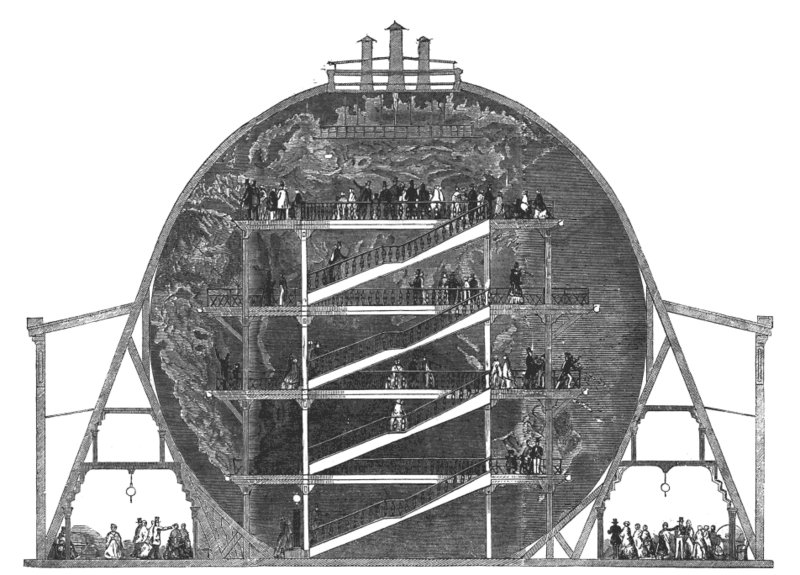
Wylde's Great Globe - Illustrated London News 7 June, 1851
Addendum. And don't forget Wyld's Great Globe, the 60-foot diameter static globe that was a public attraction in London's Leicester Square from 1851-1862. Like the modern Mapparium in Boston, it was a concave globe; the mapped surface was viewable from the inside. See the excellent Wikipedia article Wylde's Great Globe: this is the kind of geeky and uncontroversial article where the Wikipedia model excels.

- Ray

Sunday, 1 July 2012

The Desire of the Moth

After a bit of a break to catch up on various writing chores, I've resumed the project to read the entire works of Maxwell Gray (Mary Gleed Tuttiett).

1913 brings me to Something Afar (published in the USA as The Desire of the Moth), which in some blurbs has the subtitle A Romance of the Italian Lakes. You wouldn't immediately know this is what it's about, as MG, I think, was stuck in the conventions of the 19th century three-volume novel where she started out, and is very prone to astonishing amounts of framing before the actual plot begins.

The book starts with a chapter whose title, The Omnibus Horse, reflects metaphorically the situation of the protagonist. Ronald Leith is a middle-aged low-grade bank clerk who lives in London suburbia in a lacklustre marriage to Blanche; the only high point in his life is his beloved teenage daughter Beatrice. Within the characteristic (for MG) pathetic fallacy of a dark and stormy night, Leith's introspections lead to a flashback of how he came to this situation: how, some years before, he had discovered Blanche's cousin embezzling money from the bank where they both worked. Rather than report him, Leith had repaid the money out of his own pocket and let the man flee the country. The deception, however, was discovered during an audit, and Leith's involvement had permanently blighted his career.

It gets worse: Leith is superannuated (i.e. retired with a pension), and his further gloomy introspections reveal 1) the suicide decades previously of his father, Major Leith, following a scandal; 2) the fact that he and Blanche married each other on the rebound from their separate great loves of their lives; and 3) Leith's own exotic past - as a young army officer, he had been shot in Sicily due to the betrayal of a young Contessina he loved. All he has as mementos of the affair are the bullet scar, a precious ring in a drawer, and the letter of betrayal that sent him to the ambush. However, while re-reading the letter, he spots what he has missed for decades: a cipher that reveals the word dettato ("dictated"), evidence that she wrote the letter under duress. There ends the framing intro.

At this point, I'll leave it there for the evening.

It promises to be interesting biographically. As I mentioned in a recent post, I just found direct evidence that Maxwell Gray had been to Italy (she stayed in the Villino Trollope) and there may be something that 'connects'.

Both forms of the book title are allusions to a segment in Shelley's poem of devotion One Word is Too Often Profaned:
...
The desire of the moth for the star,
Of the night for the morrow,
The devotion to something afar
From the sphere of our sorrow?
Continued in The Desire of the Moth #2.

- Ray

Saturday, 23 June 2012

The works of Theodosia Garrow Trollope

Further to the previous post about Villino Trollope and its occupants,the works of Theodosia Garrow Trollope may be of interest. The entry from Dictionary of National Biography indicates the major sources:
TROLLOPE, THEODOSIA (1825–1865), authoress, born in 1825, was the only daughter of Joseph Garrow (d. 1855), by his wife the daughter of Jewish parents, and the widow of a naval officer named Fisher. Her father was a grand-nephew of Sir William Garrow [q. v.], and a son of an Indian officer who had married a high-caste Brahmine. From her mother she inherited skill as a musician, and she became an excellent linguist. By Landor's encouragement she became a contributor to Lady Blessington's annual, entitled ‘The Book of Beauty,’ and later she wrote for Dickens's ‘Household Words,’ and for the ‘Athenæum’ and other papers. The delicate state of her health prevented any extended literary toil, but she translated some of Dall' Ongaro's patriotic poems, and in 1846 produced a skilful metrical translation of Giovanni Battista Niccolini's ‘Arnaldo da Brescia.’ On 3 April 1848, at the British legation in Florence, she married Thomas Adolphus Trollope [q. v.], and as his wife she created at the Villino Trollope one of the best known salons in Italy. In 1861 some twenty-seven of her papers to the ‘Athenæum’ were reprinted as ‘Social Aspects of the Italian Revolution;’ at the time of their appearance these letters were thought to have rendered good service to the cause of Italian freedom. In the same year she contributed to the ‘Victoria Regia’ (‘A Mediterranean Bathing-place,’ Leghorn), and in 1864 she commenced a series of essays upon the Italian poets for the ‘Cornhill Magazine.’ She died at Florence on 13 April 1865, leaving one daughter, Beatrice. She was buried in the English cemetery at Florence.
[Gent. Mag. 1865, i. 670; Athenæum, 1865, i. 555; Atlantic Monthly, December 1864; authorities cited under art. Trollope, Thomas Augustus.]

- Dictionary of National Biography, 1885-1900, Volume 57, Theodosia Trollope, by Thomas Seccombe
Theodosia Garrow showed her writing talents from girlhood, writing ambitious poems at 13, when Walter Savage Landor called her the "new Sappho" and predicting that she would eclipse the fame of other poets.
TO THEODOSIA GARROW

Unworthy are these poems of the lights
That now run over them, nor brief the doubt
In my own breast if such should interrupt
(Or follow so irreverently) the voice
Of Attic men, of women such as thou,
Of sages no less sage than heretofore,
Of pleaders no less eloquent, of souls
Tender no less, or tuneful, or devout.
Unvalued, even by myself, are they,--
Myself, who reared them; but a high command
Marshalled them in their station; here they are;
Look round; see what supports these parasites.
Stinted in growth and destitute of odor,
They grow where young Ternissa held her guide,
Where Solon awed the ruler; there they grow,
Weak as they are, on cliffs that few can climb.
None to thy steps are inaccessible,
Theodosia! wakening Italy with song
Deeper than Filicaia's, or than his,
The triple deity of plastic art.
Mindful of Italy and thee, fair maid!
I lay this sear, frail garland at thy feet.
True estimation or not, this networking led her to a correspondence with the Countess of Blessington, who was then editor of a popular annual of poetry and fiction, Heath's Book of Beauty, and the publication of her poems The Gazelles and On Presenting a Young Invalid with a Bunch of Early Violets (both 1839, when she was 14), Song of the Winter Spirits (1841), and On a Portrait of Her Majesty (1842). A similar annual, The Keepsake, published more of her early poems: Imagine's Reward: A Legend of the Rhine (1841), The Doom of Cheynholme (1842), and The Lady of Ashynn (1843) and Lethe Draught (1847). Critical commentary on these early poems was very favourable - see UK Red - and to the effect that it was the best content of a couple of journals that critics otherwise viewed as collective aristocratic vanity anthologies (see the bitchy summary, A Batch of Annuals, in The Spectator, Nov 21, 1840).

Theodosia Garrow seems to have been interested in the Italian language and Italy from an early age, but as she got into her 20s, that interest took an increasingly political spin. In 1846, she contributed to The Keepsake a polemical poem called She is not Dead, but Sleepeth that argued for the unification of Italy, and in the same year had published Arnold of Brescia: A Tragedy, her translation of Giovanni Battista Niccolini's 1846 epic about Arnold of Brescia, a 12th century cleric who failed in an uprising to break from the Papacy to form a Roman republic. Her 1847 The English Heart to the Roman Pontiff (in the short-lived ex-pat periodical Tuscan Athenaeum) is in the same vein, praising Pope Pius IX for his then progressive stance.

Her hoped-for revolution actually came in 1859 - the external and internal wars of 1859-1861 that led to the establishment of Victor Emmanuel II as king of a united Italy. She described its progress in her letters to the London Athenaeum - see pages 86-88, Beyond the Traveller's Gaze: Expatriate Ladies Writing in Sicily (1848-1910) for an account of their general style and context. The letters were collected as The Social Aspects of the Italian Revolution, in a Series of Letters from Florence: With a Sketch of Subsequent Events up to the Present Time (Theodosia Trollope, London, Chapman and Hall, 1861 - Internet Archive socialaspectsit00trolgoog).

Various obituaries mention other works, of which I've tracked down some. The Cornhill Magazine series appears to be the uncredited essays under the banner Contemporary Italian Poets: No 1 — Giovanni Prati, No. 2. — Giuseppe Giusti (I haven't found No. 3). She's also reported as having written for Charles Dickens's Household Words and "papers on home topics" for All the Year Round. For instance, Kate Field's Atlantic Monthly article English Authors in Florence refers to an "exceedingly charming" poem - "Baby Beatrice, a poem inscribed to her own fairy child, that appeared several years ago in Household Words". It's uncredited, but the description fits Baby Beatrice, pp378-379, Household Words, Volume 31, 1855. This, and A Mediterranean Bathing-Place (1861) a nice piece of travelogue about "Leghorn" (Livorno) in the arts magazine Victoria Regia, show her work wasn't all politics. She also wrote a series, Notes on the most recent productions of Florentine sculptors, for The Art-Journal: see No I, No II (Hiram Powers) and No IV (Romanelli).

Thomas Trollope's 1887 autobiography What I Remember (Internet Archive whatiremembervo00trolgoog) devotes a chapter to her - see Chapter XVIII - with a few of her poems. There's also an extended analysis of her poetry and its relation to her political and social stance in Alison Chapman's 2003 essay collection Victorian Women Poets, particularly the chapter The Expatriate Poetess: Nationhood, Poetics and Politics.

To conclude: a bibliographic puzzle. As I mentioned previously, Theodosia Garrow was born in Torquay, and in the course of researching this post, I found this:
... last year All the Year Round contained a few chapters — reminiscences of her own early days passed in Devonshire.
- obituary, page 191, The Art-Journal,Volume 27, 1865
This sounded interesting. But All the Year Round is fully accessible online - see Archive - and unless the details are so unspecific that they're not recognisable, I can find no such articles.

- Ray


Tuesday, 19 June 2012

Villino Trollope


View Larger Map

This somewhat low-key building - it houses an IT office for the Italian National Railways - on the north-eastern corner of the Piazza dell’Indipendenza, Florence, Italy, is a remarkable focus of literary connections. It's the Villino Trollope (often called the Villa Trollope), the household for around 20 years of  the historian and writer Thomas Adolphus Trollope (brother of Anthony Trollope).

The extended Trollope family that lived there was itself a huge concentration of talent. There was the novelist Frances Trollope (Thomas Trollope's mother) who bankrolled the building of the villa; Trollope himself; his wife Theodosia (the poet, illustrator, journalist and translator Theodosia Garrow Trollope); and Theodosia's father Joseph Garrow, an Anglo-Indian magistrate from Torquay who was known as a talented violinist and linguist (the Times Literary Supplement said of him: "it is a curious footnote to the literary annals of Anglo-India which proves that the son of an Indian mother lived to translate Dante and to move in a circle where the Brownings and Landor were the greater lights").

Theodosia is in many ways the most interesting of the bunch. Though born in Torquay, her background was exotic: her mother was a widowed Jewish musican who had been one of the celebrated Abrams Sisters singing trio; her father the son of an East India Company merchant and (according to some accounts) a Brahmin lady called Sultan. She also moved in artistic circles; as a girl, an invalid in Torquay, she had been befriended by the older Elizabeth Barrett (later Browning). (There's considerable background on her family origins in Hostettler and Braby's 2011 Sir William Garrow: His Life, Times and Fight for Justice - see chapter 15).

Despite constant ill-health (she died at only 40) she proved to be a charismatic and multi-talented hostess for the wide circle of literati who came to stay at the Villino Trollope. But beyond this, she proved a significant figure - indeed, the chief English apologist and supporter - in the non-Italian support for Young Italy, the movement that ultimately led to Italian unification. Consequently, the plaque that still exists above the entrance to Villino Trollope is devoted not to her husband or mother-in-law, but to her.

We can get the flavour of Villino Trollope in its heyday from a December 1864 Atlantic Monthly feature, English Authors in Florence (see pages 660-671), which name-drops any number of celebrities, political as well as artistic: Tom and Theodosia Trollope themselves, Anthony Trollope, the late Frances Trollope, Colonel John Whitehead Peard (an English supporter of Garibaldi), the Irish social reformer Frances Power Cobbe, "George Eliot", Pasquale Villari, "Owen Meredith" (Robert Bulwer-Lytton, 1st Earl of Lytton), the composer Jacques Blumenthal, and Harriet Beecher Stowe. As to the house and its atmosphere:
Ah, this Villino Trollope is quaintly fascinating, with its marble pillars, its grim men in armor, starting like sentinels from the walls, and its curiosities greeting you at every step. The antiquary revels in its majolica, its old Florentine bridal chests and carved furniture, its beautiful terra-cotta of the Virgin and Child by Orgagna, its hundred oggetti of the Cinque Cento. The bibliopole grows silently ecstatic, as he sinks quietly into a mediaeval chair and feasts his eyes on a model library, bubbling over with five thousand rare books, many wonderfully illuminated and enriched by costly engravings. To those who prefer (and who does not ?) an earnest talk with the host and hostess on politics, art, religion, or the last new book, there is the cozy laisser-faire study where Miss Puss and Bran, the honest dog, lie side by side on Christian terms, and where the sunbeam Beatrice, when very beaming, will sing to you the canti popolari of Tuscany, like a young nightingale in voice, though with more than youthful expression. Here Anthony Trollope is to be found, when he visits Florence; and it is no ordinary pleasure to enjoy simultaneously the philosophic reasoning of Thomas Trollope, — looking half Socrates and half Galileo, — whom Mrs. Browning was wont to call "Aristidcs the Just," and the almost boyish enthusiasm and impulsive argumentation of Anthony Trollope, who is a noble specimen of a thoroughly frank and loyal Englishman. The unity of affection existing between these brothers is as charming as it is rare.

Then in spring, when the soft winds kiss the budding foliage and warm it into bloom, the beautiful terrace of Villino Trollope is transformed into a reception-room. Opening upon a garden, with its lofty pillars, its tessellated marble floor, its walls inlaid with terra-cotta, basreliefs, inscriptions, and coats-of-arms, with here and there a niche devoted to some antique Madonna, the terrace has all the charm of a campo santo without the chill of the grave upon it; or were a few cowled monks to walk with folded arms along its space, one might fancy it the cloister of a monastery. And here of a summer's night, burning no other lights than the stars, and sipping iced lemonade, one of the specialties of the place, the intimates of Villino Trollope sit and talk of Italy's future; the last mot from Paris, and the last allocution at Rome.

Many charming persons have we met at the Villino, the recollection of whom is as bright and sunny to us as a June day, — persons whose lives and motivepower have fully convinced us that the world is not quite as hollow as it is represented, and that all is not vanity of vanities.

- English Authors in Florence, Atlantic Monthly feature, December 1864.
This gushing luvvie-fest of a celebrity home description seems to have been as ill-fated then as it is in these days of Hello! magazine. Theodosia Trollope was dead within a few months of the Atlantic Monthly article.

IL GIORNO 13 APRILE 1865
MORI' IN QUESTA CASA
TEODOSIA GARROW-TROLLOPE
CHE SCRISSE IN INGLESE CON ANIMO ITALIANO
DELLE LOTTE E DEL TRIONFO DELLA LIBERTA

ON 13 APRIL 1865
IN THIS HOUSE DIED
THEODOSIA GARROW TROLLOPE
WHO WROTE IN ENGLISH WITH AN ITALIAN SPIRIT
OF FREEDOM’S STRUGGLES AND TRIUMPH

With nearly all his close family gone, the spell was broken for Trollope, and he moved to another district of Florence, then to Rome, and ultimately to Budleigh Salterton. It took him until 1872 to sell Villino Trollope, and subsequently, in the late 1880s, it was taken over by an American couple, the ex-politician and sculptor John McNamee and his wife Florence, who billed it as an "English and American First-Class Hotel-Pension (see the brochure ), as noted in The Critic by a writer with whom Frances Trollope's 1832 US travelogue still rankled:
IT IS A CURIOUS coincidence that a house built with money largely made by vilifying Americans and American ways should now be turned into an American boarding-house, or pension as it is called in Europe. This house is the Villa Trollope, in Florence, which was built by Mrs. Trollope, the mother of Anthony and T. Adolphus, from the sale of her book, 'The Domestic Manners of the Americans." But the whirligig of time has brought in his revenge, and the Americans who visit Florence now sit with their feet out of the front windows of her own house, or nurse their babies on the doorstep. At least that is what they do at home, if we are to believe Mrs. Trollope, and why should they not do the same abroad?
- The Critic, January 28, 1888
It continued to attract the literati, and not merely Americans, as mentioned in this late reference:
“THE FOLLOWING OF THE STAR,” the last novel by Florence L. Barclay, which has just appeared under the Putnam imprint, was begun at the Villa Trollope, in Florence. where George Eliot wrote "Romola." At this villa, Mrs. Browning. Maxwell Gray, and Lord Lytton often stayed - and more recently it has been frequented by Frances Hodgson Burnett, Thomas Hardy and Eden Phillpotts.
- The Publisher's Weekly, RR Bowker, New York, January 13th 1912
Hardy stayed there in 1887, (see Thomas Hardy: A Biography Revisited, Michael Millgate, p259); Francis Hodgson Burnettt in 1888. I don't know the date, but I strongly suspected that Maxwell Gray (the Newport-born novelist Mary Gleed Tuttiett) had been to Italy; Italian settings turn up in several of her novels, and she was a highly autobiographical novelist.

The last account I can find of Villa Trollope as a place to stay dates from 1918, when it appears in Lilian Whiting's 1918 autobiographical travelogue The Golden Road. (I've hyperlinked names not previously identified):
The house built by Thomas Adolphus Trollope, in the Piazza Independenza, had become a private hotel, admirably kept by Mrs. McNamee of New York; it was fairly enshrined in literary associations of the days when the Trollopes made their home one of such famous hospitalities; when on the terrace overlooking the garden with its ruined statue gathered the Brownings, Landor, Isa Blagden, Dall'Ongaro, and Pasquale Villari, then a youth from Sicily to whom Robert Browning took an especial fancy; when Charlotte Cushman, Harriet Hosmer, and Robert Lytton (later Lord Lytton, the "Owen Meredith" of poetic fame) were sojourning in Florence and joined in the resident group; when George Eliot and Mr. Lewes were for some weeks the guests of the Trollopes during the time that the author was making her studies for "Romola"; all these, and other delightful reminiscences related in journals and magazines by Bayard Taylor, Kate Field, and other writers, had so invested the Villa Trollope with interest for me that I joyfully embraced the opportunity of being domiciled under its roof. The long French windows in my room opened out on the very marble terrace where the famous folk had long ago assembled to talk of Italian liberty and Italian poetry, and to eat ices and strawberries on summer evenings. The full moon turned the fountain to sprays of silver, and the "ruined statue" gleamed from the dark greenery of orange trees at the end of the walk. To draw a chair out on this terrace in the witching hours and gaze on this scene was to fancy it fairly peopled again with those figures of the past. All the interior of Villa Trollope verified the descriptions I had read, — the broad marble staircase, the balconied room of George Eliot, overlooking the piazza, where in the evenings she had written out her notes for "Romola"; the faint strains of music from the streets that echoed then, as now, on the midnight air.
- The Golden Road, Lilian Whiting, Little, Brown & Company, 1918
 Villino Trollope has an entry on the database Repertorio delle architetture civili di Firenze (Inventory of the civil architecture of Florence): here.
L'edificio si presenta esternamente in forme sufficientemente anonime, sviluppato su tre piani con uno smusso in corrispondenza dell'affaccio sulla piazza. Abitò qui la famiglia inglese Trollope, che prese parte attiva nella rivolta contro il governo granducale. Una memoria (posta sul portone di via Giuseppe Dolfi) ricorda la morte nel 1865 di Theodosia Garrow Trollope, in funzione del suo impegno di patriota. Con la morte della moglie il marito, lo scrittore Thomas Adolphus, vendette la casa per acquistarne una a Ricorboli, e quindi lasciò Firenze per Roma quando la capitale vi fu trasferita. L'edificio è ora sede della Ferservizi, del gruppo Ferrovie dello Stato.
The building, which appears anonymous enough externally, is on three floors with a chamfer [at the corner] overlooking the square. Here lived the English family Trollope, who took an active part in the revolt against the Grand Ducal government. A memorial (located on the front door on Via Guiseppe Dolfi) records the death in 1865 of Theodosia Garrow Trollope, in commemoration of her committment as a patriot. With the death of his wife, her husband, the writer Thomas Adolphus [Trollope] sold the house to purchase one in Ricorboli, then left Florence for Rome when the capital was moved there. The building is now home to Ferservizi, the [IT services] group for the Italian National Railway.
There's a lot of further reading at Julia Bolton Holloway's Florin.ms, the city and the book website. While the sprawling GeoCities-flavour design is a trifle hard going, there's a lot here about the Trollope family and other ex-pat writers in Florence. The site is associated with Aureo Anello, an organisation that aims to preserve the 'English Cemetery' in Florence where they're buried.
Frances Trollope ... is buried in Florence's 'English' Cemetery. With her are also her daughter-in-law, Theodosia Trollope, Theodosia's father, Joseph Garrow, who was the son of an Indian princess, her Jewish step-sister, Harriet Theodosia Fisher, and the family's maid, Elizabeth Shinner, five Trollopes in all. With her are also Elizabeth Barrett Browning, Walter Savage Landor, Arthur Hugh Clough, Hiram Powers and Southwood Smith, all beneath the great cypresses of Arnold Boecklin and Sergei Rachmaninoff's 'Island of the Dead'.
Further reading. See the next post, The works of Theodosia Garrow Trollope.

- Ray