Showing posts with label etymology. Show all posts

Tuesday, 21 May 2013

Gormless protoplasm

I just had a brief e-mail exchange with a correspondent (US, I think) who was very amused by my use of the word "gormless", not having encountered it before (no reason to - it is a Britishism). A word I've known from childhood, I love it for its sheer insultingness - its implication not merely of stupidity, but of inept and pitiably-baffled stupidity - and the discussion prompted me to look into the background.

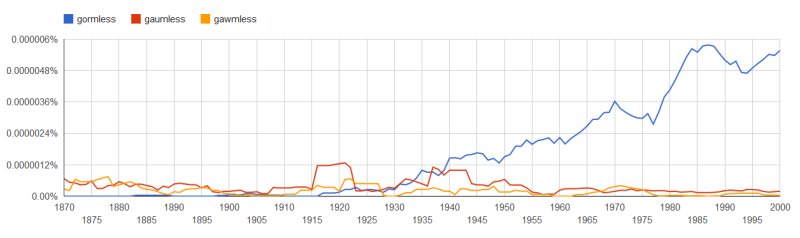
The Oxford English Dictionary tracks it back to the dialect form gaumless / gawm(b)less, where the "gaum" part means "heed, notice, understanding" and goes back to Old Norse gaum-r (masculine), gaum (feminine). From that, I assumed "gormless" must be an old word on the decline, but Google Books Ngram Viewer produced a surprise ...


click to enlarge - gormless 1870-2000
... which is that "gormless" has seen a steady rise in print use since around 1920, taking off dramatically from the competing dialect forms "gawmless" and "gaumless":

click to enlarge - gormless,gaumless,gawmless 1870-2000
Why the word should suddenly catch on in the mainstream is anyone's guess (see the addenda, below, on this). Why it should catch on in that spelling is perhaps more explicable, in that "gaum-" and "gawm-" are pretty peculiar in terms of standard English orthography, whereas "gorm-" (pronounced /ɡɔːm/ in the non-rhotic RP English) is  a normal-looking way of rendering the sound very well. With "gaum" coming from Old Norse, you'd expect "gormless" and its precursors to have a Northern English origin - a relic of the Danelaw era - and they do. Quite apart from appearing in Wuthering Heights ...
Did I ever look so stupid: so "gaumless," as Joseph calls it?
- Heathcliff
... the "gaumless" / "gawmless" forms appear from the early 19th century in a number of northern English regional dialect glossaries and the occasional work of regionally-set fiction (Google search on "gaumless" OR "gawmless").

I thought for a moment I'd beaten the OED's first citation (1883) for the form "gormless" - Google Books produced a handful of earlier hits. But I soon found that the majority of 19th century hits arose from a murk of amusing optical character recognition errors, mostly for "germless":
But there are real occurrences only a little later than the OED's, such as the English Dialect Society's 1886 documentation of "GORMLESS, adj. dull, stupid" in Stockport dialect (see A Glossary of Words Used in the County of Chester, Robert Holland, Pub. for the English Dialect Society, by Trübner & Co., 1886, Internet Archive ID aglossarywordsu00hollgoog).

Addendum:
By complete coincidence, this ties in with the current Language Log post by Mark Liberman, Ngram morality. When Google Ngram Viewer was launched - see Google Books N-gram - wow! - one of the aspects that was hyped was its potential for "culturomics": quantitative research into social trends as reflected in language: this was outlined in the paper Quantitative Analysis of Culture Using Millions of Digitized Books (Science, 14 January 2011: Vol. 331 no. 6014 pp. 176-182).

This is a powerful idea, when the results are interpreted with a lot of caution (I described previously - When pufh comef to fhove - how an apparently robust pre-Victorian era when it was OK to use the word "fuck" in print is entirely an artifact of the word "suck" being printed with a long-s as "ſuck").

But as Professor Liberman and others have discussed, there are those, often seeking confirmation for some world-view, who are ready to wade in with no such caution. One of the dubious forms of analysis is the completely simplistic conclusion that the frequency of a concept mentioned in print is a direct indicator of how that concept applies in society. By that line of argument, the steady rise of "gormless" over the past century means society has become more gormless over that time.

Ngram morality looks at a current op-ed column by the NY Times pundit David Brooks, who applies precisely the same reasoning, based on several like-minded papers, to conclude that society is going to the dogs, as evidenced by the rise and fall of certain words.

Addendum 2:
Martyn Cornell of Zythophile has offered in the comments a theory on the rise of "gormless".
It may or may not be a coincidence that the rise of "gormless" begins at about the same time as the rise of BBC radio: could it be because Northern English comedians were introducing the word to southerners, who took it up with enthusiasm? More research needed ...
This looks a very good start. I don't have any evidence of his using it, but the comedy persona of the immensely popular George Formby was regularly described as "gormless".

- Ray

Thursday, 15 November 2012

Just chatting

Clare, who's researching World War One topics, just drew my attention to this article: Of Lice and Men: Trench Fever and Trench Life in the A.I.F. by Dr. M. Geoffrey Miller.

It's a good article in itself, but one that also leads into a wealth of superb material. Up one level, and you get to The Medical Front, a compendium of texts on "all medical aspects, military and civilian, of the Great War". And this is just part of the GWDPA: the Great War Primary Document Archive, whose intention is "to present in one location both primary and relevant secondary documents between 1890-1930".

However, returning to Of Lice and Men, one point of interest was the reference to "chats" and "chatting" ...
There are three varieties of lice; head lice, or 'nits', (pediculus capitis), pubic lice, or 'crabs', (Phthirius pubis), and body lice, or 'chats' (pediculus corporis)
...
Accordingly the soldiers had to attempt to remove the lice as best they could. This removal, a procedure known as "chatting up" was usually by hand, picking out the lice from the clothes, or with the flame from lighted candles run up and down the seams of the clothes. (This was the origin of the verb "to chat" as the soldiers made the removal of their lice into a social event).
... and part of this rang etymological alarm bells with us both.

"Chat" for "louse" is fine. I suspected it might be Anglo-Indian, but it turns out not:
1699 B. E. New Dict. Canting Crew, Chatts, lice.
1725 in New Canting Dict.
1819 J. H. Vaux New Vocab. Flash Lang. in Mem., Chats, lice.
- Oxford English Dictionary
"Chatting up" checks out likewise, as a couple of contemporary references show:
Then they gave us hot water and soap and a clean towel, and told us to go to it. This was an advancing signal-corps company that was chatting up after the retreating Boche.
- The Literary Digest, Volume 59, page 42, 1918
"Chatting-up," searching for " them " by divesting oneself of tunic, shirt and even breeches. This informal parade used to take place frequently among the men in the trenches during the summer months.
- The Athenaeum, 1919 
But the statement that this is the origin of the verb "to chat" is completely untrue. "Chat" goes back to Middle English in a couple of similar obsolete senses, but even the modern sense dates back to the 1500s.
3. intr. To talk in a light and informal manner; to converse familiarly and pleasantly.
1551 R. Robinson tr. T. More Vtopia sig. ✠viiv, I muste commen with my wife, chatte with my chyldren, and talke wyth my seruantes.
- Oxford English Dictionary
"Chatting up" in the delousing sense, by the way, has no connection with the modern sense of "flirting with". The OED's first citation for this sense is much later, and seems to be a modern development, first cited to the 1960s, on an obsolete meaning of "chat" equivalent to "chat up".
1916  C. J. Dennis, Songs Sentimental Bloke 19, I tried to chat 'er, like you'd make a start Wiv any tart.
- Oxford English Dictionary
- Ray

Wednesday, 2 May 2012

Prams of one sort or other

Further to Bayan time (16): Strange moments (concerning the use of a pram to transport my bayan), "Trebots" from kalebeul drew my attention to a band of Birmingham origins called Pram.

From their sampler on MySpace -  they describe themselves as Alternative / Experimental / Progressive - they're very good. They remind me a lot of the Icelandic group múm I mentioned a while back. Their official website - www.pram.uk.net - which particularly accompanies their 2007 album The Moving Frontier,  is a work of art as Flash animation, presenting the album contents and band details as flippable pages in a quaintly archaic book.

It begins with a series of definitions of "pram",  including one I didn't know. From the OED:
pram (noun)
1.
a. An open, flat-bottomed boat or lighter, used esp. in the Baltic and the Netherlands for shipping cargo.
b. A large, flat-bottomed boat mounted with guns and used as a floating battery. Now hist.
2.
a. A ship's boat. Now rare.
b. Chiefly U.S. A very small, flat-bottomed, square-bowed boat, used with sails or oars, esp. as a fishing boat
- Oxford English Dictionary, Third edition, March 2007; online version March 2012
The OED tracks the etymology back to Czech prám ("The term was perhaps originally borrowed from Czech by sailors on the upper Elbe") from which cognates spread all across seafaring nations in north-west Europe, and eventually to Dutch and English.

Although "pram" in the sense of "baby carriage" is generally accepted as being an abbreviation of "perambulator" (including by the OED) the similarity of function - a flat-bottomed transportation device - does make me suspect that "pram" in the nautical sense helped the abbreviation into existence. The Online Etymology Dictionary agrees about this possibility:
pram
baby carriage, 1884, shortening of perambulator, perhaps influenced by pram "flat-bottomed boat" (1540s), from O.N. pramr, from Balto-Slavic (cf. Pol. prom, Rus. poromu "ferryboat").
There can't be many writers who have explored the analogies between the two kinds of pram, but the traveller James Arthur Lees did:
They went to sea in a sieve, they did,
In a sieve they went to sea.
In spite of all their friends could say,
On the shortest night and the longest day,
They sailed away from Christiansand
To Flekkefjord and Listerland,
And the place where the Fiske be.
Far and few, far and few,
Are the lakes where the Fiske live.
The trout are pink, and the waters blue,
And they went to sea in a sieve.
- Old Ballad.

So we walked down to the harbour-side, and bought a pram. Now the pram of Norway must by no means be confounded with the English vessel which bears the same name. This, as every one knows, is generally to be found cruising in Kensington Gardens, or anchored bow and stern on the pavement in front of any bonnet shop, and is navigated by a mixed crew of nursemaid, life-guardsman, and—when it has not fallen out unobserved—the baby; the last-named being the most energetic of the three.

The Norwegian pram, on the contrary, is usually mannned by a woman with a pair of sculls, and is kept afloat by the strenuous exertions of two or three males, armed with hats or boots or any other handy substitutes for the forgotten baling- tin. It is built entirely of wood, the boards being fastened with rough pegs instead of nails ; there is no keel, but the bottom is rounded rather like an English "whisket " or garden basket, and it slopes upwards to a high flat-nosed bow overhanging the water something after the fashion of a Thames punt. The joints are at first a little defective, and it is likely that if you drop your knife or sketch-book, it may fall through one of the chinks ; but after filling up the worst places with your handkerchief and socks and pieces of moss, it becomes fairly watertight, and can be used with comparative safety by any expert swimmer.

- Chapter 1, The Voyage of the “Pram”, Peaks and Pines: another Norway book, James Arthur Lees, 1899
It's an interesting passage, both for its paraphrase of Edward Lear's The Jumblies and its use of the introductory "So" (commonly maligned, by people who don't read older books, as some modern barbarism) and Lees looks an interesting writer. While I had to hack the above extract from Google Books snippet view, two other of his late-1800s comic travelogues, co-written with Walter J Clutterbuck, are available in full on the Internet Archive: Three in Norway by Two of Them (ID threeinnorwayby00clutgoog); and B. C., 1887. A Ramble in British Columbia (ID bc1887rambleinbr00lees). They read rather like Three Men in a Boat - if the three men were self-deprecating confident adventurers (sailing from Hull) exploring northern wildernesses rather than the Thames.

Addendum: I find on further reading that the works of Clutterbuck and Lees have been credited (see the Wikipedia citation #3) as an inspiration for Jerome's book. And they have British Columbian mountains named after them: see The Clutterbuck Blog.

- Ray