Showing posts with label dialect. Show all posts

Saturday, 18 January 2014

TE Brown and Manx Dialect

Mark Liberman's Language Log post More bee science (which comments on a news story's mistaken description of worker bees as drones) reminded me of a scrap of verse I remember from way back.
What's the gud of these Pazons? They're the most despard rubbage goin,
Reglar humbugs they are. Show me a Pazon, show me a drone!
Livin on the fat of the land, livin on the people's money
The same's the drones is livin on the beeses honey.
- TE Brown
I first encountered this diatribe about parsons in Arnold Silcock's 1952 anthology Verse & Worse: A Private Collection, but I'd never bothered to look into its origins. I'd assumed it was in some folksy US dialect, but far from it. It turns out to be in Anglo-Manx, a now-declining dialect of which the Manx poet, scholar and theologian Thomas Edward Brown was a major chronicler. The above verse is one small segment of "The Pazons", part 5 of a cycle of comic rants - In the Coach - purportedly heard aboard a public coach. It comes from Brown's anthology Old John and other poems (1893, Internet Archive ID oldjohnotherpoem00brow).

He looks an interesting guy. His diaries contain a wonderful and inspirational exposition of what it is to be a writer ...
I must be free free to do what I like, say what I like, write what I like, within the limitations prescribed by me by my own sense of what is seemly and fitting.
... and it seems his works were unusually robust for the time, but he self-censored them in contemporary collections (see The Drama of Storytelling in T.E. Brown's Manx Yarns, Max Keith Sutton, 1991) . The 1998 Fo'c's'le Yarns: An Uncensored Edition of Four Manx Narratives in Verse leads with:
FO'C'S'LE YARNS presents four of T. E. Brown's best Yarns uncensored for the first time. These narrative poems were originally published in 1881 in an edition Brown called an "emasculation" of his best work. George Eliot, Max Muller, Francis Thompson, and W.H. Henley admired his work, yet he was eventually dismissed as too Victorian. These original texts demonstrate the inaccuracy of this characterization with their bold treatment of sex, and their dramatic inclusion of the rough give-and-take between the yarnspinner and his shipmates in the forecastle. The frankness of the Yarns makes them a significant expression of Manx experience and culture, as does their close imitation of the dialect.
Some of the censorship was about expletives - his characters' use of "My God" and the Manx equivalent "My gough" - but I haven't been able to find specifics of what else was involved.

See the Internet Archive - search creator:"Brown, T. E. (Thomas Edward), 1830-1897" - for his many other works.

There are a number of glossaries of Manx dialect, notably AW Moor's 1924 A Vocabulary of the Anglo-Manx Dialect and WW Gill's 1934 Manx Dialect Words and Phrases. Like many regional dialects (such as that of the Isle of Wight), it's greatly declined now, reduced to a regional accent with a few dialect words. Having never heard it, I wasn't sure what kind of accent it would be - I thought it might have affinities with Irish English. In fact it has a lot of similarities to North-West accents, with a twang not unlike Liverpudlian. The British Library has a couple of historical examples, recorded in the 1950s, in its Survey of English Dialects - Amanda Crellin (b. 1878), and John Thomas Teare (b. 1873).

For a modern example, check out the videos by Ben Watterson and Juan McGuinness. While they're a scathing satire on insular attitudes, the general response has been positive, with commentary to the effect that the accent is authentic and only slightly exaggerated. It definitely sounds even more Liverpudlian than the 1950s samples.


- Ray

Monday, 10 June 2013

Calbourne - WH Long

Finally, on Saturday June 8th, we got to Calbourne - the core location, fictionalised as "Malbourne", of Maxwell Gray's The Silence of Dean Maitland.

It wasn't easy. This is a village in the core of the 'West Wight' that, for a very touristy island, is still surprisingly inaccessible if you don't drive. We could have walked the couple of miles from the nearest bus route, as we did in March (see To see Swainston), but my brother-in-law Steve kindly gave us a lift out to Calbourne, and we took the eastern third of the Tennyson Trail back to Newport (of which more later).

One of the first cool things about the visit was seeing this plaque on Grants Cottage commemorating William Henry Long:

This is not the American mycologist of the same name, nor even the Sundance Kid, but the Calbourne-born writer I briefly mentioned in the post about the Maxwell Gray novel Ribstone Pippins. He's an interesting chap who got the break to rise from illegitimate birth and majorly poor roots to become a writer, bookseller, and member of the English Dialect Society.

There's a detailed account of him here - About W. H. Long - at the website of the Isle of Wight folk group The Dollymopps, particularly commemorating his contribution to the folk tradition in recording the lyrics of Isle of Wight folk songs. Here are his books online:
  • A Dictionary of the Isle of Wight Dialect, and of provincialisms used in the Island, with illustrative anecdotes and tales; to which is appended The Christmas Boys' Play, An Isle of Wight "Hooam Harvest" and songs sung by the peasantry, forming a treasury of insular manners and customs of fifty years ago (William Henry Long, pub. Reeves, 1886, Internet Archive ID adictionaryisle00longgoog).
  • The Oglander memoirs: extracts from the mss. of Sir J. Oglander, kt. (pub. Reeves & Turner, 1888, Internet Archive ID oglandermemoirse00oglaiala)
  • Memoirs of Emma, Lady Hamilton: With Anecdotes of Her Friends and Contemporaries (pub. Gibbings, 1891, Internet Archive ID memoirsemmalady00longgoog)
  • Medals of the British Navy and how They Were Won (pub. Norie & Wilson, 1895, Internet Archive ID medalsbritishna00longgoog)
  • Naval Yarns (pub. Gibbings, 1899, Internet Archive ID navalyarnslette00longgoog).
There are a couple of points arising. I mentioned a while back - see Ribstone Pippins - that I very strongly suspect Maxwell Gray's Isle of Wight novel Ribstone Pippins to have been written with a copy of A Dictionary of the Isle of Wight Dialect to hand - the spellings and vocabulary choice were so similar. But there's another possible Maxwell Gray connection. William Henry Long was the illegitimate son of William Warne, a chaise driver in the employ of Sir Richard Simeon at nearby Swainston Manor, and Eliza Long, a farmer's daughter. With a  bit of juggling of roles, could this have been the inspiration for the situation in Gray's The Silence of Dean Maitland, when Alma, the daughter of a coachman on the "Swaynestone" estate, gives birth to an illegitimate child?

As I said, more later. It was an extremely nice weekend. Quite apart from going to one of my sisters' 40th birthday party, we got in some good walking, and (on my part) a bit of photography and some major closure on a couple of my Isle of Wight topographical obsessions. I'll blog about these these non-chronologically: some need more background research than others.

- Ray

Tuesday, 21 May 2013

Gormless protoplasm

I just had a brief e-mail exchange with a correspondent (US, I think) who was very amused by my use of the word "gormless", not having encountered it before (no reason to - it is a Britishism). A word I've known from childhood, I love it for its sheer insultingness - its implication not merely of stupidity, but of inept and pitiably-baffled stupidity - and the discussion prompted me to look into the background.

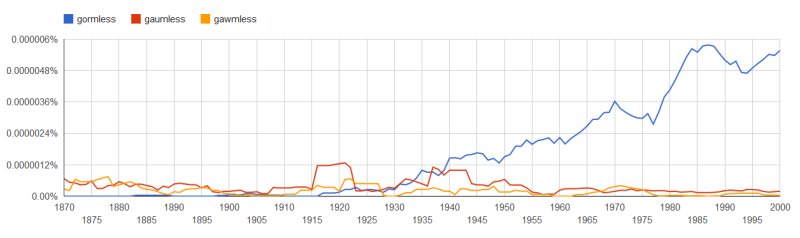
The Oxford English Dictionary tracks it back to the dialect form gaumless / gawm(b)less, where the "gaum" part means "heed, notice, understanding" and goes back to Old Norse gaum-r (masculine), gaum (feminine). From that, I assumed "gormless" must be an old word on the decline, but Google Books Ngram Viewer produced a surprise ...


click to enlarge - gormless 1870-2000
... which is that "gormless" has seen a steady rise in print use since around 1920, taking off dramatically from the competing dialect forms "gawmless" and "gaumless":

click to enlarge - gormless,gaumless,gawmless 1870-2000
Why the word should suddenly catch on in the mainstream is anyone's guess (see the addenda, below, on this). Why it should catch on in that spelling is perhaps more explicable, in that "gaum-" and "gawm-" are pretty peculiar in terms of standard English orthography, whereas "gorm-" (pronounced /ɡɔːm/ in the non-rhotic RP English) is  a normal-looking way of rendering the sound very well. With "gaum" coming from Old Norse, you'd expect "gormless" and its precursors to have a Northern English origin - a relic of the Danelaw era - and they do. Quite apart from appearing in Wuthering Heights ...
Did I ever look so stupid: so "gaumless," as Joseph calls it?
- Heathcliff
... the "gaumless" / "gawmless" forms appear from the early 19th century in a number of northern English regional dialect glossaries and the occasional work of regionally-set fiction (Google search on "gaumless" OR "gawmless").

I thought for a moment I'd beaten the OED's first citation (1883) for the form "gormless" - Google Books produced a handful of earlier hits. But I soon found that the majority of 19th century hits arose from a murk of amusing optical character recognition errors, mostly for "germless":
But there are real occurrences only a little later than the OED's, such as the English Dialect Society's 1886 documentation of "GORMLESS, adj. dull, stupid" in Stockport dialect (see A Glossary of Words Used in the County of Chester, Robert Holland, Pub. for the English Dialect Society, by Trübner & Co., 1886, Internet Archive ID aglossarywordsu00hollgoog).

Addendum:
By complete coincidence, this ties in with the current Language Log post by Mark Liberman, Ngram morality. When Google Ngram Viewer was launched - see Google Books N-gram - wow! - one of the aspects that was hyped was its potential for "culturomics": quantitative research into social trends as reflected in language: this was outlined in the paper Quantitative Analysis of Culture Using Millions of Digitized Books (Science, 14 January 2011: Vol. 331 no. 6014 pp. 176-182).

This is a powerful idea, when the results are interpreted with a lot of caution (I described previously - When pufh comef to fhove - how an apparently robust pre-Victorian era when it was OK to use the word "fuck" in print is entirely an artifact of the word "suck" being printed with a long-s as "ſuck").

But as Professor Liberman and others have discussed, there are those, often seeking confirmation for some world-view, who are ready to wade in with no such caution. One of the dubious forms of analysis is the completely simplistic conclusion that the frequency of a concept mentioned in print is a direct indicator of how that concept applies in society. By that line of argument, the steady rise of "gormless" over the past century means society has become more gormless over that time.

Ngram morality looks at a current op-ed column by the NY Times pundit David Brooks, who applies precisely the same reasoning, based on several like-minded papers, to conclude that society is going to the dogs, as evidenced by the rise and fall of certain words.

Addendum 2:
Martyn Cornell of Zythophile has offered in the comments a theory on the rise of "gormless".
It may or may not be a coincidence that the rise of "gormless" begins at about the same time as the rise of BBC radio: could it be because Northern English comedians were introducing the word to southerners, who took it up with enthusiasm? More research needed ...
This looks a very good start. I don't have any evidence of his using it, but the comedy persona of the immensely popular George Formby was regularly described as "gormless".

- Ray

Sunday, 11 July 2010

Louis-Lucien Bonaparte

I confess to a misjudgement at the end of the previous post. On seeing the reference to William Barnes' Song of Solomon in the Dorset Dialect and its limited-edition 1859 print run for H. H. Prince Louis-Lucien Bonaparte, I had visions of some quaint erotica printed for some idle French aristo.

In fact Louis-Lucien Bonaparte was a highly respected linguist with an interest in English dialects, and he had a seriously interesting life. The nephew of Napoleon I, he was born in Worcestershire when his parents were interned by the English en route to America after his father Lucien's falling-out with his brother Napoleon. Brought up in Italy, Louis-Lucien studied mineralogy and chemistry, but his interest turned toward languages. After a brief political career, he was granted aristocratic status under the Second French Empire, but lived primarily in London from the early 1850s. There, moving in distinguished circles as well as the academic, he devoted himself to studies of dialects and languages - notably Basque - as well as printing and publishing, bankrolling the publication of scholarly works. These included translations of parts of the Bible into regional dialects, and Barnes' 250-print Song of Solomon had equivalent companion editions in a variety of English dialects: see Bonaparte's Dialect Versions at the Internet Bible Catalog; the 1862 compilation Song of Solomon, in twenty-four English dialects. includes them all. Louis-Lucien's private income dried up on the fall of the Second Empire, but later, in 1883, he was granted a civil list pension for his work on English dialects. See the British Library feature Out of the confusion of tongues: Louis-Lucien Bonaparte (1813-1891) for a full account. His library, catalogued posthumously in 1894 by Victor Collins, was humungous: see Attempt at a catalogue of the library of the late Prince Louis-Lucien Bonaparte (Internet Archive cu31924031350709).
- Ray

Saturday, 10 July 2010

Yola

On Q&A forums, a quite frequent question is: "What's the closest living language to English?" The standard answer is Friesian, but it's a bit moot: Scots is closer, but in its modern form it's heavily mixed with English anyway), and there are many English-based creoles that are highly intelligible to Standard English speakers apart from their non-English vocabulary imports. But, largely due to our isolation from mainland Europe, we don't have the experience of many Europeans: contact with adjacent and distinctly different languages that nevertheless skate on the edge of mutual intelligibility. Native English speakers can't understand Friesian to the level that speakers within the Norwegian/Danish/Swedish or Ukrainian/Russian/Belorussian groups can understand each other.

This, however, hasn't always been the case. While browsing for William Barnes (the Dorset dialect poet and philologist) I ran into an extinct language I'd never heard of: Yola. It was a remarkable geographical isolate that would be impossible nowadays, arising when an enclave of Anglo-Saxon speakers went to County Wexford with Norman barons in 1169. In these baronies, Bargy and Forth, it went its own way (with minor imports from Irish Gaelic), completely missing the Great Vowel Shift that characterised the change from Middle English to Modern English. It shared many characteristics with Devon and Cornwall English - commentators say its accent was similar - and lasted for some 600 years before being swamped in the 19th century by Hiberno-English following the 1830 Irish Education Bill that fostered English literacy through Ireland.

Relatively few samples have been preserved, but one of the largest appears in the 1890 book Chronicles of the County Wexford, which reprints a Wexford Independent report from 15th February 1850, telling of an address composed in Yola to Earl Musgrave, Lord Lieutenant of Ireland, when he visited in 1836. (I've interlaced the translation).

To’s Excellencie Constantine Harrie Phipps, y’ Earle Mulgrave, Lord Lieutenant-General and General Governor of Ireland. Ye soumissive Spakeen o’ouz Dwelleres o’ Baronie Forthe, Weisforthe.


To his Excellency, Constantine Henry Phipps, Earl Mulgrave, Lord Lieutenant-General, and General Governor of Ireland. The humble Address of the Inhabitants of the Barony of Forth, Wexford.


MAI’T BE PLESANT TO TH’ECCELLENCIE, - Wee, Vassalès o’ ‘His Most Gracious majesty’, Wilyame ee Vourthe, an, az wee verilie chote, na coshe and loyale dwellerès na Baronie Forthe, crave na dicke luckie acte t’uck neicher th’ Eccellencie, an na plaine grabe o’ oure yola talke, wi vengem o’ core t’gie ours zense o’ y gradès whilke be ee-dighte wi yer name; and whilke we canna zei, albeit o’ ‘Governere’, ‘Statesman’, an alike.


MAY IT PLEASE YOUR EXCELLENCY – We, the subjects of his Most Gracious Majesty, William IV, and, as we truly believe, both faithful and loyal inhabitants of the Barony of Forth, beg leave at this favourable opportunity to approach your Excellency, and in the simple dress of our old dialect to pour forth from the strength (or fullness) of our hearts, our sense (or admiration) of the qualities which characterise your name, and for which we have no words but of ‘Governor’, ‘Statesman’, etc.


Yn ercha and aul o’ while yt beeth wi gleezom o’ core th’ oure eyen dwytheth apan ye Vigere o’dicke Zouvereine, Wilyame ee Vourthe, unnere fose fatherlie zwae oure diaez be ee-spant, az avare ye trad dicke londe yer name waz ee-kent var ee vriene o’ livertie, an He fo brake ye neckares o’ zlaves.


In each and every condition it is with joy of heart that our eyes rest upon the representative of the Sovereign, William IV, under whose paternal rule our days are spent; for before your foot pressed the soil, your name was known to us as the friend of liberty, and he who broke the fetters of the slave.


Mang ourzels – var wee dwytheth an Irelonde az ure genreale haim – y’ast, bie ractzom o’honde, ee-delt t’ouz ye laas ee-mate var ercha vassale, ne’er dwythen na dicke waie nar dicka.


Unto ourselves – for we look on Ireland to be our common country – you have with impartial hand ministered the laws made for every subject, without regard to this party or that.


Wee dwyth ye ane fose dais be gien var ee guidevare o’ye londe ye zwae, - t’avance pace an livertie, an, wi’oute vlynch, ee garde o’ generale reights an poplare vartue.


We behold in you one whose days are devoted to the welfare of the land you govern, to promote peace and liberty – the uncompromising guardian of the common right and public virtue.


Ye pace – yea, we mai zei, ye vast pace whilke bee ee-stent owr ye londe zince th’ast ee-cam, proo’th, y’at wee alane needeth ye giftes o’generale rights, az be displayth bie ee factes o’thie goveremente.


The peace – yes, we may say the profound peace – which overspreads the land since your arrival, proves that we alone stood in need of the enjoyment of common privileges, as is demonstrated by the results of your government.


Ye state na dicke daie o’ye londe, na whilke be nar fash nar moile, albeit ‘constitutional agitation’, ye wake o’hopes ee-blighte, stampe na yer zwae be rare an lightzom.


The condition, this day, of the country, in which is neither tumult nor disorder, but that constitutional agitation, the consequence of disappointed hopes, confirms your rule to be rare and enlightened.


Yer name var zetch avancet avare ye, e’en a dicke var hye, arent whilke ye brine o’zea an dye craggès o’noghanes cazed nae balke.


Your fame for such came before you even into this retired spot, to which neither the waters of the sea below nor the mountains above caused any impediment.


Na oure gladès ana whilke we dellt wi’ mattoke, an zing t’oure caulès wi plou, wee hert ee zough o’ye colure o’ pace na name o’ Mulgrave.


In our valleys, where we were digging with the spade, or as we whistled to our horses in the plough, we heard the distant sound of the wings of the dove of peace, in the word Mulgrave.


Wi Irishmen ower generale houpes be ee-boud – az Irishmen, an az dwellerès na cosh an loyale o’ Baronie Forthe, w’oul daie an ercha daie, our meines an oure gurles, praie var long an happie zins, shorne o’lournagh an ee-vilt wi benisons, an yersel and oure gude Zovereine, till ee zin o’oure daies be var aye be ee-go to’glade.


With Irishmen our common hopes are inseparably bound up – as Irishmen, and as inhabitants, faithful and loyal, of the Barony Forth, we will daily and every day, our wives and our children, implore long and happy days, free from melancholy and full of blessings, for yourself and our good Sovereign, until the sun of our lives be gone down the dark valley (of death).

Edmund Hore, who consulted with Yola speakers to write the address, commented:

In all probability it was the first time regal or vice-regal ears were required to listen to words of such a dialect; and it is even still more probable that a like event will never happen again; for if the use of this old tongue dies out as fast for the next five-and-twenty years as it has for the same by-gone period, it will be utterly extinct and forgotten before the present century shall have closed.

The major documentation of the language was done by Jacob Poole around 1800: see Jacob Poole Of Growtown - And the Yola Dialect. His 1700-word glossary was published, edited by William Barnes, 40 years after his death, and is available in full online: A glossary, with some pieces of verse, of the old dialect of the English colony in the baronies of Forth and Bargy (1867). The glossary features a few examples of Yola folk songs.

The Graphic and Historical Illustrator for 1834 has an article on the district and dialect, Observations on the social habits and dialect of the Baronies of Forth and Bargy (commonly called "the English Baronies," in the County of Wexford, which has the following anecdote:

And here it may be related, as a singular fact, that the Rev. William Eastwood, Rector of Tacumshane, Barony of Forth, while amusing himself one day in his field with a volume of Chaucer, fancied some of the obsolete words which met his eye resembled those which also met his ear, as his workmen conversed together: he accordingly called them around him, and commenced reading a page or two of old Geoffrey aloud, to their great delight, as they well understood the most obscure expressions, and often explained them better than the glossarial aids of Dryden and Johnson.

"Yola", incidentally, means "old" in this language. It doesn't appear to be what its speakers called it - they referred to it, in its moribund days, as " oure yola talke" ("our old dialect") - but seems to have grown up among philologists due to the noted citation of a folksong, "a yola zong" ("an old song"). Several modern books repeat the factoid that Yola stands for "ye olde language" ("ye olde language" presumably - see Google Books), but this is bilge. No contemporary commentators mention this derivation, and pre 20th century acronyms are invariably suspect.
- Ray

Thursday, 10 June 2010

Style Wars - Part 2

There are two main schools of thought on grammar. To paraphrase grammar.about.com, "descriptivism" studies how a language is, and " prescriptivism" is the view of some people on what it ought to be. This division surfaced recently in reaction to Gerald Warner's polemical piece in the Telegraph blogs, We need an Academy of English to save our beautiful language.

A number of language-related weblogs, such as BadLinguistics, have commented on it. I can't add much, except to note that Mr Warner's views - a conflation of multiple peeves about what seems to him the decline of language and decline of culture - are exactly those addressed by Geoffrey Pullum in his 2004 paper Ideology, Power, and Linguistic Theory. Pullum argues for the existence of explicit connections between prescriptivism and a conservative authoritarian agenda:

The clearest fact about the spirit of the regulative rules the prescriptive ideologues advance is that they are genuinely linked to conservative ideology: the mistrust of ordinary people and the pessimism about what they would get up to if left to their own devices is palpable. This makes it not so surprising that, as Geoff Nunberg 2 has observed, attention to grammatical correctness correlates to some extent with contempt for liberal-style political correctness.

- Ideology, Power, and Linguistic Theory (revised text of a presentation, annual meeting of the Modern Language Association, December 30, 2004).

The thrust of the paper is to address an unresolved clash of perceptions that has existed for over a century. Despite advances in linguistics, Pullum says, linguistically uninformed views inherited from the 19th century and earlier

... dimly grasped and often misunderstood, nonetheless form the backbone of what the general public understands and believes about English grammar.

Whatever the psychology may be, the specific origins of prescriptivism in English are interesting, and even make it an understandable stance for the time when it arose. A very nice paper, The Rise of Prescriptivism in English (Dr. Shadyah A. N. Cole, Um Al-Qura University Journal Of Educational and Social Sciences and Humanities, Vol. 15- No.2 – Jumad I 1424H. July 2003) traces the roots to the growth of the middle classes and an ethos of scientific rationalism in the late 1600s onward.

Pundits of that time knew classical Latin and Greek, which both had tight well-defined grammars, but when they found English was a mess in comparison, they assumed that it had "decayed". Furthermore, it was rapidly and actively altering: Shakespeare and his contemporaries were rapidly coining additions such as the many "inkhorn terms". Given that theory, attempts to shore up English with a similar structure, to protect it against imports and neologisms, don't look so arbitrary. Cole likewise shows neatly the historical roots of current features of prescriptivism in the prevailing social/political climate, such as the growth of the middle classes (for whom one index of betterment was language that distinguished them from the working class).

A handful of writers such as George Campbell (The Philosophy of Rhetoric, 1776) and Joseph Priestley 1(The Rudiments of English Grammar, 1772) took an essentially modern linguistic view of basing their descriptions of grammar on current best usage. But the majority made their own aesthetic judgements, dissing in their books, and in whatever venues they could find (see Swift's whinge to the Tatler 3), bits of current idiom they disliked. These got incorporated into later grammar texts, and by the 20th century, English was left with a legacy of many prescriptive rules of grammar that were the result of accretion of such arbitrary opinions.

Judging by the controversy over Professor Pullum's earlier commentary on Strunk & White (see  Style Wars - Part 1), Americans have had a particular booster dose of presecriptivism over the 20th century. Things have been less hard-line in the UK, as even the prescriptive guides of 20th century Britain were iconoclastic in some areas. When I started writing, I recall reading Gowers' excellent The Complete Plain Words (1954); no-one could mistake this for a general guide to style, as its target is the particular obfuscatory writing of post-WW2 civil servants. Nevertheless, its Correctness section comes across as pretty enlightened in its openness to coining and importing new words, and Gowers was well aware of the arbitrary nature of individual views on correctness:
One has only to look at the words proposed by Swift for inclusion in his Index Expurgatorius 3 to realise how difficult, delicate and disappointing it is to resist new words and new meanings. He condemns, for instance, sham, banter, mob, bully and bamboozle. A generation later Dr. Johnson called clever a "low word" and fun and stingy "low cant". Should we not have been poorer if Swift and Johnson had had their way with these?
Even more influential in the UK was Fowler's Modern English Usage (1926), which again has a relatively laid-back approach. While Fowler had its own set of prejudices, it nevertheless described as "superstitions" and "fetishes" many classic prescriptive diktats including those against starting sentences with "and" or "but", ending a sentence with a preposition, splitting infinitives, and the use of singular "none". Given the ubiquity and overall respect for Fowler, it's hard to see why its advice didn't become mainstream - except perhaps that a book aimed at adult writers never touched grammar teaching at school level.

I like to think the time has come for descriptive grammar to strike back. One point not mentioned in these analyses of the origins of prescriptivism is the role of access to information. In the 1700s - and in fact right up to a decade or less ago - it would take years of work to properly research the print occurrences of some disputed word or phrase. Such a situation made it relatively easy for any authority figure or persuasive writer to get their unsupported opinion enshrined as a rule, and very difficult to offer an informed riposte based on documented usage. It's refreshing, then, to see the latest and most authoritative guides to grammar, Pullum & Huddleston's the Cambridge Grammar of the English Language and its 'lite' version A Student's Introduction to English Grammar, to be completely descriptive in approach; the publicity led with its occasionally radical departure from trad grammatical diktats 4.

The beauty is, too, that anyone can be part of this. Professor Pullum's Prescriptive grammar in America: The land of the free and The Elements of Style) (scheduled for English Today, June 2010) contains an example of how Strunk & White gives grammatical advice that is flatly contradicted by usage.
The sentence None of us are perfect is given as an example of incorrect grammar; None of us is perfect is claimed to be the correction.

The arrogance here is breathtaking. None of us are perfect is a line from literature. It is uttered by Canon Chasuble in the second act of Oscar Wilde’s The Importance of Being Earnest (1895), possibly the greatest of all stage comedies in English. It is absurd to suggest that Wilde didn’t know the rule of verb agreement, and surely false that he wanted to depict the learned Dr. Chasuble as unable to speak Standard English. White is simply stipulating a rule that doesn’t accord with Standard English usage, not even the usage that prevailed in his youth.

It is extremely easy to confirm this today, when hundreds of classic novels are available in readily searchable plain text at the Gutenberg Project site ...
Just so, and not merely within Gutenberg. As I've mentioned in a number of previous posts, now it's perfectly feasible even for a lay person to do a rough-and-ready corpus search by applying Google Books to the vast number of scanned texts online. For example, you can choose a time slot, say 1800-1820, and find occurrences of "none of us is" (40 hits) and "none of us are" (274 hits). You can do similar searches in Google News: for instance, between 1990-2010 for "none of us is" (96,500 hits) and "none of us are" (168,000 hits).

It's crude, but the raw analytical power is amazing; and the results of such searches can very often demolish the authority of the more mutton-headed prescriptivist claims, revealing them for what they are: unsupported asssertions that have been passed on, virus-like, down history.

The depressing thing is how difficult it is to get these non-rules out of the system. On Yahoo! Answers I frequently run into questions about them by school students whose teachers are telling them, for instance, not to start sentences with "And" or "But". This is complete garbage. If Pullum & Huddleston (co-authors of the authoritative The Cambridge Grammar of the English Language) use the construct in their A Student's Introduction to English Grammar ...
But they also commonly condemn it as illogical.
... you can be sure it's OK. But what do you say to a student afraid that going against what their teacher says will lose them marks?

- Ray

1. The same Joseph Priestley as discovered oxygen (or was at least in the same queue as Scheele and Lavoisier).
2. The Bloody Crossroads of Grammar and Politics (Geoffrey Nunberg, New York Times, June 1, 2003) which tells of the growth since the 1960s of the factoid that sentences such as "Toni Morrison's genius enables her to create novels that arise from and express the injustices African Americans have endured" contain an error.
3. See Swift's letter to The Tatler (Number 230, 26 September 1710, original here) which is quite remarkable for the number of now-accepted words that he considered unacceptable. It's also interesting - consolation to those now worrying about neologisms - to see how many of his complained-of constructs - such as "agen" for "again" - haven't made it into English.
4. See Book's coauthor sets the record straight.

Tuesday, 8 June 2010

In search of the ochidore


Velvet Crab, Necora puber: On board of RV Belgica from the southern North Sea. Licensed under the Creative Commons Attribution-Share Alike 2.5 Generic license.

Pertaining to Dr C's excellent Friday crab blogging series, to which Felix Grant and I sometimes contribute, I coincidentally just ran into the word "ochidore", which was among the obscure words featuring recently in Scripps National Spelling Bee: see So C-L-O-S-E: West Fargo middle schooler finishes second at national spelling bee.

The contestant who got it wrong can hardly be blamed, as the word is deeply obscure ...
ochidore, n.
Perh. regional. Obs. rare.
A kind of crab, perh. the velvet swimming crab, Liocarcinus puber.
... and, according to this account at The Awl, "elicited horrified gasps" at the revelation that its root was unknown (National Spelling Bee contestants are allowed to ask about word derivations to get a clue to the spelling). Furthermore the definition comes from a single citation in literature, if not in the whole of the English language, telling of a prank played on an old schoolmaster during a maritime pageant:
And clapping both hands to the back of his neck, the schoolmaster began dancing frantically about, while his boys broke out tittering, "O! the ochidore! look to the blue ochidore! Who've put ochidore to maister's poll!"

It was too true: neatly inserted, as he stooped forward, between his neck and his collar, was a large live shore-crab, holding on tight with both hands.

- see Charles Kingsley, Westward Ho!, 1855.
It's apparently a Devon dialect word. In 1901, AL Mayhew enquired, apparently without response, to Notes and Queries ...
"Ochidore."—This word occurs with the meaning "shore-crab" in Kingsley's ' Westward Ho !' chap. ii. p. 44. I can find no instance of its occurrence elsewhere. I should be glad if any of your readers would kindly tell me whether " ochidore " is a Devon word. Query etymology ? A. L. Mayhew. Oxford.
... and in 1935, an article on dialect words for marine life - Devonshire Fish Names - elaborated the definition:
Ochidore. Prob. Velvet Crab ... (EDD suggests the shore crab ...)
...
Velvet Crab (Portunus puber). Ochidore, Velvet Fiddler.

- pages 427/432, Report and Transactions of the Devonshire Association for the Advancement of Science, Literature and Art, Volumes 67-68, 1935
I haven't been able to hack the Google Books snippet view to find whether there's any explanation of the identification as the Velvet Crab - and anyway the Kingsley passage gives no reason to think that an ochidore is anything but a generic name for crab - but I assume it's to do with the "blue" description. The Velvet Crab (pictured above) does have blue-black tips to its claws, but it doesn't seem sufficiently blue for schoolboys to exclaim "Look to the blue ochidore". Blue crabs do exist - the blue crab (Callinectes sapidus) and the blue swimmer crab (Portunus pelagicus) - but neither of them are native to British waters. Perhaps the one in Westward Ho! was an escapee; they very rarely turn up after transport in ships' ballast (see the recent news item Rare Blue Swimmer Crab discovered in Cornwall).

As to the word itself, the trail on "ochidore" has gone very cold.

Addendum: Felix Grant adds this detail (I should have had the brain to click on the OED's etymology tab):
[Origin unknown.
Apparently used only by Kingsley (see quot. 1901), and probably invented by him; compare the following:
1901 T. L. SIMKIN MS Let. 10 Dec. (O.E.D. Archive), It does not appear whence Kingsley got this name. One old fisherman, still alive at Clovelly, remembers that Kingsley so called the Spider-crab Maya Squinado (not the Shore-crab): but he never heard any one else do so.]
I admit I don't quite understand the point of this anecdote in the OED. If the implication is that Kingsley made up terminology, this isn't a data point. The spider crab is called Maja Squinado, so the story merely means the old fisherman didn't know the Latin name, not that Kingsley was unreliable. However, the absence of "ochidore" elsewhere - for instance, in the good number of 19th century works on and in Devon dialect - is a trifle suspicious.

- RG

Thursday, 1 April 2010

Songs from the past

Further to the previous post Hardy's poetry: downbeat but great, I just had an e-mail from Ken Trickett Voll of Buena Vista, Wisconsin. His own story is unusual in itself; Ken has part-German, part-Devonian roots, arising from his father Gert being interned at POW Camp No. 42 (Exhibition Field Camp), Holsworthy, during World War II. Ken's mother, Carla Trickett, was a maid in service at Soldon Manor; the two met briefly during one of Gert's several escape attempts and married after the war, emigrating to the USA to avoid prejudice.

Anyhow, to the point of the post: Ken sent me some sound files of partially-restored cylinder recordings and notes belonging to his late mother. According to her diaries, they comprise a trio of songs recorded by Cecil Sharp during a tour of Dorset and Devon in the early 20th century. In his notes Sharp writes of Percy Grainger being present at some of the recording sessions, which places the likely date as 1908, when Grainger is known to have been collecting tunes while on a concert tour of the Westcountry. 2


The first, unnamed, song is performed by Cedric "Brassy" Nupson, a Hampshire-born thatcher and keen fisherman living in Starcross. Unfortunately all but the first two and the last verse were too damaged to recover. "Mr Nupson regaled us with accounts of catches of unlikely size," Sharp wrote, "after which he sang a version of The Unfortunate Rake." This broadsheet song spawned many variants including The Streets of Laredo, and the highly interesting thing in this one is its Exeter setting (it mentions the St James district, near Exe Bridges) which makes it a 'missing link' between the English versions and the American St. James Infirmary Blues.


The second, also by Mr Nupson, is a bawdy song called My Angledog (possibly NSFW); I won't ruin the point of the song by explaining (see footnote 3 for spoiler if you must). It is rather fun because it's a glimpse at the kind of material Sharp obtained as raw recordings; as is well known, he typically bowdlerised his transcripts).


The third, which was the reason Ken got in touch, is a recording of Lydia Garger of Wareham, Dorset, singing a song called Great Things. They recorded in The Angel, Wareham Forest (the pub renamed The Silent Woman after featuring in Thomas Hardy's The Return of the Native). Sharp noted "Liddy" to be a tiny but formidable lady, almost a dwarf, who before singing needed to warm up on a prodigious amount of chewing tobacco, along with pale ale "which she downed with great gusto despite her diminutive stature. As she drank she told us of the folly of her youth, when she had 'left her head and heart on the dance floor'. We soon had no money left, but Percy organised a whip-round and all was well". The lyrics of Great Things are the Thomas Hardy poem of the same name I recently mentioned, showing that Hardy wrote it nearly a decade before its publication in his 1917 Moments of Vision. (Of interest, the Mellstock Band have also set the words to music).

Ken tells me he has severe doubts about the pieces being autochthonous folksong, and I don't disagree. The literary origin of the Great Things lyrics pretty obviously suggest it to be a parlour performance piece; conversely there's something of the flavour of music hall about My Angledog - its title word is the only regional dialect word in the song. Not that this necessarily matters: highbrow songs such as Thomas Moore's Oft in the Stilly Night and faux-rustic ones such as the charmingly naive Buttercup Joe have become well-established on the folk circuit.

A quick search through the British Library 19th Century Newspaper online archives rather confirms my suspicions of non-amateur origins, in that The Era for 8th January 1881 finds a Miss Lydia Garger getting star billing in pantomime at the Theatre Royal, Exeter. It's a sufficiently unusual name and the dates look about right. Then as now, I suppose, pantomime was a valuable, if stereotypical, work opportunity for persons of restricted growth. I've had no luck finding any more about Cedric Nupson or why he was called "Brassy".

However, I'm not too bothered; Ken's find is absolutely fascinating, and I'm sure more background will come to light. Enjoy!

1. Files copyright Ken and Hannah Trickett Voll, 2010.
2. See p.125, Percy Grainger, John Bird, 1999.
3. But if you need a spoiler, see Passing down old Devon dialect, Laura Joint, BBC Devon, for "angledog".


- Ray

Saturday, 24 January 2009

Burns Night

Re Burns Night being tomorrow, yesterday's Times had a nice compilation feature by Alexandra Blair To see ourselves as others see us ("Looking forward to Burns Night on Sunday, to mark the 250th anniversary of the poet's birth British writers celebrate his work"). It includes interesting poetic ripostes: Liz Lochhead's From a mouse, Ian McMillan's The Bard of the Button Tin, Pam Ayres' On Comparing My Husband with Robbie Burns, and W.N.Herbert's Rabbie, Rabbie, Burning Bright. There's a deal of preciousness surrounding Burns, exemplified by this ghastly RP reading of My Heart's in the Highlands by the Prince of Wales; it's often forgotten that Burns, as Michael Rosen reminds us in the Times piece, was also a filthy little blighter who wrote vigorous but rather naff erotic poetry, mainly by putting rude words to existing folk songs. It'd be amusing to hear Prince Charles reading from Burns Merry Muses of Caledonia, whose existence is currently notably absent from the archive of works at the BBC Robert Burns site.

Burns' poetry puts in an appearance in Ronald Wright's excellent A Scientific Romance - see After London - whose hero, David Lambert, finds himself in a future where the only surviving people in 2500AD Britain, feudal and devoutly religious black Scots in a settlement called Nessie, have a mystery play that conflates Christ's Passion with Scottish tradition. Their religious iconography also includes a blond white Jesus; and the time traveller Lambert, as the only white person, finds himself conscripted into the ritual to play Jesus, when he finds an unusual object in the Last Supper.

On stage was a table spread with bread, jugs of palm toddy (a new one on me; antique Scotch wasn't the only tipple), and a central plate containing a dark trussed object like a Christmas pudding in bondage. The crowd swarmed at the edge of the platform: wild, eager, fanatical faces, a dark flood from the streets.

In my nervousness, suppressed but not banished by draughts of usquebaugh, my lines deserted me. My eyes flew around in panic, alighted on the crowning ornament of the board. Not a Christmas pud. Nor, exactly, a paschal lamb. It was a haggis - the first - the first I'd seen in Nessie - and Burns came to my rescue. I got to my feet, beamed on the crowd with what I hoped was an expression of
Christly gemütlichkeit, summoned the best stage Scots I could, and stretched out my hand to the blob of dubious meat:

Fair fa' your honest sonsie face,
Great Chieftain o' the pudding-race!
Aboon them a' ye tak' your place,
Painch, tripe, or thairm:
Weel are ye worthy o' a grace
As lang's my arm.

Related at least by scenario - a post-apocalyptic Scotland - I keep meaning to read Matthew Fitt's But n Ben A-Go-Go 1, a cyberpunk novel written in Scots (i.e. Lallans). This article - Literary Language and Scottish Identity, introducing the The Association for Scottish Literary Studies 2000 conference of the same name, has a brief excerpt in which the hero, Paolo, visits his comatose partner (who is infected with an HIV-like virus called Senga 2) in a high-security hospital:

Paolo’s ile-stoor resistant bitts squealed on the ceramic flair as he stepped back an glowered west alang Gallery 1083. It wis a summer Sunday forenoon the clatty end o January an the mile lang visitors’ corridor wis toom. A singil lawyer an her lycra-leggit secretary intromittit the silence, shooglin past on a courtesy electric caur. An indie-pouered germsooker jinked inconspicuously in and oot o Paolo’s personal space, dichtin up microscopic clart as it drapped aff his body.

A quarter mile doon, the wersh blinterin sun forced itsel in throu the UV filter gless at the corridor heid, illuminatin the faces an keek panels o the first fifty Omegas. An as he skellied intae the white bleeze, a troop o droid surveillance puggies advanced in heelstergowdie formation alang the corridor roof, skited by owre his heid an wi a clatter o mettalic cleuks, skittered awa eastwards doon the shadowy vennel. The toomness o the visitors’ corridor offered Paolo nae bield fae the buildin’s oorie atmosphere; Gallery 1083 wis an eerie airt wi or wioot passengers.

See the British Council / Scotland bio for Matthew Fitt; he's a strong proponent of the Scots language. His poem Scottish National Diction celebrates in dictionary format its diverse origins (English translations of some verses here). Fitt is one member of the partnership Itchy Coo ("Braw Books for Bairns o Aw Ages") which specialises in publishing Scots language books for children and young people. It includes Rabbie's Rhymes - Robert Burns for Wee Folk.

Children will love lifting the flaps to find out
—where the wee sleekit cowrin tim’rous moose is hiding
—what the haggis is wearing on his heid
—what happens to Charlie’s kilt when the wind blows

Hmmm. Presumably it's all in working order.

1. A "but 'n' ben" is a small two-room cottage, typically in the context of a holiday residence for urban Scots. Followers of Dudley Watkins' The Broons will recall their regular visits to one.
2. "Senga" is a Scottish female personal name - "Agnes" spelt backwards - of fairly low prestige, having become the term for a female "ned" (the Scottish equivalent of "chav"): see Urban Dictionary.


- Ray

Friday, 4 May 2007

Ansible ... and Anglish

Science fiction readers won't need an introduction, but this may also be of interest to a general fiction readership: Ansible, the archive site for Dave Langford's long-running SF newsletter. One of its general-interest topics is "As Others See Us", its coverage of the antagonism from the literary circuit, where authors and reviewers will bend over backwards to portray literary works set in, say, imaginary futures, as something other than SF. For instance, Margaret Atwood, author of two post-apocalyptic novels, The Handmaid's Tale and Oryx and Crake, doesn't write SF, which she characterises as "talking squid in outer space". Other amusements include Thog's Masterclass, examples of bizarre or illogical writing (e.g. Neat Tricks Dept. "The animal ... opened two enormous lidless eyes") and Hazel's Language Lessons, interesting linguistic trivia.

The latter introduced me to the Dorset poet William Barnes who, apart from dialect poetry, conceived of a 'Pure English' expunged of Latin and French influences. Some of his coinages are very nice: Sunprint (photograph), bendsome (flexible), folkwain (omnibus), wortlore (botany), hairbane (depilatory), nipperlings (forceps) and welkinfire (meteor). There is a book with a glossary: The Rebirth of England and English, The Vision of William Barnes by Father Andrew Phillips.
      Barnes wasn't alone in advocating this Saxonism: another enthusiast was the composer Percy Grainger, who used in his letters and musical scores a similar 'Blue-Eyed English', in this case springing from a fairly eccentric racial stereotyping. Although Grainger's coinages were often as pleasant as those of Barnes - for instance, traingarth (railway station) and tonewright (composer) - those for more abstract concepts were seriously cumbersome. See, for example, Grainger's Top Ten - PDF - which mentions his terms such as puzzle-them gift-fulness (complexity) and tween-realm-some skill-hoard-fulness (international tradition).
      The author Poul Anderson and humorist Paul Jennings also played with the idea. The former wrote an 'Ander-Saxon' essay in atomic theory, Uncleftish Beholding in entirely Saxon-derived words. An atom is an uncleft, the word corresponding to its Latin root a-tomos, that which can't be divided. The latter wrote a series of articles in Punch in 1966, in a postulated 'Anglish' that might have developed if the Normans had lost the Battle of Hastings. - Ray

"In a foregoing piece (a week ago in this same mirthboke) I wrote anent the ninehundredth yearday of the Clash of Hastings; of how in that mightytussle, which othered our lore for coming hundredyears, indeed for all the following aftertide till Doomsday, the would-be imaginers from France were smitten hip and thigh; and of how not least our tongue remained selfthrough and strong, unbecluttered and unbedizened with outlandish Latin-born words of French offshoot. Our Anglish tongue, grown from many birth-ages of yeomen, working in field or threshing-floor, ringing-loft or shearing house, mead and thicket and ditch, under the thousand hues and scudding clouds of our ever-othering weather, has been emulched over the hundredyears with many sayings born from everyday life. It has an unbettered muchness of samenoiselike and again-clanger wordgroups, such as wind and water, horse and hound, block and tackle, sweet seventeen. The craft and insight of our Anglish tongue for the more cunning switchmeangroups, for unthingsome and overthingsome withtakings, gives a matchless tool to bards, deepthinkers and trypiecemen. If Angland had gone the way of the Betweensea Eyots there is every likelihood that our lot would have fallen forever in the Middlesea ringpath".

Friday, 30 March 2007

Riddley Walker

I had an interesting e-mail from Frieda Ryan of the Red Kettle Theatre Company, Waterford,about a planned late 2007 production of the Russell Hoban novel Riddley Walker. It is to be "innovative and original ... very visual,full of movement, true to the language and staged in a specially adapted space", and she's seeking to contact fans who'd consider travelling to such a production.
      This inspired me to re-read the book, a post-apocalypse novel set in Kent. It isn't, however, standard post-apocalpyse SF, but a cult literary novel written entirely in a worn-down future English, where myth and fable mix with garbled scientific phrases whose meaning has been forgotten. To get some of the flavour, you can visit Bloomsbury's Hoban microsite, which includes commentary by Hoban and the first two chapters.
      Riddley Walker Annotations, Eli Bishop's collaborative resource unravelling the linguistic references, such as the corrupted Kent placenames, is also worth exploring. Hoban's particular skill in Riddley Walker is, in my view, the plausibility of his future English, which displays the same kind of garbling that has already turned "a napron" into "an apron". Many of the Riddleyisms, such as "setting the red cord straight" are similar to 'eggcorns', a term coined by linguist Geoff Pullum for a particular kind of malapropism involving a switch to a wrong, but logical, alternative that is rapidly and widely assimilated into general language.
- Ray

Addendum, Aug 2008: Red Kettle have a couple of YouTube videos of the production online here.
- Ray