
Showing posts with label botany. Show all posts
Showing posts with label botany. Show all posts
Friday, 29 May 2015
Devon Garden: RD&E Exeter

Thursday, 7 May 2015
Prickly ash revisited

Wednesday, 29 April 2015
Agnes Ibbetson, Exmouth botanist

Wednesday, 18 February 2015
ATURFUQIL: philanthropy funded by snake oil

Thursday, 5 June 2014
The Primrose Way

Monday, 16 September 2013
The mysterious superfruit

The excellent Google Images, which Felix Grant recommended to me a while back, identifies the thing: it's just a picture of an abnormally formed hen's egg, posted originally on a Canadian poultry forum in 2009 (Weird looking egg, 11th April 2009) and later, in higher resolution, by the hen's owner on her blog My Mountain Garden Gleanings (Weird Eggs, January 27th 2011).

How this egg image came to be ripped off for a slimming ad I can't really imagine. Perhaps it's a teaser to make people click on the ad out of curiosity? Perhaps it's a "stupidity filter" to select for punters who don't get alarm bells ringing about a weird advert whose picture has no relation to the product sold. But then you'd have to be pretty stupid not to spot the ridiculous non-sequitur in the advertising text:
You may have heard of the enormously popular Ketone Extract in the news. It's a completely organic fruit found deep in the Congo rainforest of Africa.What? There's a fruit called a Ketone Extract? I must look for it in the greengrocers next to the nice ripe Aldehyde Concentrates, which are just coming into season alongside the deliciously juicy Terpene berries.
- Ray
Saturday, 3 August 2013
Teignmouth and Shaldon: revisit
 |
| Teignmouth from the Ness, CE Hannaford from South Devon, Charles R Rowe, 1907 |
Click any image to enlarge
|
|
||||
|
|
||||
 |
 |


There are a number of artistic connections, such the plaque outside Thomas Luny House commemorating the marine artist Luny, who produced the bulk of his work while living in Teignmouth (he got into the news last year over the controversy of Teignmouth Council's expenditure on one of his paintings - see Teignmouth council's £3,000 Luny art purchase criticised). Check out another of Luny's works: Fishing Boats in Teignmouth Harbour, Devon. And there's a deal of Keatsiana: the Keats poem on Teignmouth - the one he called "some doggerel" - on the New Quay Inn, and the (perhaps alleged) "Keats House" at 20 Northumberland Place.
Click any image to enlarge
|
|
||||
|
|


Over at Shaldon, we had a look at the Homeyards Botanical Gardens, a pleasant free-access garden and park on the hillside overlooking the village. On the way up, there are very nice views over Teignmouth. The garden dates from the 1920s-30s, when it was created by Thomas Rider for Maria Laetitia Kempe Homeyard, the widow of William Newcombe Homeyard, the inventor and manufacturer of Liquafruta cough syrup (he's buried in the nearby churchyard, with the word "ATURFUQIL" on the tombstone). Little of the original planting exists, but it's a very pleasant enclave; a particular point of interest is the Mrs Homeyard's castle folly. There's a Friends group whose brief is "an on-going programme of works will hopefully restore the Gardens to their original glory, for all to enjoy" - see Shaldonbotanicals's Blog.
Click any image to enlarge
 |
 |
||
 |
 |
||
 |
 |
||
 |
|
||
 |
 |

We took a quick look through the so-called Smuggler's Tunnel to Ness Cove. Looking south-west, you can see the South West Coast Path winding up the cliff on the section that leads to Babbacombe and Torquay. I plan to walk this one soon.
Addendum: see Ice cold in Shaldon.

- Ray
Sunday, 30 June 2013
Killerton: quorema and knuckle-bones
View Larger Map
I've taken a break from usual habits, and written the first draft of this with an Android tablet, on location - just below the summit of Killerton Clump (aka Dolbury Hill), a wooded hill at Killerton, a National Trust owned stately home and estate a few miles north-east of Exeter. One of Clare's friends kindly drove us out there on Saturday, but as neither she nor Clare were keen on the hill (it was a very hot day - maybe 25°C out of the breeze), we went our separate ways for an hour.
Killerton didn't immediately grip me; I'm not at all a fan of stately homes, and architecturally the frontage is a kind of Borg Cube of a house - apparently a temporary build for another house that never came to be. Inside you're immediately greeted by a huge wallful of Dead White Male portraits - members of a club called Grillion's - and it all seemed rather ominous as a sample of the kind of history we'd get.

 Clare found a cookery book - A Guide to Modern Cookery - with some unusually-named but recognisable dishes such as "The Quorema" (that is, a korma); and I was tickled by some of the titles - Hobbles' On Corns, and Nettles for Nice Noses - which on closer inspection (the books being unremovable from the shelf) turned out to be spoof book spines hiding a cupboard.
I've transcribed the titles in another post, False books at Killerton.


 |
| Bear Hut |
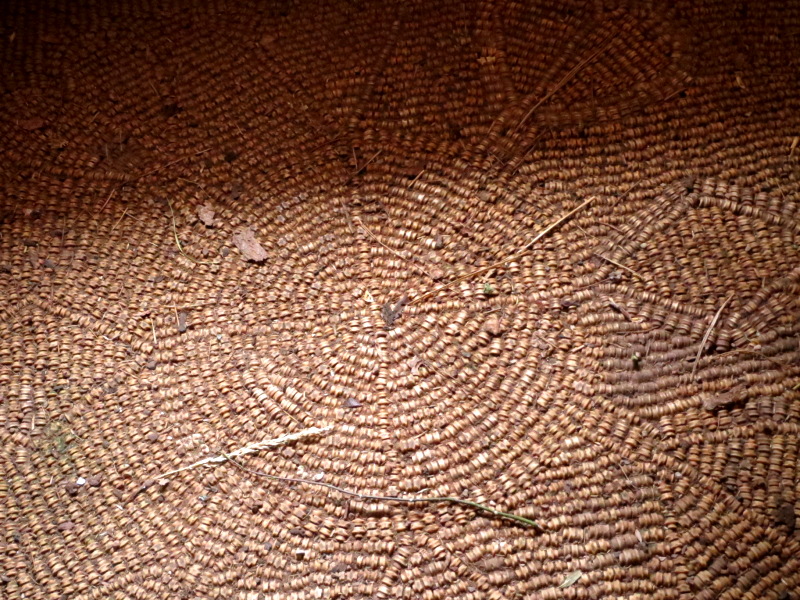 |
| Bear Hut - knucklebone floor |
 |
| Dolbury - the summit |
See The Dolbury Dragon for more about this hilltop.
 |
| Behind the hill |
 |
| The Quorema recipe |
Pellows are purely Hindoostanee dishes. There are several kinds of pellow, but some of them are so entirely of an Asiatic character and taste that no European will ever be persuaded to partake of them. It is therefore considered useless to offer instructions how to prepare such as the ukhnee pellow, in which are introduced cream, milk, butter-milk, garlic, and lime-juice; or the sweet pellow, in which almonds and raisins are introduced, in addition to sugar, &c... with vegetables are boiled for appalling times by modern standards - for instance, "two to three hours" to boil carrots. Otherwise, apart from using what seems excessive oil, the recipes look pretty palatable. The book also has many archetypally English cakes and desserts; Indian pickles and preserves; home-made "liqueurs" (including cocktails and punches); medicinal concoctions; perfumery, cosmetics and dentifrices; and miscellaneous household tips. It's good reading.
P.S. For those curious, the recipe for "uknee pellow" - which seems to correspond to the modern Yakhni Pulao - is described in a similar book, R Riddell's 1860 Indian domestic economy and receipt book ("comprising numerous directions for plain wholesome cookery, both Oriental and English, with much miscellaneous matter, answering all general purposes of reference connected with household affairs likely to be immediately required by families, messes, and private individuals, residing at the presidencies or out-stations"). Ukhnee, or Kid Pullow (page 434) doesn't look so dreadful, though it does look complicated, with a lot of boiling of presumably tough meat. Its combination of milk and meat would make it off-limits to Jewish readers of the books, but I don't know to what extent this would have been a mainstream taboo/preference in the mid-1800s.
 |
| Deer knucklebone floor - detail |
Knucklebone floors were in vogue for a comparatively short period from the late 17th - early 18th century and are therefore quite rare. Owners of buildings with simple earthen floors could consolidate and protect them from wear as well as producing a ‘pleasing’ decorative effect by driving animal bones (usually sheep) into the ground surface.Other extant examples include the floor of the Hermitage at Bicton Park, Devon; King John's House, Romsey, Hampshire (see Cattle foot floor for blog photo); and the Stiles Almshouses in Wantage, Berkshire. An example was also found during an archaeological dig for the hermitage at Belton House, Lincolnshire (see Belton's wilderness hermitage re-found (p14, National Trust Bulletin, October 2012), but it may have been re-covered; here's a good Flickr image. Though it looks difficult to find, there's a complete gazetteer of known examples in the monograph Diet and crafts in towns: the evidence of animal remains from the Roman to the post-medieval periods (Dale Serjeantson, Tony Waldron, BAR British series, B.A.R., 1989).
...
‘Knucklebone floors’ are among the better documented constructional or decorative practices from post-medieval Britain which was fairly widespread throughout the south west and south east of England in the late 17th to the early 18th century, although few have been discovered.
For fuller details on Killerton House, check out its main National Trust website: www.nationaltrust.org.uk/killerton. Despite, as I said, not being a fan of stately homes, I found a lot of interest there, in its general topgraphy and botany, and the scope of its estate for walks looks as if it would repay further exploration. There's a more academically-styled description at its National Heritage List Entry (ID 1000694); it has changed remarkably little from the description in an 1883 issue of The Garden:
KILLERTON
From Silverton Station, on the Great Western Railway, to Killerton is about two miles, but the walk is a pleasant one, especially after one crosses the stone bridge which spans the river Clyst, fur the road runs between high banks shaded by trees, Ferns being abundant on the banks, the Hart'stongue predominating. Killerton is especially celebrated for its grand old trees, and their grouping has been done with rare taste and skill. There are no sharp, hard lines anywhere. The whole place is an illustration of the way in which art can help or mend Nature. Intending planters might learn useful lessons in bold grouping by studying the planting here. Much of it was done or altered by the late Sir Thomas Acland, in combination with the late Mr. Veitch, of Exeter.
The soil is very fertile, overlying a stratum of rock called honeycomb rock, which is of volcanic origin. In many places the rock is deeply covered; in others it crops up near the surface, but in such cases it cracks into fissures, and the roots of the trees penetrate to a great depth. A curious instance of this was pointed out to me on the Beech Mount, in the deer park. Here a shifting of the surface on the edge of a ravine showed the fissures in the rock as if upheaved by a subterranean force; the roots of the trees had gone down, and from their luxuriant development they were evidently enjoying the feeding ground provided for them below.
 |
| Chapel - built of the local dolerite in a style imitating the Norman-Gothic St Mary's Chapel, Glastonbury |
In the grounds surrounding the private chapel, built by the late Sir Thomas in 1811 with stones dug on the spot, are many handsome trees. Several of the common Larch are very fine. One I measured was 12 feet in circumference at 3 feet from the ground, and had an altitude of not less than 130 feet. Here also were several handsome Cedars of Lebanon, transplanted some years ago when they were more than 40 feet high. They are now about 65 feet, and suffered but little check from their removal, having been heavily mulched as soon as the work was done. Near here is a very fine scarlet Oak, and a short distance away in an opening stands a handsome specimen of the Lucombe Oak girthing 17 feet 6 inches. In and around the open glade in front of the chapel are many fine trees, although some of them are comparatively youthful specimens. For instance, here is a Spanish Chestnut planted by the late Mr. Veitch seventy-two years ago which girths 13 feet at 5 feet from the ground. The upright Cypress, C. sempervirens, and C. torulosa are in duplicate 50 feet high; and near the chapel-yard is a hedge of Berberis asiatica, and another of common Box. These I notice just to say how elegant they look growing in a free and open manner, without shearing, the only attention given being to nip off long ends with the knife once a year of so.
Standing in front of the mansion and looking southwards across the park the views are very fine, extending for many miles' The park is of considerable extent and well timbered; handsome specimens of English Elm abound. To the left of the mansion, and some 300 yards or 400 yards away from it, is a group consisting of the finest specimens of evergreen Oak in the country. One of the largest measures 13 feet round the trunk, and has a spread of branches of 81 feet, and scattered about in this part of the park are many handsome Thorns. A small formal flower garden fills a sort of recess on the east side of the house, and this is the only bit of really formal gardening I saw at Killerton. But the handsome trees and their picturesque grouping are worth going a journey of many miles to see.
The mansion is a square building, suggestive of comfort rather than architectural beauty. In a glass colonnade is the usual assortment of flowering plants adapted to such structures; also such plants as Bougainvillea glabra, Acacia Riceana, Luculia Pinceana, Heliotropes, and Abutilon Boule de Neige, trained on the wall and roof. The latter plant makes an excellent climber, its white flowers being so useful, and produced most abundantly and continuously when planted in a light position. The walls of the mansion are clothed with climbing plants, among which are Magnolias and the Judas tree, which reaches up to the roof; Chimonanthus fragrans, Banksian Roses, Akebia quinata (quite hardy and flowering freely); and last, but not least, there is the old pink monthly Rose. In the flower garden are apair of nice plants of the hardy Palm, Chamrcrops Fortunei, and to the west of the mansion and only a few yards from it standing on the open lawn is one of the finest Tulip trees in the country. It measures 17 feet round the bole 5 feet from the ground and must be at least 100 feet high, and of handsome proportions.
 |
| southward view |

There are several acres of dressed ground on the west side of the mansion. Its surface rises upwards like an amphitheatre and it is embellished with trees and shrubs of the most varied and interesting character. Handsome groups of trees, wide stretches of closely shaven velvety turf, deep glades running far back up the hillside with an unseen, unknown termination, arc evidences of taste on the part of a bygone generation. Away far back, many feet above our standpoint is a large, bold group of common Beech, which thrives amazingly here, intermixed with the wild Cherry, which also forms a timber tree, and must be especially ornamental when in flower in spring amid the delicate tints of unfolding foliage. In front of the deciduous trees are masses equally bold of Wellingtonias, Taxodiums, Cupressus Lawsoniana and C. macrocarpa, with the funereal Cypress jutting out into the foreground, and variegated Hollies and lighter lifted low-growing shrubs in front. Rhododendrons also abound, as do many other flowering and evergreen shrubs, which lack of space compels me to pass over.- Ray
In a secluded spot with an open space of turf in front is the conservatory, chiefly filled with handsome specimen Camellias, some being as much as 15 feet high and well furnished. East of the conservatory is a small enclosed garden devoted to hardy herbaceous plants called Miss Acland's garden, and a most interesting spot it is.
As we ascend the hillside we come upon a handsome specimen of Thujopsis dolobrata, the best furnished example I have yet seen; it is 17 feet high and of proportionate diameter. Then we come upon a Scotch Fir with a straight and massive trunk 33 feet to the first branch, thougli the branches are drooping to the ground. The bole is 12 feet in circumference and as straight as an arrow; next a Picea cephalonica in cone, a handsome specimen. But the grandest feature in this part of the grounds is the group of Cedrus atlantica, at least 90 feet high, furnished down to the ground, and showing the beautiful silver tint for which this Cedar, when well grown, is remarkable. Pinus insignis, many years old, was green as a young plant, and a fine Araucaria, 54 feet in height, healthier and better coloured than usual, feeling the benefit of the warm sea air.
One of the features of the grounds at Killerton, and a very pleasing one it is, is the mixed groups of climbing Roses, Honeysuckles, Thorns, and other shrubs which mingle in a wild, graceful manner. The outlook from a rustic summerhouse, which occupies a retired spot on the side of the hill, is a most delightful one. Dartmoor, some 20 miles away, is distinctly visible, looming up dark aid drear. To the left is the break in the chain of hills called Sidmouth Gap, through which the sea is visible. Westward are the woodcrowned Woodbury Hills and Woodbury Castle, whilst we have a foreground that cannot be surpassed in the tastefully-planted park.
We leave the dressed grounds, and ascend higher up the hill, and come upon a rockery formed principally from the natural rock, and wild and bold with steep banks and ravines planted with bamboos, Azaleas, Ferns, and other appropriate plants. Far up 40 feet above is also a large natural self-sown bed of the Evening Primrose (Knothera biennis), which here seeds and grows abundantly, giving a bright and pleasant character to the .place. Foxgloves might be added to keep them company with advantage.
Further on we emerge upon an open space where there is a rustic seat, in front of which is a monument erected to the .memory of the late Sir Thomas Acland by a few of his friends. It is in the shape of a Maltese cross, and occupies a pleasant site amid leafy glades, and commanding a charming view up the Exe valley. The Fern glen is an exceedingly pretty and interesting spot. It is a ravine or deep glen, shaded by trees and spanned by a rustic bridge, and is full of very fine specimens of hardy Ferns.
We pass onwards through a Beech avenue noting some extremely fine Chestnuts and a group of Cupressus Goveniana, and grand examples of Taxodium and Cryptoraeria japonica, tlirough a wilderness of natural beauty called the Druids, where we find a plant of Rhododendron Blandfordianum 10 feet high, one of R. Thomsoni 10 feet high and as much through. We pass up through the Beech wood which crowns the summit of the hill, taking note of the fine herd of deer in the park below, through the Deodar glen which contains a handsome healthy lot of trees, the undergrowth consisting of Rhododendrons. We turn to the left across a wide, open, breezy hill covered with Bracken with Thorns planted thinly among it from which the views are magnificent. The shades of evening were descending as we entered the kitchen garden, but enough light remained to show that there was an abundance of fruit and vegetables.
The pyramid Pears were especially well managed and full of fruit. The walls also were well furnished with healthy trees. The Vines, both the Muscats and others, were producing plenty of fine Grapes, and several other ranges of glass were occupied with healthy collections of Orchids, Ferns, and flowering plants. Mr. Garland grows all his Potatoes and coarser vegetables in the open field, and I saw two acres planted with Regents and Champions looking at the time of my visit remarkably well, and in an adjoining field another acre planted with Onions, Carrots, &c. The Potatoes are planted !1 feet apart in the rows, and never earthed up, Turnips (Orange Jelly and Red Globe) being sown between the rows for autumn and winter use. This system of growing the main crop of roots, Cabbages, &c., in the open field, and leaving the enclosed, sheltered garden for the early crops and things that are benefited by shelter, or which, such as Celery, require to be .near the water supply, is a step in the right direction.
- E. Hobday, The Garden - An Illustrated Weekly Journal of Gardening in All Its Branches, Volume 23, Jan. 13 1883.
Wednesday, 25 July 2012
Topsham Bookshop: Veitch Exhibit
 |
| These rare long-stemmed begonias (left and right) are the prototypes from which all modern begonias were bred |
If you ever go to garden centres - I do, though I'm not as enthusiastic about plants as my wife - you often wonder where the new exotic plants they keep inventing come from. The answer is, generally, that they're hybridised in nurseries from precursors that go back to Victorian times and a vast amount of international prospecting. Veitch had a team of 22 plant-hunters who searched worldwide over the second half of the 19th century.
It was a risky business. One Veitch explorer, Thomas Lobb, suffered a leg injury in the Phillipines, leading to amputation; Gottlieb Zahn drowned near Costa Rica; Gustav Wallis, died of some combination of yellow fever, malaria and dysentery; and Henry Chesterton, also died of tropical disease in Colombia after collecting the 'Dracula orchid' Dracula chestertonii. His obituary in the Shipping List read:
Mr. J. H. Chesterton, the botanist, died at Puerto Berrio on the 26th. He had been quite ill, but left the hotel 'San Nicholas,' thinking that he had sufficiently improved to be able to make his trip up the river. Sad mistake! He continued to decline, and was barely put on shore at Puerto Berrio where he died. Poor Chesterton's reckless spirit rendered him very efficient as a plant-collector.You can read more in the Lives of Travellers section of Hortus Veitchii itself.

Anyhow, horror stories apart, Veitch were were the largest group of family-run plant nurseries in Europe during the 19th century, and by the outbreak of the First World War had introduced 1281 plants into cultivation. Their legacy continues today with the Chelsea Flower Show, which is the modern incarnation of the International Horticultural Exhibition organised in 1912 by Sir Harry Veitch.
See Caradoc Doy's site caradocdoy.co.uk for further background, and the Topsham Bookshop Veitch Exhibit page for a taster of the bookshop display.
James H Veitch's classic 1906 book Hortus Veitchii : a history of the rise and progress of the nurseries of Messrs. James Veitch and sons, together with an account of the botanical collectors and hybridists employed by them and a list of the most remarkable of their introductions is online at the Internet Archive (ID hortusveitchiihi00veitrich). If you want to see an original copy, The Topsham Bookshop has one on display for the week; and for botany enthusiasts who prefer the real thing to an e-version, Caradoc has a special offer on his very nice centenary reprint.
 |
| title page of Hortus Veitchii |
 |
| Veitch's original Chelsea nursery, from Hortus Veitchii |
- Ray
Wednesday, 30 May 2012
Ventnor - good for lungs and plants
 |
| The Palm Garden, Ventnor Botanic Garden |
VENTNOR
I did not get to Ventnor without a struggle. Everybody that I met held up hands of horror. "What! Going to Ventnor? You will be roasted before your time." My friends grieved, my very publishers wrung their hands, my newsvendor took me aside and besought me to live on a high hill. Yet through the whole of August I sat coolly writing on a low terrace. There is a superstition about Ventnor, and none of the people who talk glibly about its temperature have ever been there. But I think I have discovered the origin of the great Ventnor myth. The place is a winter resort of consumptives; and Mr. Frederick Greenwood, who was the chief charm of Ventnor, told me that you may take coffee on your lawn in November. The town, then, is warm in winter. The popular mind, with its hasty logic, thinks that this is tantamount to saying it is broiling hot in summer. I fancy there is a similar fiction about Bournemouth. But as a rule the British climate pays no heed to guide-books. By the natives, Ventnor, though as beautiful as a little Italian town, seems to be regarded as a good place to go away from, for every other man keeps a coaching establishment (I don't mean a school), and you cannot walk two yards without being accosted by a tout, who resents your walking the next two. Its regatta is a puerile affair, its own boating crews going off by preference to rival regattas. But in illuminations it comes out far better than Cowes, whose loyal inhabitants throw all the burden of fireworks upon the royal and other yachts anchored in the bay. And besides, Ventnor has a carnival, which I saw in the shop-windows in the shape of comic masks.
Bonchurch, the suburb of Ventnor, which plumes itself upon a very artificial pond, furnished in the best style with sycamores, Scotch firs, elms and swans, is more interesting for containing the old churchyard by the sea which received the bones of John Sterling and inspired the best poem of Philip Bourke Marston:--
Do they hear, through the glad April weather,
The green grasses waving above them?
Do they think there are none left to love them,
They have lain for so long there together?
Do they hear the note of the cuckoo,
The cry of gulls on the wing,
The laughter of winds and waters,
The feet of the dancing Spring?
I was married in Ventnor. At least so I gather from the local newspapers, in whose visitors' lists there figures the entry, "Mr. and Mrs. Zangwill." I do not care to correct it, because, the lady being my mother, it is perfectly accurate and leads to charming misconceptions. "There, that's he," loudly whispered a young man, nudging his sweetheart, "and there's his wife with him." "That! why, she looks old enough to be his mother," replied the young lady. "Ah!" said her lover, with an air of conscious virtue and a better bargain, "they're awfully mercenary, these literary chaps." The reverse of this happened to a young friend of mine. He married an old lady who possessed a very large fortune. During the honeymoon his solicitous attentions to her excited the admiration of another old lady, who passed her life in a Bath-chair. "Dear me!" she thought: "how delightful in these degenerate days to see a young man so attentive to his mother!" and, dying soon after, left him another large fortune.
- Without Prejudice, Israel Zangwill, 1896, Internet Archive withoutprejudic00unkngoog.
(The book is a collection of pieces that originally appeared in Zangwill's column in Pall Mall magazine; and this piece comes from the travel writing section Here, There, and Somewhere Else: Philosophic Excursions. See the previous post - Sharland grave, Bonchurch Old Church - for PBM's poem).
 |
| Ventnor in October 2010 - very different weather |

The Ventnor sanatorium - later renamed The Royal National Hospital for Consumption ad Diseases of the Chest - no longer exists; made obsolete by drug treatment of tuberculosis, it was closed in 1964 and demolished in 1969. However, the same climate that benefited TB sufferers enabled the establishment of Ventnor Botanic Garden on its 22-acre site.
View Larger Map
It's not a huge general-purpose botanic garden, but a specialist one designed to exploit the conditions of the Undercliff, showcasing plants from the subtropical climate zones of the world (South Africa, The Mediterranean, New Zealand, Australia and Japan). The overall layout is of a roughly east-west vale, with the drier habitats (hosting rock plants, cacti and exotic succulents) on its south-facing northern slope, and moister ones (largely hosting trees and shrubs) in the central vale, which is sheltered from the wind by the wooded higher ground on the coastal boundary of the gardens.
It's not remotely been plain sailing; the planting needed to accommodate the thin chalky soil, and the generally mild microclimate has had spectacular exceptions. The hardest winter for 150 years, in 1986/7, killed around 40% of the plants; and the garden suffered major storm damage in 1987 and 1990. Nevertheless, it's thoroughly flourishing now.
Even if you're not a plant aficionado (and I'm not especially) it's visually interesting and has a delightfully relaxing atmosphere. Admission is free, apart from parking, and it's on the Undercliff bus route between Ventnor and Newport. See the official website: Ventnor Botanic Garden.
 |
| Cacti and succulents section |
 |
| Cacti and succulents section |
 |
| The hothouse - it may not look it, but it was about 105F with 100% humidity in here. |
 |
| Looking down to central vale |
 |
| The Palm Garden |
 |
| In the Australian Garden |
 |
| In the Australian Garden |
 |
| Australian section - a soakaway makes a humid spot for ferns |
 |
| Mild microclimate or not, the day was sweltering |
Something we somehow missed: the tunnel entrance in the middle of the garden (see Wikimedia Commons). It's not open to the public, but there are pictures at the 28dayslater.co.uk urban exploration forum - Ventnor Hospital Tunnel - Isle of Wight - which explains that it was a chute used by the hospital to dump rubbish in the sea.

- Ray
Subscribe to:
Posts (Atom)