Friday, 14 October 2011

Nauscopy

Talking of oceanic matters: MetaFilter just had an interesting post, The Nauscopy Wizard of Mauritius, with some links concerning Étienne Bottineau, an engineer in the late 1700s who developed what he called nauscopie, a technique for seeing when ships were over the horizon, several days before their arrival.

The Smithsonian Magazine's Naval Gazing: The Enigma of Étienne Bottineau provides a good overview. It was a brief craze on the scientific circuit at the time: obviously if it worked, it would have been of massive tactical advantage - an 18th century over-the-horizon radar. Google Books finds a number of contemporary descriptions, including the following sceptical one from Encyclopædia Britannica.

NAUSCOPY, the art of discovering the approach of ships or the neighbourhood of land at a considerable distance. This pretended art was invented by a M. Bottineau, employed in the King and Company's service in the island of France, from the year 1782 to 1784; and the account of it is given by the inventor as follows:

"This knowledge is not derived either from the undulation of the waves, or from the subtilty of sight, nor from any particular sensation; but merely from observation of the horizon, which discovers signs indicating the proximity of ships or of land

"On the approximation of a ship towards the land, or towards another ship, there appears in the atmosphere a meteor of a particular nature, visible to every one without any painful attention. It is not by any kind of accident that this meteor appears under these circumstances; on the contrary, it is the necessary result of the approximation of one vessel towards another, or towards the land. The existence of the meteor, and the knowledge of its different modifications, are what constitute the certainty and the precision of my informations.

"If I am asked, how it is possible that the approach of a ship towards land should give birth to any meteor whatsover in the atmosphere, and what connexion there can be between two objects at such a distance from each other? I reply, that I am not obliged to give an account of the hows and the wherefores: that it is sufficient for me to have discovered the fact, without being obliged to account for its principle."

The writer concludes, by desiring to be called on for experimental proofs, and by promising in future a complete treatise of Nauscopy, with maps, plates, &c.

This complete treatise, as far as we know, has not yet been published, nor do we expect ever to see such a treatise on the subject as will satisfy the minds of those who are persuaded that every effect must have an adequate cause. The administrators of the island, who gave to M. Bottineau what he calls a report, containing the most authentic and most explicit testimony of the reality of the discovery, seem to be of our opinion ; and yet they speak of this discovery with doubt, and with a degree of respect to which we think it can lay no claim. Their report is in the form of a letter directed to the Marechal de Castries: and that our infidelity may not deprive the public of what, inthe immense catalogue of possibilities, may lead to a useful discovery, we shall here subjoin a copy of it.

Port Louis, Island of France, the 18th February 1784.
"My Lord, A letter which you have written on the 6th of April to M. Bottineau, employed in the King and Company's service in this colony, obliges us not to refuse him one for you, os which he proposes being himself the bearer. The desire only of being useful to his country, is (as he says) the motive which determines him to take this step. He would be angry with himself were he to conceal a discovery which hath hitherto escaped the most enlightened persons, and of which he only is in possession. This, discovery is the art of announcing the presence of one or several ships, at 100, 150, and as far as 200 leagues distance. This is by no means the result of his studies, nor the fortunate application of the principles of any particular science; his science is in his eyes only, and he can have no other: what we call penetration and genius cannot make up to him what he is deficient in from education. He perceives (as he says) in nature, some signs which indicate to him the presence of the vessels, as we know that there is a fire in a place when we perceive the smoke which comes from it. This is the comparison which he .makes use of himself to those who have conversed with him about his art: this (though he has kept his secret to himself) is the plainest thing he has said, in order to make it be understood that he hath not made this discovery by the knowledge of any art or science, which had been the object of his application, or his former studies.

"It is according to him the effect of chance : he hath taken nature in the act, and hath discovered his secret ; so that his science, or rather the first elements of it, hath not cost him the least trouble; but the thing which hath cost him a great deal of labour, and which may be really called his own, is the art of judgeing of the exact distance.

"According to him, the signs very clearly indicate the presence of ships ; but none but those who can well read these signs can draw any conclusions from them with regard to distances; andthis art of reading them well, is according to him, a true and a very laborious study: for this reason he hath himself, for a very long time, been the dupe of his science. It is at least 15 years since he first foretold here the arrival of ships. At first this was regarded only as a frolic. Wagers were laid on both sides. He often lost, because the ships did not arrive at the time prescribed by him. From thence came his application to find out the cause of these mistakes ; and the perfection of his art is the result of this application.

"Since the war, his informations have greatly increased, and probably were sufficiently exact to excite the attention of the public. The noise of them reached us with the degree of enthusiasm which is always excited by the marvellous. He himself spoke of the reality of his science with a tone of a man convinced. It would have been too cruel to have dismissed him as a visionary.

"Besides, every thing depended upon proofs, and we required that he should produce some: in consequence, he hath regularly sent us, for eight months, the informations which he thought he might venture to send us; and the result is, that several of the ships he announced are arrived at the time he foretold, after several days of information.

"Others have come later than was expected, and some have not appeared at all.

"With regard to some of these, it hath been ascertained, that their delay had been occasioned by calms or by currents. M. Bottineau is persuaded, that those which never appeared were foreign vessels which went on; and accordingly we have learned, that some English ships were arrived in India, which might perhaps have been in sight of the island at the time indicated. But this is no more than a conjecture, which our occupations have not allowed us to investigate. What we can ascertain is, that in general it appears that M. Bottineau hath made just observations: whether it is owing to chance or to his abilities, it might be, perhaps, imprudent to determine. It is however certain, that the fact is so extraordinary, under whatever light it is.considered, that we have not  thought ourselves able either to affirm or deny it; and we have wished the Sieur Bottineau to compel us to take one or the other side of the question, by trusting his secret to some trusty and able person. But this he hath refused, being probably afraid that he should not acquire by the discovery all the benefit which he imagines he may reap from it.

"Supposing the reality of the discovery, we do not believe that its utility can be as important as M. Bottineau persuades himself it is; but it might perhaps throw a great light upon natural history. In order to be useful it would be necessary that the discovery should be confined to one nation, and remain unknown to all others. This will be impossible, if every fleet, every vessel, and every privateer, is obliged to carry a man on board who is in possession of this secret.— We remain, with respect, my Lord, yours, &c. Le Vte. de Soulliac, Chevreau."

- "Nauscopy", pp 776-777, Encyclopædia Britannica: or, A dictionary of arts, sciences, and miscellaneous literature, Volume 12, 1797

In hindsight the evidence for the success of nauscopy looks heavily subject to confirmation bias. If ships arrived as predicted, nauscopy had worked. If they arrived later than predicted, there was the excuse that they'd been temporarily becalmed: nauscopy had worked. If they didn't arrive as predicted, they'd changed course (and would be identified with ships arriving elsewhere that - unprovably - might have been in the vicinity): nauscopy had worked! 

Note that "meteor" doesn't have the modern meaning; in its older use, it applied to any kind of atmospheric phenomenon:

Atmospheric phenomena were formerly often classed as aerial meteor or airy meteors (winds), aqueous meteor or watery meteors (rain, snow, hail, dew, etc.), luminous meteors (the aurora, rainbow, sun halo, etc.), and igneous meteor or fiery meteors (lightning, shooting stars, etc.)
- OED

Bottineau's Extrait du mémoire de M. Bottineau sur la nauscopie (available in full via Google Books) postulates a mechanism for these "meteors":

The waters of the ocean form an immense gulf, in which in which substances of all kinds are swallowed up.

The innumerable multitudes of animals, fish, birds, vegetable, and productions, which decay, and are decomposed in that vast basin, produce a fermentation abounding in spirits, salt, oil, sulphur, &c. &c. The existence of these is sufficiently apparent by the disagreeable smell and flavour of sea water, which can only be rendered drinkable by distillation and by the evaporation of those heterogeneous particles which infect it.

The spirits intimately united to the sea waters, continue undisturbed, a long as those waters remain in a state of tranquillity; or, at least, they experience only an internal agitation, which is slightly manifested externally.

But when the waters of the sea are set into motion by storms, or by the introduction of an active mass which rides upon their surface, with violence and rapidity, the volatile vapours contained in the bosom of the sea escape, and rise up a fine mist, which forms an atmosphere round the vessel.

This atmosphere advances with the vessel, and is increased every moment by fresh emanations rising from the bottom of the water.

These emanations appear like so many small clouds, which, joining each other, form a kind of sheet projecting forward, one extremity of which touches the ship, whilst the other advances into the sea, to a considerable distance.

But this train of vapours is not visible to the sight. It escapes observation by the transparency of its particles, and is confounded with the other fluids which compose the atmosphere.

But as soon as the vessel arrives within a circumference, where it meets with other homogeneous vapours, such as those which escape from land, this sheet, which till that time had been so limpid and subtil, is suddenly seen to acquire consistence and colour, by the mixture of the two opposite columns.

Tliis change begins at the prolonged extremities, which by their contact are united, and acquire a colour and strength; afterwards, in proportion te the progression of the vessel, the metamorphosis increases and reaches the centre. At last the phenomenon becomes the more manifest, and the shin makes its appearance.

- translation on page 351, The Monthly Anthology, and Boston Review, Volume 6, 1809
Hmm.

- Ray

Wednesday, 12 October 2011

Floodland

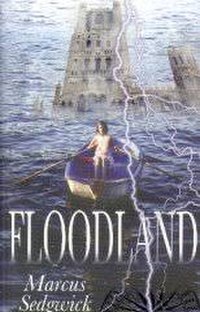
"Imagine that England is covered by water, and Norwich is an island ..." begins the cover blurb of Marcus Sedgwick's young-adult novel Floodland (Dolphin Paperbacks / Orion Children's Books, 2000, ISBN 1 85881 763 3).

Monday, 10 October 2011

Bayan time (10): Ochi Chyornye


Another work-in-progress from Saturday: Ochi Chyornye (Очи чёрные = Black Eyes). Sorry about the general murkiness of sound; the laptop microphone isn't so good. It's a nice tune with such a huge history of variant covers that it allows plenty of scope for improvisation, whatever your skill level. It shows a couple of the many nice features of the bayan: the compactness of the layout, allowing a 'three-handed' effect (left-hand bass and, with unexceptional stretch, melody on right thumb and a third part over an octave above that using the other fingers of the right hand); and the ease of playing chromatic runs.

As the Wikipedia entry mentions, despite its reputation being stereotypically Russian, the lyrics to Очи чёрные are a Ukrainian romantic poem by Yevhen Hrebinka, and the music probably German. The poem is very Swinburne:

Очи чёрные, очи страстные
Очи жгучие и прекрасные
Как люблю я вас, как боюсь я вас
Знать, увидел вас я в недобрый час

Ох, недаром вы глубины темней!
Вижу траур в вас по душе моей,
Вижу пламя в вас я победное:
Сожжено на нём сердце бедное.

Но не грустен я, не печален я,
Утешительна мне судьба моя:
Всё, что лучшего в жизни Бог дал нам,
В жертву отдал я огневым глазам!

Dark eyes, passionate eyes
Burning and splendid eyes
How I love you, how I fear you
Verily, I espied you in an ill-starred moment

Oh, not for nothing are you darker than the deep!
I see mourning for my soul in you,
I see a triumphant flame in you:
A poor heart immolated in it.

But I am not sad, I am not sorrowful,
My fate is soothing to me:
All that is best in life, God gave us.
In sacrifice I returned to the fiery eyes!

Its tune is an 1884 arrangement of an originally piano piece called Hommage-Valse by a German composer, Florian Hermann. There's a deal of garbling of the composer name and title, but the most reliable sources I can find are in the Library of Congress Records of its Nicolas Slonimsky Collection ...

BOX 285 Gerdal, Sofus (arranger)
BOX 285 Ochi chernyia, ochi strastnyia (na motiv val'sa "Hammage" Germana)
[voice and piano]. Moscow: A. Gutkheĭl', 1884.
Photocopy and negative photocopy.
Based on "Hommage-valse" by Florian Hermann, quod vide.
...
BOX 287-A Hermann, Florian
Hommage-valse [piano]. [S.l.]: [s.n.], n.d.
Negative photocopy of original edition [?].

... and the entry in James J Fuld's The Book of World-Famous Music: Classical, Popular, and Folk (pp 417-418), which notes further that it appeared in collection billed as "favourite songs of the Moscow gypsies".

- Ray

Sunday, 9 October 2011

All generalizations are false

A question on Yahoo! Answers drew my attention to yet another example of Mark Twain as a 'quote magnet' - an iconic author who attracts misattributions.
All generalizations are false, including this one.
This is widely attributed to Twain online, but it undoubtedly isn't by him: the first print attribution to Twain I can find dates to 1973. So who did coin it? Google Books finds the first appearances are in the second decade of the 20th century, with the usual vague attributions, including:

"some one, a Frenchman perhaps" (1911); "the man" (1917); "an old Chinese proverb" (1919); "Dumas" (1920);  "a French professor" (1920); "one of my history professors at college" (1921); "the Frenchman" (1922; "the witty epigrammatist" (1923); "the Gallic epigrammatist" (1926); "a witty philosopher" (1927); "the witty writer" (1928).

All that can really be said is that the earliest examples are all in US publications. The repeated attribution to a French origin did look hopeful (see previously, Batrachian breakfasts), but the French form - "Toutes les généralisations sont fausses, y compris celle-ci" - appears no older, nor any better attributed, than the English version.

I have, however, found a more detailed scenario for a different wording:
I would recall what happened in a debate of the French Chamber of Deputies. A deputy, criticising the previous speaker, said: "Monsieur X has generalized too freely. I contend that all generalizations are wrong" — and here he paused, and his Gallic wit saved him, when he added — "Yes, all generalizations are wrong, even this one."
- The Asiatic Review, Volume 24, The East India Association, 1928.
Currently, the trail ends there.

Addendum: 10 April 2014. I just pushed back the date a little, though with attributions no more likely to be true:
Voltaire has said, "All generalizations are false, and this is no exception."
- Engineering News, Vol 1, No. 26, page 366, 1903

.... as a Frenchman brilliantly said, “All generalities are false, this one included"
- The Blue and Gold, Volume 20, page 179, 1893
 The bulk of attributions, nevertheless, claim a French origin.

- Ray

Saturday, 8 October 2011

Bayan time (9): San Antonio Rose


I keep meaning to post videos on the bayan progress, but I seem to go into palm-sweating panic the instant the webcam is switched on.  However, here's one at last. I learned this today: the Western swing classic, San Antonio Rose. It's technically New San Antonio Rose, as I recalled the tune from the sung version, not the original Bob Wills instrumental. Check out the excellent Patsy Cline cover. My left little finger: I think it must be some flavour of dystonia. When my other left fingers are doing stuff, it does that.

- Ray

Topsham Inns

I just put up a post - Topsham Inns - backdated to 26th August 2010. I didn't post it here previously as there was a slight conflict of interest involved in posting a rather lukewarm book review on a blog closely associated with the shop selling the book. Now JSBlog is unequivocally personal, and the book has been out over a year, I guess it's OK to post.

- Ray

Friday, 7 October 2011

Ameliaranne and the Linking R

I've just been reading the 1930 Ameliaranne in Town, one in the long series of early 20th century children's illustrated books published by George Harrap and featuring the adventures of Ameliaranne Stiggins.  Ameliaranne is a country girl who lives in an unnamed village with her washerwoman mother Mrs Stiggins (no Mr Stiggins ever makes an appearance) and five younger siblings. The series started in the 1920s with Ameliaranne and the Green Umbrella, written by Constance Heward and illustrated by Susan Beatrice Pearse; the latter (a prolific illustrator of book and cards) drew the series throughout the unageing Ameliaranne's thirty-year career, while the stories were written by various authors including Heward, Natalie Joan, Margaret Gilmour, Eleanor Farjeon, and Ethelberta Morris.

The stories tend to be rather slight. Ameliaranne is a helpful and competent girl who goes around overcoming difficulties in largely realistic circumstances. For instance, Ameliaranne in Town tells of her visit to an aunt in London who has connections with a large toy store. Due to a mix-up, she isn't collected at the station, but safely negotiates the Underground and gets to her aunt's house unaided. Later, she is accidentally locked in the toy store, but is unafraid, finding a bed to sleep in, and guarding its four corners with four benign toy animals she identifies with the Matthew, Mark, Luke and John of her bedtime prayer. When a fire breaks out on a floor below, she raises the alarm and helps fight the fire, and consequently she and her family are rewarded by the directors of the store.

A cynic might find Ameliaranne a poster-girl for the clean, pious and socially obedient working-class. DL Kirkpatrick's Twentieth-century Children's Writers (1983) notes that the feisty little girl of the early books (in Green Umbrella she tries to smuggle food from the Squire's tea-party for her siblings, who can't attend through illness) became "a collection of virtues" toward the end of the series. Nevertheless, the books are very charmingly illustrated and the stories satisfyingly resolved; they've become highly collectable.  See Ameliaranne and other stories ... and Ameliaranne and knitted elephants for more pictures (and of course Google Images).

A point that became forgotten as the series proceeded was the origin of the name "Ameliaranne" - quite clearly a representation of "Amelia Anne" or "Amelia-Anne" with the linking/intrusive r that appears at vowel-vowel transitions in some UK dialects. This is explicit in the very first imprints of Green Umbrella, where both the cover and text refer to the heroine as "Ameliar-Anne" (as in the image at this post at the blog Umelecky Reconsidered).

Her name was Ameliar-Anne Stiggins. She was a pale child with black hair which she wore in curl rags from Friday night till Sunday morning. Her mother was poor and took in washing; because, besides Ameliar-anne, who was the eldest, there were some five other little Stigginses to feed.

This r-insertion and the country setting, we can assume, fits into with Ameliaranne being among the now-diminishing rhotic rural speakers of southern England. I'm not sure much else can be deduced about her background, because the writers didn't make much attempt at dialectical consistency. In Green Umbrella, she speaks with a dialect more consistent with urban London (with its dropped aitches and hypercorrected form of "awful") ...

"Oh sir, I'm glad you saw, 'cos I didn't take a bit more'n what I could easy 'ave ate; and the five of them's got colds in their 'eads, and when I left them they was all howlin' somethink horful, and I couldn't bear to go home and tell them everything and them not 'ave a bite, as you might say."

... but in Ameliaranne in Town, her speech shows no sign of any non-RP dialect at all.

Constance Heward et al weren't the only authors to note the r-phenomenon as it manifested with the name "Amelia", and "Ameliar" crops up in a number of late 19th century and early 20th century texts.  For instance:

From Miss Mary Ann Patten, Calcutta, to Miss Amelia Sophia Roshervile, lady's maid in the family of John Stiffneck, Esquire, Portman Square.

Deer Ameliar—I ope this finds you well, as it leaves me at present. I received your kynd note, which as I now confess I did not expect, for I know well the duties of high life take up a great deal of time ...
- p222, The Ganges and the Seine: scenes on the banks of both, Volumes 1-2, Sidney Laman Blanchard, 1862

One cried out " Oh !" the other began to laugh; and with a knowing little infantine chuckle, said, " Missa Pen-dennis !" And Arthur, looking down, saw his two little friends of the day before, Mesdemoiselles Ameliar-Ann and Betsy-Jane. He blushed more than ever at seeing them, and seizing the one whom he had nearly upset, jumped her up into the air, and kissed her : at which sudden assault Ameliar-Ann began to cry in great alarm.
- p125, The History of Pendennis, William Makepeace Thackeray, 1869

"You won't have to wait long. There's apoplexy in that woman's red face and short neck, as sure as my name is Ameliar Berringer."

Mrs. Berringer was not above introducing a superfluous " r " at the end of a word, any more than she was above uttering virulent ill-nature, in spite of her "good-heartedness," against her professedly dearest friend.
- p300, Only Herself, Annie Thomas, 1869

A few passers-by, attracted by Ameliar's cries, have collected round them, and are looking on with that eager, delighted interest in a "row" always manifest on such occasions.
- A great mystery solved: a sequel to 'The mystery of Edwin Drood', by Gillan Vase, Elizabeth Newton, 1878

But though authors tended to stereotype it as a feature of uneducated speech (or American speech), the reality was (and still is) quite different. As I mentioned previously, the philologist Henry Sweet was probably the first to notice that it was also an unacknowledged feature of educated Southern English speech.

The fact is that the statements of ordinary educated people about their own pronunciation are generally not only valueless, but misleading. Thus I know as a fact that most educated speakers of Southern English insert an r in idea(r) of, India(r) office etc. in rapid speech, and I know that this habit, so far from dying out, is spreading to the Midlands; and yet they all obstinately deny it. The associations of the written language, and inability to deal with a phonetic notation, make most people incapable of recognizing a phonetic representation of their own pronunciation.
- A Primer of Spoken English, 1890, Preface, page viii.

Addendum: if this is a general phenomenon, one might predict that it would appear in relation to similar names. It is: again, used by authors as a marker of non-prestige speech.

"Sartain, ma'am, he gin it to me hisself; an' he said I should 'form you, Miss Celiar, he would n't be so ill-mannerly as to send his bill, only as his landlord craved him for money, an' he was out of pocket."
- "The Travelling Artist", AMF Buchanan, Godey's Magazine, 1840

Now Hamlet was a prince upon
A throne, and flunkeys kep';
So never did conductin' on
A humble bus door-step.
They call him a philosophar,
Who overtaxed his brain;
His treatment of Opheliar
Vos certainly insane.
- "The Cockney Bus Conductor", Woodin's whimsies: satiric, comic and pathetic, W. S. Woodin, 1868

I wouldn't hurt you for the world, you know that, Ceciliar." The girl winced slightly ; his pronunciation of her name was one of the little things that grated on her sensitive taste ; but a superfluous letter or two lose force when the aggressor is handsome and spirited.
- Donahoe's Magazine, 1892

- Ray

Tuesday, 4 October 2011

New address

Since its launch five years ago (the first post was at the end of September 2006) JSBlog has always been my personal books blog. It was written on my own time, but informally affiliated with Joel Segal Books. However, as I'm thinking of publishing on some topics I've covered here, to make the copyright and ownership situation clear-cut I've decided to rebadge it as an unequivocally personal site - hence the new title and web address. Business will, otherwise, remain entirely as usual and the informal affiliation continue with the new incarnation of the shop as The Topsham Bookshop.

I'll probably be experimenting with new templates over the next day or so. Pardon the web equivalent of scaffolding and dust-sheets. I'm also finding a lot of broken links: exporting and importing Blogger .xml files occasionally renames files and alters file paths, breaking internal links.

- Ray

More on Teignmouth

Angela Williams - whose Literary Places blog I've mentioned previously - very kindly sent me some more details about Teignmouth's historical and literary connections, starting with John Keats.

You can see a couple of photos of one candidate for Keats' house on my website: Keats at Teignmouth.

I've spent quite a bit of time roaming the back streets of Teignmouth tracking down the various literary associations - it's well worth making several visits. I've got a lot more pictures still to add to my site including some of another Keats house which the staff at the Museum say is the 'real' one. The 'doggerel' poem is nicely displayed on the exterior wall of a pub down by Back Beach and Keats' description of the beach and sea opposite the Ness in his 'Epistle to J. H. Reynolds' poem still makes perfect sense.

Wilfred Owen went there twice because of the Keats connection - he had relatives in Torquay and it's all recorded in the biog of him by Dominic Hibberd
...
Charles Babbage was married at the church on the seafront - St Michael's - and Edmund Gosse went to school there too. Then there's the poet Winthrop Mackworth Praed…

Yesterday was definitely a "pier, promenade and tea shop" visit. And I must have still been slightly addled from the previously mentioned bug: however did I manage to forget (despite knowing it perfectly well) that Babbage was born in Teignmouth? (Anthony Hyman's 1985 Charles Babbage: Pioneer of the Computer has a section about his early life there - see page 12). A return visit when more compos mentis is definitely in order.

- Ray

Monday, 3 October 2011

Keats in Teignmouth

Teignmouth - SW toward Shaldon

I really fancied a day out today - I was feeling fragile after flu, and thought fresh air would help - so we went to Teignmouth for the first time today, I was surprised. I'd been told, on the basis of friends' experience a decade or more ago, that it was rather seedy, but it was by no means that. It came across as a mix of rather quiet off-season resort and sympathetically-renovated Georgian, with some remarkably folksy corners. We had a pleasant afternoon pottering between tea shops - marred only by the end, on finding at 5.20pm that all the facilities at the railway station (ticket/information office, cafe, toilets, waiting room) were shut. That's pretty lame, but I'm trying not to let that detract from the general niceness of Teignmouth: a pretty town, flanked at one end (north-east) by the long sea-wall walk by the railway leading toward the Parson and the Clerk rocks; and at the other (south-west) by a view across the outlet of the Teign estuary to the headland of Shaldon. We must go again when I feel better.

Teignmouth - NE toward 'Parson and Clerk'.

The Devon Heritage website has an interesting page - John Keats comes to Teignmouth - about the romantic poet John Keats's visit to Teignmouth, when his brother Tom (ill with tuberculosis) came there in the hope of remission/cure. Keats wrote a poem, that he called "some doggerel", about the area:

TEIGNMOUTH
by John Keats

For there’s Bishop’s teign
And King’s teign
And Coomb at the clear Teign head -
Where close by the stream
You may have your cream
All spread upon barley bread.

There’s arch Brook
And there’s larch Brook
Both turning many a mill;
And cooling the drouth
Of the salmon’s mouth,
And fattening his silver gill.

There is Wild wood,
A Mild hood
To the sheep on the lea o’ the down,
Where the golden furze,
With its green, thin spurs,
Doth catch at the maiden’s gown.

There is Newton Marsh
With its spear grass harsh -
A pleasant summer level
Where the maidens sweet
Of the Market Street,
Do meet in the dusk to revel.

There’s the Barton rich
With dyke and ditch
And hedge for the thrush to live in
And the hollow tree
For the buzzing bee
And a bank for the wasp to hive in.

And O, and O
The daisies blow
And the primroses are waken’d,
And violets white
Sit in silver plight,
And the green bud’s as long as the spike end.

Then who would go
Into dark Soho,
And chatter with dack’d-hair’d critics,
When he can stay
For the new-mown hay,
And startle the dappled Prickets?

The commentary to this poem, in the 1818 Gowans & Gray edition of The Complete Works of John Keats, Volume 2, notes that that the poem, sent in a letter to BR Haydon, must have involved an extremely active travelogue if he had really visited all the places mentioned in the "three fine days" he described.

The 'doggerel' on Teignmouth and its surroundings has collateral interest out of all proportion to its merits. Keats's correspondence for the Spring of 1818 shows that on his arrival in Devonshire he had on his hands, besides attendance on his sick brother, the final work connected with the publication of 'Endymion.' At the end of the first ten days he writes to Haydon of having copied the fourth book for the press; and between the completion of that operation and the end of April, when the poem was out, he must have been more or less busy with it. The greater part of' Isabella' was composed at Teignmouth, whence he wrote of it to Reynolds towards the end of his stay, as about to be copied out. These circumstances would account for the limited extent of the series of poems special to Devonshire. These, although inferior in interest to the Scottish series of the Summer of 1818, are full of the individuality of Keats. The first piece belongs to the 14th of March 1818. It occurs in a letter to Haydon published by Mr. Tom Taylor in Haydon's Autobiography without any date beyond "Teignmouth, Saturday morning"; but the verses form, with the next song, the staple of the letter, and appear from the context to have been written off as a part of it, and not copied into it . The date of the letter is to be fixed thus: Keats says in the prose paragraph of which the verses are the continuation—" the six first days I was here it did nothing but rain; and at that time having to write to a friend I gave Devonshire a good blowing up—it has been fine for almost three days, and I was coming round a bit; but to day it rains again—with me the County is yet upon its good behaviour. I have enjoyed the most delightful Walks these three fine days beautiful enough to make me content..." Now on the 25th of March Keats wrote to Reynolds or the weather as if the county's trial had lasted three weeks: this gives the 4th as the day of his arrival; and the tenth day from that (when he was writing to Haydon) would be the 14th, which was a Saturday. Keats describes these verses as "some doggrel." If he had gathered all their local details in the three fine days, he had not been idle; for he had been exploring both sides of the Estuary of the Teign. Starting from Teignmouth along the right-hand bank he would come to Bishop's Teignton about three miles distant, and King's Teignton or Teignton Regis about five miles distant; and crossing the ferry at Teignmouth to get to the left-hand hank he would go through Shaldon and Ringmore to get to the village of Coomb-in-Teign-Head—perhaps three or four miles from his lodgings. He oonld not have had his cream and barley bread close to the stream in the village proper; but twenty or thirty years later, and onwards, there was certainly every accommodation of that kind in a group of curious old oottages perched up over the mud-banks, and known as Coomb Cellars—a favourite place for pic-nics, not so celebrated for cream as for cockles, raked out of the mud bottom of the Estuary at low tide. He would cross Arch Brook, or Archy Brook, by a single-arch bridge just before he reached Coomb Cellars. Of 'Larch Brook' I know nothing except that it rhymes with 'Arch Brook.' It may be either the brook in Brimley Vale or the brook in Coomb Vale, both on the Teignmouth side of the Estuary. The "Wild wood" of stanza 3 answers to any of the thick plantations of little Haldon on the Exeter road. —a down such as Keats describes—furze and all. Newton Abbot, about six miles from Teignmouth, lies in a marshy situation enough, though the name of "the Marsh" has been appropriated to a spot near the Railway station. The town still has, like most country towns of any consequence, a Market Street. Of the dykes, ditches &c. of "the Barton" I can give no account, as I do not know to what particular manor-house and demesne the term was ever applied at Teignmonth. There is a touch of "local colour" in the white violets of stanza 6; for, though primroses and violets are found in almost all parts of the country, white violets are not quite common about Teignmonth, but are to be found at Bishop's Teignton. It is a pity that this choice little hit of trifling should be disfigured by the false rhyme "critics" and "Prickets". Keats does not seem to have been quite certain when he despatched his letter whether his "doggerel" had been written seriously or not; for he resumes prose with—" I know not if this rhyming fit has done anything; it will be safe with yon, if worthy to put among my Lyrics." We must consider these trifles worthy to go among his lyrics, in virtue of their fine sense of rhythm and their keen relish for out of door life. It is clearly to the present poem, and not to the Epistle to Reynolds, that the title 'Teignmouth' belongs of right; and I have therefore headed it accordingly. The text has been very copiously amended from the original letter—quite clearly written; and I need not detain the reader with the details of the absurd perversion of it by Mr. Taylor. But I must mention that "Barton" as a place-name instead of "the Barton " was suspicious on the face of it, as there is no such place there; that the critics are clearly described, not as dark-hair'd or as dank-hair'd, but as dack'd hair'd (=shock-headed); and that the dappled creatures are certainly not crickets, but Prickets, or two-year-old deer.
- pp207-210, The Complete Works of John Keats, Volume 2, John Keats, Gowans & Gray, 1818


The modern poet Charles Causley
wrote a poem - Keats at Teignmouth - commemorating Keats's visit, that I think conveys beautifully both the nature of Teignmouth and of Keats himself.

Keats At Teignmouth - Spring 1818

By the wild sea-wall I wandered
Blinded by the salting sun,
While the sulky Channel thundered
Like an old Trafalgar gun.

And I watched the gaudy river
Under trees of lemon-green,
Coiling like a scarlet bugle
Through the valley of the Teign.

When spring fired her fusilladoes
Salt-spray, sea-spray on the sill,
When the budding scarf of April
Ravelled on the Devon hill.

Then I saw the crystal poet
Leaning on the old sea-rail;
In his breast lay death, the lover,
In his head, the nightingale.

- Ray