Tuesday, 30 December 2008

Butterflies: entomology and etymology

It's that time of year when summer seems so distant. Let's have a little glimpse of it with the ongoing discussion at the Guardian's Letters page of the many nice words in different languages for "butterfly": see Buttervogel, pinpilinpauxa, bimbi: the global butterfly effect goes on and on. At insects.org, Butterfly etymology covers even more: but the etymologies are sometimes biologically problematical. Are they interested in butter; or milk-thieves, as in the German dialect "Molkendieb")? Are they seen as little old women, as in the Russian бабочка ("babochka")? In Wilhelm Oehl and the Butterfly at OUPblog, Anatoly Liberman offers a different theory: that in whatever language, these pretty stories are just folk-elaborations on simple onomatopoeic words for the butterfly's wing-flapping.

Anatoly Liberman - here's his regular Oxford Etymologist blog - is the author of Word Origins ... and how we know them (Oxford University Press, 2005, ISBN-10: 0195161475) which looks rather fun. Targeted at the lay reader, it discusses etymologies but, crucially, also the processes by which etymologies are discovered (and created): an antidote to the genre of cut-and-dried etymologies of newspaper columns and popular books (and, of course, the Internet - you may have received the ghastly "Life in the 1500s" e-mail).

Perhaps if someone explained to them that, compared to the drama of words, Hamlet is a light farce, they might develop a more informed attitude toward philological research and become students of historical linguistics rather than gullible consumers of journalists' pap.

You can sample Word Origins ... and how we know them at Google Books. At first acquaintance, I like the quirky style and iconoclasm, as in Chapter 5 ("in which people take the cause of word origins in hand, or Folk Etymology") or Chapter 11 ("in which history pretends to raise its veil, or Coinages by Known Individuals").
- Ray

Wednesday, 24 December 2008

Christmas Ghost Stories

It used to be a tradition, one that unfortunately dwindled, to have atmospheric and very English ghost stories on late-night BBC television on Christmas Eve. A few are findable on YouTube, however.

One, part of a series produced in the 1970s by Lawrence Gordon Clark, was The Signal-Man by Charles Dickens (part 1 / 2 / 3 / 4) filmed at Birchen Coppice Cutting and Tunnel Mouth, Kidderminster, Worcestershire. Many others dramatised MR James' Ghost Stories of an Antiquary (Gutenberg ETexts 8486 and 9629). They included Oh, Whistle, and I'll Come to You, My Lad, filmed as Whistle And I'll Come To You (parts 1 / 2 / 3) and Number 13 (parts 1 / 2 / 3 / 4 / 5). The Woman in Black is very much in the same vein; based on Susan Hill's 1983 novel, the TV film was by Nigel Kneale (see parts 1 / 2 / 3 / 4 / 5 / 6 / 7 / 8 / 9 / 10 / 11).

That reminds me: check out The Incredible Robert Baldick (PDF), an extended article, archived at The Mausoleum Club, about Kneale's little-remembered The Incredible Robert Baldick: Never Come Night. Broadcast in October 1972, it brought Kneale's frequent "ancient evil" theme to a Victorian setting, producing an effect rather like an MR James story with more technology and action (Baldick is a scientist-investigator with his own private train). It was a pilot episode for a series that never came about, due apparently to scheduling issues, various BBC internal politics, and the possibility of legal action by a Robert Baldick Jnr who objected to the use of his father's name (it's hard to see why, since Baldick in the story is a thoroughly positive character). See YouTube again for a clip from the programme.
- Ray

Tuesday, 23 December 2008

Medical and Dickensian: 2008

As last year, I recommend the British Medical Journal's Christmas issue for its usual combination of the strange and mildly morbid. This year, for instance, we have Festive medical myths, a Frankincense: systematic review, Rugby (the religion of Wales) and its influence on the Catholic church: should Pope Benedict XVI be worried?, Churchill’s flu poem, Reappraising Florence Nightingale, A symphony of maladies (occupational diseases of musicians), Fantastic feeding funnels (a look at a rather specialist motif in art, such as that of Bosch and Kahlo), and Please, sir, I want some more (a look at the dietetics of Oliver Twist in the workhouse).

The last piece is nicely revisionist. Rather as hostile commentators like "Jack Nastyface" - Jack Tar: book launch - exaggerated the ghastliness of shipboard food, it appears that Dickens, angry about his own deprived childhood, exaggerated the poverty of diet in the workhouse. He perhaps wasn't even so traumatised by working in a blacking factory, if the story that he wrote advertising jingles for Warren's Jet Blacking is true (see A twist in the tale, Guardian, 1 November 2003). It's not the only example of Dickens' misinformation about social evils: for instance, John Sutherland has commented about the the older Magwitch in Great Expectations - a model capitalist at that - being under threat of death at a point some years after the real-world abolition of the death penalty for returning transportees. This brings me to Scrooge – the Sequel (1) ("Ebenezer Scrooge has been transformed into a kind and charitable man. But can it last?"): this is the first episode of John Sutherland's ongoing story in the Guardian. A Christmas Carol sequels have been done before - see the addendum to Noir and the North Kent Marshes - but given Sutherland's background in witty and deeply informed academic litcrit, his Guardian version looks worth following. I'll link to installments as they're added.

Scrooge: the Sequel (1)
Scrooge: the Sequel (2)
Scrooge: the Sequel (3)

On a medical-meets-Dickensian theme still, the Dec 23 episode of the BBC's Holby City hospital drama was, interestingly, also based on A Christmas Carol.

- Ray

Tuesday, 16 December 2008

Felix: "Nothing propinks like propinquity"

Felix Grant recently introduced a Growlery post, Picture perfect, with the aphorism "nothing propinks like propinquity" - that is, nothing engenders a relationship (of whatever sort) better than proximity. The background is interesting. As Felix says:

*Exactly who "they" [who say it] are, in this case as in many others, is unclear. My mother used to say it before I started school in September 1956. The phrase is often attributed to George Ball, a US Undersecretary of State in JFK's and LBJ's administrations, but his first recorded usage of it is in the 1960s. Ian Fleming used it as a chapter title in Diamonds are forever, published (London: Jonathan Cape) in 1956; but I am fairly certain that my mother has never read any Ian Fleming, and Fleming seems, in any case, to be quoting.

Just so. Ball is widely quoted as using the aphorism - later called the "Ball rule of power" - concerning the political value of closeness to the President (Walter Mondale is also credited with its use in that context in the mid-1970s). Fleming, in the chapter of the same name in Diamonds are Forever, put the words into the mouth of Felix Leiter, as he says goodbye to the still-bickering Bond and Tiffany Case.

"And you've got your plane to catch. You can go on fighting at twenty thousand feet. Get a better perspective from there. May even decide to make up and be friends. You know how they say." He beckoned to the waiter. "Nothing propinks like propinquity."

But where did it come from before that? A number of unspecific citations - the spelling varies ("propinks", "propinqs", "propinques") - call it "an old saying", "a modern saying", and so on. A couple specifically credit PG Wodehouse (Sarah Bradford, 1984, and Petronella Wyatt, 1999) but although Wodehouse clearly relishes the word (see Right-Ho, Jeeves) there's no sign of this specific quotation, so it looks like a "Hillfinger". The same goes for Frank Welsh's 1982 attribution to "the immortal words of Groucho Marx".

There are a number of precursors, "nothing ... propinquity" sayings to exactly the same effect:

There is nothing like propinquity to intensify friendship
- New Outlook, Alfred Emanuel Smith, 1918

Nothing breeds interest like propinquity
- A Heroine of Reality: A Novel, Percy Vincent Donovan, 1903

"nothing fosters a passion like propinquity"
- Arthur's Home Magazine, 1892

As Miss Edgeworth says, Cupid desires nought so favourable as propinquity
- A Midshipman in Love, Harvardiana, Vol III, No II, October 1836

"Miss Edgeworth" is an allusion to the novelist Maria Edgeworth (1767-1849) who repeatedly stressed the role of "propinquity" in cementing relationships (as in the 1809 Tales of Fashionable Life - see quotation), and that seems to be the root of the saying. But there's no sign pre-Fleming of the specific form, so he wins the Internets for the first solid citation. However, it'd be nice to find the coiner of propinking.
- Ray

Thursday, 11 December 2008

Re-colouring the past

A bit of a non-bibliophile and vanity post (I'll get to that bit) but it does spring from something currently in print. This week's Radio Times - 13th-19th December 2008 - has an interesting article by Jon Wilde, "Re-colouring the past", about the recolouring of "Room at the Bottom", a 1969 episode of Dad's Army. The article's not online, but there's an equivalent at The Guardian (Unscrambling an army of colours, Charles Norton, 11 December 2008). The restored episode is to screen on Saturday 13 December, BBC2, 8.25pm.

The RT's explanation of how this was achieved wasn't quite clear, but I was interested to find source, the Wiki of the BBC's Colour Recovery Working Group. The section An examination of source material explains that the episode was originally filmed in colour video format, but archived to monochrome 16mm film by "telerecording" (i.e physically refilming by pointing a movie camera at the colour output on a big TV screen) and only the archive remains. Sometimes, however, telerecording was done without subsequently filtering the colour signal, so the mono film shows the position of the RGB phosphor dots on the colour screen as an overlay of artifacts ("chroma dots") whose pattern contains partial information about the original colour signal. With plausible assumptions, this makes digital colour recovery possible. Techie details here and here.

The actor Ian Lavender stresses in the RT article that this is restoring material to its original coloured condition. He expresses the common view that the more radical process of colourising originally b&w film is "cultural vandalism" (a phase previously used by the Writers Guild of America West on the same subject - see the Museum of Broadcast Communications). Others think it legitimate creation of novel value-added material. In between those extremes, accurate restoration of originally-coloured material seems pretty uncontentious.

This leads to the vanity bit: a few years back I wrote an article which may be of related interest on the whole topic of historical photo and video colourisation: The colour of the past (Scientific Computing World, July/August 2005). It's not just computer-geeky, I promise: there's plenty of historical interest such as Sergei Mikhailovich Prokudin-Gorskii's remarkable early colour photos (see The Empire that was Russia for a taster); Don P Mitchell's reprocessings of the equally remarkable (and largely forgotten) Venus images from Soviet landers; Mark Simpson on "The Colour of Whiteness" (the cultural effects of the development of colour photography); and a box-out by The Growlery's Felix Grant on the world's oldest known photograph, Joseph Nicéphore Niépce's iconic image View from the Window at Le Gras, c. 1826.
- Ray

Wednesday, 3 December 2008

Exeter riddles

Exeter Riddle, image by Tom Jolliffe, used under
Creative Commons Attribution-ShareAlike 2.0 license.

Just dug from the archive: The Riddle of the new Exeter Statue. The Michael Fairfax Exeter Riddle sculpture marking the city centre redevelopments is now over three years old. An eight-sided bladed spike in polished stainless steel, it has on each segment a riddle from the 10th century Exeter Book (Codex Exoniensis). Here are a couple of lists of the riddles or enigmata: TechnoZEN ignores the fragmentary and uncertain ones; this Kenyon College compilation by the Kalamazoo Riddle Group goes into the subtleties. A number of the riddles such as (numbering scheme varies) Riddle 23 and 43 are double-entendres.
One of the riddles on the sculpture isn't exactly well-chosen for modern readers; the one with the section

The capital G suggests my name and Æ, R, and O assist it so do H and I. I am called what these six characters clearly spell out".

The answer - a magpie - makes no sense in modern English, but in Anglo-Saxon one name for a magpie is agu (hence "a G" suggests it) and in the original manuscript the six characters are embedded in a different script: the Futhark runic alphabet. As this page on Nordic Magic Healing mentions, these can be arranged into higoræ, the feminine of higora, another Anglo-Saxon word for a magpie or jay (see A Grammar of Iconism, page 149).

The reason I mention the Exeter Riddle is that I finally made the effort, during Christmas shopping, to find a little-noticed further riddle on the High Street. This one is embedded as a twisty trail of metallic script in the granite pavement outside the Guildhall (see Google Maps). Click on the image to enlarge; the composite was stitched with AutoStitch then, as it's not terribly easy to read on a photograph, the image run through colour deconvolution to increase the text contrast.

click to enlarge

Conjure with me: three letters
of the alphabet, or two and one, or one.
Run me backwards and I would seem to be unchanged,
but that would be an uphill task of course.
My name speaks of former times
while I am still current:
though what current can be still?

This riddle is by the poet Richard Skinner, and originally appeared in The New Exeter Book of Riddles (Enitharmon Press, May 2002, ISBN-10: 1900564319), a book of commissioned modern riddles commemorating those in the Exeter Book. Richard's riddle was selected by Exeter City Council to be incorporated into the pavement as part of its environmental enhancement programme. As the book blurb says, subjects range from the traditional to the modern such as DNA and a getaway car.

What can I tell you? Though your quarry
lies exhausted at the bottom of an exhausted quarry,

to follow that lure
will almost certainly end in failure.
While I did indeed sink

like a stone among bottles, cans, a fridge, a sink,

a slab of marble granite
or slate I'm not

...

Why would a hostage's hand hacked off with a hacksaw
weigh on me now like a blood-spattered ingot

from that 24-Hour Bank, I who once cut such a figure
in its drive-up window? Go figure.

- from Rune, Paul Muldoon

Others:

Through frost and snow and sunlight, through rain and night and day I go back to where I come from, I pass all things, yet stay.

- Brian Patten

Grab the beast by the horns. Wrestle it down the narrow streets till you break its will to skitter its own way. Subdue it. Burden its rib-cage. Let your children ride. And then let it stray. Who cares? They'll send a herdsman to round it up at the end of the day.

- Stuart Henson


Spoiler: solution to Richard Skinner's riddle here; Brian Patten's here; and Stuart Henson's here

- Ray

Tuesday, 2 December 2008

Bonzo

Via sourcing a book - Bonzo: The Life and Work of George Studdy (Paul Babb & Gay Owen, Richard Dennis, 1998, ISBN 090368523X) - I ran into a nice site: George E Studdy and Bonzo the Dog about this cartoon dog whose heyday was in the 1920s-30s. Unlike some cartoon creations, Bonzo didn't much outlive his creator, although his depictions are going strong on the memorabilia circuit. He did, however, give his name to the Bonzo Dog Doo-Dah Band, whose work is still popular and whose family tree of musical and comedy influences could be blogged in all directions: see Sir Henry at Rawlinson's End; Crank (1 / 2 / 3), the Late Show tribute to Viv Stanshall; and so on.

I've mentioned the Alan Moore's League of Extraordinary Gentlemen a couple of times (see Rider Haggard and HG Wells adaptations). I didn't make the connection at the time, but now I recognise poor old Bonzo as the failed experiment H-216 dead on Dr Moreau's slab in League of Extraordinary Gentlemen 2. The Moreau page at Damian Gordon's League of Leagues site identifies various other animal characters in that segment, including those from The Wind in the Willows and a number of others I'd scarcely heard of, such as Toby Twirl.

Nobody knows where the dog's name "Bonzo" - thought up in 1922 by Bruce Ingram, Studdy's editor at The Sketch - came from. However, the name appears to have been quite a popular meme inthe previous couple of decades. Puccini's Madame Butterfly has an Uncle Bonzo; this because the Italian "bonzo" (English "bonze") is an archaic name for a Buddhist priest deriving from a Portuguese import from Japanese (an unusual etymological path deriving from the Portuguese being the sole Western trading contact with Japan in the Shogunate period in the late 1500s). There was a Colonel Bonzo, a main character in Pemberton and Fleming's 1908 play The Woman of Kronstadt (based on the novel serialised in The Windsor Magazine and Munsey's Magazine in 1897-8), as well as one in the 1913 play The Shepherdess Without A Heart and Sylvanus Cobb's 1892 novel Ivan the Serf.

"Bonzoline" was also a patent composite plastic formulation for billiard balls from the late 1800s - see The Global Snooker Centre - leading Punch to postulate the Bonzo in a spoof article about billiards:

Ivory balk held the field until the opportune discovery of the bonzo in the forest of Swami by the late Sir H. M. STANLEY. The explorer came suddenly upon a huge herd of them in a clearing. The creature is practically all tusk, the merest thread of body with several hundred-weights of the hard glistening material attached to it. No sooner did the bonzos see STANLEY than they made a huge break for cover a happy augury. The herd, however, moved but slowly owing to their wealth of bonzoline (as it is now called), and it was an easy matter to round them up and secure them. Bonzo ranches now cover the Swami district and large fortunes are being made. Not only are the bonzo's tusks (which, we ought to explain, it drags behind, having insufficient strength to carry them) useful for billiard balls, but excellent false teeth almost like real, are made from them too, and the best professionals wear no others. Ex-President ROOSEVELT also keeps a set by him, in case of accident.
- Punch, April 26, 1911, p.309 (Internet Archive)

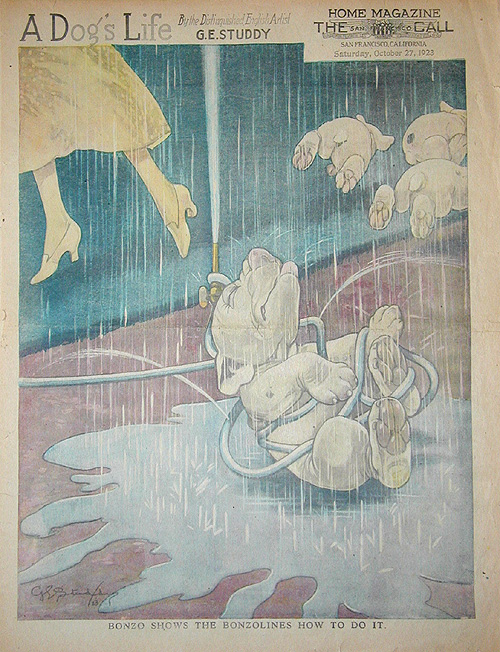
Interestingly, Ingram/Studdy must have been well aware of the term "Bonzoline", as it's used in a number of the Bonzo captions such as the one for this picture ("Bonzo shows the Bonzolines how to do it" - where "Bonzoline" appears to refer to other Bonzo-type dogs) and others mentioned in the sketch list at Studdying with Bonzo ("The Bonzolines 'have a couple'" and "The Bonzoline has a sweet tooth"). If I had to bet on an inspiration, I'd go for Bonzoline.

However, one could speculate forever. I'm sure it's coincidence that "Bonzo" could be read in some kind of semi-Latin as bon zo (= good animal), or that there was a Creole proverb "Bon chien pas janmain trappé bon zo" (= "a good dog never gets a good bone"). But whatever the origin, it was an inspired choice for Studdy's characterful little bull terrier pup.
- Ray

Addendum: Julie Heyward just sent us a YouTube link: Bonzo in Tanked. Thanks!

Thursday, 27 November 2008

Finnish folk roots

This is mostly not about books, but lately I've been getting into Finnish music. Finland has a very strong folk tradition. But it's one with a very intimate relationship with modern musical forms, a seamless connection in a way that doesn't seem to be sideline hybrid music into genre (such as "folk-rock" or - like the much under-rated Wurzels in the UK - "comic"); folk groups happily experiment with jazz, scat and electronica. Modern dance forms have readily evolved from folk forms, such as the jenkka and the letkajenkka (based on a schottische); and there's humppa (an astonishingly fast foxtrot style named after the German "oompah" band). The cult band Eläkeläiset ("The Pensioners") are hilarious performers of the latter, who do humppa cover versions of pop and and heavy metal: at YouTube, for instance, Humppamaratooni (Whiskey in the Jar, dubbed over the Metallica version) and Humppa Arvoitus (Nik Kershaw's The Riddle) and Ryhtivaliohumppaare (ZZ Top's Sharp Dressed Man) are representative.

EARWORM WARNING (Dec 2nd). Follow the asterisked links at your own risk! Ievan Polka is immensely catchy: so much so that there's a strong chance of your getting an earworm that lasts for days, as I've just found. I guess this is why it became an Internet meme. (If you've read the "Tenser, Said The Tensor" section of Alfred Bester's The Demolished Man, you'll know what I mean).

Moving away from the comic extreme, MetaFilter just mentioned *** Ievan Polkka (Eva's Polka) ***, a horribly catchy tune going way back (trad. arr. Eino Kettunen, 1930). But the MetaFilter version is *** this one *** sung a capella by the Finnish folk quartet Loituma. For whatever reason, Ievan Polkka has blossomed into an Internet meme via the strange decision to use it to back an animated manga character spinning a leek. Go figure.

Loituma themselves have done variants: see *** their MySpace page *** for "house" and "remix" versions, and YouTube for this *** upbeat pop version *** (an example of what I meant by Finnish folk grading seamlessly into mainstream). But the highlight there is a more reflective piece, Missing Him (called Kun Mun Kultani Tulisi on YouTube), a beautiful love song in close harmony backed with the kantele (Finnish zither). The lyrics, along with other songs from Loituma's album Things of Beauty, are here. It'd be a pity if Loituma's other work were buried by the very Internet hit that brought them to notice; their second album is In the Moonlight - full track here of Salaisia kyyneleitä (Secret Tears), which has a very Eastern European flavour.

Missing Him (the standard title - Jos Mun Tuttuni Tulisi - usually translated as If the One I Know Came Now) is Finland's most famous poem:

Should my treasure come
my darling step by
I'd know him by his coming
recognize him by his step
though he were still a mile off
or two miles away.
As mist I'd go out
as smoke I would reach the yard
as sparks I would speed
as flame I would fly;
I'd bowl along beside him
pout before his face.
I would touch his hand
though a snake were in his palm
I would kiss his mouth
though doom stared him in the face
I'd climb on his neck
though death were on his neck bones
I'd stretch beside him
though his side were all bloody.
And yet my treasure has not
his mouth bloody from a wolf
his hands greasy from a snake
nor his neck in death's clutches:
his mouth is of melted fat
his lips are as of honey
his hands golden, fair
his neck like a heather stalk

The words are late mediaeval, and were among those incorporated into the Kanteletar, the body of folk lyrics and poetry collated by Elias Lönnrot in parallel with his work compiling Finnish folkore into the epic Kalevala. The oldest known printed version was that noted down by the musician and ethnographer Giuseppe Acerbi on a trip to Lapland in 1799. In the mid-1800s, a Stockholm civil servant, Carl Gustav Zetterqvist, was so taken with the poem that he wrote around internationally and solicited 467 translations (they weren't published, but reside in the Elias Lönrot Collection, Finnish Literature Society, Helsinki). As with any orally transmitted text, there are variants such as these two, Finnish and Karelian, of a shorter version, the one Goethe translated in 1810 as Finnisches Lied.

Käm' der liebe Wohlbekannte,
Völlig so wie er geschieden:
Kuß erkläng' an seinen Lippen,
Hätt' auch Wolfsblut sie gerötet;
Ihm den Handschlag gäb' ich, wären
Seine Fingerspitzen Schlangen.

Wind! o hättest du Verständnis,
Wort' um Worte trügst du wechselnd,
Sollt auch einiges verhallen,
Zwischen zwei entfernten Liebchen.

Gern entbehrt' ich gute Bissen,
Priesters Tafelfleisch vergäß' ich
Eher, als dem Freund entsagen,
Den ich Sommers rasch bezwungen,
Winters langer Weis' bezähmte.

The poem also appears on Arctic Silence by Merja Soria, another exponent of vocal/kantele arrangements of ancient Finnish songs. A few samples, though not including Jos Mun Tuttuni Tulisi, are here. If you like this taster of Finnish folk music, there's more at Etno.net, more or less the experimental wing of the Sibelius Academy of Music, where Loituma originated. See the recordings list: for musicians and groups marked "F" there are samples; for those marked "E", full tracks are available for download.
- Ray

Addendum: I'd wondered what "Loituma" means in Finnish. Tuulikannel at YouTube kindly checked it out: apparently it's the name of a lake in Karelia.

Addendum #2: I just saw (25 January 2009) that a new Ready Brek TV ad is using a version of Ievan Polkka.

See also:
Värttinä.

Willows competitions update

From Academi (and elsewhere), Toad's Brave New World, a competition by The River & Rowing Museum

"to re-frame Kenneth Grahame’s famous book for the 21st Century by creating a short story (under 4,000 words) in a contemporary riverside setting which reflects a drastically changing world"

Ideas given include online dating, the credit crunch, environmental change, and so on. It's stressed that

"Entries don’t have to be about the River Thames, they can be about World Rivers and even mythical and fictional rivers. The brief is wide open for interpretation!"

Again, this looks interesting, though with a minor limitation that - looking at the small print in the entry form (PDF) - the readership for the story is age 5-16.

Meanwhile, the winner has been announced of the The Wind in the Willows Cover Competition, which asked young artists to illustrate the cover of the Vintage Classics centenary edition. The entry by Harry Jones was deservedly the winner, but all of the top four have very sophisticated composition (see the Times slideshow). Winners have also been announced for the Kenneth Grahame Society's competition to write a sequel, prequel or countertext to Wind in the Willows. The anthology will be published around March 8th 2009 (the 150th anniversary of Kenneth Grahame’s birth).

See the previous posts Wild at heart and Something wild for background.

- Ray

Addendum: you might be amused by my attempt, inspired by examples found for the Lurid classics post, at a pulp-style WITW cover.

The promised anthology from the Kenneth Grahame Society Competition came out a few months later than expected. The Society has also removed the discussion forum from its website.

The Kenneth Grahame Society Forum finally closed. It existed for about two years, and it had some interesting discussions and information. However, it was only used by a very small minority of the membership, and it often remained dormant for months at a time. At the 2009 AGM in Oxford it was agreed that the Forum, in such a dormant state, was no great credit to the name of Kenneth Grahame, and the decision to close it was approved. We would like to thank everyone who contributed postings to it over the years. All the information on it has been saved, and some of that will be repackaged and placed on the main website during forthcoming updates to the website.
Clare and I will admit to feeling a trifle miffed at not getting anywhere in this competition; mine (a countertext that retold Heart of Darkness as a post-apocalyptic river journey with Kim Newman style intertextuality) was trying a bit too hard to be clever, but Clare is regularly placed in writing competitions, and I thought her story (which used the WITW setting for a parable about xenophobia and global warming) could be faulted: it was heartwarming and stylistically impeccable. Honestly, it's not just sour grapes - the Society's handling of the anthology seemed a bit peculiar. The delay in publication, they explained on the now-defunct forum, was because some of the entries they'd chosen to anthologise weren't up to anthology standard, and needed work in collaboration with the Society to revise them. Seems to me that they shouldn't have been chosen, then ...

Addendum: I decided, rather than let my story languish on my computer, to post it here. See the update Wild at Heart.

- Ray

Friday, 21 November 2008

All at sea

Another film adaptation: The African Queen (Penguin edition left, original published in 1935) vs. The African Queen (the 1951 film). I've just read it, and it's good: not great literature, but a well-told adventure and romance with (as is usual) interesting diferences from the film. Charlie Allnutt is a Cockney in the book; he's 30 and Rose Sayer 33 (Bacall and Bogart were 44 and 52 when the film was made). There are minor plot differences too, mainly surrounding the sinking of the Königin Luise; the film, I think, is an improvement dramatically. However, the chief surprise for me - though the detail ought to be have been in plain sight - was that the book is by CS Forrester, author of the Horatio Hornblower series.

I didn't encounter the Hornblower books until quite late; my early teen reading included the melodramatic saga of a seafarer on the other side of the fence, Dr Syn, the creation of actor and author Russell Thorndike. I'd probably hate them now, going by the chronology at The Life and Times of the Rev. Doctor Christopher Syn, Parson, Smuggler, and Sometime Pirate. Christopher Syn is a respectable vicar whose wife Imogene is seduced and elopes with his friend, and so Syn becomes a pirate and stalks the pair around the world for a couple of decades (the books have the essentially sexist assumption that Imogene is a passive victim in the affair). Twice in his career, Syn murders almost his whole crew by blowing up his ship when he wants to quit piracy for the time being. He is, is at the least, an antihero. Hornblower is definitely more clean-cut, and the prototype of many fictional English naval heroes of the Napoleonic period. Check out Novels of Nelson's Navy for a list of the rather varied bunch: for instance, the rather neurotic Hornblower (based on Lord Nelson and Thomas Cochrane), the ultra-confident Ramage, and the tough but intellectual Jack Aubrey (also based on Cochrane).

Hornblower's influence, however, extends outside historical genre fiction; in Ansible's Hornblower in Space, Dave Langford discusses the many overt homages in science fiction. For instance, there are A. Bertram Chandler's Captain Grimes, David Feintuch's Nicholas Seafort, and David Weber's Honor Harrington series (space opera featuring a female Hornblower, with added homage to Nelson in losing an arm and eye *). Hornblower was also an influence in the characterisation of Star Trek's Captain Kirk (see C.S. Forester, Hornblower & the Hotspur) and Captain Jean-Luc Picard (see Becoming Picard). As another example of genre-crossing, Chris Roberson's Set the Seas on Fire - see interview - looks quite interesting as a novel that's more or less "Horatio Hornblower meets H.P. Lovecraft".

Langford mentions in particular Weber's "manic determination to keep space warfare tactics as similar as possible to nautical ones" by constructing the physics and technology so that, for instance, starships have to fire broadsides through a limited number of gaps in their shields. Much the same applies in the late Barrington Bayley's excellent The Fall of Chronopolis, in which Time Fleets sail the "strat" (the substratum of unrealised events underlying time), materialising to battle face-to-face at assigned "trysts" according to strict rules of engagement; ships, when damaged, "sink" into the strat.

While these are extreme examples, a general tendency toward naval trappings for interstellar craft runs through science fiction. At some level, while it might be silly to expect historical naval uniforms, this is logical. A large spacegoing craft would have similar concerns to a terrestrial ship - a habitable craft surrounded by a hostile medium, with necessary infrastructure for propulsion, steering, defence, chain of command, etc. However, such setups often make assumptions that are archaic even now, such as need for a large crew and even the general effectiveness of "battleships" (see Starship Combat Tactics for an analysis of this, and the necessarily strange assumptions required to explain ship-to-ship combat observed in the Star Trek and Star Wars canons). NASA's Starship 2040 is NASA's extrapolation of how a commercial spacecraft would be organised in reality. It looks rather different, with a far smaller crew and most of the infrastructure handled by computer. **

Hornblower has attracted a certain amount of parody. Inside SF, there's Harry Harrison's Captain Honario Harpplayer, who is colour-blind and unable to recognise that a press-ganged crew member is a green-skinned alien. Outside: the Mr Blowhard of Stephen Leacock's 1911 Soaked in seaweed: or upset in the ocean - one of his genre parodies in Nonsense Novels (Gutenberg E-text 4682) - may well come from the same stable, although I think Leaock wasn't on top form for this story, being clearly hostile to the genre, as suggested by the ending:

I fell ill. I died. I buried myself.Would that others who write sea stories would do as much.

- Ray

* Yeah, I know. Nelson didn't lose his eye. He lost the sight in his right eye at the siege of Calvi, but it wasn't disfigured and, contrary to general myth, fostered by the film That Hamilton Woman, he didn't wear an eyepatch. See The Telegraph and Fortean Times.
** Seriously interestingly, World War I battleships actually had computers. See the Argo Aim Corrector at the technology section of The Dreadnought Project, and also The Mechanical Analog Computers of Hannibal Ford and William Newell (PDF).

P.S. By coincidence, the Guardian books section just had a brief editorial In praise of ... Erskine Childers. If you're into nautical things, his The Riddle of the Sands (Gutenberg Etext 2360) is a classic for various reasons: its attention to detail, its role as an early pre-WWI invasion novel, and some say the first modern thriller.