Saturday, 12 March 2011

Bayan time (2)

Further to Bayan time: a progress report about the Орфей six weeks on (I thought I'd document it, on the vague possibility that it might help anyone else learning the bayan (B system chromatic button accordion).


It's going extremely well, considering the radical difference from a piano keyboard system and that I'm largely on my own.  It took about a month of solid practice to get reasonably comfortable with the unfamiliar note locations (left). The bass - left hand - proved more of a problem than I expected; although it has the same Stradella system as the piano accordion I'm used to, the buttons are considerably closer in spacing, and I'm still finding them a rather cramped. Actually, it's not quite the same system as I'm used to; being a full 120-bass, there are the counterbasses and extra chord rows to learn (as well as unlearning some of the ways of making chords unavailable as presets on the 24-bass).

However, I'll put a demo on YouTube shortly; I can already play some of my party pieces from the piano accordion (Stormy Weather, and the ubiquitous Bluebell Polka). The chromatic layout is proving very versatile, equally comfortable for simple Morris tunes and heavily chromatic tunes like the Pink Panther theme.  I highly recommend the bayan for its tone; the eBay description called it "a strong sweet voice" but I wasn't prepared for how different it would be.  The default reeds have a powerful and mellow clarinet-like flavour quite unlike the stereotypical accordion, but it has four other voices including a "wet" tuning giving the classic French musette accordion sound.

The single most useful website I've found so far has been Blumberg's Music Theory Cipher, which has helpful charts of notes, scales, triad shapes, and general note relationships within the chromatic keyboard.  And the second: YouTube.  Once you get past the depressing bits - such as the virtuosity of Lidia Kaminska and Alexander Dmitriev - it's seriously helpful in showing things like hand position and which fingers to use (there's an interesting interview with Lidia Kaminska on the technology and technique of bayan playing here).  But for clear examples of more achievable playing, I've found the Bayanina Music channel especially helpful.

Looking at YouTube and website discussions, there doesn't seem to be much consensus over use of the thumb: some players brace it against the keyboard edge and just use four fingers (it seems to have been standard technique in the past); some use it to play. Personally I go for the latter, as my little finger doesn't work very well. A second area where opinion seems to vary is whether to stick to three rows (the darker grey section in the image above). Some do, and it has the advantage that you can learn the pattern for a single scale, and play in any key by shifting that pattern elsewhere on the keyboard. However, looking on YouTube at what players actually suggests this shouldn't be stuck to obsessively, or even at all: in context, often notes outside the three-row scale make a better alternate fingering.

I've one major warning: watch the shoulder and back.  A heavy accordion (and the Orfei weighs 10kg) is working the rotator cuff of the left shoulder especially hard.  I've found it most comfortable to play sitting, and use the left thigh to support the left half of the bayan and do some of the effort of working the bellows.

Wednesday, 9 March 2011

SF and other text source visualisations

Via MetaFilter: The History of Science Fiction, a lovely infographic by Ward Shelley that was one of the winning submissions to 7th Iteration of the Places & Spaces: Mapping Science Exhibit on "Science Maps as Visual Interfaces to Digital Libraries" (2011).

"History of Science Fiction" is a graphic chronology that maps the literary genre from its nascent roots in mythology and fantastic stories to the somewhat calcified post-Star Wars space opera epics of today. The movement of years is from left to right, tracing the figure of a tentacled beast, derived from H.G. Wells’ War of the Worlds Martians. Science Fiction is seen as the offspring of the collision of the Enlightenment (providing science) and Romanticism, which birthed gothic fiction, source of not only SciFi, but crime novels, horror, westerns, and fantasy (all of which can be seen exiting through wormholes to their own diagrams, elsewhere). Science fiction progressed through a number of distinct periods, which are charted, citing hundreds of the most important works and authors. Film and television are covered as well.

It has a number of works of proto-SF that I keep meaning to read, and suggests some intriguing "genetic" paths for the origins of genres. For instance, treating the Western as an offshoot of Gothic seems a strange but by no means unarguable theory, given the tropes of Westerns: wild landscapes, imperilled heroines, clear-cut good and evil, grotesque villains, and brooding Byronic "man with no name" heroes.

See also the Winning Entries page for Places & Spaces: Mapping Science, which leads off in other interesting directions, such as Chris Harrison's projects on Visualizing the Bible (maps of "social networks" created by plotting people and places occurring in the same Bible verse).

Sole Survivor

More brilliance from the Internets. From YouTube: Sole Survivor (1970). The image quality isn't great, the soundtrack grotty, and the copyright undoubtedly very grey, but it's the only place you're likely to see this superior CBS TV movie, which has acquired a cult following.

It opens with a group of ragged and cynical US airmen sheltering in the vicinity of a wrecked B-25 Mitchell bomber in the desert. Shortly an aeroplane flies overhead and a recovery team arrives - at which point the story takes a major turn when we realise the airmen aren't crash survivors but ghosts, and it is 18 years since the crash. The site is being investigated by Major Michael Devlin (Vince Edwards) and Lieutenant-Colonel Josef Gronke (played by William Shatner), who have brought along the powerful Brigadier-General Russell Hamner (Richard Baseheart). The find is a mystery, since Hamner, the original navigator of the bomber, has said that he and all the crew bailed out over the sea 700 miles away. Gradually the backstory emerges: that Hamner bailed out prematurely in combat; this act of cowardice caused the misnavigation that led the rest of the crew to become stranded in the desert. The ghostly crew, through limited ability to move objects and to manifest as hauntings, attempt to guide Devlin and Gronke to the truth of events and to find their remains; otherwise, they will be doomed to an eternity in limbo at the crash site. It's a clever and poignant story, making the most of its single-location story with tight dialogue of stage-play quality. For whatever reason, it hasn't been on TV for decades and it's well possible that it has been lost apart from poor video copies. It's very worth watching.

See Wikipedia for the basics: Sole Survivor (1970 film). The story is closely based on the real-life incident of the Lady Be Good, a American B-24D Liberator bomber and its crew, similarly lost in the Libyan desert through a navigation error in 1943, and not rediscovered until 1958. I'm unaware of any direct evidence, but it seems very likely that Elleston Trevor's 1964 novel The Flight of the Phoenix, though more upbeat in its outcome, was inspired by the Lady Be Good incident (the 1964 review in Air Pictorial: Journal of the Air League, Volume 26, noted the similarity of scenario).

- Ray

Monday, 7 March 2011

Désenchantée and other videos


I've mentioned previously liking Europop, and you may have spotted in the sidebar Mylène Farmer's Désenchantée (Disenchanted): despite this being a chart-topping hit in France, neither the song nor the singer - who has been nicknamed "the French Madonna" - are much known in the UK.

French is not a strong point with me, but the Wikipedia article explains that the lyrics were inspired by the 1934 book On the Heights of Despair, a powerful expression of existential hopelessness by the Romanian philosopher Emil Cioran. This evidently struck a chord in France in 1991, at a time of student unrest and the Gulf War. What I can say, though, is that the video is brilliant and chilling: what's musically a bright and upbeat anthem set against a powerfully-filmed and bleak dramatisation of the theme of disenchantment. It's a commentary on messianism: a charismatic woman incites rebellion at some kind of boys' gulag (with allusions to Oliver Twist at the workhouse) and triumphantly, like La Liberté guidant le peuple, leads the inmates out to ... well, watch.

Désenchantée is among a number of Mylène Farmer videos filmed by composer and director Laurent Boutonnat with large budgets and cinematic-quality technique. Often inspired by literature and generally tackling difficult themes - for instance, existential angst, sexuality and subversive views of religion - they stand out as examples of pop video as a non-trivial artform.  I wish I knew French better to appreciate the lyrics.

The video for Je te rends ton amour (I Give Back Your Love) is a powerful, and for many shocking, mix of religious, horror and sexual imagery. That for Libertine has a lush and decadent visual flavour based on Kubrick's Barry Lyndon and the novels of de Sade; and its long continuation Pourvu qu'elles soient douces (Let's hope they are soft) interweaves the song into an extremely dark but beautifully-filmed historical drama of lust and betrayal, in which Farmer's female libertine character fights to the death with her rival against the backdrop of a massacre of an English army company in the Seven Years' War (these three videos are NSFW, but you can find them at YouTube).

L'Âme-stram-gram (video) takes its visual style from Chinese mythological / Wuxia films (A Chinese Ghost Story and, I thought, Zu Warriors). The lyrics are about psychoanalysis, and interspersed with erotic punning; the title alone is pretty hard to translate. The moderator at  MF International  has translated, and explains: "Ams tram gram" is essentially meaningless, the start of the French equivalent of "Eeny, meeny, miny, moe", but Farmer has spliced extra meaning into it by converting the first syllable to "L'Âme" = "The Soul".

That for Tristana (video) is a retelling, in a style reminiscent of early Russian cinema, of the story of Snow White and the Seven Dwarfs set against the background of the Russian Revolution.  And Sans contrefaçon (Without forgery - video) tells a sad and unsettling story with, according to Wikipedia, multiple inspirations - The Adventures of Pinocchio, the Dargaud Media children's animation Peter Swift et Le Petit Cirque (Peter Swift and The Little Circus), and Apollinaire's poem Les Saltimbanques (The Acrobats) - of a ventriloquist who finds his dummy becomes a real woman ... but only when away from him.

- Ray

Adventure at Horseshoe Cove

While Googling "Horseshoe Cove" (mentioned previously) I ran into a unconnected reference; it's the name of a location in Florence L Barclay's 1910 romance novel The Mistress of Shenstone.

Like a number of writers little known a century later, Mrs Barclay was a highly popular novelist whose work included her debut romance The Wheels of Time and the bestselling The Rosary. The Times obituary favourably recalled her work,which praised her ability to tackle themes of romance and religious feelings in a way that dispensed with Victorian piety yet retained moral integrity:

Her death removes a figure as well known ten years ago to large sections of the novel-reading public as Charles Garvice, Marie Corelli, or Ethel M Dell. Her most popular book, "The Rosary," enjoyed a circulation of vast dimensions, and made friends of the author in homes all over the land.
...
It was one of the secrets of her success that she managed to be entirely sincere, and yet to infuse into an atmosphere which many people regard as narrow a kind of repressed excitement.
...
A writer who appealed to and won the affection of so many of her fellow country men and women is no negligible quantity. Indeed, there is reason to think that Mrs Barclay understood the tendency of her age better than many contemporary novelists whose technical skill exceeded her own. The way in which she blended passion with the spirit of pilgrimage was distinctly post-Victorian.
- Death of Mrs Barclay: a loss to millions of readers, The Times, March 11, 1921

The Mistress of Shenstone tells of the young and beautiful Lady Myra Ingleby, who goes for a rest cure incognito in Cornwall after the death of her husband in some unnamed military adventure at "Targai", somewhere in the Middle East.

"You know perfectly well that Lord Ingleby volunteered for this border war because he was so keen on experimenting with his new explosives, and on trying these ideas for using electricity in modern warfare, at which he has worked so long."

(Does she really want to be married to this guy? Anyhow...)  In Cornwall, her life is saved by a young man called Jim Airth, who helps her climb a cliff after she falls asleep on the beach and is cut off by the tide, and the two fall in love and become engaged. Jim, however, doesn't know that she is Lady Ingleby; and she doesn't know that Airth was the man who accidentally killed Lord Ingleby by prematurely detonating a mine. This naturally enough places a tension on their relationship, with a further twist when a telegram appears to indicate that Lord Ingleby is still alive, and there are also class issues (eventually resolved when it turns out that Jim Airth is himself an aristocrat going incognito).

Some of the book is fairly silly, such as Lord Ingleby's dog that gets vibes of his death and dies in sympathy, and also reflective of the prejudices of its time (for instance, the idea that the protagonists must be of the same class for a proper resolution). But it's well-plotted and well-paced, and not at all a bad read; it was filmed in 1921 (see IMDb).

Here's the full book at Project Gutenberg - E-text No. 26235 - and here are the chapters featuring the beach and the cliff climb: In Horseshoe Cove / Jim Airth to the rescue / "Yeo, ho! We go!" / 'Twixt sea and sky.

Many of Mrs Barclay's works are on the Internet Archive (see creator:"Barclay, Florence L. (Florence Louisa), 1862-1921") as is the subjective, but nonetheless interesting, biography by one of her daughters, The life of Florence L. Barclay: a study in personality. There's more biography, and some works, at Literary Heritage West Midlands; as the commentary says, some of her shorter works - such as "My heart's right there" - are morbidly patriotic by modern standards. Contrary to the now more popular anti-war writers and poets of World War One, Mrs Barclay (like Jessie Pope) was distinctly jingoistic at times.

It's a righteous war, my girl; and every man who fears God and honours the King, should be up, and out, and ready to do his share; and every woman who loves her home, must be willing bravely to do her part, by letting her man go. And if she has to hear that he has given his life, she must stand up, brave and true--as a soldier's wife or a soldier's mother--and say: 'God save the King!'
- from My heart's right there

- Ray

Journal of Religion and Film

Journal of Religion and Film: I just ran into this very interesting University of Nebraska journal via the MetaFilter thread Shinto Perspectives in "Spirited Away".

Even in secular Western culture, religion is still deeply intertwined with cultural memes and the tropes of storytelling, such as representations of good and evil in film, as the statement of purpose explains:

The Journal of Religion and Film examines
the description, critique, and embodiment of religion in film.

Many films, directly or indirectly, serve a "religious" purpose. Like religions, they present meanings that people give to life. They portray people and the values people embrace in life. The films themselves, then, are a part of the fundamental religious "struggle with the ultimate problems of human life."

Articles in the JR & F, then, are not restricted to a denominational list that equates religion with a commonly accepted set of rituals, beliefs, and laws. "Religion," in contemporary times and in the issues of the Journal, is much more personal and interactive than that. It is the living of values constructed in a dialogue between an individual and a culture. A particular worldview is received, adjusted, reapplied, and lived by the individual.

So the JR & F will consider not only films that explicitly highlight traditional religious images and themes. Although there will be analysis of films that consider such religious themes as sacred space, sacred times, savior-figures, images of god(s), and battles between good and evil, there also will be investigation of notions and assumptions that underlie everyday, "secular," human talk and action.

Better still, JR & F is free-access.  Check out its index of films.

Just skimming, the "A" section I find: "Angels Carrying Savage Weapons:" Uses of the Bible in Contemporary Horror Films, by Mary Ann Beavis; Mozart & Salieri, Cain & Abel: A Cinematic Transformation of Genesis 4, by Gregory Allen Robbins; The Devil We Already Know: Medieval Representations of a Powerless Satan in Modern American Cinema, by Kelly J. Wyman; Archetypes on Screen: Odysseus, St. Paul, Christ and the American Cinematic Hero and Anti-Hero, by John Fitch, III; Anti-feminism in Recent Apocalyptic Film by Joel W. Martin; Any Gods Out There? Perceptions of Religion from Star Wars and Star Trek by John S. Schultes; and James Cameron's Cathedral: Avatar Revives the Religious Spectacle by Craig Detweiler.

- Ray

Sunday, 6 March 2011

Dawlish coves

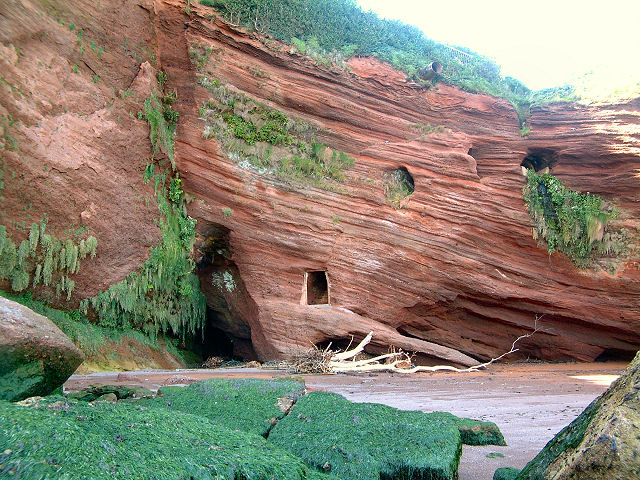
Horse Cove, Dawlish

Another spot of local geography: Horse Cove is a small and usually inaccessible cove at Dawlish between Coryton Cove and Shell Cove. I took the above picture (now at Geograph) when I walked round at low tide four years ago.

I just spotted that the newspapers had some excellent aerial shots in February, notably the Daily Mail - see the second image in The £1.7m house whose sea view just got closer: Home at cliff edge as 15ft garden disappears after landslide (10th February 2011) - concerning the precarious position of a clifftop house above the cove following recent cliff falls.

The whole changeability of  the coast extends to placenames. A look at Ordnance Survey maps up to the mid-1900s - see Old Maps - shows the above location unnamed, and Horse Cove is what is now called Shell Cove. Shells do figure in older accounts: an article on Teignmouth and Dawlish in The Bristol Mercury and Daily Post for June 16, 1884, says:

The Cowrie cove, or shell beach, just beyond Coryton Cove, is a favourite for ladies; it can only be reached at low water, or through the private tunnel.

Shell Cove just seems to have solidified as a placename over the past century. Other location names have been more durable: Coryton Cove (aka Coryton's Cove) was named after the Corytons, landowners who lived at Cliff Cottage above the cove (see page 308, A complete parochial history of the county of Cornwall). As I mentioned at the DHS blog - 1885: Dawlish "death trap" - Coryton Cove was also called the Gentlemen's Cove, because of its historical use for segregated male bathing. The three railway tunnels nearest Dawlish were similarly named after the respective landowners: the Coryton tunnel after Jane Coryton; the Phillott after the Rev. Charles Phillott, of the Clevelands; and the Kennaway after Mark Kennaway, who owned Lea Mount, the promontory through which the tunnel runs (see the Dawlish Community Trust flyer).

A feature of Horse Cove that intrigues me is the rectangular tunnel entrance with steps leading up. At the time I visited it wasn't accessible; the ledge leading up to it had eroded too badly. Where does it go? Is it to do with the railway or was it the abovementioned "private tunnel" to the beach?

- Ray

Saturday, 5 March 2011

Topsham Book Swap

A note for your diaries: World Book Night is on Saturday March 5th 2011.

World Book Night represents the most ambitious and far-reaching celebration of adult books and reading ever attempted in the UK and Ireland.

On Saturday, 5 March 2011, two days after World Book Day, with the full support of the Publishers Association, the Booksellers Association, the Independent Publishers Guild, the Reading Agency with libraries, World Book Day, the BBC and RTE, one million books will be given away by an army of passionate readers to members of the public across the UK and Ireland.

The book give-away will comprise 40,000 copies of each of the 25 carefully selected titles, to be given away by 20,000 ‘givers’, who will each distribute 48 copies of their chosen title to whomever they choose on World Book Night. The remaining books will be distributed by World Book Night itself in places that might otherwise be difficult to reach, such as prisons and hospitals.

The twenty-five titles were selected by a wide-ranging editorial committee, chaired by James Naughtie. After looking through the list of titles, you can apply to become a giver on World Book Night itself.

While one might suspect the ultimate reason is promotional for the book industry rather than sheer altruism, World Book Night is marked by various interesting literary events and reading group gatherings that go beyond the chance of a freebie book.

In Topsham, we have Topsham Book Swap at the Globe Hotel on Saturday March 5th, 6.30-8.30pm, when you're invited to "bring a book you love, swap it for another".

See the World Book Night website - www.worldbooknight.org - and the Facebook page for more information.

- Ray

Thursday, 3 March 2011

Salutation Inn

Salutation Inn, Topsham
A book on my search list: Salutation Inn. A novel (Richard Gray, pub. Michael Joseph, 1941). I stumbled across some reviews, and found from one that the novel's setting is actually Topsham's Salutation Inn. Here's one:
Although it is a first novel, "Salutation Inn" is a powerful story that shows its unknown author as a gifted writer. It is a psychological study that depends largely on atmosphere for its success. The author uses an old inn in a lonely marshland English village as a retreat from a murderer for whom the police are hunting. At this "Salutation Inn," Inigo Orton, a man of strange passions, who calls himself Mr. Crawley, finds an understanding, appreciative soul in the barmaid, and a welcome from an eccentric old woman. But he can find no peace of mind, and. inevitably, tragedy results when his identity is discovered. This is a decidedly unusual book, with a pervading and inescapable atmosphere that only artistry and true feeling could produce.
- The Advertiser (Adelaide), 20 September 1941
It looks strange enough to be a good yarn, and I'd love to read it. The Catalog of Copyright Entries for 1941 identifies "Richard Gray" as Jasper Salwey, a sufficiently unusual name to be most likely the artist and architect Jasper Philip Salwey (1884-1956).

Update: see Salutation Inn revisited for more on this book.

The Salutation Inn in Topsham has been closed as a pub for around two years, but I was delighted to be given a tour today by the new owner Ed Williams-Hawkes, who is renovating it as a top-of-the-range hotel. I'd previously only seen the ground floor and a handful of the first floor rooms, but it's an amazing 26-room labyrinth over three floors, and architecturally very interesting underneath the many (often hamfisted) modifications over four centuries.
Reverting to Topsham at the time of its prosperity, a further development of the vernacular is to be seen in the Salutation Inn, famous as an hostelry for travellers by road from North to South Devon as well as a rest-house for those travelling by sea to the Continent. This building which, in its external treatment as in the interior details of the Assembly Room and other apartments, follows the mode of 1720, marks another and later stage of the formative development. By this time the Dutch influence had become completely anglicised. The main feature of the design is the prominence given to the Assembly Room, which is placed over the coach entrance and in former days was supported on two timber Doric columns of proved substance. The original stone pedestals are in situ, but the corpulent supports have in the last twenty years been replaced by modern brick piers which lack grace and character, apart from their efficiency as structural supports.
- Regional Architecture of the West of England, Sir Albert Edward Richardson, Charles Lovett Gill, 1924.

Cat mummy, Salutation Inn
It's quite gothic in places, and in the attic there's a mummified cat (above) such as are found occasionally in old buildings. It has been nicknamed "Tonic", because it has a gin trap on one foot. It's unclear if this is how it died, or if this was added as a scary detail posthumously.

The showpiece of the Salutation, however, has to be the Assembly Room that overhangs the frontage, and is a prominent feature of Topsham's Fore Street.  The Salutation must have seen some memorable junkets. As I've mentioned before, in the late 1700s the Salutation was the headquarters for Colonel Robert Hall's Devonshire and Cornwall Fencibles during the War of the First Coalition (see Samuel Carter Hall visits Topsham); and the Assembly Room was the venue for the upper-crust booze-up ...

The officers of the navy and army, resident at Topsham, and the Gentlemen of the town, repaired to the Assembly Room, at the Salutation Inn, to drink the King's health; and the Rev. Mr. Carrington being unanimously requested to take the chair, and having complied in a very obliging and polite manner, many loyal toasts were drank, and many excellent songs were sung, particularly one printed and dispersed amongst the company upon the occasion.

... following the hanging of Tom Paine in effigy in Topsham in 1793 (see Tom Paine hanged in Topsham).

Assembly Room, Salutation Inn, Topsham

See Exeter Memories - The Salutation Hotel - Exe Street, Topsham - for a bit of the history.  A skim of the British Library 19th Century Newspapers archive finds the Salutation had extremely varied use in the 19th centuries: for balls, property auctions, society dinners, coroner's inquests and even as unofficial mortuary for people found drowned in the Exe.

Addendum: 1st August 2011.

Renovation of the frontage is now visible, involving restoration to historically authentic appearance (slate blue, not black, paint; exposed wood on the gate; and the paint removed from the brick pillars).

Addendum: 21st August 2012

See Salutation.

- Ray

Tuesday, 1 March 2011

That's no cave!


A spot of regional geography. The Express & Echo carried a story yesterday (Man rescued after being taken ill in remote cave while looking for bats, E&E 28th February 2011) concerning a mishap at "Hooken Cave" at the Hooken Undercliff, near Beer.

I've never seen the place called Hooken Cave before; this particular hole in the ground, nicely illustrated here at Wikimedia, is called the Beer Stone Adit or Hooken Adit or Connett's Hole (I've no idea who Connett is/was). It's not technically a cave but a mine entrance formerly used to extract Beer Stone, the local variety of hard chalk. Contrary to some descriptions, as far as I can tell there's no evidence of it connecting to the well-known Beer Quarry Caves a mile inland. A number of accounts, such as Alfred John Jukes-Browne's 1903 The Cretaceous rocks of Britain, mentions that its specific purpose was to extract rock for transport by sea; at least when Jukes-Browne was writing, dressed blocks of stone were still recognisable "lying on the slope below, alongside the pathway leading down to the shore".

There are further geological details at the Beer and Seaton page for Ian West's excellent series of south coast field guides. It notes that the adit entrance is not to be messed with by non-climbers.

Addendum: I've just found a majorly nice image in an Internet Archive copy of Arthur William Clayden's 1906 The History of Devonshire Scenery; an essay in geographical evolution: see the plate (which is zoomable) opposite page 137 of Hooken Cliff and Under Hooken. Connett's Hole is clearly visible, but what's chiefly interesting is the lack of undergrowth - Clayden calls the terrain of Under Hooken a "greensward".  The difference is probably down to the same factors that have made the Lyme Regis Undercliff heavily overgrown: change in land use, with the area no longer grazed by sheep and rabbits.

See Hooken and Beer for our visit in September 2012 revisit.

- Ray