Tuesday, 12 November 2013

Magic Merganser metafiction

While checking out one of the titles in the previous post, William Black's 1877 Madcap Violet (Internet Archive madcapviolet01blacgoog), I ran into a comment in William Lyon Phelps's litcrit collection Essays on Modern Novelists. Phelps describes various instances of novelists addressing the reader - what we'd now call "breaking the fourth wall" - and singles out Black as an egregious example, implying Black wasn't quite taking the novel seriously:
William Black once wrote a novel called Madcap Violet, which he intended for a tragedy, and in which, therefore, we have a right to expect some artistic dignity.
- page 14, Essays on Modern Novelists (1910, Internet Archive cu31924027206170).
Black's authorial excursion is worth quoting in full:
CHAPTER XXII.
THE MAGIC MERGANSER

At this point, and in common courtesy to his readers, the writer of these pages considers himself bound to give fair warning, that the present chapter deals solely and wholly with the shooting of mergansers, curlews, herons, and such like fearful wild-fowl; therefore those who regard such graceless idling with aversion, and are anxious to get on with the story, should at once proceed to the next chapter. There is no just reason, one might urge, why fiction should speak only of those days in a man's life in which something supremely good or supremely bad happened to him — jumping over the far greater number of days in which nothing particular happened to him — and thereby recording the story of his life in a jerky, staccato, impossible manner. Destiny is not for ever marching on with majestic stride ; even the horrid Furies sometimes put away their whips. Give a man a gun, place him on a Highland loch on a still day in August, show him a few dark specks swimming round the distant promontories, and he will forget that there is even such a thing as to-morrow. To write out the whole story of his life in this fashion would, of course, be impossible ; for it would be twenty times as long as the longest Japanese drama in existence ; while the death rate among the readers — say twenty-four in a thousand per annum — would interfere with the continued attention demanded by the author. But occasionally, in the briefest story, one of these idle and unmemorable days ought to come in, just to show that the people are not always brooding over the plan of their existence. Anyhow — and this is the long and the short of it — three out of five of the passengers onboard the Sea-Pyot are going in pursuit of mergansers ; and the gentle reader is entreated to grant them this one holiday, which will be the last of its kind.
- pages 214-15, Madcap Violet.
I've only skimmed so far, but far from this aside being an aberration, it marks out Madcap Violet as having metafictional elements, which appear elsewhere in the book. At the beginning of Chapter IV, for instance, Black brings slightly dizzying multiple layers to the text by quoting from a highly autobiographical romance about a "Virginia Northbrook" written by the protagonist, Violet North - then noting that it might be plagiarised from some un-named original, which in turn may itself be unconsciously plagiarised.
CHAPTER IV.
FLUTTERINGS NEAR THE FLAME

A secret rumour ran through the school that Violet North had not only got a sweetheart, but was also engaged in the composition of a novel. As regards the novel, at least, rumour was right ; and there is now no longer any reason for suppressing the following pages, which will give an idea of the scope and style of Miss North's story. The original is written in a clear, bold hand, and the lines are wide apart — so wide apart, indeed, that the observant reader can, if he chooses, easily read between them.
"It was a beautiful morning in May, and the golden sunshine was flooding the emeraid meadows of D—, an ancient and picturesque village about two miles nearer London than the C—  P—. Little do the inhabitants of that great city, who lend themselves to the glittering follies or fashion — little do they reck of the verdant beauties and the pure air which are to be had almost within the four-mile radius. It was on such a morning that our two lovers met, far away from the haunts of men, and living for each other alone. In the distance was a highway leading up to that noble institution, the C—  P—., and carriages rolled along it ; and at the front of the stately mansions high-born dames vaulted upon their prancing barbs and caracoled away towards the horizon.*
* This sentence, or the latter half of it, may recall a passage in a famous novel which was published two or three years ago ; and I hasten to say that Miss North had really never read that work. The brilliant and distinguished author of the novel in .question has so frequently been accused of plagiarism which was almost certainly unconscious, that I am sure he will sympathize with this young aspirant, and acquit her of any intentional theft.
I shall give this a bit more attention.

- Ray

More Wight literary miscellany

Dave Parker's very browsable Isle of Wight Nostalgia site has some transcripts from the 1948 Ward Lock Guide. The introduction has a section on literary references, which I thought worth annotating in case anyone wants a bit of an Isle of Wight reading list.

A Literary Note

It is somewhat curious that the Isle of Wight, with its wealth of natural and historical interest, should have figured so little in fiction. The writer has yet to rise who will do for it what Scott did for the Highlands, Blackmore and Kingsley for North Devon, Thomas Hardy for "Wessex," and more recently Sheila Kaye Smith for Sussex, and Brett Young for Worcestershire. Dickens, we know, stayed at Bonchurch, and wrote enthusiastically of his surroundings, but, beyond a brief reference to Shanklin Sands in Our Mutual Friend, he did not introduce them in any novel. References, more or less extended, are made to the Island in numerous well- known works, of which we need only mention Fielding's Voyage to Lisbon, Scott's Surgeon's Daughter, Marryat's Poor Jack and The Dog Fiend, and Meredith's Adventures of Harry Richmond and The Ordeal of Richard Feverel.

Readers with a partiality for "local colour" may be glad of references to other novels dealing with the district. Recent works can of course be purchased from any bookseller, or borrowed through the subscription libraries. For others it may be necessary to consult the files at public libraries or seek for second-hand copies.

Chronologically, our summary should commence with two excellent historical stories, The Count of The Saxon Shore, by Professor Church, and Caedwalla, or the Saxons in the Isle of Wight, by F. Cowper.
The Count of the Saxon Shore for Britain (Latin: comes littoris Saxonici per Britanniam) was the head of the "Saxon Shore" military command of the later Roman Empire. Alfred John Church's 1887 novel, a well-researched sword and sandal adventure, is on Project Gutenberg: The Count of the Saxon Shore, or, The Villa in VECTIS: A Tale of the Departure of the Romans from Britain (Gutenberg E-Text No. 44083).
Frank Cowper's 1887 Caedwalla takes place between 680-709 CE, and tells of the Isle of Wight campaign of Cædwalla of Wessex; I can't find it online.
  Maxwell Gray needs little introduction ...
Topographically, we will start with the capital of the Island, Newport, which appears as "Oldport" in Maxwell Gray's The Silence of Dean Maitland, in which also "Chalkburne" is Carisbrooke.
... so I'll skip and direct you to maxwellgray.co.uk.
The Captain of the Wight, by F. Cowper, is a romance of Carisbrooke Castle in 1468; The Prisoner of Carisbrooke, by S. H. Burchell, deals with the imprisonment and attempted escape of Charles I, and the same subject is treated in The Cavaliers, by S. R. Keightley, and in Marjorie Bowen's Governor of England. The White King's Daughter, by Mrs. H. Marshall, narrates the latter days at Penshurst and Carisbrooke of Charles's young and ill-fated child, the Princess Elizabeth.
  The Captain of the Wight follows the exploits of Sir Edward Woodville, the last "Lord of the Isle of Wight", up to his death in a disastrous and undermanned expedition to fight the French in Brittany.
  Sidney Herbert Burchell's 1904 The Prisoner of Carisbrooke focuses strongly on the life and loves of the hero, Robert Hammond, who became the jailer of Charles I.
  Samuel Robert Keightley's 1896 The Cavaliers tells of a young Cavalier, Thomas Duncombe, who becomes involved in the failed attempt to spring Charles I from Carisbrooke Castle; it's on the Internet Archive (ID cavaliers00keiggoog).
  As Marjorie Bowen died in 1952, her 1913 Governor of England is in UK copyright until 2027 (though you could look for it on Project Gutenberg Australia).
  The 1895 The White King's Daughter isn't findable.
A Reputed Changeling, by C. M. Yonge, has episodes at Carisbrooke Castle and Blackgang Chine about 1667; and Moonfleet, by J. Meade Falkner, in its early pages an exciting smuggling story of Dorset about 1757, hinges upon the discovery of hidden treasure in the well of the Castle. Jitny and the Boys, by B. Copplestone, describes a visit to the Island and especially to Carisbrooke during the Great War. Reminiscent of the War also is The Sub., by Taffrail - the training at Osborne of a naval sub-lieutenant and his after experiences.
  Charlotte Mary Yonge's 1889 A Reputed Changeling, or, Three Seventh Years Two Centuries Ago (Internet Archive areputedchangeli12449gut) tells of episodes in the life of the rebellious and lovelorn Peregrine Oakshott, born in 1667, who becomes involved with royal politics and a plot to reinstall James II after his deposition.
  The well-known 1898 Moonfleet, actually mostly set on the coast of Dorset, is at Gutenberg E-Text No. 10743.
  Bennet Copplestone's 1916 Jitny and the Boys isn't online, but if you like maritime stories, his 1916 The Lost Naval Papers is.
  "Taffrail" is the pseudonym of  the writer Captain Henry Tapprell Dorling; The Sub: Being the Autobiography of David Munro, Sub-Lieutenant, Royal Navy is one of his many naval thrillers based on his own experience.
Cowes appears as "Lowport" in The Caddis Worm and as "Thorneyhurst" in The Story of Anna Beames, by Mrs. C. A. Dawson Scott, whose The Burden is set at the mouth of the Medina. Wootton and neighbourhood are the scene of Scarlet Sails, by Mrs. Baillie Saunders.
  The Caddis Worm refers to Catherine Amy Dawson Scott's 1914 novel The Caddis-worm; Or, Episodes in the Life of Richard and Catharine Blake: the saga of Catherine Blake (the self-effacing "caddis worm" of the title), married in her teens to the domineering but successful Lowport doctor. Her first novel, The Story of Anna Beames (1907), tells of the conflict between its titular heroine and the Heathcliff-like Stephen Barclay. The Burden (1908) seems to be in similar vein.
  Margaret Baillie-Saunders' 1924 Scarlet Sails is a love story: according to The Bookman, "a delightful story with the fragrant beauty of the Isle of Wight for background, and a celebrated journalist on holiday and the pretty daughter of a reprobate mother".
Bembridge, Ryde and Sandown all appear in The Privateers, by H. B. Marriott-Watson. Ventnor and Shanklin, under different names, will be found in Old Mr. Tredgold, by Mrs. Oliphant. Ursula, by Miss E. Sewell, and A Romance of the Undercliff, by Mrs. E. Marshall, deal with the Undercliff, and the closing chapters of William Black's Madcap Violet take us to the same delightful region. The Rev. Wm. Adams, author of Sacred Allegories, lived at Bonchurch, the scene of his stories, and is buried there.
   H. B. Marriott Watson's 1907 The Privateers is a thriller in which (according to the advertising blurb) "Lieut. Kerslake, a good type of the British naval officer meets Herbert Alston, a young American, and becomes involved in adventures of a Conan Doyle description".
  Margaret Oliphant's 1895 Old Mr. Tredgold: A Story of Two Sisters (Internet Archive oldmrtredgold00margoog) is a novel of social drama and satire about two sisters, one staid and deserving, the other who elopes with her lover.
  I've already mentioned the locations of Elizabeth Missing Sewell's 1886 Ursula: A Tale of Country Life - see "Ursula" and Blackgang and the Internet Archive (ursulataleofcoun00sewe).
   Emma Marshall's A Romance of the Undercliff; or, the Isle of Wight in 1799, was described by the author as "a shilling story of the French War" - see Emma Marshall, a biographical sketch (1900).
  William Black's 1877 Madcap Violet (Internet Archive madcapviolet01blacgoog) tells the story of a wilful and impulsive tomboy, from childhood to womanhood and tragic love.
  William Adams and Sacred Allegories: see William Adams: The Old Man's Home.
Blackgang will be found in A Cavalier's Ladye, by Constance MacEwen, a tale of the sixteenth century. Freshwater and the Needles are seen in H. B. Marriott-Watson's Twisted Eglantine. The Trespasser, by D. H. Lawrence, includes a visit to Freshwater; Headon Hill's Spies of the Wight and Millions of Mischief are staged at Totland Bay, while Beacon Fires, by the same author, includes stories of Freshwater and Hurst Castle. Laurence Clark's Bernard Treve's Boots is a Wartime "spy" story set at Freshwater and Newport. And the Stars Fought, by Eva Fitzgerald, The Lady Isabella, by Sir F. W. Black (Cowes and Carisbrooke), and Towards Love, by Irene Macleod, are other good Island stories for holiday reading, as is also Yesterday, a Tory Fairy Tale of the Isle of Wight, by Norman Davey.
  The 1889 A Cavalier's Ladye: A Romance of the Isle of Wight by Constance Macewen (aka Mrs AC Dicker) is a saga set during the English Commonwealth, purporting to be the journal recounting the adventures of an ardent Royalist, Miss Judith Dionysia Dyllington.
  Marriott Watson's 1905 Twisted Eglantine (Internet Archive twistedeglantin00watsgoog) is a romance of the Regency, the hero being Sir Piers "Beau" Blakiston.
  The Trespasser (1912) is DH Lawrence's second novel, drawing on the experiences of a friend of Lawrence, Helen Corke, and her adulterous relationship with a married man.
  "Headon Hill" (a pseudonym based on an Isle of Wight coastal hill between Alum Bay and Totland) was the author and journalist Francis Edward Grainger; he wrote a number of mystery and adventure stories, including some in the paranoid pre-WW1 'invasion threat' genre. Spies of the Wight (1899) is one, in which a holidaying journalist encounters German agents. Millions of Mischief: The Story of a Great Secret is online (Internet Archive millionsofmischi00hilliala), and concerns a plot to kill the Prime Minister of England. Beacon Fires (1897) is an anthology of "war stories of the coast" generally featuring the foiling of foreign coastal invasions in various eras, including the Napoleonic Wars and Anglo-Dutch war of a century before.
  Laurence Clark's 1920 Bernard Treves's Boots; A Novel of the Secret Service is online (Gutenberg E-Text No. 42459); it's another invasion story, involving the foiling of a German submarine attack on the fleet at Portsmouth.
   And the Stars Fought (A Romance) (1912) by Ena Fitzgerald is an Isle of Wight romance; you may recall the author from Poets of the Wight.
    Lady Isabella: A Thirteenth Century Tale Of Carisbrooke Castle And The Isle Of Wight Told In Verse By Sir Frederick W Black (1924) looks a fairly eccentric effort. The author was a civil servant for the Admiralty, and another of the IOW celebrities to appear in Poets of the Wight: Sir Frederick Black KCB. Lady Isabella tells the story of Isabella de Fortibus, Countess of Devon, the wealthiest woman in England in the late 13th century, and owner of Carisbrooke Castle. She is, incidentally, the Countess who Countess Wear, near Topsham, is named after.
    Towards Love. A novel (1923) is by Irene Rutherford Macleod (later wife of Aubrey de Sélincourt). I haven't been able to find anything about it.
     Yesterday: A Tory Fairy-Tale (1924) is by Norman Davey, and features a near-future secession of the Isle of Wight.
Finally, The Scarlet Rider, by Bertha Runkle, is an exciting romance of a highwayman about 1780, and deals with an old manor-house, and we are informed that the manor-houses of The Reproach of Annesley and Ribstone Pippins, both by Maxwell Gray, are respectively Arreton and Westridge.
      The Scarlet Rider (1913) is by the American author Bertha Runkle. , and concerns the headstrong daughter of an impoverished aristocratic family who shelters a fugitive who appears to be the "Scarlet Rider", an infamous highwayman. See the Internet Archive (ID scarletrider00compgoog).
      I'll refer you to previous posts for The Reproach of Annesley and Ribstone Pippins.

An older edition of the Ward Lock guide is online - A pictorial and descriptive guide to the Isle of Wight in six sections : with excursions, and cycling and pedestrian routes from each centre ; upwards of seventy illustrations, map of the Island (1900, Internet Archive guidetoisleofwig00ward). There's a deal of historical and pictorial interest in there.

- Ray

Saturday, 9 November 2013

None so fast as stroke

An out-take from the Maxwell Gray work: I just ran into a MG reference in a 1923 article, Novelists' sporting blunders, which concerns sporting bloopers in novels.
Ouida's classic hero, who rowed twice as fast as his fellows in the Boat Race, is the supreme example of the errors into which authors who venture to deal with a phase of sport of which they are ignorant may fall.
...
Maxwell Gray's Boat Race
Maxwell Gray, the author of "The Silence of Dean Maitland," makes a curious reference to the Boat Race in "The Great Refusal," published in 1906.
Once he remembered — on a boat-race day — when every coster cart fluttered light or dark blue ribbons and the colours were in shop windows and ladies' dresses, and expectation was on tiptoe for the result of that five minutes' swift sweep over Thames waters — he remembered thinking that the sixteen god-like youths smiting the river with strokes too swift to count were, after all, of real flesh and blood like himself.
These inaccuracies are the more inexplicable as it does not require a knowledge of rowing to know that about twenty minutes is the average time for the race from Putney to Mortlake, and that it is perfectly easy to watch and count the strokes of the oars as they are seen rowing past.
Novelists' sporting blunders, page 580, T.P.'s and Cassell's Weekly, Volume 1, 1923
The Maxwell Gray error is verifiable. The Ouida one is not. A little Googling finds that its attribution to Ouida (the novelist Maria Louise Ramé) seems to have been a popular meme of the early 20th century. The quotation generally took the form"All rowed fast, but none so fast as stroke" ("stroke" being the rower at the stern who sets the pace for the whole crew), and it seems to be an abbreviated paraphrase of this passage ...
The word sounded clear from the mouth of the 'Varsity captain of boats, and at once Ralph exerted the full force of Herculean arms. His blade struck the water a full second before any other; the lad had started well. Nor did he flag as the race wore on… as the boats began to near the winning-post, his oar was dipping into the water nearly twice as often as any other.
... which comes from Desmond Coke's 1903 Sandford of Merton. Written under the pseudonym Belinda Blinder, it's a comic novel of Oxford university life, a pastiche of The History of Sandford and Merton - and the howler is of course a deliberate joke.

I can't find any precise origin of the accretion of the story to Ouida. The first citation I can find for the "... none so fast as stroke" line is 1908 ...
In one way and another, however, the crowds which watch the practice of the crews have come to know more about rowing than any earlier generation. ...  And there is certainly not a novelist left who could write with a grave face that "all rowed fast and furiously, but none so fast as stroke."
- The Boat-Race, The Spectator, 28 March 1908
... and in the same year, it was ascribed to a female novelist (for no reason I can see beyond sheer sexism):
We do not know whether or not it was a lady novelist who wrote gravely that "all rowed fast and furiously, but none so fast as stroke," but we suspect it was.
 - 'Varsity Howlers, The Press (Canterbury, NZ), 14 Hōngongoi 1908, Page 6
By the 1920s, the story was solidly attached to Ouida (see Google Books hits). Probably the connection was forged because of the female pseudonym of the author of Sandford of Merton, and the easy target that Ouida made as an eccentrically florid stylist known for such inaccuracies. The misattribution has been repeatedly debunked - notably via the correspondence column of The Spectator in 1937, and by Elizabeth Knowles on page 21 of What They Didn't Say: A Book of Misquotations (OUP, 2006) - but it refuses to die, and has been given new currency by the usual quotation websites.

Addendum: I find a clue in a contemporary review of Sandford of Merton:
"The Oxford Magazine" once published a delicious chapter on the Eights extracted from an imaginary novel by Ouida ...
- Reviews,  The Saturday Review of Politics, Literature, Science and Art, page 817, Volume 95, 27 June 1903
If this is accurate, it might be identifiable as the source that kicked off the meme.

- Ray

Thursday, 31 October 2013

Schalken the Painter, and other Halloween tales


This YouTube video - very murky in both vision and sound - is probably the only chance currently to see Schalken the Painter, Leslie Megahey's atmospheric adaptation, broadcast in December 1979, of the Sheridan Le Fanu story Strange Event in the Life of Schalken the Painter. The adaptation is based around the real paintings of Godfried Schalcken (1643-1706).

Strange Event in the Life of Schalken the Painter is one of the online stories in The Little Professor's 2013 Annual Halloween Horde of Horrible Happenings, this year compiled from mid-19th century horror fiction. Read on.

Addendum: And for a bonus - I nearly forgot - check out the Exeter CVS podcast of Clare Girvan's story Meet the Wife, originally on the Exeter CVS radio show.

"When their light aircraft crashlands in the middle of nowhere on Halloween, two stranded airmen seek help from a local villager."

Ray

Wednesday, 23 October 2013

Mysterious superfruit #2

More on the peculiar phenomenon of marketing dubious health products with images that have nothing to do with the product.

The mysterious superfruit turned out to be a malformed hen's egg. Now it's this thing, that comes with the promise "Eat THIS, Never Diet Again ... Dr OZ:"The Holy Grail of weight loss".

The site links to an advert for extract of "Garcinia gambogia" - a fruit native to Indonesia that goes under various names such as Malabar tamarind. Its scientific name is Garcinia gummi-gutta, but slimming product vendors have latched on to the former scientific name Garcinia gambogia. There's little or no evidence of its claimed weight loss properties, and one trial had to be abandoned because of liver toxicity.
Garcinia gummi-gutta, however, looks like a small pumpkin (above left).

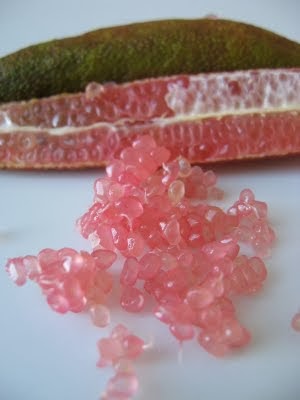
A Google Images search finds that the fruit in the advert link picture comes from an entirely different plant, the Finger Lime (Citrus australasica - depicted right). A thorny shrub native to Australia, it has lately acquired a reputation as a gourmet "lime caviar".

- Ray

Thursday, 17 October 2013

Coming soon: A Wren-Like Note


A few of my contacts know already, and others may have guessed, that I've been working been for some time on a biography of the Newport-born author Mary Gleed Tuttiett (1846-1923), who wrote under the pseudonym Maxwell Gray.

The project is close to completion - I'm at the final proofing stage, finalising the cover image, and completing the index - so I expect it to be finished and in production within a week or two.

Meanwhile, the website is now live at www.maxwellgray.co.uk.

The title comes from one of Maxwell Gray's poems
There comes a time when all the woods are mute;
No longer sounds the blackbird's mellow flute,
Throstle and lark and linnet no more sing,
And men have long forgotten how in spring
The nightingale in golden splendour poured
Her magic song's accumulated hoard;
The wintry day hangs heavily; 'tis then
Pleasant to hear the small, hedge-haunting wren;
Good folk, when grander poets are not near,
These wren-like notes of mine may bring you cheer.
- Ray

Tuesday, 15 October 2013

Beer pump artwork

Beer pump labels are a fine little genre of miniature artwork. I was struck by a couple this week:

Firstly, there was Tolchards "Devon Coast" (a pleasant hoppy beer made by Red Rock Brewery of Bishopsteignton). With its ocean vista, and foreground shed and path disappearing down into a cove, it's a nice example of a picture that fits Jay Appleton's "prospect-refuge theory": the claim that human aesthetic experience of landscape is based on perceptions that are evolved for survival (e.g. places to hide, escape routes, places with a clear view).. See the previous posts Landscapes in mind and Prospect and refuge in a beer glass.

And then there's the depiction of Lord Nelson on the label for St Austell's "Admiral's Ale".

detail from St Austell Admiral's Ale label
This deserves credit as a very sharp caricature of the classic Lemuel "Francis" Abbott portrait (currently hanging in the Terracotta Room of number 10 Downing Street).


As in other depictions, the red sash is borrowed from a different portrait by William Beechey. See previously: Nelson gets a facelift.

- Ray

Wednesday, 9 October 2013

The art of Shanklin Chine

Shanklin Chine is a coastal ravine on the south-east coast of the Isle of Wight, prettily-landscaped as a visitor attraction, and only a few hundred yards from the town of Shanklin. We visited it about four years ago, but we were in a little of a hurry then, and I fancied a more leisurely look when we were back on the Island at the end of September.

This is the "Longfellow Fountain" by the Crab Inn in Shanklin Old Village. The inscription ...

O Traveller, stay thy weary feet;
Drink of this fountain, pure & sweet;
It flows for rich & poor the same.
Then go thy way remembering still,
The wayside well beneath the hill,
The cup of water in his name.

Longfellow

... is a poem credited to Henry Wadsworth Longfellow when he stayed at the Crab Inn in 1868 (below the poem is a little twin-flag logo, UK and USA). On investigation, this attribution appears a trifle shaky. The book The Poetical Works of Henry W. Longfellow (18??) carries this explanation:
INSCRIPTION ON THE SHANKLIN FOUNTAIN,
ISLE OF WIGHT.

The following quotation from a private letter, dated "Shanklin, Isle of Wight, 1st October 1879," is the authority for ascribing this inscription to the Poet:—

"just look at this group of thatched cottages! The one on the right is a library where we go for books. In the middle is the Crab Inn. Do you see what looks like a pile of stones to the right of it? That is a fountain for the use of the public. I read some verses painted there on a piece of tin, and said to myself: 'That must be from Longfellow.' I found afterward that they were written by him, by request, when he was here some years ago:
The author of this "private letter" is unidentified. The first citation to Longfellow appears in George Shaw's The tourist's picturesque guide to the Isle of Wight (1873). There doesn't seem to be any great reason to doubt it - nevertheless, there is no primary evidence from Longfellow himself that he wrote it.

The place has changed a deal since Longfellow was there. Shanklin Old Village is a characteristically commercialised English "olde village", a cluster of thatched houses of genuine antiquity adapted into a complex of pubs, tearooms and gift shops, all on a busy main road. But just a minute's walk takes you down a quiet pedestrianised lane to the top of the Chine, and you find you're in a different world.


Clare at Chine entrance
You can take a slight detour first to the adjacent park, Rylstone Gardens, where there's a good chance of seeing red squirrels. I saw one in the distance, and it wasn't the best day for views. But there was an interesting and unexpected feature in the now rather dented stainless steel commemorative Elvis plaque by the clifftop, installed by the Isle of Wight Rock and Roll Society in 1978.


It has short score quotations from four Elvis classics (below): 1 is "Hound Dog"; 3 is "Teddy Bear". Any thoughts on the others? Although I'm perfectly capable of reading the score, they're quite difficult to place without the rhythm backing.

click to enlarge


Back to the Chine. The rustic-styled entrance booth takes you instantly into the fresh and humid microclimate of this mini-ravine. It's virtually silent apart from birdsong and the sound of the stream.


After initial steps, the path levels out to a shallower descent with rustic bridges, benches and landscaped pools, with a choice of exits to beach level or via an aviary, tearoom and exhibition centre, up to the clifftop. It began to rain, but surprisingly little made it down to the chine floor level; we sat for a while in one of the little shelters, and just chilled out. It's very obviously a managed landscape, but I really don't care; Shanklin Chine is unique, a calm and lovely experience. "A very great Lion," as Keats put it. *


If you're visiting in the near future, the current Heritage Centre exhibition is Turner's Isle of Wight Landscapes and the Discovery of Shanklin Chine. I'm a great fan of historical Isle of Wight scenic artwork, and this exhibition follows JMW Turner’s journey around the island from his sketchbook of 1795. It also features scenes of the Chine and elsewhere in the Wight by other artists including Thomas Rowlandson, Richard Banks Harraden, Samuel Howitt, William Daniell, Charles Tomkins, and Lefevre James Cranstone. It's extremely well-selected and well-annotated, and thoroughly worth a visit.

Chine Cottage, and the Heritage Centre, from the seaward end of the Chine
A bonus to the visit: on the way out, going up the path back to Shanklin, Clare and I saw our first fully-fledged red squirrel. We've seen them before, but they were rather dark brown. This was the real thing, a brilliant marmalade-coloured squirrel. Unfortunately it zipped by and up into the treetops too fast to bring the camera to bear ... but it was there.

See the older post - Shanklin Chine - for more background on the Chine's history, as well as one of my favourite poems, Mimi Khalvati's The Chine, which means a lot to me as an uncannily accurate impression of how the chine powerfully evokes that 'double exposure' sensation of reconnecting with the landscape of remembered childhood.

See also the official website www.shanklinchine.co.uk.

- Ray

* Lions = an archaic expression for "Things of note, celebrity, or curiosity (in a town, etc.); sights worth seeing" (Oxford English Dictionary).

Sunday, 6 October 2013

Thomas Randle elucidated

Further to Victory: for a long time I've had my doubts about one of the standard Topsham claims to fame, that one Thomas Randle (the spelling varies) was quartermaster aboard the HMS Victory at the Battle of Trafalgar. The story is perpetuated by a gravestone, whose general condition shows it's not 150+ years old, by St Margaret's Church. The National Maritime Museum's maritime memorials record - M4401 - explains that it's a replica of the original, which was broken by a mower.


THOMAS RANDLE
WHO WAS MANY YEARS
IN THE ROYAL NAVY
HAVING SERVED IN SEVERAL SHIPS
AND AS QUARTERMASTER
ON BOARD THE VICTORY
AT THE BATTLE OF TRAFALGAR
JAN. 2ND 1851
AGED 78

My doubts came from the discrepancy between the details on the stone, and those in the HMS Victory crew muster roll, available at the official HMS Victory site - here. The Quartermasters are listed, and Randle is not among them. There was a "Thomas Randall" aboard, but he was merely an able seaman.

This discrepancy is resolved by the document ADM 36/15900 in the National Archives (Admiralty: Royal Navy Ships' Musters (Series I). ADM 36. Ship: VICTORY), which contains Randall's full naval service record. It's online in the National Archives Trafalgar Ancestors section - Thomas Randall aged 41 born in Exeter, Devon, England - and here's the relevant section:
HMS Victory
Ship's pay book number: (SB409)
11 May 1803 to 19 May 1803
Rank/rating: Able Seaman
Comments: prest

20 May 1803 to 9 November 1803
Rank/rating: Quartermaster

10 November 1803 to 15 January 1806 (Was at Trafalgar)
Rank/rating: Able Seaman
So he was at Trafalgar, and was a quartermaster aboard the Victory - but not at the same time. For some reason, he'd been demoted to Able Seaman around two years before the battle. This conflation of detail was thoroughly entrenched by the mid-1800s.
DEATHS
January 16, at Topsham, in her 88th year, Mrs. Frances Randal, widow of Mr. Thomas Randal, Quartermaster of H.M.S. Victory at the battle of Trafalgar.
- Trewman's Exeter Flying Post, January 20, 1859
- Ray

Saturday, 5 October 2013

Victory


On 23rd September, we were passing through Portsmouth, and visited HMS Victory, Lord Nelson's flagship, which is preserved in dry dock in Portsmouth Dockyard. Clare had never been here before, and I hadn't been since around 1970, so it was a major experience for both of us.

As with the previously-mentioned Osborne House, the Victory is set up for self-guided tours that take you along a roped-off continuous route taking in all the decks, from poop deck (top stern 'bridge') to the hold. Unfortunately the uppermost levels were under renovation, but it was still a superb experience. It's not for the unfit or infirm, and it's bad enough if you're merely tall - there are steep steps, and the ceiling heights range from low to very low. We were a trifle worried about having our luggage with us, as this is a working dockyard with security issues. The Dockyard staff, however, were very helpful in recommending a couple of places where luggage can be left nearby, but there turned out to be no problems with our carrying it (we were travelling reasonably light).

When I was younger, I think I would probably have been chiefly interested in the naval aspects - the armaments, how the ship was steered, etc - but it proved oddly interesting to find the minutiae of infrastructure: how a large ship worked as a self-contained community. For instance, the toilets - the 'heads' - were far more sophisticated than I'd imagined; and the galley was a wonder. Brodie's Patent Galley was a surprisingly compact installation considering its capacity (with a suitably organised rota) to cook daily meals for hundreds of crew; there were 821 aboard the Victory. Its one central range is augmented with sub-stoves for individual cookery, and a large copper distiller for desalinating seawater for the surgeon's use.

Visiting is not cheap: it's £17 for an adult. But this covers a year's repeat visits, and - unlike the miserly Osborne House - there are no restrictions on photography. I can't recommend this visit too highly. Check out the official site hms-victory.com.

(Sincere thanks to Buddy for the loan of his tickets).


The head

Over the bows: a wonderful vista of historic and modern buildings


Brodie's Patent Galley


Out to modern Portsmouth: Number One Tower, Gunwharf Quays.
Clare and I call this the Death Star, because when we first saw it,
it was under construction, and rather recalled the half-constructed
new Death Star in Star Wars Episode VI: Return of the Jedi.
- Ray